Glaucoma drainage devices (GDDs) are commonly used in the surgical management of patients after failed trabeculectomy or as a primary intervention for refractory glaucoma. Since the outcomes of the Tube Versus Trabeculectomy (TVT) study were published, the volume of GDD cases continues to increase. Tube erosion through the conjunctiva is an important long-term complication of GDDs, carrying the potential risks of infection and vision loss. In this article, Shivani Kamat, MD, discusses various risk factors for tube exposure related to patients’ underlying characteristics and reviews the types of implant material and patch grafts used during surgery. She describes various surgical techniques and offers tips for minimizing this complication.
—Sarwat Salim, MD, FACS; Section Editor
Despite ongoing innovation in glaucoma technology and advances in surgical techniques, GDD implantation remains one of the most commonly performed procedures to treat refractory glaucoma. Eyes with GDDs are at long-term risk of tube erosion, a complication well described in the literature. The timely diagnosis of tube erosion and immediate intervention are necessary to prevent infection and potential vision loss. After GDD implantation, the surgical site should be inspected carefully at all follow-up visits, with particular attention to thinning of the overlying conjunctiva.
OCCURRENCE AND RISK
Fortunately, tube erosion is uncommon. Exposure occurs most frequently along the length of the tube, but the plate itself may also become exposed. In the Ahmed Baerveldt Comparison (ABC) study, the incidence of tube erosion at 5 years was 1% and 3% in the Ahmed Glaucoma Valve (New World Medical) and Baerveldt glaucoma implant (Allergan) groups, respectively.1 In the TVT study, which compared trabeculectomy to implantation of a Baerveldt 350-mm2 tube shunt, the total incidence of erosion in the tube shunt group was 5%.2
GDDs can be composed of different materials, typically silicone or polypropylene. Research has not shown a significant difference in the rate of erosion between these two materials,3,4 but some studies have shown improved IOP lowering with silicone tube shunts.5 In general, the rate of erosion does not vary significantly among different types of GDDs. Certain factors, however, can increase the overall risk of erosion. These include a history of ocular inflammation, a high number of preoperative topical medications, neovascular glaucoma, prior conjunctival surgery, diabetes mellitus, and inferiorly implanted tubes.6,7 Tube exposure also tends to be more common in children, with younger age, a combined procedure at the time of GDD implantation, and a history of ocular surgery increasing the risk.8 Furthermore, the growing use of intravitreal injections for ocular comorbidities has increased the overall risk of primary erosion in patients with GDDs. Liu et al found that intravitreal injections were associated with higher rates of tube erosion, particularly in patients receiving long-term serial injections.9 In this situation, it is important to emphasize the quadrant of tube shunt implantation to the retina specialist so that direct trauma to the conjunctiva near the tube and plate can be avoided, particularly with larger-bore needles such as those used for corticosteroid implants or with subconjunctival anesthesia.
The surgical technique and tissue manipulations during GDD implantation can also influence the subsequent risk of tube exposure. Tension on the conjunctiva after primary peritomy closure can cause dehiscence or conjunctival retraction in the postoperative period and lead to early tube exposure. Furthermore, the location and angle of tube entry into the eye can create unfavorable points of chronic mechanical trauma by the eyelid and lead to late tube exposure. This is often observed with anterior insertion of the tube at or close to the limbus.
Careful pre- and intraoperative planning can help to mitigate the potential risk of erosion. For example, creating the tube entry 1 to 2 mm posterior to the limbus with a tunneled track can decrease exposure complications. Entering the eye superiorly, closer to the 12 clock position, can also decrease direct pressure of the lid margin on the tube shunt, preventing chronic conjunctival trauma and atrophy. Using a patch graft during primary tube placement or tunneling the tube through the sclera for at least 5 mm is critical to decreasing the risk of erosion by preventing direct contact between the tube and the overlying conjunctiva.
PATCH GRAFTS
Multiple types of patch grafts can be used at the time of primary tube shunt implantation, including pericardium, sclera, cornea, amniotic membrane, and biodegradable porcine-derived collagen matrix (Ologen, Aeon Astron Europe). Although used less commonly, both the collagen matrix and amniotic membrane have shown the same ability as pericardium to decrease the incidence of tube shunt exposure.10,11 Processed pericardium allografts come in both single- and double-thickness versions. Studies have shown that double-thickness pericardium significantly reduced the incidence of conjunctival erosion.12 Pericardium has also been compared to glycerol-preserved cornea. Corneal patch grafts were associated with a statistically significant decrease in the amount of tube erosions, with the added benefits of having a lower profile and being more cosmetically pleasing.13 Ultimately, the selection of a patch graft should be individualized according to surgeon experience and preference.
MANAGEMENT OF TUBE EROSION
Because the risk of endophthalmitis increases significantly if any part of the GDD is exposed, urgent surgical intervention is indicated. Typically, the conjunctiva surrounding the exposure is friable and tenuous. The tissue dissection must therefore extend beyond and posterior to these areas to access mobile and viable conjunctiva and achieve tension-free closure at the limbus. Cauterization of any epithelial ingrowth around the tube may promote proper healing and minimize recurrent exposure.
If the entry angle and position of the tube are satisfactory, it may suffice to undermine healthy conjunctiva to avoid placing tension on the closure, perform careful cautery to deepithelialize the adjacent sclera, and add a fresh patch graft. With an anteriorly placed tube near the limbus, repositioning of the tube to a different location may be necessary to prevent recurrence from chronic eyelid trauma. A tube that is positioned posteriorly to the limbus is generally less likely to erode. Repositioning a tube to a new entry site with a longer scleral tunnel can be helpful. Alternatively, moving the tube into the ciliary sulcus or pars plana may be considered depending on the lenticular status of the eye to minimize the mechanical factors at the limbus leading to erosion.
Achieving a watertight conjunctival closure without tension can be challenging. The use of other materials may be required to achieve complete coverage. Patch grafts are often used to cover the tube, and options include pericardium, sclera, cornea, and even umbilical cord tissue. In cases of severely inadequate tissue coverage, the conjunctiva can be sutured directly onto the patch graft. Over time, the area will reepithelialize to provide adequate coverage of the original surgical site. Conjunctival autografts from the inferior bulbar conjunctiva or palpebral conjunctiva can be employed, as can other techniques using amniotic membrane, buccal membrane transplants, or rotational pedicled flaps.14-16
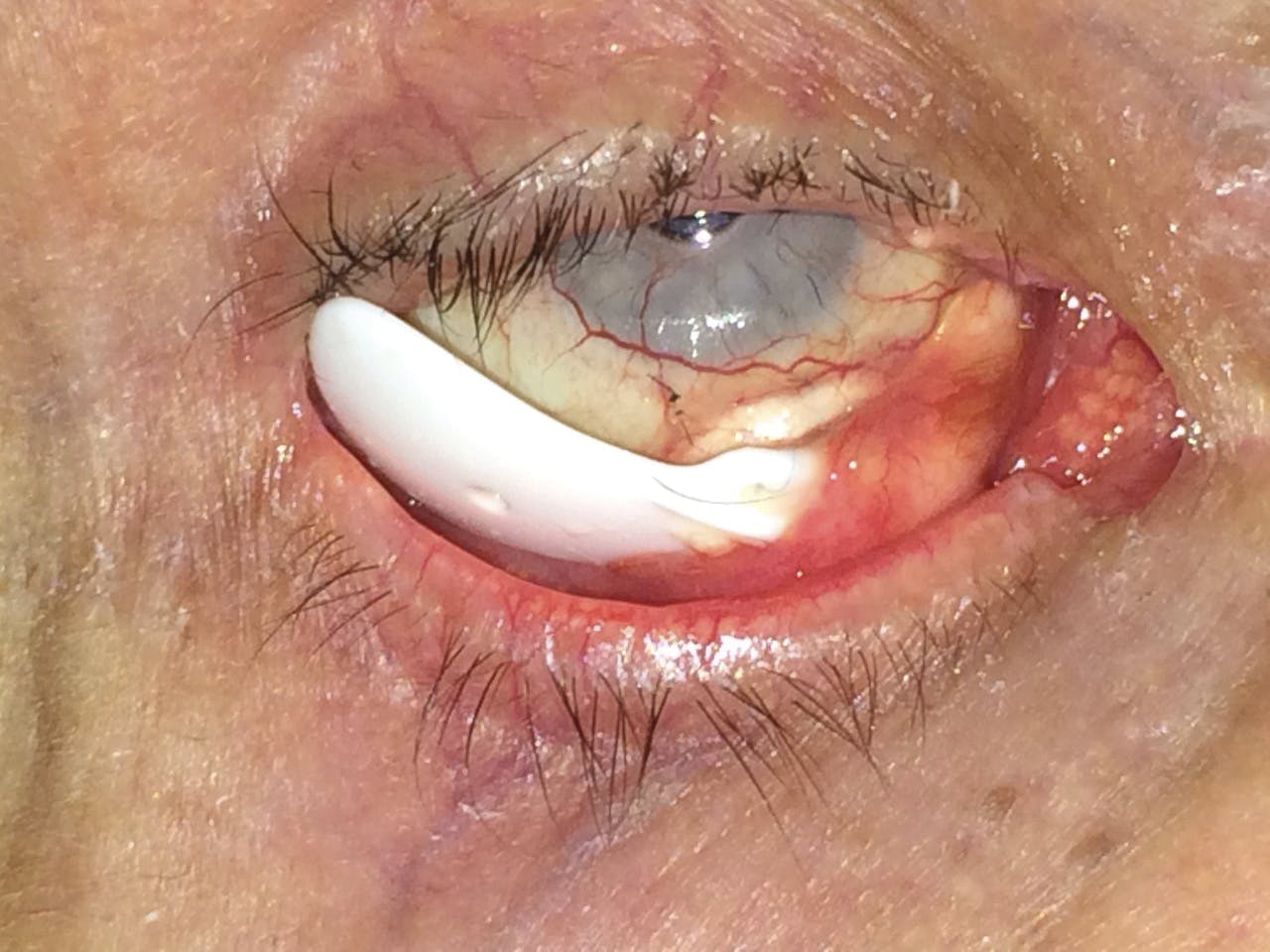
If the plate of the tube shunt is exposed (Figure), fully closing and repairing the site of erosion can be difficult. In this situation, the entire drainage device may be removed. Plate exposure can sometimes be the initial ocular presentation of an occult autoimmune or inflammatory predisposition, requiring a thorough laboratory workup and evaluation to guide subsequent surgical planning.
CONCLUSION
Patients who experience tube erosion generally do well after repair unless endophthalmitis occurs. It is important to remind patients to avoid rubbing their eyes, discontinue wearing contact lenses unless they are specifically contoured for a tube shunt, and visit their physician immediately if they notice increased redness, irritation, tearing, discharge, or pain. n
1. Budenz DL, Feuer WJ, Barton K, et al; Ahmed Baerveldt Comparison Study Group. Postoperative complications in the Ahmed Baerveldt Comparison Study during five years of follow-up. Am J Ophthalmol. 2016;163:75-82.
2. Gedde SJ, Schiffman JC, Feuer WJ, Herndon LW, Brandt JD, Budenz DL; Tube Versus Trabeculectomy Study Group. Treatment outcomes in the Tube Versus Trabeculectomy (TVT) Study after five years of follow-up. Am J Ophthalmol. 2012;153(5):789-803.
3. Brasil MV, Rockwood EJ, Smith SD. Comparison of silicone and polypropylene Ahmed Glaucoma Valve implants. J Glaucoma. 2007;16(1):36-41.
4. Law SK, Nguyen A, Coleman AL, Caprioli J. Comparison of safety and efficacy between silicone and polypropylene Ahmed glaucoma valves in refractory glaucoma. Ophthalmology. 2005;112(9):1514-1520.
5. Ishida K, Netland PA, Costa VP, Shiroma L, Khan B, Ahmed II. Comparison of polypropylene and silicone Ahmed Glaucoma Valves. Ophthalmology. 2006;113(8):1320-1326.
6. Chaku M, Netland PA, Ishida K, Rhee DJ. Risk factors for tube exposure as a late complication of glaucoma drainage implant surgery. Clin Ophthalmol. 2016;10:547-553.
7. Muir KW, Lim A, Stinnett S, Kuo A, Tseng H, Walsh MM. Risk factors for exposure of glaucoma drainage devices: a retrospective observational study. BMJ Open. 2014;4(5):e004560.
8. Jomar DE, Al-Shahwan S, Al-Beishri AS, Freidi A, Malik R. Risk factors for glaucoma drainage device exposure in children: a case-control study. Am J Ophthalmol. 2023;245:174-183.
9. Liu KC, Gomez-Caraballo M, Challa P, Asrani SG. Recurrent tube erosions with anti-vascular endothelial growth factor therapy in patients with age-related macular degeneration. Ophthalmol Glaucoma. 2020;3(4):295-300.
10. Tanito M, Sano I, Ikeda Y, Fujihara E. Patch grafting using an Ologen collagen matrix to manage tubal exposure in glaucoma tube shunt surgery. Case Rep Ophthalmol. 2018;9(1):9-16.
11. Sheha H, Tello C, Al-Aswad LA, Sayed MS, Lee RK. Outcomes of the Shunt Tube Exposure Prevention Study: a randomized clinical trial. Ophthalmol Glaucoma. 2019;2(6):392-401.
12. Lankaranian D, Reis R, Henderer JD, Choe S, Moster MR. Comparison of single thickness and double thickness processed pericardium patch graft in glaucoma drainage device surgery: a single surgeon comparison of outcome. J Glaucoma. 2008;17(1):48-51.
13. Wigton E, Swanner JC, Wade J, et al. Outcomes of shunt tube coverage with glycerol preserved cornea versus pericardium. J Glaucoma. 23(4):258-261.
14. Einan-Lifshitz A, Belkin A, Mathew D, et al. Repair of exposed Ahmed Glaucoma Valve tubes: long-term outcomes. J Glaucoma. 2018;27(6):532-536.
15. Grover DS, Merritt J, Godfrey DG, Fellman RL. Forniceal conjunctival pedicle flap for the treatment of complex glaucoma drainage device tube erosion. JAMA Ophthalmol. 2013;131(5):662-666.
16. Bains U, Hoguet A. Aqueous drainage device erosion: a review of rates, risks, prevention, and repair. Semin Ophthalmol. 2018;33(1):1-10.