CASE PRESENTATION
Cataract surgery on the left eye (axial length, 17.48 mm) of a 56-year-old woman is aborted before the capsulorhexis when severe intraoperative malignant glaucoma causes marked shallowing of the anterior chamber and severe iris prolapse. A surgical iridectomy is performed to reposit tissue and close the incisions.
Postoperatively, the anterior chamber depth is 1.47 mm, and the angles are closed (Figure 1). The IOP is 20 mm Hg OS on a therapeutic regimen of three drop classes. Moderate glaucomatous changes are evident on visual field testing (Figure 2). Choroidal effusions and a small, full optic nerve result in an abnormally thick retinal nerve fiber layer reading (Figure 3).
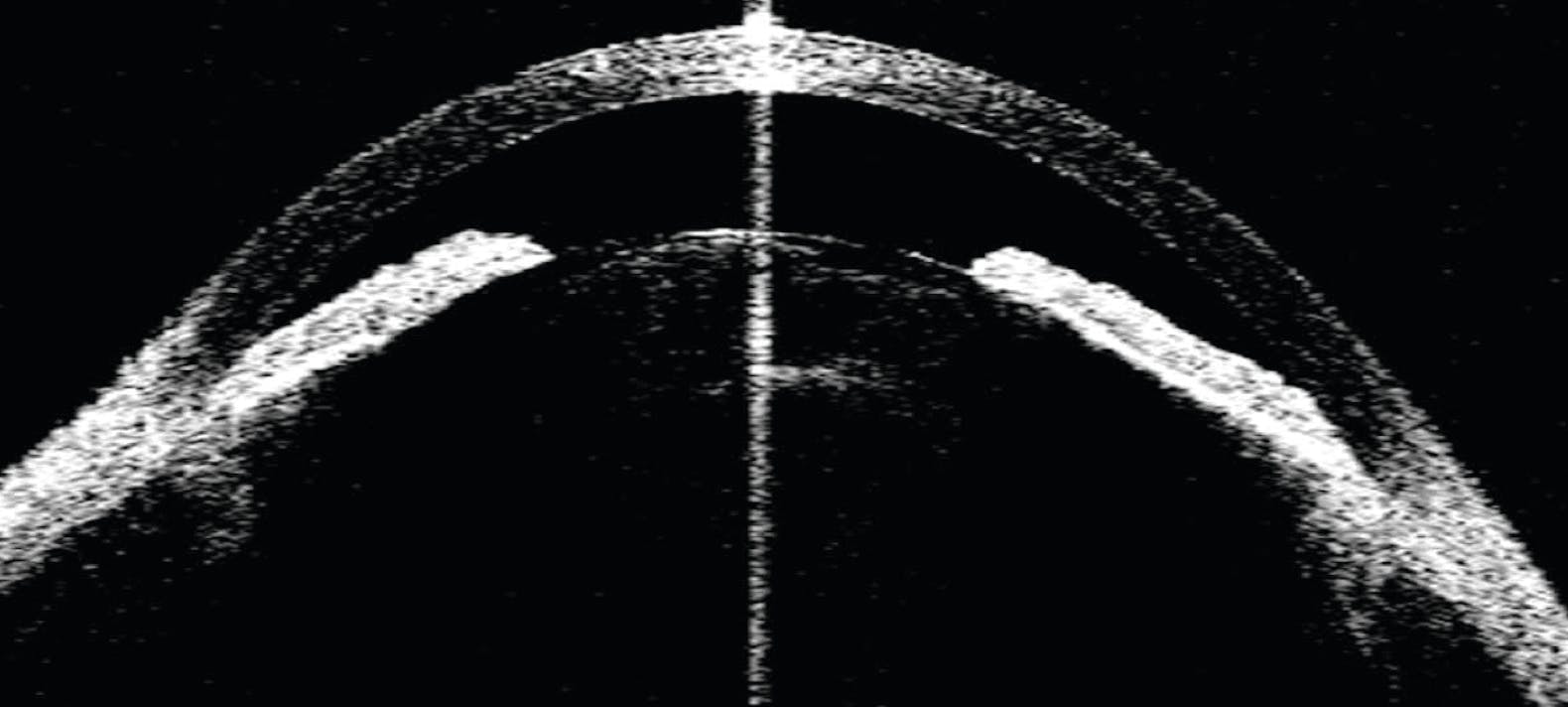
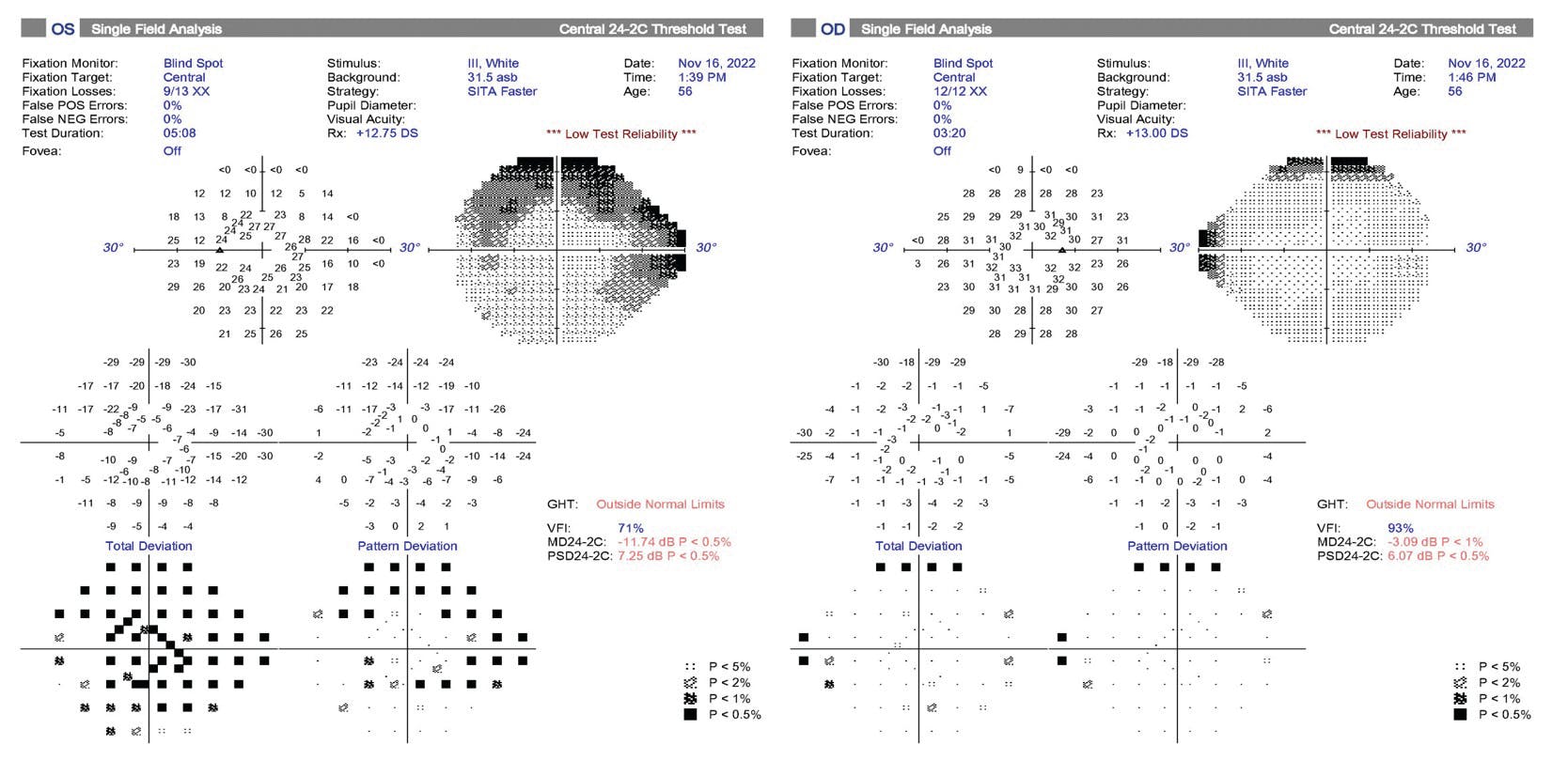
Figure 2. Humphrey visual field testing (Carl Zeiss Meditec) shows moderate glaucomatous loss in the left eye and mild loss in the right eye.
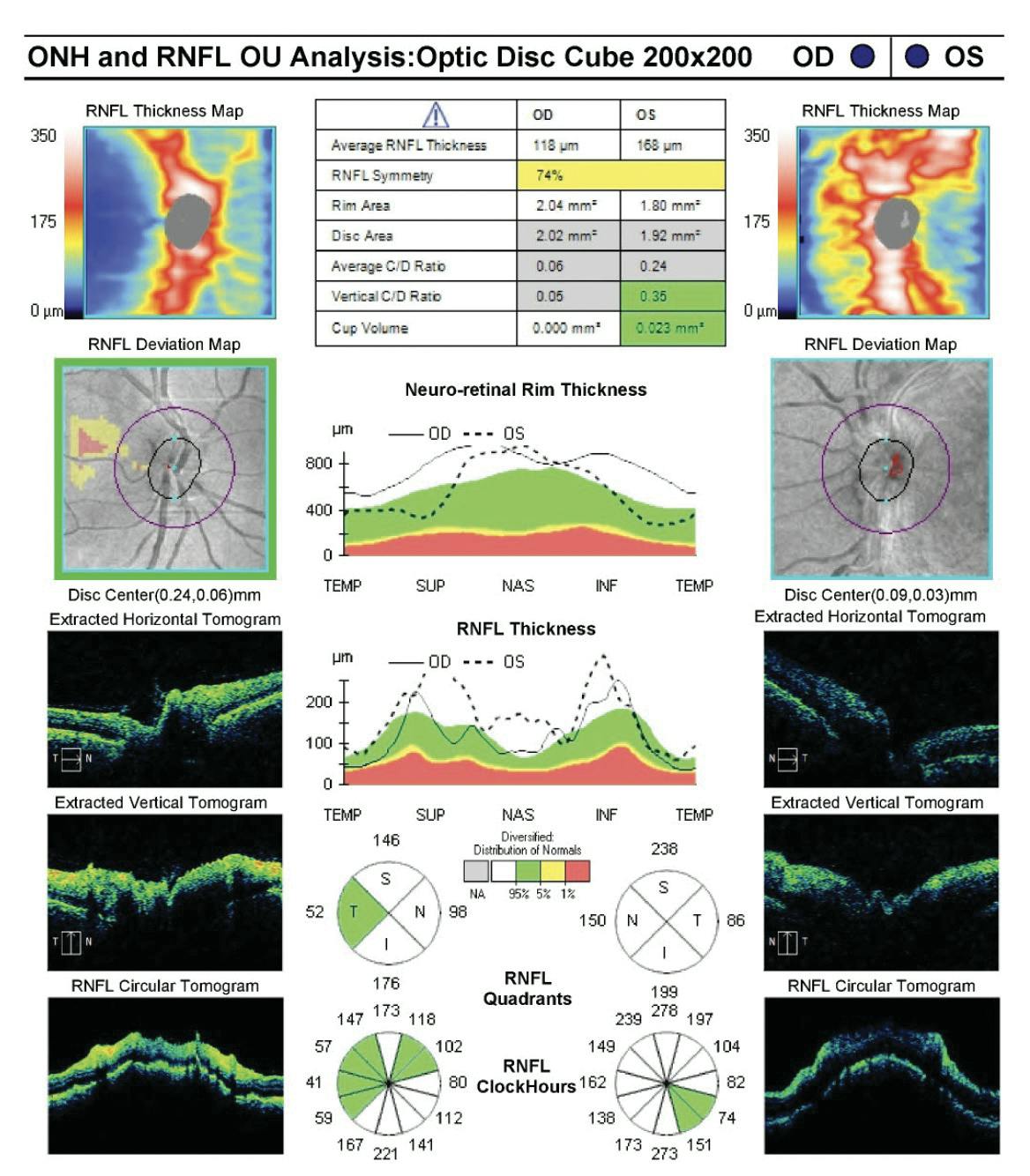
Figure 3. OCT imaging shows greater fullness of the optic nerve in the left versus right eye, consistent with high hyperopia bilaterally and choroidal effusions in the left eye.
The patient is referred for definitive lens-based surgery. While awaiting the procedure, her chronic choroidal effusions are treated medically with prednisone by a retina specialist and settle.
The patient presents for lens-based surgery. How would you approach the case? Would you modify your technique to create and maintain space inside the eye? How would you prevent and manage the malignant glaucoma?
—Case prepared by Devesh K. Varma, MD, FRCSC
LAUREN S. BLIEDEN, MD
Preparation is key. The major requirements with a short eye are maintaining the chamber by controlling the pressure gradient, addressing aqueous misdirection, and/or expanding or managing choroidals. I would expect the iris to be floppy.
I would take a kitchen sink approach. Preoperatively, atropine would be added to the dilation protocol, and acetazolamide (Diamox, Wyeth Pharmaceuticals) would be administered intravenously. My first surgical step would be a scleral cutdown 2 to 4 mm behind the limbus. If the sclera is thick, I would create a window to facilitate identification of the posterior edge of the ciliary body and location of the pars plana, which is not always where I expect in eyes like this one.
For the lens extraction, an adaptive OVD such as Healon5 (Johnson & Johnson Vision) would be injected to maintain the chamber. I would use a bimanual approach for as long as possible, including for the capsulorhexis, which I would perform with a cystotome and 23- or 25-gauge retina forceps. If luck is on my side, because of the patient’s age, the bimanual I/A or vitrector setup will be able to remove the lens material before the main wound is opened to insert the IOL. If phacoemulsification is necessary, however, I would assess the chamber before making the temporal wound. An iris hook might be placed under the main wound to help prevent prolapse, but the measure may not suffice.
I would be prepared to perform an iridozonulohyaloidectomy (IZH) at any time during surgery. If the chamber cannot be maintained for an anterior approach, I would enter the eye through the pars plana or posterior ciliary body. A stab incision made straight through the peripheral iris and zonules with a 30-gauge needle may be used as a rescue maneuver to relieve fluid and allow the anterior chamber to deepen.
CARA CAPITENA YOUNG, MD
Nanophthalmic eyes pose unique surgical challenges and are at increased risk of malignant glaucoma during and after surgery.1 High-powered, sometimes special-ordered IOLs are often required. I counsel patients on the risk of a refractive surprise and target slight hyperopia because the most commonly used IOL formulas trend toward myopia in short eyes.2 I try to avoid piggyback IOLs owing to a lack of space.
An intravenous push of 12.5 g of mannitol would be administered before surgery. A block or general anesthesia can be useful in complex cases such as this one where there is a high likelihood of iris manipulation to prevent posterior pressure from the patient’s squeezing her eyes or holding her breath owing to discomfort or anxiety. The corneal incision would be more anterior than usual to prevent iris prolapse. If manual dilation of the pupil is required, iris hooks would be ideal because of their slim profile in a narrow anterior chamber. I would favor a high-viscosity OVD such as Healon5 to maintain space and flatten the anterior lens vault that is often present in eyes like this one. I want to avoid intraoperative shallowing of the anterior chamber, which can predispose the eye to effusions, malignant glaucoma, and iris prolapse. I find it beneficial to refill the chamber with an OVD before entering or exiting the main wound.
Given the patient’s history of malignant glaucoma, I would perform an IZH through the existing iridectomy with an anterior vitrector set to a low cut rate. I would then attempt to perform goniosynechialysis, which combined with lens removal may achieve sufficient IOP control to prevent glaucomatous progression.
Postoperatively, atropine drops with a slow taper would be prescribed to prevent malignant glaucoma (the only symptom may be a myopic shift). I would have a low threshold for administering a sub-Tenon injection or prescribing an oral steroid to treat and prevent effusions.
WHAT I DID: DEVESH K. VARMA, MD, FRCSC
The patient received 50 mg of mannitol 20% solution 30 minutes before surgery. I carefully made incisions longer than usual to reduce the potential for iris prolapse. I was initially reluctant to place a pars plana trocar because I thought the pars plana was likely located only 2 mm behind the limbus and I was concerned about inducing lens trauma.
With a supercohesive OVD, adequate space was created for safe phacoemulsification. The anterior chamber was maintained with an OVD at all times during instrument removal to avoid intraoperative malignant glaucoma. A 46.00 D one-piece acrylic IOL (Aspira-aA 46, HumanOptics) was implanted in the bag.
Once phacoemulsification was complete, I was less concerned about inducing capsular trauma. A 25-gauge trocar was placed 2 mm from the limbus to remove anterior vitreous and deepen the anterior chamber in preparation for an IZH with vitrectomy (IZHV) and pupilloplasty. A cutter was introduced into the anterior chamber, and a peripheral iridotomy was performed. The cutter was then turned so that the port faced away from the capsule, and the instrument was passed through zonules and the anterior hyaloid to create an IZHV. Next, two interrupted sutures were placed to repair the previous iridectomy, leaving the IZHV patent.
I did not place scleral windows but would be willing to if the choroidal effusions recur.
Postoperatively, the anterior chamber was deep, and the angles were open. Treatment with topical glaucoma drops was continued in the early postoperative period. The patient is being monitored closely for the development of malignant glaucoma, which could present as a myopic shift, as well as a recurrence of the choroidal effusions.
1. O’Grady RB. Nanophthalmos. Am J Ophthalmol. 1971;71(6):1251-1253.
2. Melles RB, Holladay JT, Chang WJ. Accuracy of intraocular lens calculation formulas. Ophthalmology. 2018;125(2):169-178.