When it comes to MIGS procedures, anatomy is key. As far as physiologic drainage pathways are concerned, MIGS implants must bypass the trabecular meshwork (TM) to allow drainage of aqueous from the anterior chamber into Schlemm’s canal (SC). SC is not a smooth, simple, tubular passage as the name seems to imply; it is a complex structure of hinged septa attached to the outer SC wall leading into collector channel ostia, with cylindrical attachment structures spanning between the trabecular meshwork and the outer wall of SC.1 Awareness of this anatomy is critical to understand when navigating devices, such as the HYDRUS Microstent (Alcon Vision, LLC; Irvine, CA, USA) within SC.
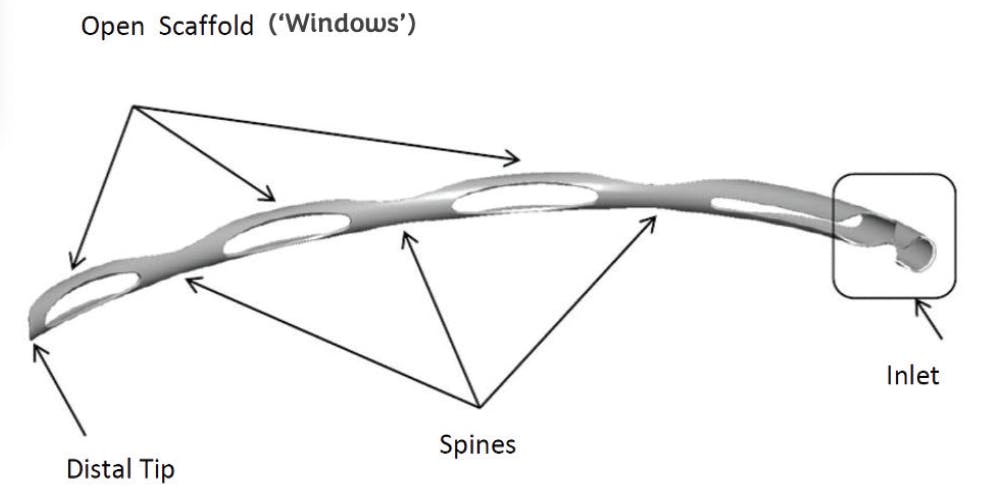
Immediate visual feedback is important when performing ophthalmic surgery. Within SC, encountering septa, or engaging the edge of a collecting channel ostium may provide resistance when advancing a device. It is, therefore, very important to remain parallel to SC when advancing a device into SC to avoid advancing it posteriorly into the supraciliary space or back into the anterior chamber. In the case of the HYDRUS Microstent (Figure 1), one of its benefits is that the preformed, smooth, polished structure fits within the curvature of SC and can advance easily once the approach angle is established.2
The approach angle is affected by two positions in space: 1) placement of the clear corneal incision through which the insertion canula is advanced to the angle structures, and 2) the rotational position of the insertion canula (elevation angle). The clear corneal incision should be about 4 clock hours away from the anticipated entry point into SC to allow for an ergonomic trajectory of the injector and a tangential alignment of the injector tip to the TM/SC (Figure 2).
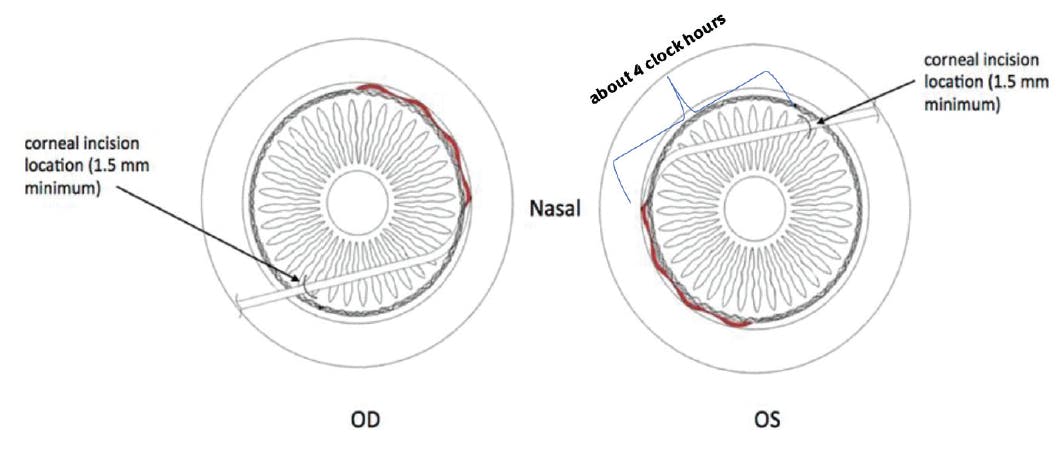
Figure 2. Preferred Position of Incisions and Target Placement of the HYDRUS Microstent for right-handed insertion
The cannula tip should also be angled slightly anteriorly (approximately 15 degrees) toward the target entry site at the trabecular meshwork.2 Visualizing each step as it progresses, as well as stent advancement into SC until all 3 windows and the distal end can be seen through the trabecular meshwork is extremely important.2 Proper stent insertion must be ensured in order to take advantage of the Trimodal mechanisms of action that are incorporated into the design of the HYDRUS Microstent.
With these characteristics in mind, insertion pearls for the HYDRUS Microstent from expert glaucoma surgeons are presented with accompanying insertion videos of different surgical scenarios. All videos are provided by the surgeons with their permission.
Question 1: Are there any prerequisite skills that need to be mastered to insert the HYDRUS Microstent successfully?
Dr. Schlenker
- Adequate bimanual dexterity (though can be learned)
- Ability to position the head and the microscope
- Placing the HYDRUS wound aiming at the TM, ~ 2 clock hours away from the temporal wound. Avoid vasculature at the limbus.
- Prevent striae during insertion (maintaining chamber stability by adding enough OVD and avoiding burping this OVD from the wound, not pushing too hard with the gonioprism, not torquing on the wound)
- Ensuring an en-face view, ideally so that Schlemm’s canal is in the horizontal plane
- Start on the right side of your view on the gonioprism (for right handed surgeons) to allow visualization of the entire stent insertion, and allow for room if another new insertion site is required
- Angling the inserter ~30 degrees upward when scoring the TM and while dialing in the first window, then relieve forward pressure and redirect injector to align with the axis of Schlemm’s canal (see Routine HYDRUS Insertion video S1)
- Gently dial the rest of the stent under direct visualization
- If the patient ‘gasps’, stop, as it may not be in Schlemm’s canal
- If the stent is too ‘shiny’, it may be in the TM and it is possible to dissect in between its layers, which can lead to superficial placement; also, the stent may not 'traverse' around SC as smoothly. Sometimes the leading window can also come out of the TM and into the anterior chamber.
Dr. Funke
Having a comfortable grasp of intraoperative gonioscopy is necessary prior to starting to utilize MIGS. This skill can be mastered with practice during standard cataract surgery. After the cataract surgery is performed, the surgeon should practice ideal head positioning for an optimal goniscopic view. Non-dominant hand position with the gonioscopic lens should be practiced in addition to dominant hand position of an instrument into the anterior chamber.
Dr. Blieden
The surgeon should be very comfortable with gonioscopy – both clinically and surgically. This helps the surgeon not only focus on the implant insertion but also helps the surgeon identify potentially problematic anatomy prior to device insertion.
Question 2: How does the shape and size of the HYDRUS Microstent affect your placement technique?
Dr. Schlenker
The length makes it important to start on the right side (for right handed surgeons) of your view on the gonioprism, to ensure placement under direct visualization. Using an Ahmed goniomirror can also be helpful to visualize the entire stent. There are some levels of pigmentation that make visualization difficult. Clues for malalignment: the trailing inlet is not in the plane of Schlemm’s canal, the eye was moving a lot during insertion (not gliding into Schlemm’s canal), there was bleeding during placement, the patient gasped during placement, or the obvious one is if the HYDRUS has come through the TM in some areas.
Dr. Funke
The shape and size of the HYDRUS Microstent necessitates that a surgeon be knowledgeable about the anatomy of the angle. When placing a HYDRUS, I score the trabecular meshwork in order to visualize the back wall of the scleral spur (See HYDRUS Insertion Video F1).
This maneuver has given me confidence that I am in the canal.
Dr. Blieden
Due to the ergonomic nature of the HYDRUS Microstent and its inserter, I find if I approach the angle as described above AND if the anatomy accepts the device, it is a very smooth insertion, so the size and shape do not impact my placement technique. I tend to move slowly through the insertion steps and feel for tactile resistance. I never force placement; the implant should glide in easily.
Question 3: How confident are you after HYDRUS Microstent insertion that you have placed it correctly?
Dr. Schlenker
Confident about 90% of the time. If the first window dives into the suprachoroidal space I often leave it, as I find it is hard to fix, and I’m not sure it adversely affects outcomes. Having some suprachoroidal drainage may actually be a good thing. If more than one window has dived, I remove and go to another area.
Dr. Funke
The size of the stent makes it such that it must be in the canal to advance, therefore, I have confidence that if the stent inserts smoothly, it is in the correct position. In addition, seeing the three windows of the stent aids in confirming correct positioning.
Dr. Blieden
Typically, if the implant glides in smoothly, and I can manipulate it back and forth in the canal without resistance, then it’s likely in the correct position. I always do a quick visual confirmation of the windows through my goniolens. In some patients, I’ve noticed that you can often do a secondary visual confirmation through the operating scope – you will see a subtle glint of the implant sitting in SC under the conjunctival insertion. You would not be able to see this if you were in the supraciliary space.
Question 4: Are there recognizable anatomic variants that dictate a slightly different approach to ensure appropriate placement of a HYDRUS Microstent?
Dr. Schlenker
- If not sure where the TM is: I bias anteriorly. If you choose inferiorly, you will hit the iris ± the suprachoroidal space, which can lead to an iridodialysis, and/or cleft, with associated bleeding.
- Heavy TM pigment: easy to know where to place it, but much harder to know if all 3 windows are in TM. While going in you can often see the TM moving as the HYDRUS goes in (almost like a wave or ripple).
- Peripheral anterior synechiae: I often will do goniosynechialysis prior to insertion to improve visualization and outflow.
Dr. Funke
In a patient with a larger cataract, I prefer to perform HYDRUS after cataract removal. The angle is wider and more easily accessible after phacoemulsification.
Dr. Blieden
Yes, I take care in people that have slightly larger corneas to ensure the entire device is fully seated. Sometimes, you may leave the inlet area a bit longer to ensure this placement, assuming it is clear of the iris. Similarly, I also take care in open angles where the iris insertion seems to be a bit more anterior, I prefer to leave the inlet tucked in a bit further to avoid potential iris chafing. Also, you may put up the goniolens and see pathology in the angle in that quadrant (angle recession, PAS, etc). If so, I do not implant the HYDRUS microstent.
Question 5: Are there times when you have to decide to do something else due to insertion challenges? How often does this happen?
Dr. Schlenker
Not really. Some patients can form or reform PAS to the area, though I do not see this as a reason to avoid insertion.
Dr. Funke
On rare occasion, the HYDRUS Microstent will not insert/seat properly. I will often attempt to position the stent a few times, either further from downstream of my initial attempt or going in the opposite direction, prior to aborting HYDRUS placement. If insertion is not possible, I will perform a goniotomy with the use of the stent and the inserter.
Dr. Blieden
Yes, I would say this happens once every 2-3 months. These are the 2 scenarios where I perform a rescue goniotomy: 1) I put the goniolens on and see angle pathology, but we already have the HYDRUS open or 2) I try to insert the HYDRUS but it won’t insert easily. In both of these cases, I retract the HYDRUS and convert to a traditional goniotomy, which can be performed with anything that can incise the TM (for me, the tip of the HYDRUS inserter works fine!).
Question 6: If you had to provide a single HYDRUS Microstent insertion pearl that you wished you had known when you started, what would that guidance be?
Dr. Schlenker
Angle up (~30 degrees) while inserting the first window with forward pressure against Schlemm’s canal (see HYDRUS Insertion by Fellow Video S2).
Dr. Funke
Never attempt insertion until you have an excellent view of the angle.
Dr. Blieden
You can always rescue with a goniotomy.
This is glaucoma; always have a back-up plan (see Stuck Goniotomy Video B1 of a stuck goniotomy, in which a goniotomy, let alone a HYDRUS insertion, could only go opposite the intended direction).
While we would like successful placement of the stent, you are still able to safely do something for your patient in those rare cases where leaving a stent may not be appropriate. For me, this took the “performance anxiety” out of the equation when I was first using the device and let me focus on ergonomics. When I realized this, I stopped worrying and stressing as much about getting the implant in and got a lot better at my technique, while still helping my patients.
Question 7: Are there any other 'insertion pearls' that you think would be worthwhile to point out?
Dr. Schlenker
“It’s all about the view.”
Dr. Funke
- Be comfortable with the anatomy of the angle. Knowing your anatomical target will make your cases smoother.
- Ensure your incision is offset and the head of the inserter sits parallel to the canal.
- Fill the angle to mild over inflation with OVD. This will increase your view of the angle anatomy (see HYDRUS Insertion with Iris Hook Video F2).
Dr. Blieden
I have 3 tips that I teach to my trainees, which make a big difference in their success rates:
1. Learn to “toe down” your goniolens, so you are pushing the OVD into the angle and not pushing straight down onto the cornea (see Push-down vs Toe-down Goniolens Visualization Video B2*).
2. Line up your injector so it’s ergonomic, then use the tip of the injector to make a small goniotomy incision which allows you to a) confirm position and b) dock the tip of the injector into SC.
3. Once you are lined up, take a breath, and relax as you steadily insert the device – this prevents pushing on the wounds or pushing against the outer wall of Schlemms and allows you to feel for tactile resistance, if any (see video B3 by Dr. Nguyen).
The views and opinions expressed in this content may not necessarily represent those of Bryn Mawr Communications or Glaucoma Today.
Important Product Information
CAUTION: Federal law restricts this device to sale by or on the order of a physician.
INDICATIONS FOR USE:
The Hydrus Microstent is indicated for use in conjunction with cataract surgery for the reduction of intraocular pressure (IOP) in adult patients with mild to moderate primary open-angle glaucoma (POAG).
CONTRAINDICATIONS:
The Hydrus Microstent is contraindicated under the following circumstances or conditions: (1) In eyes with angle closure glaucoma; and (2) In eyes with traumatic, malignant, uveitic, or neovascular glaucoma or discernible congenital anomalies of the anterior chamber (AC) angle.
WARNINGS:
Clear media for adequate visualization is required. Conditions such as corneal haze, corneal opacity or other conditions may inhibit gonioscopic view of the intended implant location. Gonioscopy should be performed prior to surgery to exclude congenital anomalies of the angle, peripheral anterior synechiae (PAS), angle closure, rubeosis and any other angle abnormalities that could lead to improper placement of the stent and pose a hazard. The surgeon should monitor the patient postoperatively for proper maintenance of intraocular pressure. The surgeon should periodically monitor the status of the microstent with gonioscopy to assess for the development of PAS, obstruction of the inlet, migration, or device-iris or device-cornea touch. The Hydrus Microstent is intended for implantation in conjunction with cataract surgery, which may impact corneal health. Therefore, caution is indicated in eyes with evidence of corneal compromise or with risk factors for corneal compromise following cataract surgery. Prior to implantation, patients with history of allergic reactions to nitonal, nickel or titanium should be counseled on the materials contained in the device, as well as potential for allergy/hypersensitivity to these materials.
PRECAUTIONS:
If excessive resistance is encountered during the insertion of the microstent at any time during the procedure, discontinue use of the device. The safety and effectiveness of use of more than a single Hydrus Microstent has not been established. The safety and effectiveness of the Hydrus Microstent has not been established as an alternative to the primary treatment of glaucoma with medications, in patients 21 years or younger, eyes with significant prior trauma, eyes with abnormal anterior segment, eyes with chronic inflammation, eyes with glaucoma associated with vascular disorders, eyes with preexisting pseudophakia, eyes with pseudoexfoliative or pigmentary glaucoma, and when implantation is without concomitant cataract surgery with IOL implantation. Please see a complete list of Precautions in the Instructions for use.
ADVERSE EVENTS:
The most frequently reported finding in the randomized pivotal trial was peripheral anterior synechiae (PAS), with the cumulative rate at 5 years (14.6% vs 3.7% for cataract surgery alone). Other Hydrus postoperative adverse events reported at 5 years included partial or complete device obstruction (8.4%) and device malposition (1.4%). Additionally, there were no new reports of persistent anterior uveitis (2/369, 0.5% at 2 years) from 2 to 5 years postoperative. There were no reports of explanted Hydrus implants over the 5-year follow-up. For additional adverse event information, please refer to the Instructions for Use.
MRI INFORMATION:
The Hydrus Microstent is MR-Conditional meaning that the device is safe for use in a specified MR environment under specified conditions.
Please see the Instructions for Use for complete product information.
1. Hariri S, Johnstone M, Jiang Y, Padilla S, Zhou Z, Reif R, Wang RK. Platform to investigate aqueous outflow system structure and pressure-dependent motion using high-resolution spectral domain optical coherence tomography. J Biomed Opt. 2014;19(10):106013.
2. HYDRUS Microstent [instructions for use]. Irvine, CA: Alcon Vision LLC; September 2021 (United States).
© 2024 Alcon Inc. 1/24 US-HDM-2300260