CASE PRESENTATION
An 88-year-old woman with glaucoma that has been difficult to control presents for follow-up. The patient also has wet age-related macular degeneration (AMD) and has received multiple injections of an antivascular endothelial growth factor (anti-VEGF) agent in both eyes. She underwent bilateral cataract surgery 20 years ago.
The patient’s IOP was 39 mm Hg OD at her initial visit to a glaucoma clinic 4 years ago. She subsequently underwent implantation of an Ahmed Glaucoma Valve (AGV; New World Medical). Malignant glaucoma developed during the recovery period that resolved with medical treatment, but the IOP in the right eye rose again a year later. The elevation was treated successfully with transscleral cyclophotocoagulation (TSCPC).
The IOP in the left eye was well controlled initially but rose to 31 mm Hg 2 years ago. Given the patient’s history of malignant glaucoma in the contralateral eye, TSCPC was performed on the left eye. The IOP subsequently remained in the midteens for 2 years, at which point it rose again. Repeat TSCPC was performed on the left eye, after which the IOP was controlled for 3 months.
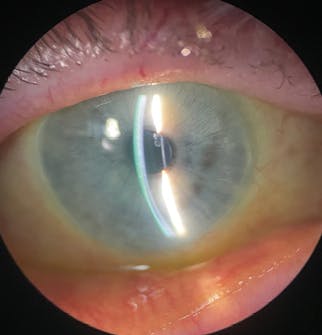
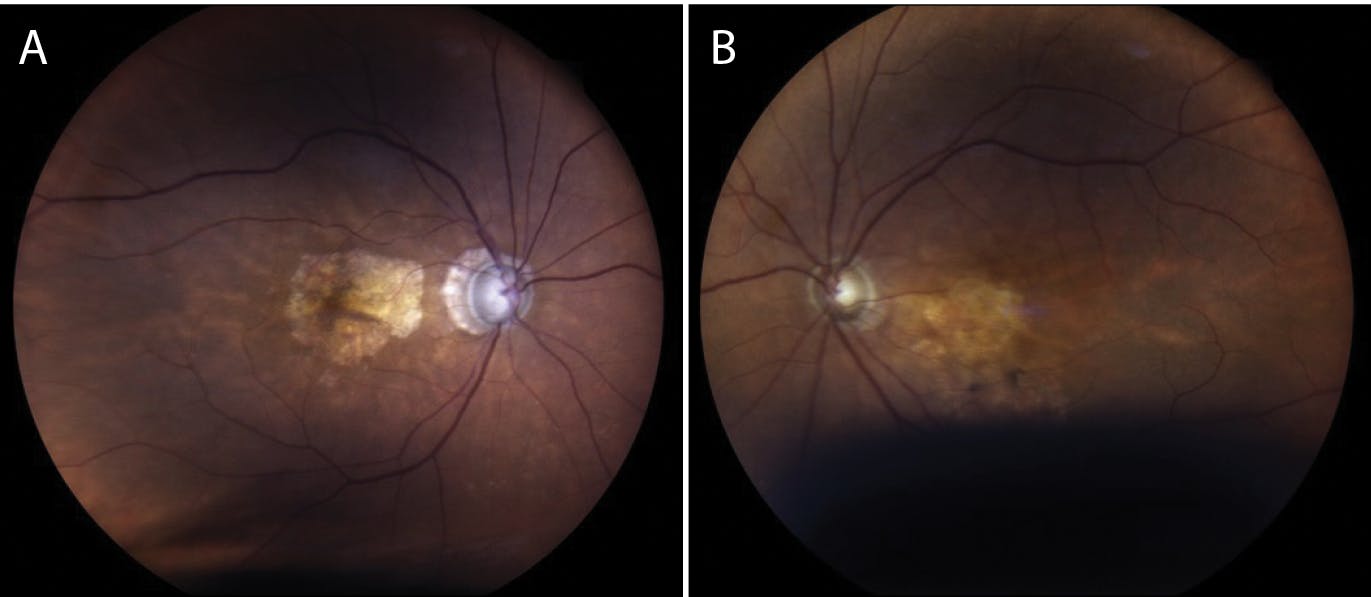
At the current follow-up appointment, the patient describes irritation from the fixed combination of brinzolamide and brimonidine she instills twice a day in her left eye. She also administers latanoprost in both eyes at night. Her BCVA is 20/80 OD and 20/150 OS. The IOP is 15 mm Hg OD and 33 mm Hg OS. An examination reveals a well-covered tube shunt in the right eye and conjunctival injection in the left eye. A posterior chamber IOL and narrowing of the anterior chamber are observed in both eyes (Figure 1). Gonioscopy shows grade 1 to 0 angles and wide areas of peripheral anterior synechiae (PAS) in both eyes. A fundus examination shows optic nerve cupping in the right eye and macular scarring from wet AMD in both eyes (Figure 2).
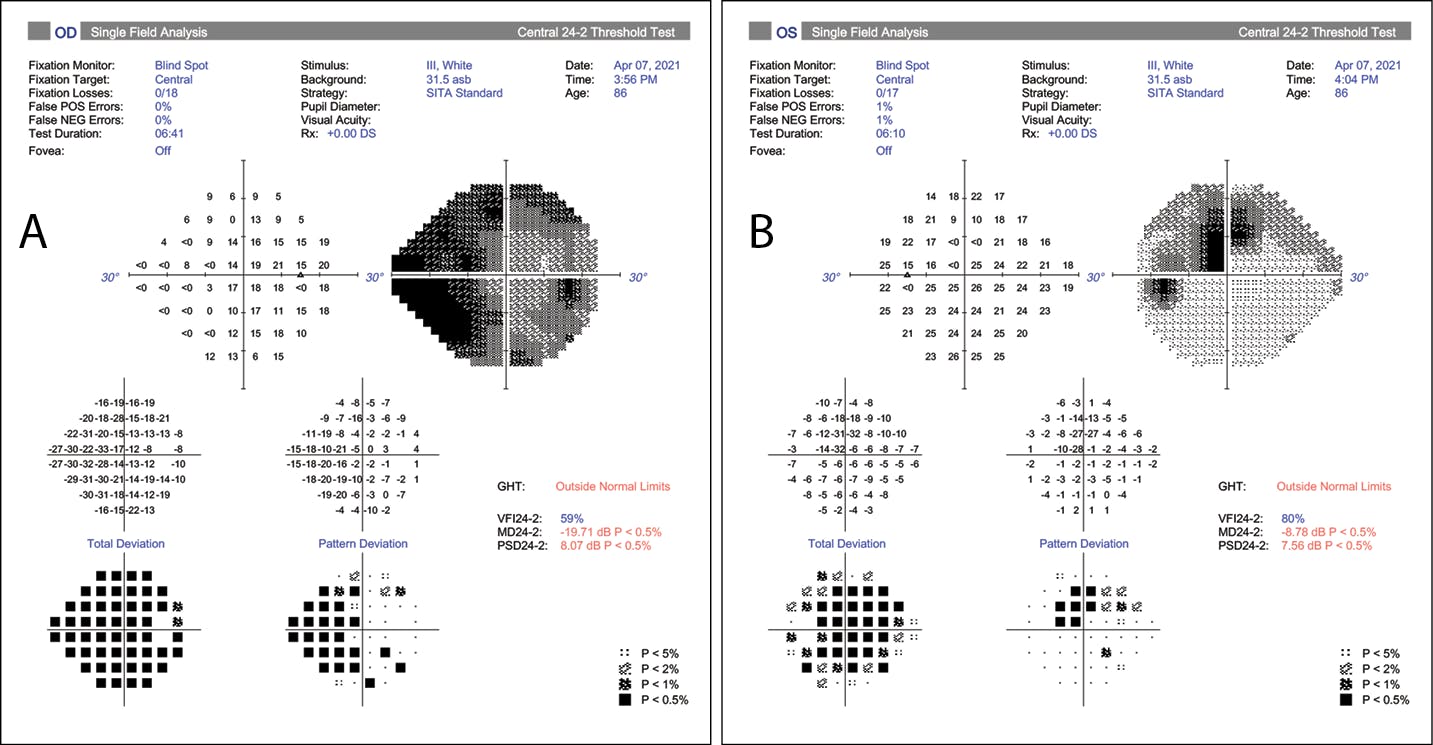
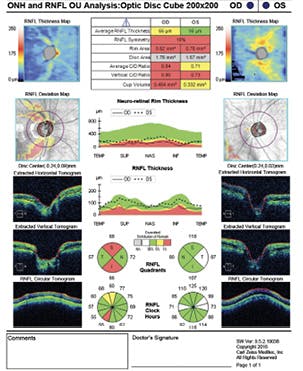
Humphrey visual field testing (Carl Zeiss Meditec) shows a constricted visual field in the right eye and a superior paracentral scotoma in the left eye (Figure 3). OCT imaging reveals severe cupping and thinning of the retinal nerve fiber layer (RNFL) in the right eye and a normal RNFL in the left eye (Figure 4).
The patient desires a more permanent solution to IOP control that will allow her to discontinue the fixed combination to which she recently developed an allergy. How would you proceed?
—Case prepared by Jacob Brubaker, MD
BRIAN A. FRANCIS, MD, MS
This is an interesting case of uncontrolled chronic angle-closure glaucoma with an additional diagnosis of advanced neovascular AMD. The presence of AMD limits the patient’s visual potential, and recurring intravitreal anti-VEGF injections raise the risk of acute and chronic IOP elevation. The glaucomatous optic nerve damage is severe in the right eye but mild to moderate in the left eye. OCT imaging shows a normal RNFL in the left eye, so the abnormality of the visual field may be due to AMD. Interestingly, the angle is narrow with PAS on gonioscopy although the patient is pseudophakic.
An important question to consider is why malignant glaucoma occurred in the right eye after AGV implantation. Presumably, postoperative hypotony was the initiating factor, and the eye was unable to recover normal aqueous outflow. The patient responded to medical treatment, however, and did not require surgery. How can malignant glaucoma be prevented in the left eye, assuming the level of risk is the same? Answering this question requires knowing the axial length of each eye. A short eye (due to nanophthalmos or relative nanophthalmos) is at increased risk of malignant glaucoma following acute IOP lowering.
With these issues in mind, several surgical options may be considered. An angle-based MIGS procedure is unlikely to be successful because of the narrow angle with PAS. Even if goniosynechialysis is combined with a trabecular stent or opening, the angle is likely to close with recurrent synechiae.
Endoscopic cyclophotocoagulation is an option despite the patient’s history of failed TSCPC. She is likely to require therapy with multiple glaucoma medications after surgery, but she may tolerate a fixed combination of dorzolamide and timolol better than her current regimen.
A third option is to implant a glaucoma drainage device. To prevent malignant glaucoma with a valved device, an OVD may be placed in the anterior chamber, or the tube may be ligated to lower the IOP in gradual steps. A nonvalved implant may be more likely to achieve sustained IOP lowering and not require subsequent TSCPC, but the risk of malignant glaucoma would be the same when the tube opens. Thus, nonvalved aqueous tube shunt surgery can be performed as a staged procedure, or the tube may be opened with a laser in the office and the anterior chamber re-formed with an OVD or balanced salt solution if necessary. Treatment with atropine at the time may help. For the most definitive prevention of malignant glaucoma, a pars plana vitrectomy (PPV) could be performed at the same time as tube implantation with an irido-zonulo-hyaloidectomy (IZH) to ensure communication between the anterior and posterior chambers. The tube may also be placed in the pars plana to prevent corneal endothelial loss over time due to the shallow anterior chamber.
JOHN T. LIND, MD, MS
Of particular importance when determining how to approach the case are the patient’s age, stage of glaucoma, IOP, current health, anticoagulation status, and risk tolerance. Her IOP is currently not controlled. If she is a poor candidate for surgery, trials of a beta blocker, methazolamide, and pilocarpine could be considered. I would be concerned, however, that pilocarpine might cause a paradoxical IOP elevation in an eye with extensive preexisting PAS. Although iridoplasty is an option, it is unlikely to be effective, because the patient already appears to have synechiae in the angle.
Based on her goals, surgical therapy is likely warranted if she is a candidate. Repeat TSCPC with a diode or micropulse laser could be attempted. Definitive treatment, however, would be to place a glaucoma drainage device. AGV tube shunts are valved and therefore likely to be safer than a nonvalved device for this patient. Based on her history of malignant glaucoma in the contralateral eye, an IZH would be performed. I generally favor an anterior approach with a vitrector at the time of tube shunt implantation, but a posterior approach with a limited vitrectomy is another option. It could be argued that AGV implantation combined with IZH is overly aggressive for a patient this age who has a relatively healthy RNFL, but I believe the strategy has the best chance of success with one surgery.
JASDEEP SABHARWAL, MD, PHD
Given the high maximum IOP and level of glaucomatous damage, the starting target IOP would be 16 mm Hg. Because the patient is having difficulty with the current drop regimen, I would consider two options: tube shunt placement or repeat TSCPC. Before discussing the benefits and drawbacks of each approach, I would obtain her previous records and speak with her original surgeon.
If the duration of earlier TSCPC treatment applications was short (2 seconds), total energy delivered was low, or laser application was not titrated to audible pops, I would be inclined to proceed with repeat TSCPC in hopes of achieving a better outcome.1 I would also inform the patient that laser treatment may exacerbate the redness and dryness of the eye and she could be at risk of worsening vision.2 During surgery, the location of the ciliary body would be assessed with transillumination to see if abnormal anatomy is limiting the effect of treatment.3
If the patient already had the aforementioned (titration to audible pops and transillumination for anatomy assessment) performed during the previous treatments, I would temper her expectations regarding the durability of IOP lowering and strongly consider the alternative of tube implantation.
If implanting a tube shunt, an AGV would be my preference because of the device’s current effectiveness in the contralateral eye. I would explain to her that the risk of malignant glaucoma in the right eye could be reduced with more extensive surgery, including a PPV and tube placement in the vitreous cavity. If a vitrectomy is not performed, an IZH would be combined with the placement of an AGV in the anterior chamber or sulcus.4
WHAT I DID: JACOB BRUBAKER, MD
Given the patient’s challenging recovery after tube shunt surgery on the right eye, a similar experience in her fellow eye seemed probable. That coupled with the narrow angles and anterior chambers despite previous cataract surgery made me suspect that chronic malignant glaucoma was present in both eyes, either caused or exacerbated by vitreous expansion syndrome from years of anti-VEGF therapy.5
After a lengthy discussion of her options, the patient and I elected to proceed with a PPV with IZH, goniosynechialysis, and goniotomy. I explained that the intervention might not achieve IOP control but should allow tube shunt surgery to be performed successfully in the future without the risk of malignant glaucoma.
Surgery on the left eye was uneventful. After a PPV port was placed, two sideport incisions were made through clear cornea. Care was taken to line up the second incision across from the desired IZH site. The vitrector was then advanced into the anterior chamber to create the initial iridotomy with the I/A-cut setting. Next, a thorough PPV was performed, with attention paid to ensure breakup of the anterior hyaloid face. The vitrector was advanced under the iridotomy and into the anterior chamber to complete the IZH. Next, after completion of a 360º goniosynechialysis, a 100º to 110º goniotomy was created with a Kahook Dual Blade (New World Medical) in the nasal angle. (Watch the video on Eyetube)
On postoperative day 1, the angle was noticeably deeper, the IOP was 26 mm Hg, and the patient’s visual acuity was hand motion due to a hyphema. She restarted therapy with latanoprost. Two weeks later, the IOP was 14 mm Hg OS, and her visual acuity approached baseline (Figure 5).
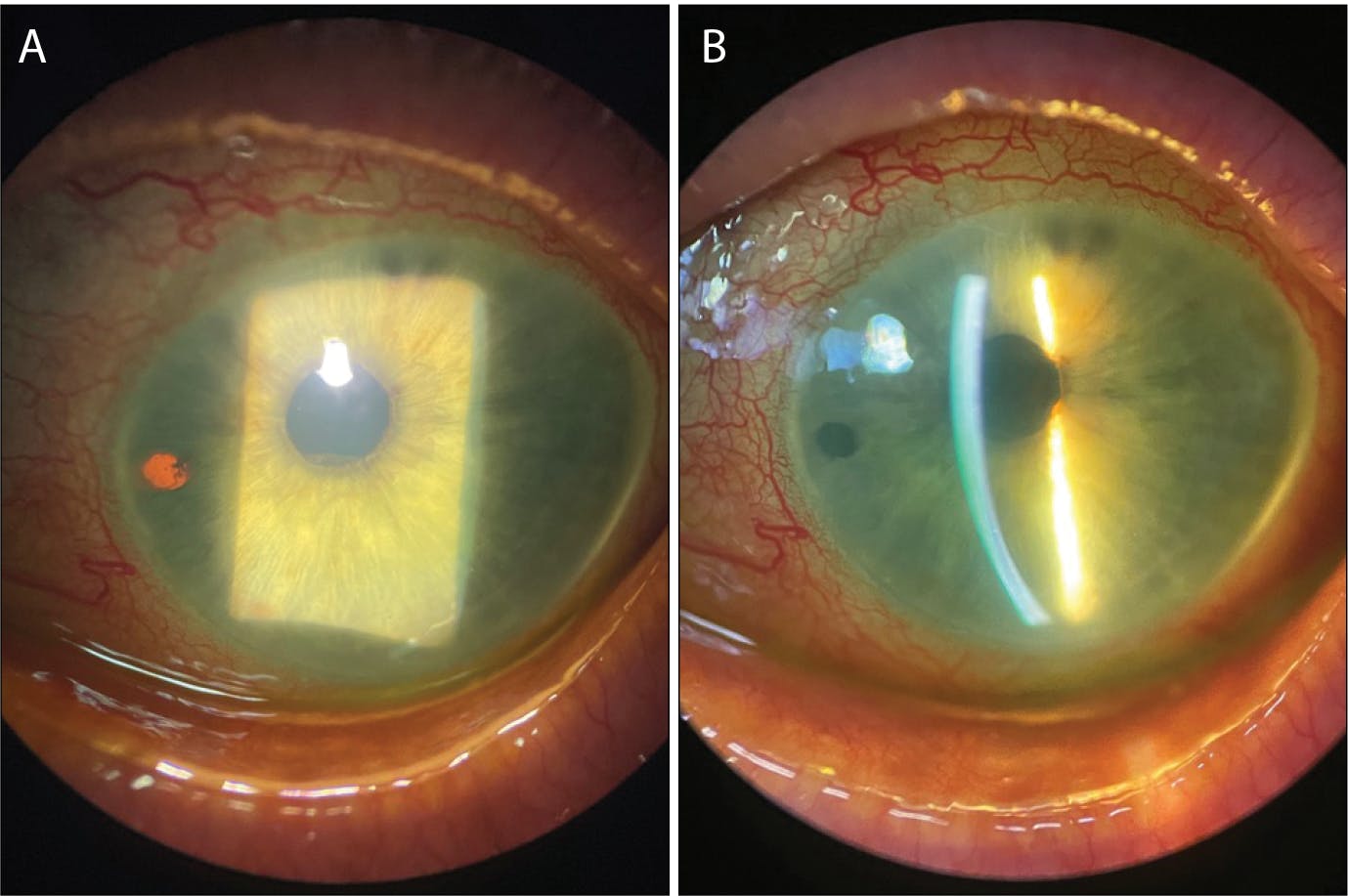
Figure 5. A slit-lamp photograph of the left eye shows deepening of the anterior chamber (A) and an IZH with retroillumination (B).
At the patient’s most recent follow-up visit, the unmedicated IOP was 10 mm Hg OS. She was pleased with her rapid recovery and IOP control.
1. Quigley HA. Improved outcomes for transscleral cyclophotocoagulation through optimized treatment parameters. J Glaucoma. 2018;27(8):674-681.
2. Bloom PA, Tsai JC, Sharma K, et al. “Cyclodiode.” Trans-scleral diode laser cyclophotocoagulation in the treatment of advanced refractory glaucoma. Ophthalmology. 1997;104(9):1508-1519; discussion 1519-1520.
3. Pastor SA, Singh K, Lee DA, et al. Cyclophotocoagulation: a report by the American Academy of Ophthalmology. Ophthalmology. 2001;108(11):2130-2138.
4. Sheybani A. Iridozonulovitrectomy for malignant glaucoma. American Academy of Ophthalmology. March 19, 2019. Accessed January 2, 2024. www.aao.org/education/1-minute-video/iridozonulovitrectomy-malignant-glaucoma
5. Krawitz BD, Misra P, Bearelly S, Al-Aswad LA. Late-onset angle closure in pseudophakic eyes with posterior chamber intraocular lenses. J Cataract Refract Surg. 2020;46(12):e48-e51.