CASE PRESENTATION
A 53-year-old woman is referred by her optometrist for a glaucoma evaluation owing to the development of new visual field and OCT changes suspicious for glaucoma since her previous examination 1 year earlier. No IOP elevation has ever been detected at one of her visits.
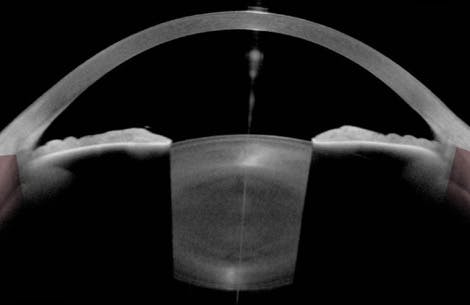
On examination, the patient’s IOP is 17 mm Hg OU. The angles are open (Figure 1). Mild superior thinning of the optic nerve is observed in the right eye, and asymmetric cupping (0.7 OD and 0.5 OS) is evident (Figure 2). Humphrey visual field testing (Carl Zeiss Meditec) shows inferior arcuate defects that are greater in the right versus left eye, in keeping with the optic nerve changes (Figure 3). OCT imaging of the optic nerves is suspicious for superior and inferior thinning bilaterally, but the findings are confounded by a split bundle artifact due to blood vessel anatomy in each eye (Figure 4).

Figure 2. Photographs of the optic nerves show thinning of the superior rims that is greater in the right versus left eye.

The patient has no history of prolonged steroid use, trauma, or neurologic or inflammatory disease. She recently recovered from an episode of long COVID-19, during which her oxygen saturation level was 92% for a period of almost 8 weeks.
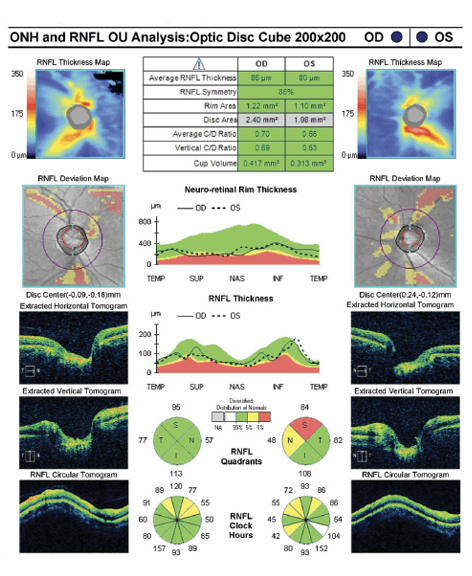
Figure 4. OCT imaging reveals superior and inferior thinning and a split bundle artifact in each eye.
Repeat visual field testing and OCT imaging 3 months after the initial consultation demonstrate stability. In the interim, the patient performed home tonometry for 1 week with an iCare Home tonometer (Icare USA). The IOP readings fluctuated from 12 to 21 mm Hg (mean, 16.5 mm Hg) OD and 10 to 19 mm Hg (mean, 15.3 mm Hg) OS (Figure 5).

Would you advise the patient to begin treatment?
—Case prepared by Devesh K. Varma, MD, FRCSC
RONALD L. FELLMAN, MD
This case presents a common clinical problem: how to proceed when the reliability and availability of prior glaucoma testing are uncertain?
Unfortunately, the patient’s old visual field tests and OCT scans are not available for review. Her history is complicated by a recent recovery from long COVID-19 with reduced oxygen saturation. For the purposes of this discussion, I will assume that the 92% oxygen saturation level was on room air and not during supplemental oxygen therapy while she was hospitalized.
Current findings include suspicious visual field and nerve bundle OCT parameters confounded by anomalous optic discs with split bundle artifacts and disc cupping. Repeat visual field testing and OCT imaging at 3 months were unchanged. The patient’s ocular history is unremarkable. Her refractive status is unreported but likely myopic. Home tonometry measurements are essentially normal.
The visual field findings are confusing because the defects do not match the OCT nerve findings. The situation is further confounded by myopia.
Clinically, the left disc appears to have inferior torsion, and the right disc seems to be large (OCT disc area is 2.40 mm2 OD and 1.98 mm2 OS). Both disc variants alter the segmentation pattern for the retinal nerve fiber layer (RNFL), giving the appearance of so-called red disease on the OCT printout, even though the disc may not be pathologic. If the RNFL defects are new and related to long COVID-19, the ganglion cell test would likely be abnormal. Instead, the ganglion cell analysis for both eyes is completely normal, indicating that the RNFL defects are more likely red disease based on variations in disc size in the right eye and native torsion of the left disc. I make this statement with a full appreciation of the controversy over whether optic nerve damage—not to mention disc damage from COVID—first shows up in the visual field, RNFL, or ganglion cell analysis.
Clinically, close observation combined with serial stereo disc photographs to monitor for disc changes seems a reasonable strategy for this asymptomatic, myopic patient. Documentation that the patient is a glaucoma suspect and requires follow-up would be added to her medical record.
JOANN GIACONI, MD
The patient’s risk factors for glaucoma include a cup-to-disc ratio that is larger than average in each eye, asymmetry in the cup-to-disc ratios, optic nerve rims that are thinner superiorly than inferiorly, and IOP fluctuation of 9 mm Hg. The optic nerves look slightly tilted in the photographs, and the RNFL deviation map is difficult to interpret because the RNFL peaks are located more temporally than in the normative database.
Certain presentation features are atypical of glaucoma. First, there are the large changes found on OCT imaging and visual field testing in a year’s time (history implies both were normal the year before). Also atypical are the inferior scotomas with the greatest depression outside the nasal step area.
It would be helpful to review old RNFL printouts and look for thinning in the superior and inferior areas of the RNFL deviation map. It could also be beneficial to examine old visual field tests for hints of early scotomas in the same areas.
COVID-19 has been associated with acute angle closure attacks due to prone positioning, hyponatremia, or swelling of the ciliary body, but these case reports all involved patients with shallow chambers. In this case, anterior segment OCT imaging shows a deep chamber. I therefore think asymptomatic, intermittent angle closure is highly unlikely. COVID-19 has also been reported in association with a number of retinal diseases that can cause visual field defects. These include acute macular neuroretinopathy, vein and artery occlusions, and neuro-ophthalmic disease. The patient’s nerves do not appear to be pale. Nor do the visual field defects respect a vertical midline.
I would obtain an OCT scan of the macula, and I might ask a retina colleague to join me in carefully examining the maculas for any sign of retinal microvascular disease. Treatment can be delayed to allow further workup, and this patient may require just observation.
WHAT I DID: DEVESH K. VARMA, MD, FRCSC
Cases of optic neuropathy related to COVID-19 have been reported.1-4 Most have been associated with the inflammatory and hypercoagulation sequelae of the disease, and patients have generally presented with optic neuritis, cranial nerve palsies, venous sinus thrombosis, and posterior circulation strokes. Although steroid use during COVID can affect IOP, the patient in this case did not receive prolonged steroid treatment, and the IOP measurements obtained shortly after her recovery were not high. Nor was her IOP elevated upon examination at my office.
Home tonometry demonstrated wide fluctuations in IOP, but the mean reading was within normal limits. I thought it possible that a prior insult from prolonged hypoxia had caused the changes in her visual fields and optic nerves. This may not fully explain the disease asymmetry, but I did not feel comfortable making a diagnosis of normal-tension glaucoma and potentially setting the patient on a path toward lifelong IOP-lowering treatment. Instead, I recommended regular observation with an understanding that treatment will be initiated only if active disease progression is detected. In that situation, the patient would be tested for other mechanisms not dependent on IOP such as sleep apnea; nocturnal hypotension; and compressive, metabolic, and inflammatory causes. If these are ruled out, she would begin treatment for normal-tension glaucoma.
1. Sawalha K, Adeodokun S, Kamoga GR. COVID-19-induced acute bilateral optic neuritis. J Investig Med High Impact Case Rep. 2020;8:2324709620976018.
2. Sen M, Honavar SG, Sharma N, Sachdev MS. COVID-19 and eye: a review of ophthalmic manifestations of COVID-19. Indian J Ophthalmol. 2021;69(3):488-509.
3. Maleki A, Look-Why S, Manhapra A, Foster CS. COVID-19 recombinant mRNA vaccines and serious ocular inflammatory side effects: real or coincidence? J Ophthalmic Vis Res. 2021;16(3):490-501.
4. Gold DM, Galetta SL. Neuro-ophthalmologic complications of coronavirus disease 2019 (COVID-19). Neurosci Lett. 2021;742:135531.