CASE PRESENTATION
A 71-year-old man with primary open-angle glaucoma presents for a routine follow-up visit. The patient’s surgical history is as follows:
- Selective laser trabeculoplasty (SLT) in the right eye in October 2020;
- Placement of a travoprost intracameral implant (iDose TR, Glaukos) in the left eye in November 2020;
- Repeat SLT in the right eye in November 2021;
- Placement of a bimatoprost implant (Durysta, AbbVie) in the right eye in June 2022; and
- A third SLT procedure in the right eye in November 2022.
Upon examination, the patient’s BCVA is 20/20 OU, and his IOP is 15 mm Hg OU. Pachymetry readings are 500 µm OD and 530 µm OS. His current medical regimen consists of a fixed combination of timolol and brimonidine in the right eye. He has not administered a topical agent in the left eye since entering the iDose clinical trial in 2020, before which time the left eye was treated with the same fixed-combination agent. The patient has a sulfa allergy, and his eyes became red when treated with a prostaglandin analogue in the past. The IOP in the right eye is currently at the top of his target range on maximum tolerated medical therapy.
A 1+ nuclear sclerotic cataract is evident in each eye. The patient reports having excellent vision, however, and is not interested in cataract surgery at present (Figures 1 and 2). He would like to discontinue topical medical therapy for the right eye.
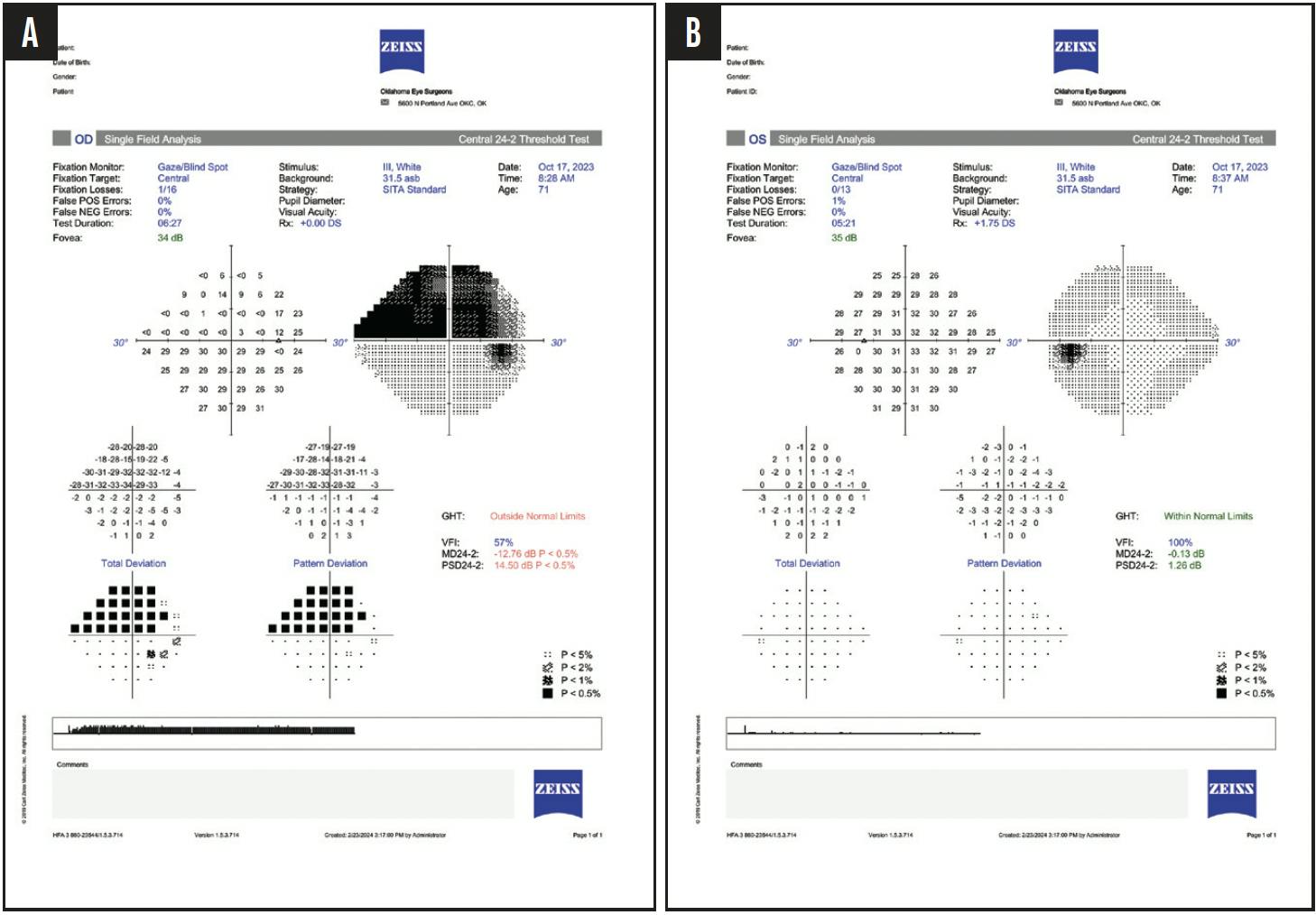
Figure 1. Visual field testing reveals a significant superior defect in the right eye (A) but only minimal changes in the left eye (B).
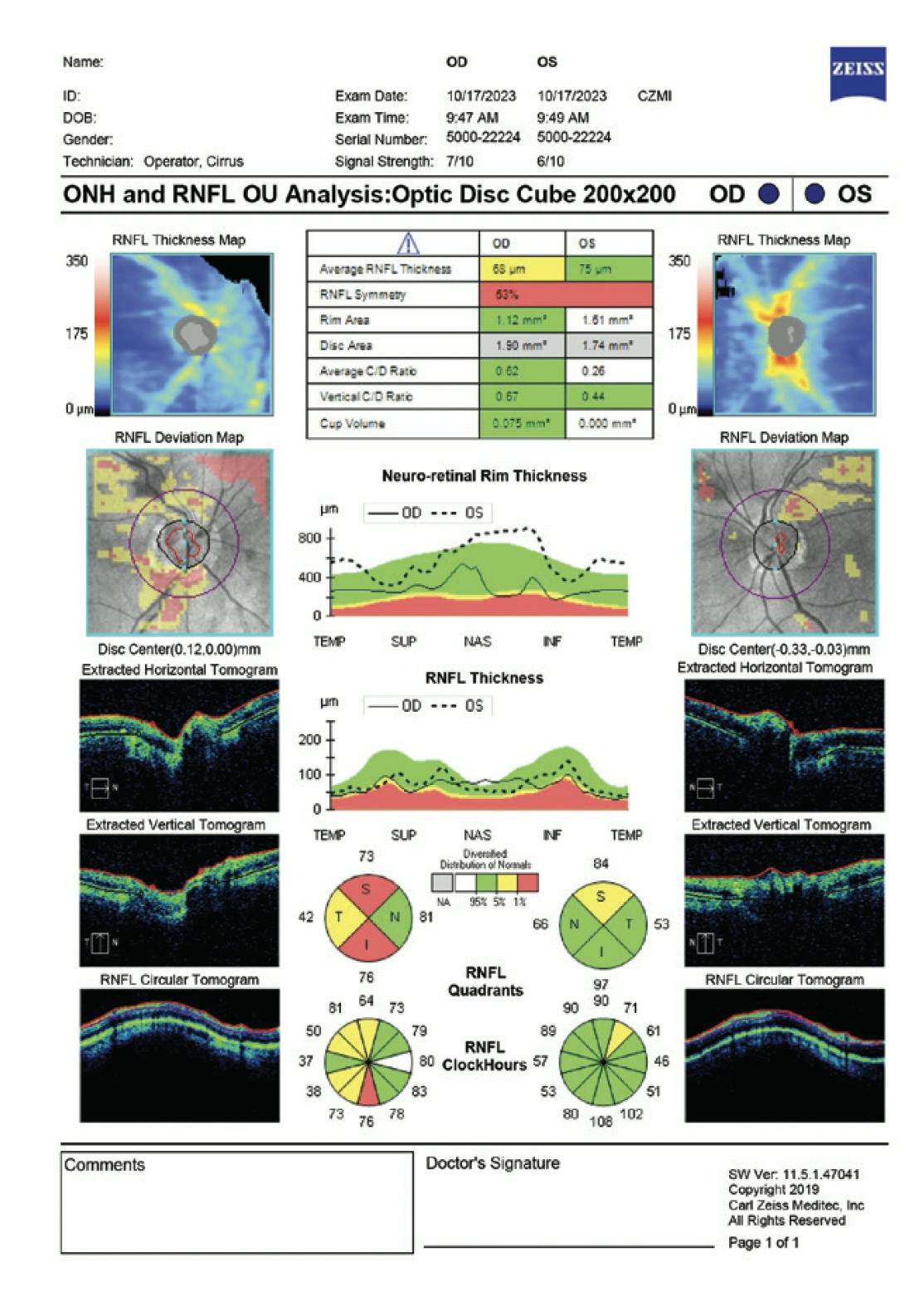
Figure 2. OCT imaging shows significant retinal nerve fiber layer loss that is worse in the right eye and optic disc drusen in both eyes.
How would you proceed?
—Case prepared by Steven R. Sarkisian Jr, MD
MATTHEW BRINK, MD
The case presentation provides a good history of the patient’s recent interventions. I would also consider the rate of progression in the right eye and factor in the high likelihood of adherence issues; this patient has had multiple reactions to topical medications, which makes compliance with prescribed eye drop therapy more challenging. It would also be important to look for any history of trauma, subtle pseudoexfoliation, and other causes of asymmetric glaucoma.
Because of the uncertainty inherent in glaucoma management, I usually recommend a stepwise approach. Less invasive interventions have been tried in the right eye, and the patient has significant visual field loss that threatens fixation. If this eye has been stable but drop therapy has been difficult, the next step could be to place a travoprost intracameral implant, given the excellent response in the contralateral eye. If visual field progression occurred recently, my preference would be to implant a Xen Gel Stent (AbbVie). I favor an ab interno approach with primary needling. Although an open-conjunctival approach would be reasonable, I find a closed-conjunctival approach gentler for patients who are not prone to scarring.
I emphasize the quality of IOP control rather than aim for the same target IOP for every patient. I would counsel the patient about possible cataract formation and the risk of bleb failure if cataract surgery is performed after a bleb-based procedure.
The surgical approach selected must address his chief complaint while preventing further damage. A stepwise approach would leave options open for future intervention if necessary.
GEORGE R. REISS, MD
The visual field loss in the patient’s right eye is severe. Fortunately, no field loss is evident in the left eye, and the retinal nerve fiber layer of that eye appears to be robust with an average thickness of 75 µm.
A little more information on the IOP would help to confirm that control has been achieved and no spikes are occurring in the right eye. Because the patient appears to be intolerant of some classes of medication and prefers to avoid topical therapy, nontopical therapy seems prudent.
I would give the patient an iCare Home tonometer (Icare USA) with instructions on its use. He would be asked to obtain, over the course of 3 to 4 days, two readings each in the morning, afternoon, and evening as well as to set an alarm for a reading at 3 am. Several studies have shown that, in approximately 65% to 70% of patients, maximum IOP occurs outside of office hours,1 yet we physicians make treatment decisions based on readings obtained during office hours.
I would not rely on the actual reading from the iCare Home tonometer but rather the range from highest to lowest. In some of my patients with unexplained visual field progression, the device has detected ranges of greater than 15 mm Hg. If something similar is occurring in this case, I would consider more definitive treatment such as canaloplasty, iStent Infinite (Glaukos) placement, or the implantation of a Xen Gel Stent. Waiting for further field loss to occur in the right eye is not indicated in a 71-year-old man. The plan must be to preserve vision for at least 10 to 15 years.
The situation with the left eye is less worrisome. Depending on the IOP range detected, either repeat SLT or repeat iDose placement would be a reasonable strategy. The advantage of combining the iDose with iStent Infinite implantation or repeat SLT is that it would address both uveoscleral outflow (prostaglandin analogue) and pressure-dependent outflow (SLT or iStent), leading, one hopes, to better and longer-lasting control.
I. PAUL SINGH, MD
I had a similar case recently. Assuming no structural or functional progression has occurred, my goal would be to keep the IOP in the low to midteens and reduce the drop burden in the right eye.
The highest recorded IOP is not mentioned in the case presentation, but I assume that SLT had an effect, which is why the procedure was repeated. The patient has allergies to topical prostaglandin analogues and carbonic anhydrase inhibitors. The IOP-reducing effect of the bimatoprost implant placed in 2022 has likely worn off, but the tolerability of an intracameral prostaglandin analogue has been demonstrated.
An off-label reinjection of the bimatoprost implant could be considered. That said, the travoprost intracameral implant has received FDA approval. Because phase 2 trials showed that the latter may offer 3 years of efficacy and the implant in the patient’s left eye still seems to be working, I would suggest placing a travoprost intracameral implant in the right eye.
If entering the eye to place a travoprost intracameral implant, I would recommend also performing a canaloplasty to address the entire conventional outflow pathway because the patient has more advanced disease in the right versus left eye. The combined procedure would maintain high safety, minimize disruption to the trabecular meshwork, and keep many options open for the future—an important consideration because cataract surgery is inevitable. Given the patient’s history of SLT and maximum tolerated medical therapy, the placement of an iStent Infinite to bypass the trabecular meshwork and access the collector channels would be an option with or without canaloplasty.
WHAT I DID: STEVEN R. SARKISIAN JR, MD
The patient was so satisfied with the travoprost intracameral implant placed in his left eye during the phase 3 trial that he asked to receive the same implant in his right eye as soon as it received FDA approval. I placed the implant in his right eye on the first day the device was available to me. One month after surgery, his IOP was 12 mm Hg on no topical medication.
The patient’s disease had been stable for more than 6 years at the time this surgery was performed. Otherwise, I would have implanted a Xen Gel Stent with adjunctive mitomycin C or perhaps, as Dr. Reiss suggests, combined placement of a travoprost intracameral implant and an iStent Infinite.
I, too, advocate the use of home tonometry to detect IOP fluctuations. This strategy can be especially helpful when the IOP of a patient presenting for SLT is much lower than when they were evaluated. In my experience, showing them data from the iCare Home tonometer documenting a diurnal curve over the course of 5 to 7 days can help them to understand their need for glaucoma surgery.
1. Asrani S, Zeimer R, Wilensky J, Gieser D, Vitale S, Lindenmuth K. Large diurnal fluctuations in intraocular pressure are an independent risk factor in patients with glaucoma. J Glaucoma. 2000;9(2):134-142.
_1754918026.png?auto=compress,format)