AT A GLANCE
- Eye drops are a vital component of ocular health care, yet challenges associated with their administration can impede patient adherence and reduce treatment efficacy.
- Eye drop aids can help overcome the challenges associated with eye drop administration.
- By understanding the strengths and limitations of the available eye drop aids, health care providers can tailor their recommendations to optimize patient adherence and satisfaction.
Topical therapy is essential for the management of various ocular conditions. However, patients often encounter difficulties with eye drop use, such as remembering to administer their medications, navigating complex dosing regimens, properly instilling the agents, managing cost, and dealing with side effects.1,2 Because these challenges can hinder patient adherence and therefore compromise treatment outcomes, a range of eye drop aids have been developed to enhance accessibility and accuracy.
CHALLENGES IN EYE DROP ADMINISTRATION
Administering eye drops presents several challenges for patients. These include hand tremors, poor hand-eye coordination, difficulty aiming, flinching, blinking, decreased visual acuity, limited dexterity, and impaired mobility. The precision and coordination required for accurate dosing can be difficult to achieve, leading to medication waste and suboptimal treatment outcomes. These issues contribute to poor adherence and disease progression.
EVOLUTION OF EYE DROP AIDS
Eye drop aids have evolved significantly since their introduction in the 1990s. Initially, solutions such as dropper guides and magnifying aids were developed to assist patients with positioning and aiming the bottle. As technology advanced, more sophisticated devices emerged with features such as stabilization platforms, dosage indicators, and electronic functionality.3
CONTEMPORARY EYE DROP AIDS
Four contemporary aids are available to help overcome some of the challenges associated with eye drop administration and address the diverse needs of patients (Figure). These include the AutoDrop (Owen Mumford), AutoSqueeze (Owen Mumford), Nanodropper (Nanodropper), and GentleDrop (GentleDrop).
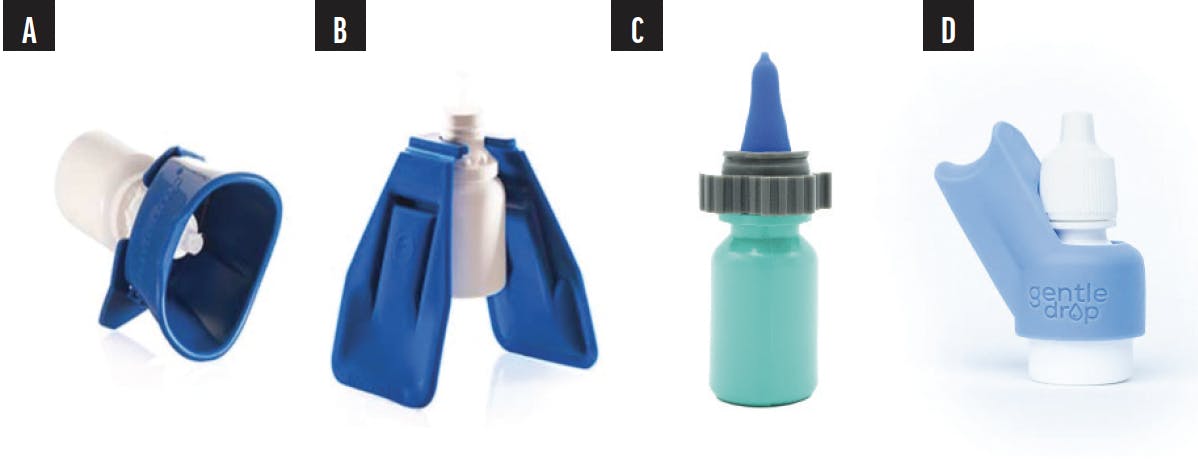
Figure. Contemporary eye drop aids include the AutoDrop (A), AutoSqueeze (B), Nanodropper (C), and GentleDrop (D).
AutoDrop
AutoDrop is a mechanical device designed to facilitate precise eye drop delivery. It attaches to standard eye drop bottles and rests on the orbit surrounding the eye to ensure proper bottle alignment and minimize spillage.4
The advantages of the AutoDrop device are as follows:
- Improved accuracy of drop delivery;
- Ease of use;
- Decreased bottle tip contamination; and
- Decreased trauma.
The disadvantages of the AutoDrop device include the following:
- The inconvenience of an additional step; and
- A potential increase in the number of drops used.
AutoSqueeze
AutoSqueeze is a mechanical device designed to eliminate the difficulty of squeezing the eye drop bottle. The device has a central holder that attaches to standard eye drop bottles and a wing on either side. Squeezing the wings causes the grooves on the inside of the wing to apply pressure to the eye drop bottle so that one drop is released.4
The advantages of the AutoSqueeze device are as follows:
- An ergonomic grip;
- Help in overcoming mobility difficulties; and
- The potential to be used in combination with the AutoDrop device.
The disadvantage of the AutoSqueeze device is the inconvenience of an additional step.
Nanodropper
Nanodropper is a portable attachment that reduces the size of each eye drop, allowing more efficient dosing and reducing waste. The device attaches to standard eye drop bottles and dispenses smaller, more precise drops, maximizing the number of doses per bottle.5
The advantages of the Nanodropper are as follows:
- Precise dosing;
- Improved adherence;
- Cost efficiency;
- Decreased side effects;
- Decreased waste; and
- Improved accuracy.
The disadvantages of the Nanodropper include the following:
- A learning curve for using the device;
- The inconvenience of an additional step;
- An increased risk of contamination due to an extended bottle lifespan; and
- Varying compatibility with different bottle designs.
GentleDrop
GentleDrop is a nose-pivoted drop delivery device. With this aid, the eye drop bottle is inserted into a sleeve that rests on the bridge of the patient’s nose to ensure proper bottle alignment.6,7
The advantages of the GentleDrop are as follows:
- Improved aim;
- A lower mean number of drops;
- Minimized waste; and
- Decreased bottle tip contamination.
The disadvantages of the GentleDrop include the following:
- Incompatibility with some eye drop bottles;
- The inconvenience of an additional step; and
- An additional layer of complexity for patients with limited dexterity.
BENEFITS AND LIMITATIONS
Each eye drop aid caters to certain patient needs and preferences. Mechanical aids such as the AutoDrop and AutoSqueeze provide simplicity and reliability but lack advanced features. Attachments such as the Nanodropper reduce side effects and improve the accuracy of drop administration, but they are not compatible with all bottles on the market. The GentleDrop decreases waste and bottle tip contamination but may also have somewhat limited compatibility.
CONCLUSION
Eye drop aids play a crucial role in overcoming the challenges associated with eye drop administration. From mechanical guides to advanced technological solutions, these aids offer a range of benefits to patients with diverse needs. By understanding the strengths and limitations of each aid, health care providers can tailor their recommendations to optimize patient adherence and satisfaction, ultimately improving ocular health outcomes. Continued research and innovation are essential to address the evolving needs of patients and further enhance the efficacy and accessibility of eye drop aids.
1. Newman-Casey PA, Robin AL, Blachley T, et al. The most common barriers to glaucoma medication adherence: a cross-sectional survey. Ophthalmology. 2015;122(7):1308-1316.
2. Zaharia AC, Dumitrescu OM, Radu M, Rogoz RE. Adherence to therapy in glaucoma treatment-a review. J Pers Med. 2022;12(4):514.
3. Davies I, Williams AM, Muir KW. Aids for eye drop administration. Surv Ophthalmol. 2017;62(3):332-345.
4. Brand G, Hecht I, Burgansky-Eliash Z, et al. Comparison of the usability of eye drop aids and the conventional bottle. J Clin Med. 2021;10(23):5658.
5. Hoppe CB, Yonamine S, Kao BW, et al. Randomized trial to evaluate the efficacy of the Nanodropper device for pupillary dilation and cycloplegia in children. Ophthalmology. 2023;130(3):324-330.
6. Sanchez FG, Mansberger SL, Kung Y, et al. Novel eye drop delivery aid improves outcomes and satisfaction. Ophthalmol Glaucoma. 2021;4(5):440-446.
7. Grissom N, Gardiner SK, Rees JP, et al. Patients with low vision struggle with placing eye drops and benefit from an eye drop aid. Ophthalmol Glaucoma. 2023;6(5):501-508.