Repetitive strain injury has been defined as “an umbrella term for disorders that develop as a result of repetitive movements, awkward postures, sustained force, and other risk factors.”1
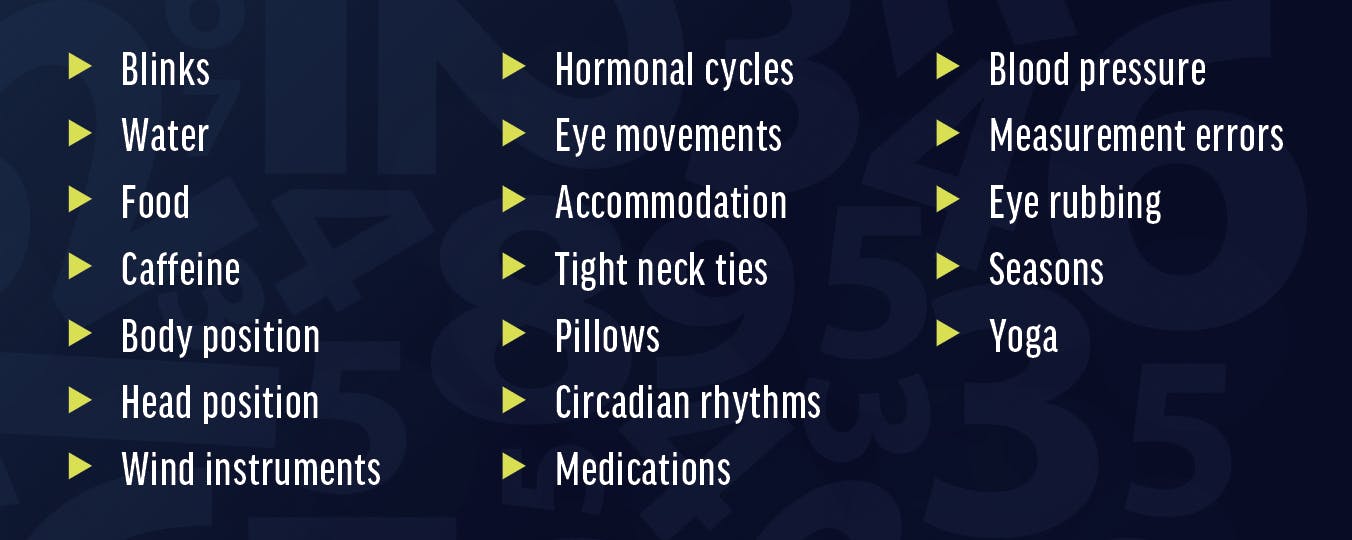
The eye is subjected to repetitive and constant forces. IOP pushes continuously on the optic nerve, and it is dynamic—it varies due to numerous factors (Figure 1), and those variations affect the optic nerve head. In 1991, Coleman et al published the first article showing that the optic nerve head displaces with acute changes in IOP.2 Seeing as these repetitive strains occur with variations in IOP, it begs the question: Do they cause damage and ultimately lead to glaucoma?
Answering this question requires a closer look at four others:
- Why does IOP vary?
- What is the association between IOP variations and glaucoma?
- Do IOP variations cause glaucoma?
- What are the next steps?
WHY DOES IOP VARY?
IOP and Body Position
IOP can fluctuate depending on body position. In a study of yoga practitioners, Baskaran and colleagues measured IOP before, during, and after a headstand position.3 They found that IOP increased twofold when the practitioners were inverted but quickly normalized to baseline when they returned to a seated position.
My colleague and I investigated the effect of different head and body positions on IOP in 24 healthy volunteers.4 We used pneumatonometry to obtain two sets of IOP measurements, sitting and recumbent. In the sitting position, IOP was measured with a neutral neck position, neck extension, and neck flexion. In the recumbent position, IOP was measured in the supine position and right and left lateral decubitus positions. We found that the lowest IOP reading was recorded in the seated upright plus neutral neck position. Based on this, a patient’s in-office IOP reading will be their lowest measurement. We also found that, in the right lateral decubitus position, IOP was slightly higher in the dependent (lower) eye, so recumbent positioning has an effect as well.
Understanding why these variations occur requires consideration of aqueous humor dynamics. The modified Goldmann equation describes the relationship among four variables of aqueous humor dynamics that define IOP: aqueous humor outflow rate (Q), uveoscleral outflow rate (U), conventional outflow facility (C), and episcleral venous pressure (EVP): IOP = (Q - U)/C + EVP.
Richard F. Brubaker, MD, a pioneer in aqueous humor dynamics, measured the relationship between body position and the rate of aqueous humor formation.5 He and his colleagues altered IOP by changing their subjects’ gravity-dependent body position and measured aqueous humor flow fluorophotometrically. They found that, if body position varied by a small amount—15° up or down—small variations in IOP occurred, but no change in aqueous humor flow was observed. With severe changes in body position—50° up or down—large fluctuations in IOP occurred, but only a small change in aqueous humor flow was observed. Further, when participants were placed in a head-down position, IOP increased but aqueous humor flow rate decreased slightly. Thus, aqueous humor flow rate does not seem to explain the variations in IOP that occur with changing body positions.
Decades later, my colleagues and I investigated the variation in aqueous humor outflow facility with body position changes.6 We utilized constant weight tonography using a modified electronic Schiotz tonometer with healthy volunteers in seated and supine positions. We found that IOP increased in the supine versus seated position, but outflow facility did not vary significantly between positions. Aqueous humor outflow facility also does not seem to explain the variations in IOP that occur with changing body positions.
EVP is difficult to measure because the episcleral veins are only about 100 μm in diameter. Around 13 years ago, my colleagues and I developed a technique to measure EVP objectively and reproducibly (Figure 2).7 Our system involves placing a clear balloon on the surface of the eye that is inflated automatically using a computer-controlled motor drive. A transducer records the pressure, and a high-definition video camera captures vein collapse. Pressure measurements are synchronized with the video stream to determine the pressure required to collapse the vein to a predetermined degree, with EVP corresponding to the start of collapse.
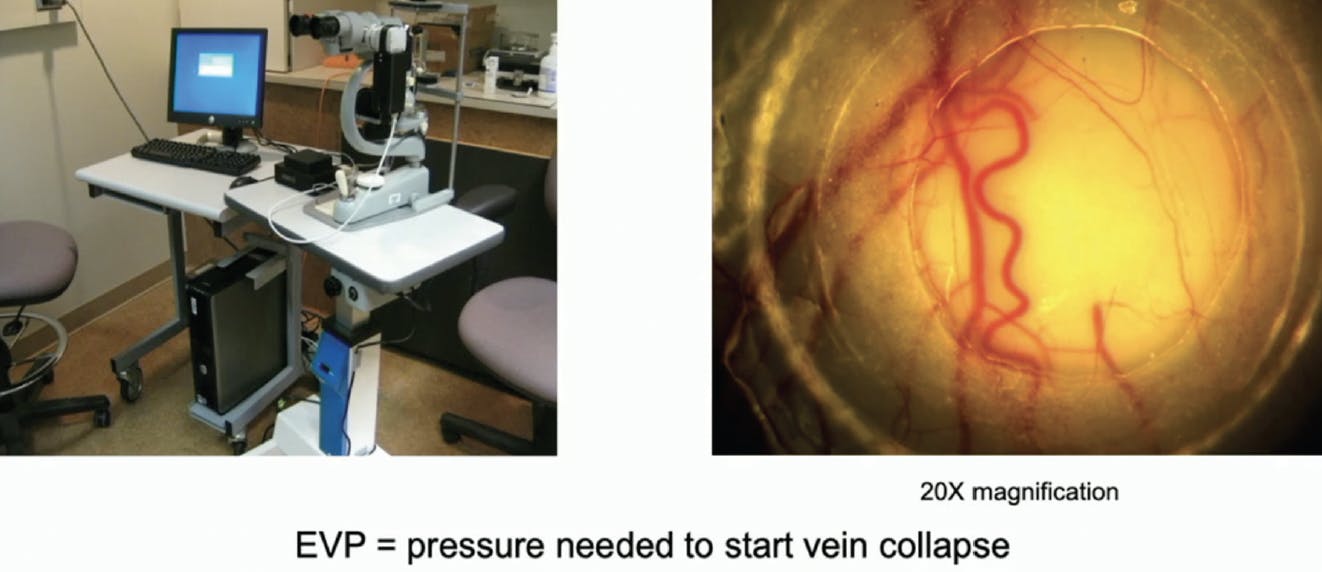
Figure 2. A novel system for measuring EVP using a custom computer-controlled episcleral venomanometer.
Using this technique, my colleagues and I investigated changes in EVP between two body positions, sitting and inclined, and compared them to changes in IOP.8 We found that IOP increased when healthy volunteers went from a seated position to an inclined position, as expected. EVP, however, also increased when the volunteers went from a seated position to an inclined position, and the postural increases in EVP and IOP were almost equal. This showed that the posture-induced increase in IOP could be attributed to an increase in EVP.
Circadian Rhythms of IOP
Robert Weinreb, MD; John H.K. Liu, PhD; and colleagues conducted the seminal studies investigating the circadian rhythms of IOP in humans. They have shown that IOP tends to be highest in the morning and decrease over the course of the day. Additionally, when individuals lie down to sleep, IOP increases significantly.9 This is curious because, at night, aqueous humor production decreases by about 50%.10 Given this decrease in aqueous humor production, IOP might be expected to decrease significantly when measured in the same body position.
About a decade ago, my colleagues and I decided to explore this discrepancy.11 In a group of healthy volunteers, we measured aqueous humor flow rate, IOP in the seated position, outflow facility, and EVP during the middiurnal period (2 PM to 4 PM). Uveoscleral outflow was calculated from the other variables using the modified Goldmann equation. These variables were then remeasured during the midnocturnal period (2 AM to 4 AM) and compared with those measured during the middiurnal period.
We found that, from the middiurnal period to the midnocturnal period, aqueous humor flow rate decreased by about 50%. Neither IOP nor EVP changed. Outflow facility decreased by about 15%, and uveoscleral outflow decreased by 93%. These decreases in uveoscleral outflow and outflow facility seem to compensate for the decrease in aqueous humor production and keep IOP relatively stable nocturnally when measured in the body-independent position.
More recently, my colleagues and I looked at the diurnal rhythm of EVP and the relationships between EVP variations and IOP.12 We found that EVP and IOP both follow a diurnal rhythm, with highest values in the early morning that decrease gradually throughout the day. Diurnal EVP and IOP changes are correlated, but the change in EVP only partially explains the change in IOP.
WHAT IS THE ASSOCIATION BETWEEN IOP VARIATION AND GLAUCOMA?
Although we now have a good understanding of why IOP varies, the association between these variations and glaucoma remains somewhat unclear.
In the Advanced Glaucoma Intervention Study (AGIS), Caprioli and Coleman investigated the relationship of IOP fluctuation and mean IOP with visual field progression.13 Patients were stratified into low mean IOP and high mean IOP groups. The investigators found that patients with low mean IOP and high IOP fluctuation were at greater risk of visual field progression than those with low IOP fluctuation or high mean IOP.
Musch et al performed a similar analysis of patients in the Collaborative Initial and Glaucoma Treatment Study (CIGTS), which compared medication and trabeculectomy as initial treatment for newly diagnosed glaucoma.14 The investigators found that, in patients treated surgically, no measures of IOP fluctuation were predictive of visual field progression. However, in patients treated medically, the range of the IOP, the standard deviation of IOP, and the maximum IOP were predictive of visual field progression; mean IOP, however, was not.
In the Los Angeles Latino Eye Study (LALES), which was a population-based survey, the investigators obtained just six IOP readings: three at baseline and three at the 4-year follow-up.15 They found that, among patients with lower IOPs (< 15 mm Hg), higher levels of maximum IOP, standard deviation, and range of IOP were all associated with a higher risk of developing glaucoma, but mean IOP was not. Among patients with higher IOPs (≥ 15 mm Hg), only higher levels of mean IOP and maximum IOP were associated with a higher risk of developing glaucoma.
Circadian variations in IOP are also important. De Moraes and colleagues conducted a study of 445 eyes of 445 patients with treated open-angle glaucoma.16 They obtained 24-hour recordings of IOP patterns using the Triggerfish contact lens sensor (CLS; Sensimed) and stratified patients into groups based on their rate of visual field progression. A total of 55 CLS-derived variables were assessed to determine their association with rates of visual field change. The investigators found that several CLS variables were associated with fast visual field progression, and most occurred at nighttime or in the transition from day to night. These variables were better predictors of fast visual field progression than IOP measured with Goldmann tonometry during office hours.
It appears that variations in IOP are strongly associated with glaucoma and its progression, especially in patients with low or medically treated IOP. Nocturnal factors seem to be particularly important. However, this still does not confirm whether IOP variations cause glaucoma and whether causation is being mistaken for association.
DO IOP VARIATIONS CAUSE GLAUCOMA?
Serendipitously, my colleagues and I were once working on a retrospective, population-based cohort study to determine the risk of primary open-angle glaucoma after vitreoretinal surgery.17 We looked at the medical records of all residents of Olmstead County, Minnesota, who underwent scleral buckle surgery and/or vitrectomy between 2004 and 2015. Patients’ fellow nonoperative eyes were used as the comparison cohort.
We found that patients who had vitreoretinal surgery were approximately nine times more likely to develop glaucoma over 10 years than those who did not have vitreoretinal surgery. However, when we looked at the types of surgery, we found that no eyes that received a scleral buckle without vitrectomy developed glaucoma. We examined several factors but did not find anything other than baseline IOP being more predictive of the development of glaucoma.
Why might a scleral buckle be protective against glaucoma? The answer requires an understanding of the term compliance. Thinking of a balloon, compliance is the change in volume divided by the change in pressure. Although the eye is filled with fluid not air, it is like a balloon in that it is elastic, changes, and has compliance. IOP can only change with a change in ocular volume. Higher compliance in the eye means a lower IOP change for a given volume change, which leads to lower IOP variations. Clinically, this relationship can be measured with the Friedenwald ocular rigidity coefficient.18 Essentially, this is the log of the pressure change that occurs in the eye before and after a 10-g weight is placed on it, divided by the volume change before and after placing the 10-g weight.
Recently, my colleagues and I looked at nine patients with unilateral 360° encircling scleral buckles without vitrectomy for rhegmatogenous retinal detachments.19 We measured their IOP in the seated and supine positions using pneumatonometry and determined outflow facility using pneumatonography. Then we measured the Friedenwald ocular rigidity coefficient.
We found that seated IOP did not differ between eyes with and without a scleral buckle. However, supine IOP was significantly lower in eyes with a scleral buckle than in eyes without. Thus, when patients go from a seated to a supine position, the change in IOP is much lower in eyes with a scleral buckle. Outflow facility can also influence IOP variations. With higher outflow facility, there will be less variation in IOP. However, we did not find any difference in outflow facility between eyes with and without a scleral buckle. We did find that ocular rigidity was significantly lower in eyes with a scleral buckle than in eyes without, and this effect appeared to wane over time.
Why might a scleral buckle reduce ocular rigidity? A scleral buckle compresses the eye and reduces ocular volume. When the eye needs to expand, it does not need to stretch the entire sclera; instead, it just needs to distend the buckle, which results in reduced ocular rigidity. It is easier to stretch that scleral buckle than the entire sclera. With reduced ocular rigidity, there will be reduced variations in IOP and possibly a reduced risk of glaucoma.
WHAT ARE THE NEXT STEPS?
With all of this in mind, what are the next steps in determining whether glaucoma is a repetitive strain injury of the eye, and what tools are needed going forward?
Ocular Biomechanics
To start, an increased understanding of ocular biomechanics is essential, because the tissues in the eye and the properties of those tissues matter. My colleague Xiaoming Zhang, PhD, and I have been developing a technique called ultrasound vibroelastography. This involves placing a shaker on the eye that sets up waves; those waves propagate through the tissues and are detected by an ultrasound probe. We can then image the eye, track the waves, and measure the wave speed.
In an initial study using this technique, we evaluated the wave speed of the cornea in normal versus glaucomatous eyes.20 We found no difference in wave speed between the groups, likely because we were looking at the cornea while, in glaucoma, other tissues such as the lamina cribrosa and sclera are probably more important. Additionally, wave speed by itself is a measure only of elasticity, and viscosity may play a more significant role. We did find that glaucomatous eyes had lower ocular rigidity than normal eyes and thus had higher compliance, leading to smaller fluctuations in IOP. However, the relationship between glaucoma and ocular biomechanics is more complex than this result suggests.
In nonhuman primate models, investigators have found laminar and scleral hypercompliance in early disease21 and scleral stiffening in later disease.22 It seems that tissue behavior may change over the course of glaucoma. Our study was also complicated by the fact that we were evaluating eyes treated with prostaglandin analogues, which can modify tissues through upregulation of matrix metalloproteinases. Ongoing studies are being conducted to look at ocular biomechanics of patients with untreated normal-tension glaucoma, at the role of scleral and laminar properties, and at the role of viscosity.
Continuous IOP Monitoring
The final tool needed in this space is continuous IOP monitoring. Downs et al used continuous telemetry in nonhuman primates to characterize IOP dynamics at multiple time scales for multiple 24-hour periods.23 They found that IOP varied constantly and rapidly, fluctuating by as much as 10 mm Hg from day to day and hour to hour.
My colleagues and I recently utilized a similar implantable telemetric sensor to obtain 24-hour telemetry curves in rabbits.24 We observed that they have a strong circadian pattern, and the peak IOP occurred during the dark phase, corresponding to IOP patterns in humans. Increased IOP fluctuations were also associated with animal motion, again corresponding to our understanding of IOP variations and body position.
Expanded use of continuous IOP monitoring in humans is on the horizon, with implantable microsensor platforms such as the Eyemate (Implandata; CE Mark only) and the Injectsense (Injectsense) in development. These devices may finally provide the data needed to show if IOP fluctuations are causative of glaucoma.
CONCLUSION
Variations in IOP cause repeated strains on the optic nerve and are strongly associated with glaucoma. Aqueous humor dynamics explain why IOP varies, and ocular biomechanics show why alterations in tissue properties may be protective or detrimental in glaucoma and glaucomatous progression. Continuous IOP monitoring is the holy grail and is close to ready for routine clinical use in patients.
Evidence strongly supports that IOP variations are associated with glaucoma. Given this information, is it time to abandon target IOP, which is just a single number or, at best, a small range of numbers? We are not quite at that point yet, but it is time to start considering IOP quality and not just quantity in the management of our glaucoma patients.
1. Van Tulder M, Malmivaara A, Koes B. Repetitive strain injury. Lancet. 2007;369(9575):1815-1822.
2. Coleman AL, Quigley HA, Vitale S, Dunkelberger G. Displacement of the optic nerve head by acute changes in intraocular pressure in monkey eyes. Ophthalmology. 1991;98(1):35-40.
3. Baskaran M, Raman K, Ramani KK, Roy J, Vijaya L, Badrinath SS. Intraocular pressure changes and ocular biometry during Sirsasana (headstand posture) in yoga practitioners. Ophthalmology. 2006;113(8):1327-1332.
4. Malihi M, Sit AJ. Effect of head and body position on intraocular pressure. Ophthalmology. 2012;119(5):987-991.
5. Carlson KH, McLaren JW, Topper JE, Brubaker RF. Effect of body position on intraocular pressure and aqueous flow. Invest Ophthalmol Vis Sci. 1987;28(8):1346-1352.
6. Selvadurai D, Hodge D, Sit AJ. Aqueous humor outflow facility by tonography does not change with body position. Invest Ophthalmol Vis Sci. 2010;51(3):1453-1457.
7. Sit AJ, Ekdawi NS, Malihi M, McLaren JW. A novel method for computerized measurement of episcleral venous pressure in humans. Exp Eye Res. 2011;92(6):537-544.
8. Arora N, McLaren JW, Hodge DO, Sit AJ. Effect of body position on episcleral venous pressure in healthy subjects. Invest Ophthalmol Vis Sci. 2017;58(12):5151-5156.
9. Liu JH, Zhang X, Kripke DF, Weinreb RN. Twenty-four-hour intraocular pressure pattern associated with early glaucomatous changes. Invest Ophthalmol Vis Sci. 2003;44(4):1586-1590.
10. Larsson LI, Rettig ES, Sheridan PT, Brubaker RF. Aqueous humor dynamics in low-tension glaucoma. Am J Ophthalmol. 1993;116:590-593.
11. Nau CB, Malihi M, McLaren JW, Hodge DO, Sit AJ. Circadian variation of aqueous humor dynamics in older healthy adults. Invest Ophthalmol Vis Sci. 2013;54(12):7623-7629.
12. Kazemi A, Wirostko B, Fautsch M, Htoo T, Sit AJ. Diurnal variations in episcleral venous pressure. Invest Ophthalmol Vis Sci. 2023;64:3473.
13. Caprioli J, Coleman AL. Intraocular pressure fluctuation as a risk factor for visual field progression at low intraocular pressure in the Advanced Glaucoma Intervention Study. Ophthalmology. 2008;115(7):1123-1129.
14. Musch DC, Gillespie BW, Niziol LM, Lichter PR, Varma R; CIGTS Study Group. Intraocular pressure control and long-term visual field loss in the Collaborative Initial Glaucoma Treatment Study. Ophthalmology. 2011;118(9):1766-1773.
15. Jiang X, et al. Variations in intraocular pressure and the risk of developing open-angle glaucoma: The Los Angeles Eye Study. Am J Ophthalmol. 2018;188:51-59.
16. De Moraes CG, Mansouri K, Liebmann JM, Ritch R; for the Triggerfish Consortium. Association between 24-hour intraocular pressure monitored with contact lens sensor and visual field progression in older adults with glaucoma. JAMA Ophthalmol. 2018;136(7):779-785.
17. Mansukhani SA, Barkmeier AJ, Bakri S, et al. The risk of primary open-angle glaucoma following vitreoretinal surgery: a population-based study. Am J Ophthalmol. 2018;193:143-155.
18. Friedenwald JS. Contribution to the theory and practice of tonometry. Am J Ophthalmol. 1937;20:985-1024.
19. Lyons LJ, Kazemi A, Bakri SJ, et al. The effect of scleral buckle surgery on tonographic outflow facility, positional intraocular pressure, and ocular biomechanics. Ophthalmol Glaucoma. 2024;7(1):1-7.
20. Kazemi A, Zhou B, Zhang X, Sit AJ. Comparison of corneal wave speed and ocular rigidity in normal and glaucomatous eyes. J Glaucoma. 2021;30(10):932-940.
21. Ivers KM, Yang H, Gardiner SK, et al. In vivo detection of laminar and peripapillary scleral hypercompliance in early monkey experimental glaucoma. Invest Ophthalmol Vis Sci. 2016;57(9):OCT388-OCT403.
22. Girard MJ, Suh JK, Bottlang M, Burgoyne CF, Downs JC. Biomechanical changes in the sclera of monkey eyes exposed to chronic IOP elevations. Invest Ophthalmol Vis Sci. 2011;52(8):5656-5669.
23. Downs JC, Burgoyne CF, Seigfreid WP, Reynaud JF, Strouthidis NG, Sallee V. 24-hour IOP telemetry in the non-human primate: implant system performance and initial characterization of IOP at multiple timescales. Invest Ophthalmol Vis Sci. 2011;52(10):7365-7375.
24. Sit AJ, Gow CK, Downs JC, Anderson KJ. 24-hour telemetric IOP monitoring in rabbits. Invest Ophthalmol Vis Sci. 2023;64(8):950.