Normal-tension glaucoma (NTG) is an optic neuropathy characterized by optic nerve head cupping, retinal nerve fiber layer thinning, and corresponding visual field loss. The absence of high IOP makes the diagnosis of glaucoma more challenging, and this feature should prompt consideration of other causes of optic neuropathy.
Clinicians must not miss masqueraders of NTG, because the underlying etiology could be sight-threatening and also reversible with appropriate treatment. Aside from glaucoma, four broad categories to consider in the setting of gradually progressive optic neuropathy include (1) compressive lesions, (2) toxicity, (3) hereditary and nutritional etiologies, and (4) optic disc drusen.
COMPRESSIVE OPTIC NEUROPATHY
Compressive optic neuropathy typically progresses slowly and is often characterized by dyschromatopsia out of proportion to the patient’s visual acuity. In contrast, the visual acuity and color vision of patients with NTG are often preserved until late in the disease course.1 Although compressive optic neuropathy is generally expected to present more with pallor than cupping, cupping can develop in the setting of a compressive lesion, thereby complicating the diagnostic process.2 Compressive lesions can produce a variety of visual field defects, some of which may mimic glaucoma; however, visual field defects respecting the vertical meridian (eg, homonymous or bitemporal field defects) and markedly asymmetric or unilateral field defects should raise suspicion for a nonglaucomatous process (Figure 1).
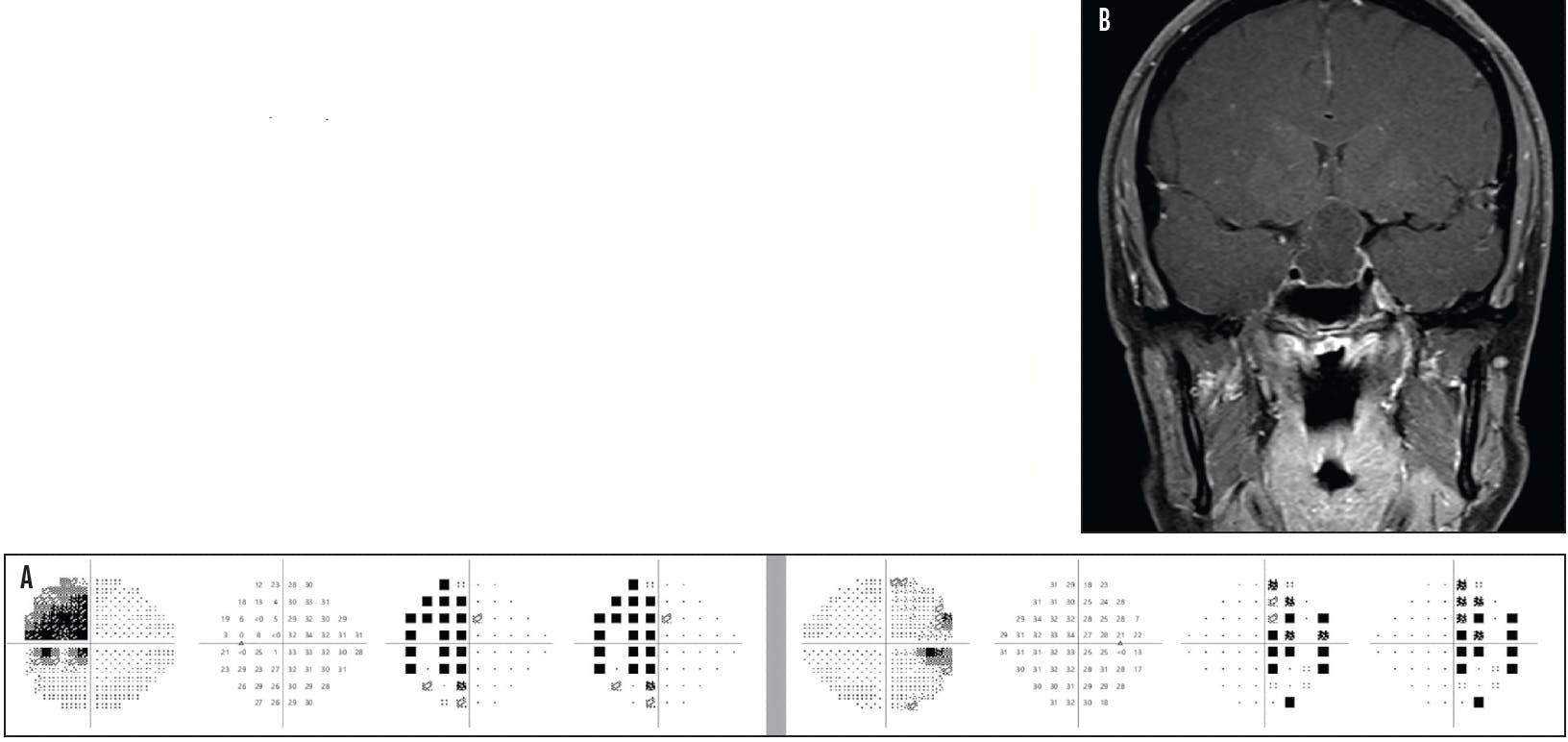
Figure 1. Humphrey visual field testing (Carl Zeiss Meditec) with the 24-2 Swedish interactive thresholding algorithm–Fast (SITA-Fast) demonstrates incomplete bitemporal hemianopia (A). A T1-weighted, postcontrast coronal MRI scan shows an arachnoid cyst with compression of the optic chiasm (B).
Although compressive lesions can present with associated symptoms such as headache, double vision, and proptosis, patients are often asymptomatic aside from a visual decline. Thus, it is important to maintain a high index of suspicion for compressive optic neuropathy in a patient with suggestive features. These individuals require an MRI of the brain and orbits with and without contrast, specifically with fat saturation sequences. Prompt neuroimaging may identify lesions that are amenable to treatment, which may improve not only the patient’s vision but also other neurologic outcomes.
An MRI is superior to a CT scan for the evaluation of soft tissue structures, such as the optic nerves, chiasm, and tracts in these cases. Because fat is typically bright on MRI studies, orbital fat may obscure more subtle lesions such as optic nerve sheath meningiomas; however, with fat saturation, this intrinsic signal is effectively suppressed, leading to improved detection of contrast-enhancing orbital tumors that would otherwise be hidden by fat.3
Communication with the reading radiologist is paramount, and the ordering physician should specify the precise reason for the MRI study in the order indication. For example, rather than list “vision changes” as the indication, request “attention to right optic nerve, concern for optic neuropathy.”4 This approach encourages the radiologist to review the pertinent structures carefully and reduces the risk that a causative lesion will be overlooked.
TOXIC OPTIC NEUROPATHY
Toxic optic neuropathy usually presents as gradually progressive bilateral optic neuropathies. These are commonly characterized by central or cecocentral field defects and occasionally by bitemporal field defects. When field defects are not classically glaucomatous, reviewing a patient’s current and past medications and inquiring about a history of ethanol and tobacco use can helpful.
Ethambutol may cause a progressive bilateral toxic optic neuropathy with central, cecocentral, or bitemporal field defects (Figure 2). Ethambutol optic neuropathy has an incidence of 1% to 5%. Generally occurring 2 to 8 months after initiation of the drug, the condition may lead to visual symptoms, commonly including early dyschromatopsia.5 Risk factors include diabetes mellitus, chronic renal failure, alcoholism, older age, concomitant ethambutol-induced peripheral neuropathy, and a daily dose of ethambutol exceeding 15 mg/kg.6,7 If ethambutol toxicity is suspected, communication with the prescribing physician to recommend urgent drug cessation is appropriate.

Figure 2. Humphrey visual field testing with the 24-2 SITA-Fast demonstrates bilateral cecocentral visual field defects secondary to ethambutol toxicity.
HEREDITARY AND NUTRITIONAL OPTIC NEUROPATHIES
Hereditary and nutritional optic neuropathies can present similarly to toxic optic neuropathy and should be considered if a patient has slowly progressive bilateral optic neuropathy and central or cecocentral scotomas.8 In this setting, a history of a parent with a slowly progressive visual decline may raise suspicion for dominant optic atrophy, whereas a history of conditions that may lead to malabsorption (eg, inflammatory bowel disease and bariatric surgery) or limited diets may increase suspicion for a nutritional optic neuropathy. If nutritional optic neuropathy is suspected, serum labs to check red blood cell folate, vitamin B12, and thiamine may help identify a treatable cause for the vision loss.
OPTIC DISC DRUSEN
Most patients with optic disc drusen are asymptomatic, but formal visual field testing often shows visual field loss that closely resembles glaucomatous visual field defects (ie, nasal steps or arcuate visual field defects; Figure 3A).9 Unlike the cupped appearance of a glaucomatous nerve, optic nerves with disc drusen usually appear full and sometimes elevated. The identification of drusen with biomicroscopy alone can sometimes be challenging. Enhanced depth imaging OCT is a powerful tool that can help identify these deposits (Figure 3B).10 Once the presence of drusen is confirmed, patients can be reassured that specific treatment typically is not required.
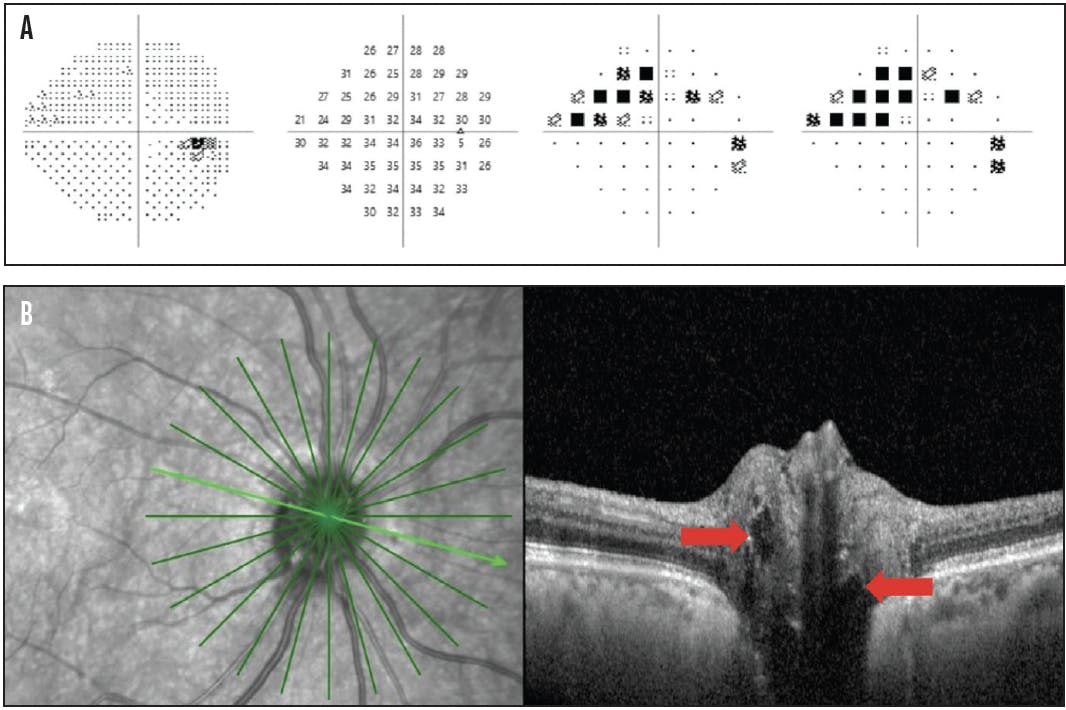
Figure 3. Humphrey visual field testing with the 24-2 SITA-Fast demonstrates a nasal step in the right eye (A). Enhanced depth imaging OCT (Spectralis, Heidelberg Engineering) shows optic disc drusen, as indicated by the red arrows (B).
CONCLUSION
Several nonglaucomatous optic neuropathies can mimic NTG, and each requires a specific treatment approach. In cases that are atypical for glaucoma, a careful review of the patient’s clinical history, visual acuity, color vision, and visual field pattern may raise suspicion for a possible mimic of NTG and prompt further imaging or laboratory evaluations.
1. Araie M. Pattern of visual field defects in normal-tension and high-tension glaucoma. Curr Opin Ophthalmol. 1995;6(2):36-45.
2. Waisberg E, Micieli JA. Neuro-ophthalmological optic nerve cupping: an overview. Eye Brain. 2021;13:255-268.
3. Jackson A, Patankar T, Laitt RD. Intracanalicular optic nerve meningioma: a serious diagnostic pitfall. Am J Neuroradiol. 2003;24(6):1167-1170.
4. Stunkel L, Newman-Toker DE, Newman NJ, Biousse V. Diagnostic error of neuro-ophthalmologic conditions: state of the science. J Neuroophthalmol. 2021;41(1):98-113.
5. Polak BC, Leys M, van Lith GH. Blue-yellow colour vision changes as early symptoms of ethambutol oculotoxicity. Ophthalmologica. 1985;191:223-226.
6. Mathur KC, Sankhla JS. Ophthalmic manifestations of the toxicity of ethambutol. Indian J Ophthalmol. 1976;24:6-9.
7. Lee EJ, Kim SJ, Choung HK, et al. Incidence and clinical features of ethambutol-induced optic neuropathy in Korea. J Neuroophthalmol. 2008 28:269-277.
8. Carey AR. Hereditary optic neuropathy. In: Henderson AD, Carey AR, eds. Controversies in Neuro-Ophthalmic Management. Springer; 2021.
9. Lee AG, Zimmerman MB. The rate of visual field loss in optic nerve head drusen. Am J Ophthalmol. 2005;139(6):1062-1066.
10. Malmqvist L, Bursztyn L, Costello F, et al. The Optic Disc Drusen Studies Consortium recommendations for diagnosis of optic disc drusen using optical coherence tomography. J Neuroophthalmol. 2018;38(3):299-307.