In March, a public advisory committee meeting of the FDA’s Ophthalmic Devices Panel of the Medical Devices Advisory Committee was held to discuss the FSYX Ocular Pressure Adjusting Pump (Balance Ophthalmics).1 This technology is indicated as adjunctive therapy for the reduction of IOP during nightly use in adult patients with open-angle glaucoma and IOP of 21 mm Hg or less. The Ocular Pressure Adjusting Pump is eligible for evaluation under the de novo classification based on its intended use and technological characteristics.
Balance Ophthalmics’ Founder and Chair John P. Berdahl, MD, began the meeting with an overview of the Ocular Pressure Adjusting Pump technology and its potential in glaucoma care. As Dr. Berdahl noted, approximately 2.3 million US individuals fall into Balance Ophthalmics’ target population of patients with open-angle glaucoma and IOP of 21 mm Hg or less. This population is difficult to manage, he explained, because most available treatments are less effective at lowering nocturnal IOP elevations, which are common in these patients and associated with glaucomatous progression. Furthermore, most therapies do not lower IOP effectively when it is less than 21 mm Hg, so better options are needed for normal-tension glaucoma.
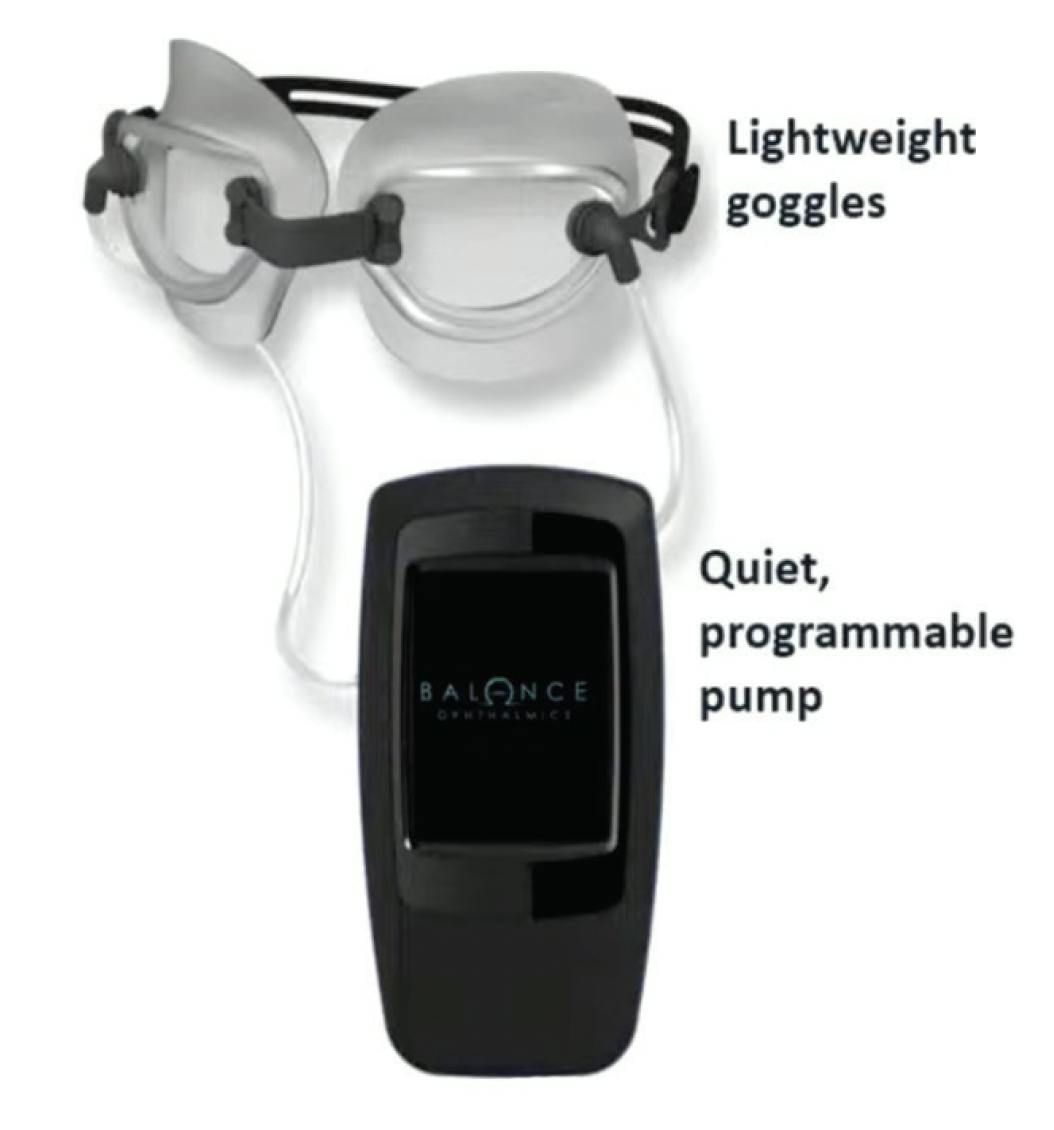
The Ocular Pressure Adjusting Pump is a nonsurgical, nonpharmaceutical, and noninasive removable device (Figure 1). The system includes a pair of lightweight goggles that apply negative pressure (NP) over the anterior eye. These goggles are attached to a quiet programmable pump that, with one button, holds NP within the goggles at a steady state. This NP can be applied to each individual goggle or bilaterally. If vacuum is lost, an audible beep sounds to notify the patient. The Ocular Pressure Adjusting Pump is designed to lower IOP during nightly use, when most IOP elevations occur, and can be used adjunctively alongside other treatments. Clinicians will receive data on patient compliance and device use.
In an overview of the technology’s function, Dr. Berdahl described to the committee how the weight of the atmosphere pressing over the eye is reduced by applying NP within the Ocular Pressure Adjusting Pump goggles, thereby reducing IOP. “This reduction is not one to one,” Dr. Berdahl noted. “The Ocular Pressure Adjusting Pump reduces IOP by about 40% to 60% of the [NP] applied because a new pressure-volume relationship is established.”
The company’s most recent investigation, the CONFIRM study, included 17 patients who were prepped for cataract surgery. Eyes were cannulated with a manometer to measure IOP every 0.5 seconds for five intervals: (1) baseline, (2) -10 mm Hg NP, (3) no NP, (4) -20 mm Hg NP, and (5) no NP. Each interval was about 30 seconds. After this sequence was complete, patients underwent cataract surgery.
Mean IOP data for all 17 patients demonstrated that the Ocular Pressure Adjusting Pump reduced IOP in a dose-response fashion (Figure 2). An NP of -10 mm Hg lowered mean IOP by 5.6 mm Hg, representing a 33% reduction, and an NP of -20 mm Hg lowered mean IOP by 7.7 mm Hg, representing a 51% reduction. “These manometrically measured IOP-lowering results are consistent with the measurements … from our clinical studies and confirm that we are addressing FDA’s question and actually lowering [IOP],” Dr. Berdahl said.
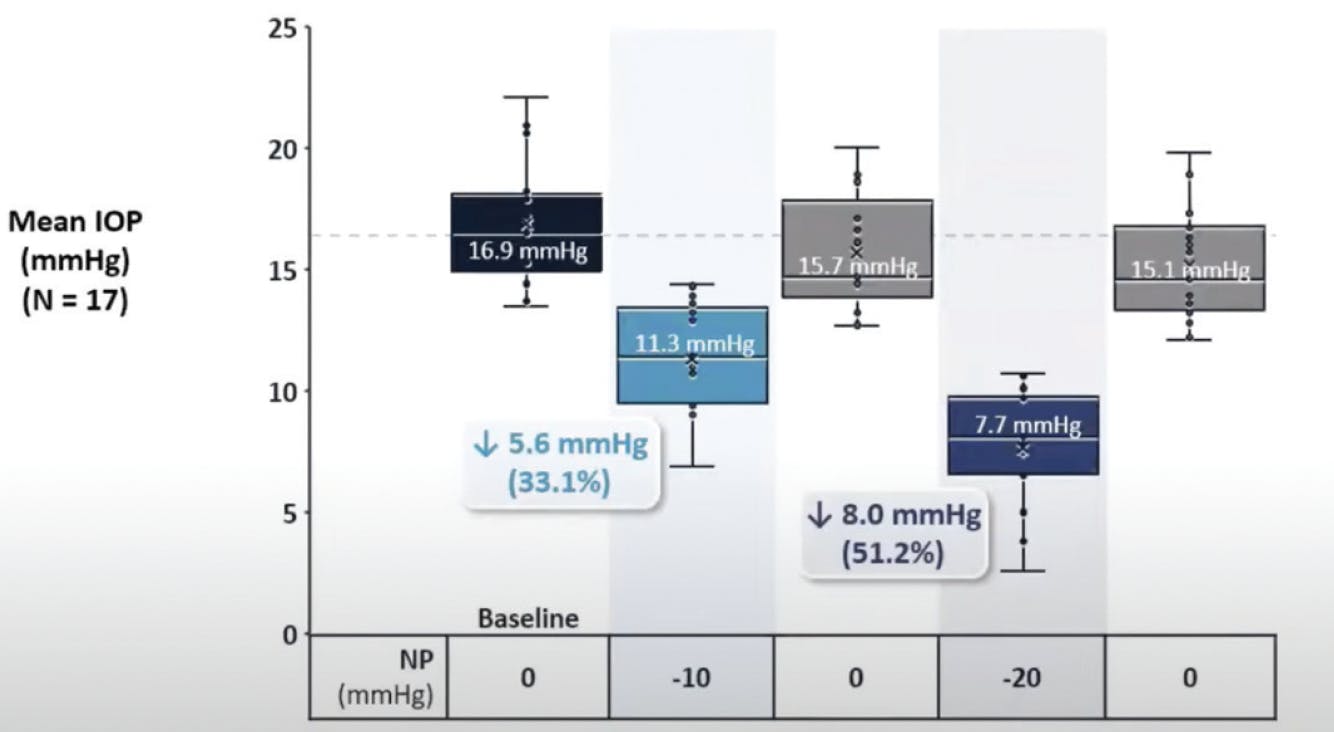
Figure 2. Mean IOP data for 17 patients in the CONFIRM study demonstrated that the Ocular Pressure Adjusting Pump reduced IOP in a dose-response fashion.
In addition to the CONFIRM study, the Ocular Pressure Adjusting Pump has been evaluated in two randomized controlled clinical trials (APOLLO and ARTEMIS), both of which showed about 8 mm Hg of IOP lowering to a mean IOP of approximately 12 mm Hg, which represented a 39% decrease.
In reference to the ARTEMIS study, Thomas Samuelson, MD, of Minnesota Eye Consultants, said, "The primary and secondary effectiveness endpoints were met, and notably the difference in IOP during device wear between the study and control eyes was even larger in the per protocol population, which is more representative of the real-world results because these are the patients who routinely wear the device." Dr. Samuelson continued, "I am unaware of any glaucoma treatment with such impressive and consistent effectiveness." Approximately 97% of patients in the sleep lab had more than a 20% reduction in IOP, and 100% of patients at all times points showed IOP lowering.
Because Goldmann applanation tonometry cannot be performed in a supine position or in a sealed, negative-pressure chamber environment, Dr. Berdahl noted that the Balance Ophthalmics team developed excursion goggles to measure IOP while maintaining the sealed NP environment during Ocular Pressure Adjusting Pump wear. With this approach, a Model 30 Pneumatonometer probe (Reichert Technologies) is brought into contact with the corneal surface across a Tonopen cover within a sealed cartridge and objectively displays IOP dynamically.
Additional studies have shown that the physiological response to the Ocular Pressure Adjusting Pump is consistent with lowering IOP. Although relatively small, Dr. Berdahl noted that exploratory work shows that, with NP application, investigators have found an increase in blood flow,2 an increase in the percent area perfused and capillary density,3 improvement in pattern ERG,4 and improvement in metabolic function.5 Overall, the Ocular Pressure Adjusting Pump has been evaluated in 23 studies (12 clinical and 11 nonclinical) with consistent safety and effectiveness results. Sixteen peer-reviewed publications have been published, and a total of 634 study and control eyes of 378 patients have been evaluated.
While reviewing the company’s regulatory history, Dr. Berdahl said, “In [August 2023], we submitted a new de novo application that included complete 12-month data from the ARTEMIS trial as well as a narrowed indication and requested that this panel meeting be convened to determine if the likely benefits outweigh the likely risks of [the] Ocular Pressure Adjusting Pump for this indication. The CONFIRM study was … conducted in [December 2023] in response to an additional information request from FDA.”
After a thorough review of the safety and effectiveness of the Ocular Pressure Adjusting Pump, the panel’s consensus was that the probable benefits of the device outweigh the probable risk for patients who meet the proposed criteria. This conclusion was unanimous.
During the committee meeting, Leon Herndon, MD, of Duke Eye Center, commented, "There is a significant unmet need for additional and adjunctive treatments to lower IOP in patients who have open-angle glaucoma and an IOP of 21 mm Hg or less. IOP increases at night in most glaucoma patients, especially those with normal daytime pressure, and that nocturnal elevation is associated with progressive vision loss."
Dr. Herndon continued, "Most therapies have minimal impact on the nocturnal IOP elevations and limited effect in patients with IOP less than 21 mm Hg. We need treatment options that can be used adjunctively to reduce patients’ pressure with normal daytime IOP and that can specifically reduce their IOP at night when [they] are most at risk of a peak in pressure."
Editor's note: On June 28, Balance Ophthalmics announced that the FDA granted de novo classification to the FYSX Ocular Pressure Adjusting Pump. Read more here.
1. Ophthalmic Devices Panel of the Medical Devices Advisory Committee. March 21, 2024. Accessed June 1, 2024. www.youtube.com/live/-MtrgURZTFs?feature=shared
2. Hashimoto R, Al-Share Z, Duvdevan-Strier N, Full JM, Nellis J, Kardon R. Autoregulation of blood flow in the human retina, optic nerve, and choroid in response to active decrease in intraocular pressure using novel vacuum goggles. Invest Ophthalmol Vis Sci. 2020;61:1735.
3. Kamalipour A, Moghimi S, Inpirom VR, Mahmoudinezhad G, Weinreb RN. Multipressure dial goggle effects on circumpapillary structure and microvasculature in glaucoma patients. Ophthalmol Glaucoma. 2022;5(6):572-580.
4. Kudrna JJ, Ferguson TJ, Swan RJ, et al. Short-term steady-state pattern electroretinography changes using a multi-pressure dial in ocular hypertensive, glaucoma suspect, and mild open-angle glaucoma patients: a randomized, controlled, prospective, pilot study. Ophthalmol Ther. 2020;9(4):981-992.
5. Sun MT, Beykin G, Lee WS, et al. Structural and metabolic imaging after short-term use of the Balance Goggles System in glaucoma patients: a pilot study. J Glaucoma. 2022;31(8):634-638.