As with any new treatment option, a common question regarding sustained-release drug delivery for glaucoma is, “Who is an ideal candidate?” Ophthalmologists may want to cherry pick cases for this approach, but I consider it for a range of patients—from those newly diagnosed with ocular hypertension to those who continue using topical drops after glaucoma surgery. Sustained-release drug delivery provides an opportunity to improve the health of the ocular surface, cosmesis, and patients’ quality of life as well as to provide a better procedural outcome by yielding more consistent IOP lowering.
Case Study
A 63-year-old man presented with a complicated ocular history that included steroid-induced glaucoma, retinal detachment in the left eye, tube shunt surgery in the left eye, and selective laser trabeculoplasty in both eyes.
For years before his first visit with me, the patient had been in the care of a glaucoma specialist who had been vocal about his opposition to sustained-release drug delivery. The patient's IOP had been controlled with topical drops after the aforementioned tube shunt and selective laser trabeculoplasty procedures.
Ultimately, he developed an allergy to brimonidine and became unhappy with the appearance of his eyes (Figure A). When I presented the option of sustained-release drug delivery, he responded negatively, having been influenced by his previous eye care provider. However, after speaking with the patient about my experiences with this treatment approach and describing the patients I have treated with the technology, he felt more open to the option.
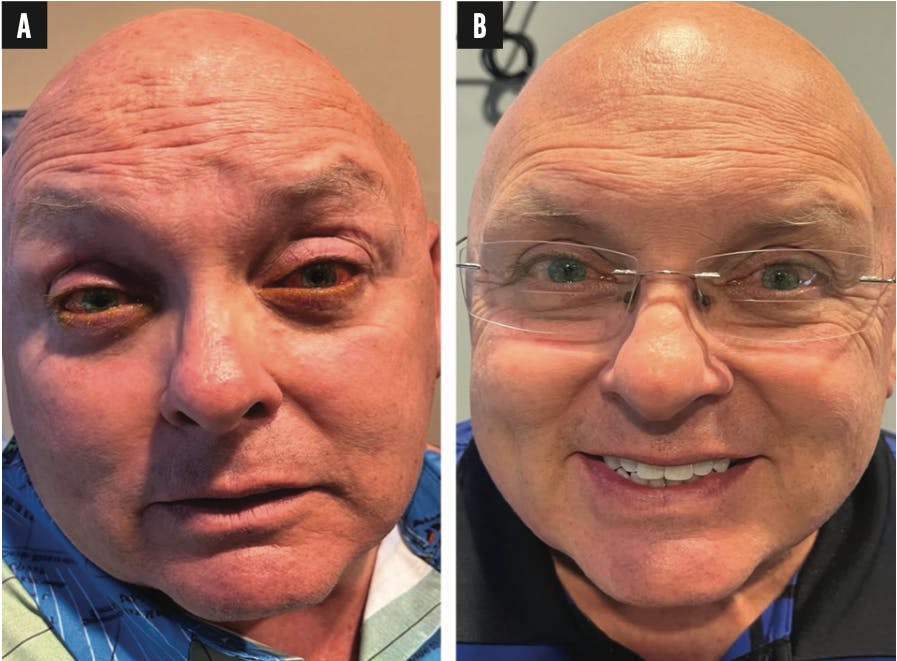
Figure. The patient had developed an allergy to brimonidine and was unhappy with the appearance of his eyes (A). One year after the placement of an intracameral bimatoprost implant, he continues to look and feel dramatically different (B).
An intracameral bimatoprost implant (Durysta, AbbVie) was implanted in the patient’s first eye, and brimonidine therapy was stopped. One week later, a bimatoprost implant was placed in the second eye. One year post procedure, the patient continues to look and feel dramatically different than he did preoperatively (Figure B). His IOP has remained in the low teens without the use of topical drops.
Drug Delivery in the Practice
About 2 years ago, I moved to a new practice and took over the care of many patients with prescriptions for multiple classes of glaucoma medication. I came in with a new approach sustained-release drug delivery—to attempt to minimize their medication burden. The response from both staff members and patients has been overwhelmingly positive. The staff is relieved to be less burdened with prior authorizations from managing fewer prescriptions.
I have also seen firsthand how patients can benefit from this treatment option. Even for a couple of patients administering generic latanoprost, I opted for sustained-release drug delivery simply to achieve better IOP control and later realized that the latanoprost had been causing significant ocular redness. This experience has reminded me of the importance of pausing during every encounter to ask patients how they feel instead of assuming that they are doing well and are pleased with their topical drop therapy.
Incorporating sustained-release drug delivery does not require a dramatic shift in practice workflow. I prefer to keep my practice patterns consistent to streamline processes for my staff. The first eye is treated, followed by the second eye a couple of days to 1 week later. I see the patient around 4 to 6 weeks after treatment and typically again for a routine 4-month follow-up visit.
Conclusion
Sustained-release drug delivery is helping to optimize the standard of care in glaucoma. Fear may prohibit some from embracing this new technology. The key is to gain enough direct experience to be able to tell patients with conviction that this treatment option can be used to control their disease and improve their quality of life.