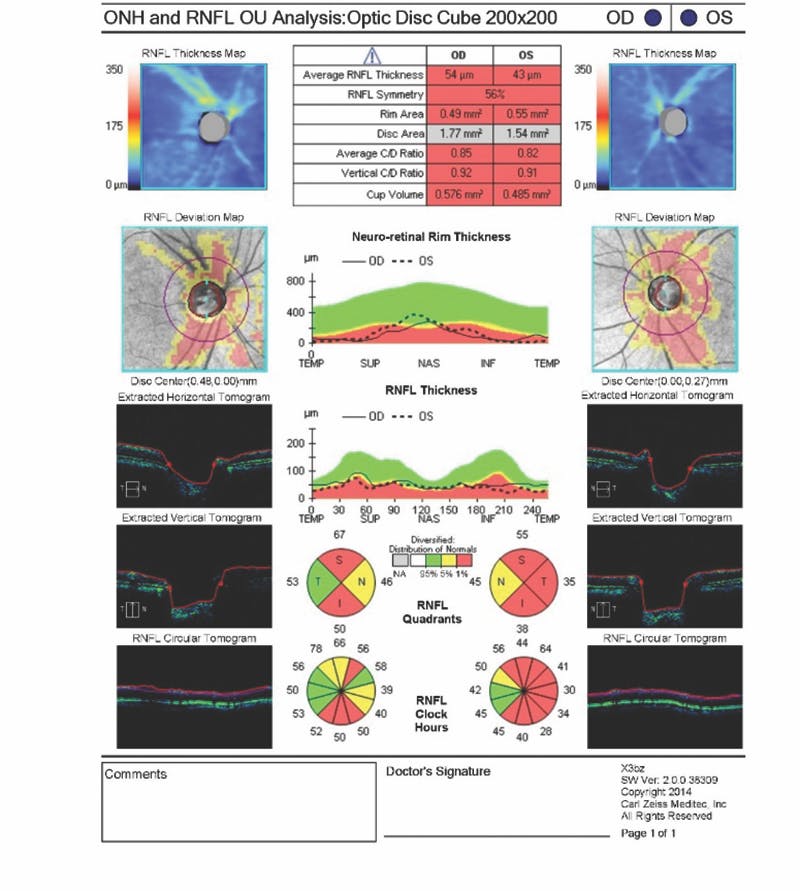
A 68-year-old White woman with a history of severe primary open-angle glaucoma was referred for an evaluation. Her BCVA was 20/20 OU, and her IOP measured 14 mm Hg OU with Goldmann applanation tonometry. Central corneal thickness was 556 µm OD and 544 µm OS. Humphrey visual field testing (Carl Zeiss Meditec) demonstrated dense superior arcuate defects and possible central involvement in both eyes. OCT imaging showed significant retinal nerve fiber layer loss, with superior, inferior, and temporal thinning of both optic nerves (Figures 1 and 2).
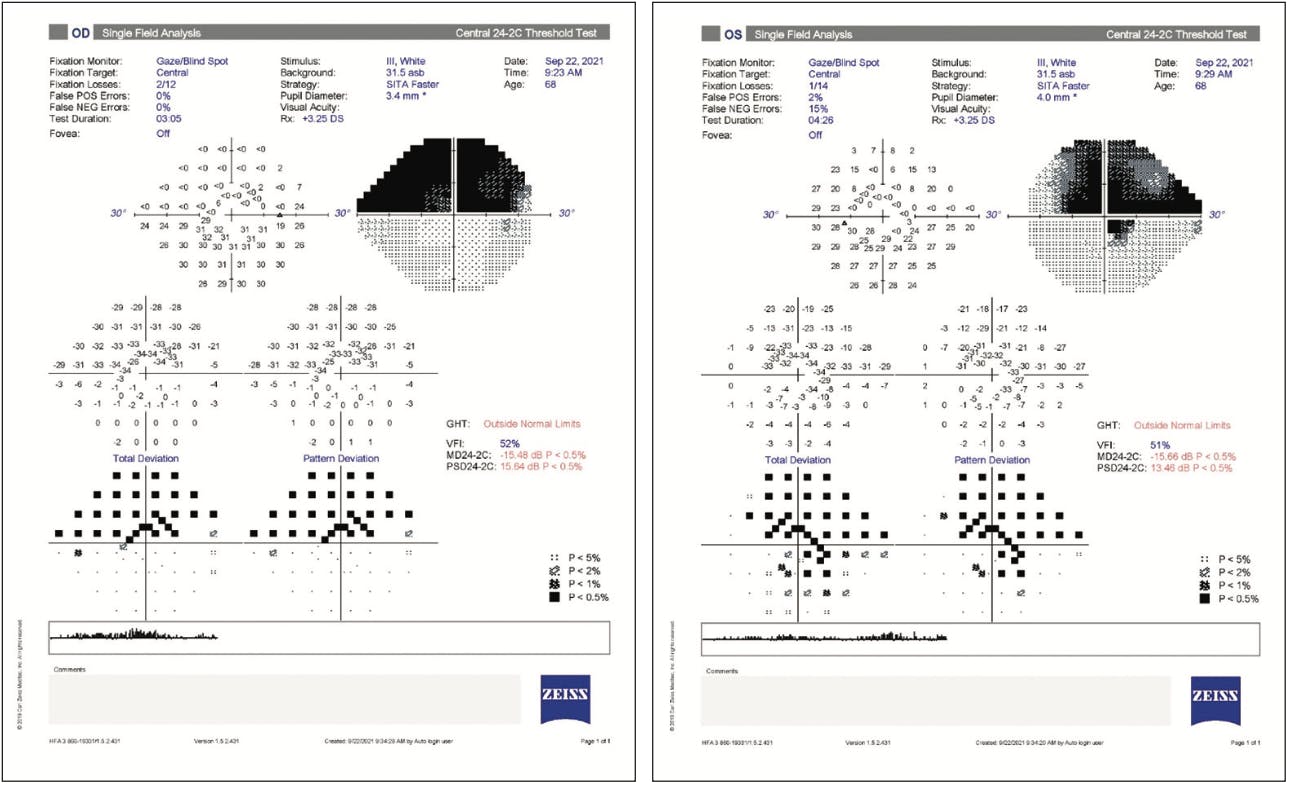
Figure 1. Humphrey visual field testing demonstrated dense superior arcuate defects in both eyes as well as possible central involvement.
The patient’s glaucoma was initially managed with a fixed combination of timolol and dorzolamide (Cosopt, Mundipharma Ophthalmology Products) twice daily and a fixed combination of netarsudil and latanoprost (Rocklatan, Alcon) once daily at bedtime, with both agents administered bilaterally. Although her IOP was controlled, she experienced significant hyperemia, tearing, photosensitivity, and blurry vision. An anterior segment examination demonstrated conjunctival injection and punctate epithelial erosions (Figure 3A). The ocular surface symptoms persisted despite a switch to preservative-free topical therapy and aggressive lubrication. She was offered surgical glaucoma management but preferred less invasive treatment.
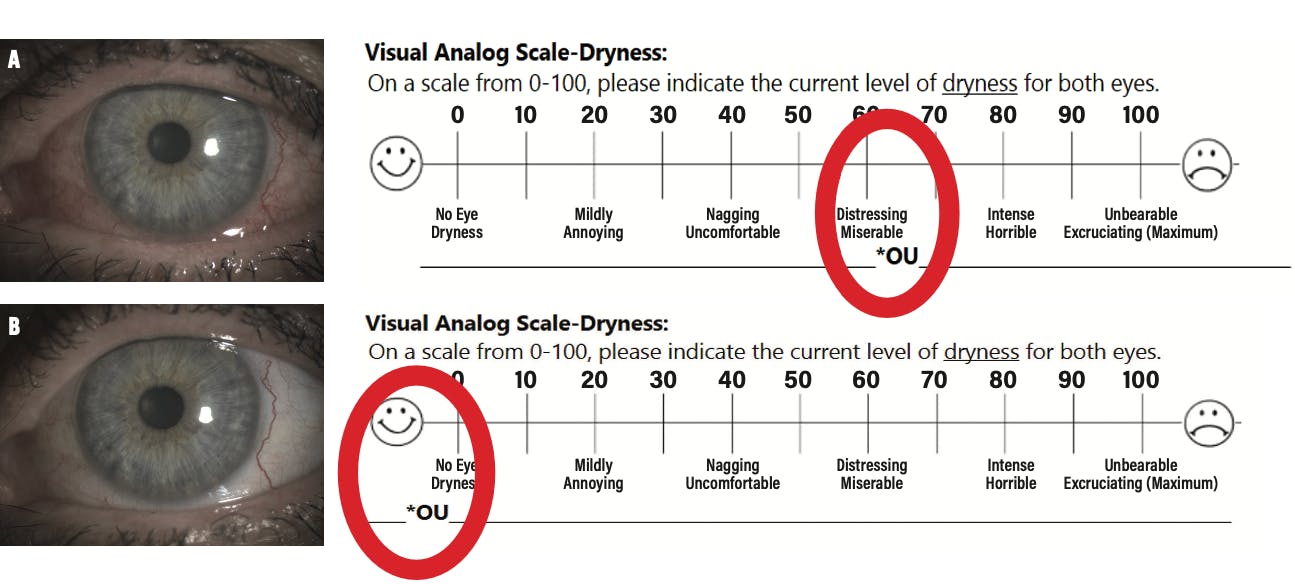
Figure 3. A slit-lamp photograph demonstrating diffuse conjunctival injection and ocular surface irritation due to topical drop usage, with distressing levels of dryness indicated on visual analog scale testing (A). A slit-lamp photograph demonstrating resolution of the ocular surface injection and irritation after topical therapy ceased and an improvement in subjective dryness symptoms on visual analog scale testing (B).
The patient underwent placement of a sustained-release bimatoprost implant (Durysta, AbbVie), followed by selective laser trabeculoplasty (SLT) 1 month later. The bimatoprost implant was chosen as the initial treatment because its onset of action is shorter than that of SLT, resulting in earlier IOP lowering. The patient’s IOP remained controlled with the bimatoprost implant for the next 6 months, significantly decreasing her topical drop burden and improving her ocular surface symptoms (Figure 3B). Per our standard protocol for sustained drug delivery, the patient was evaluated every 3 to 4 months for waning therapeutic efficacy.
Discussion
The reported prevalence of dry eye disease (DED) in patients with glaucoma ranges from 5% to 50%.1,2 Glaucoma patients with DED are generally less adherent to prescribed therapy than those without DED (63% vs 89%).3 DED may therefore play a pivotal role in glaucoma management, guiding therapeutic decisions and affecting patient quality of life. In this situation, and especially for patients deferring incisional surgery, combining a sustained-release implant and SLT can offer a powerful approach to controlling IOP while minimizing or eliminating topical agents.
1. Erb C, Gast U, Schremmer D. German register for glaucoma patients with dry eye. I. Basic outcome with respect to dry eye. Graefes Arch Clin Exp Ophthalmol. 2008;246(11):1593-1601.
2. Schmier JK, Covert DW. Characteristics of respondents with glaucoma and dry eye in a national panel survey. Clin Ophthalmol. 2009;3:645-650.
3. Nijm LM, Schweitzer J, Blackmore JG. Glaucoma and dry eye disease: opportunity to assess and treat. Clin Ophthalmol. 2023;17:3063.