Patients with glaucoma who struggle to adhere to their medication regimens typically can be divided into two categories: (1) those whose disease progresses to visual impairment in their lifetime and (2) those whose disease remains stable or who have such a slow rate of visual field deterioration that there will be no functional loss in their lifetime.
A 76-year-old man with worsening visual field loss had been treated with glaucoma medications for more than 15 years. He underwent gonioscopy- assisted transluminal trabeculotomy, which stabilized his disease for more than 4 years despite poor clinical follow-up. When he returned to the clinic 8 years after his initial surgery, he reported a subjective worsening of vision, although his visual acuity measured 20/25 OU. His IOP readings were near 40 mm Hg OU, and, after a few subsequent IOP checks, it became clear that he was still noncompliant with his medication regimen. The IOP graph shown in Figure 1 demonstrates sparse periods of IOP checks followed by closely spaced clinic visits as he became symptomatic from his disease.

Figure 1. The patient’s IOP graph demonstrated sparse periods of IOP checks followed by closely spaced clinic visits when he was symptomatic from his disease.
OCT imaging of his optic nerve showed such severe retinal nerve fiber layer loss that only the nasal quadrant might have been clinically useful for following disease progression (Figure 2). Over the course of 5 years, his visual field testing showed progression with central islands remaining (Figure 3).
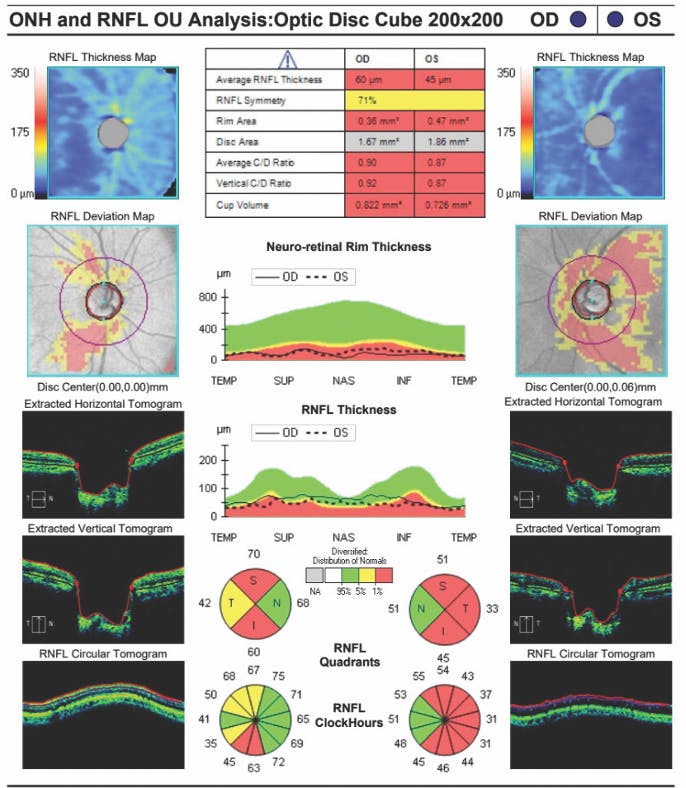
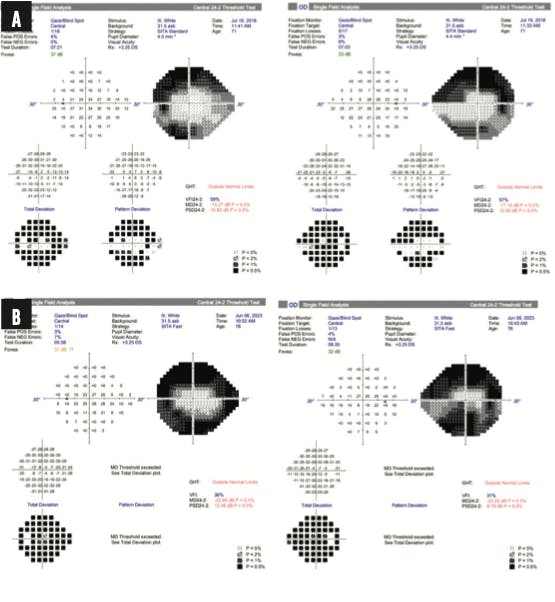
Figure 3. Visual field testing showed progression from 2018 (A) to 2023 (B) with central islands remaining.
Given the poor clinical follow-up, this patient was not a good candidate for trabeculectomy. With his worsening glaucomatous visual field loss and poor compliance with prescribed medical therapy, nonvalved tube shunt surgery was discussed with him. Prospective data have shown that individuals who receive nonvalved tube shunts generally still must administer glaucoma medications to maintain their target IOP.1 The patient therefore underwent non- valved tube shunt surgery with simultaneous implantation of a travoprost intracameral implant 75 µg (iDose TR, Glaukos). At 6 months postoperatively, the patient’s IOP was 11 mm Hg without the need for glaucoma medication. The same procedure is planned for the contralateral eye.
The use of drug delivery implants should not be restricted to the management of early glaucomatous disease even though this patient population was the one studied in the landmark clinical trials. When used appropriately, sustained drug delivery may also be an option for individuals with refractory glaucoma and for whom traditional glaucoma surgery (not MIGS) is planned.
1. Budenz DL, Barton K, Gedde SJ, et al. Five-year treatment outcomes in the Ahmed Baerveldt Comparison study. Ophthalmology. 2015;122(2):308-316.