AT A GLANCE
- When contemplating cyclodestructive procedures for the primary treatment of primary open-angle glaucoma (POAG), points to consider include the treatments’ effect on aqueous outflow, their effectiveness in washout studies, and whether any randomized controlled trials have supported their use for POAG.
- Data from two washout studies showed that high-intensity focused ultrasound and micropulse laser treatments did not affect aqueous outflow and resulted in less than a 10% reduction in washout IOP at 3 to 6 months postoperatively.
- The CONCEPT study is a randomized controlled trial to explore the use of a ciliary body treatment for POAG in patients with cataract, and 1-year results seemed to favor the use of endoscopic cyclophotocoagulation.
Cyclodestructive procedures can be successful in certain scenarios, such as diode laser cyclophotocoagulation for the treatment of neovascular glaucoma. However, the term cyclodestructive, referring to procedures that reduce aqueous humor production by destroying the ciliary body epithelium and thereby lowering IOP, may instill a feeling of fear, particularly when considered as a primary treatment for primary open-angle glaucoma (POAG). Should ophthalmologists fear the use of cyclodestructive procedures in patients with POAG?
In addition, do cyclodestructive treatments improve aqueous outflow? How effective have high-intensity focused ultrasound (HIFU) and micropulse transscleral cyclophotocoagulation laser treatments been in washout studies? Have any randomized controlled trials supported the use of these therapies for POAG?
Data from two recent studies may help begin to answer these questions.
EFFECTS OF CYCLODESTRUCTIVE PROCEDURES
Antiglaucoma medications such as timolol, apraclonidine, brinzolamide, and acetazolamide have been reported to have an 87% cumulative effect on aqueous suppression.1 If, in clinical practice, many patients experience more than a 50% suppression of aqueous production with two or three aqueous-suppressing medications, then a cyclodestructive procedure that reduces aqueous production by 50% should not be something to fear.
Do HIFU and micropulse laser treatments increase aqueous outflow? Investigators evaluated the uveoscleral outflow pathways of patients with refractory glaucoma and observed suprachoroidal changes after HIFU. Specifically, anterior segment OCT and in vivo confocal microscopy showed increased intrascleral cystic spaces and an enlarged suprachoroidal space as a proxy for increased uveoscleral outflow.2 Additionally, a video presented by Murray Johnstone, MD, in 2018 showed contractions of the trabecular meshwork after micropulse laser treatment in an ex vivo eye (see Watch Now).
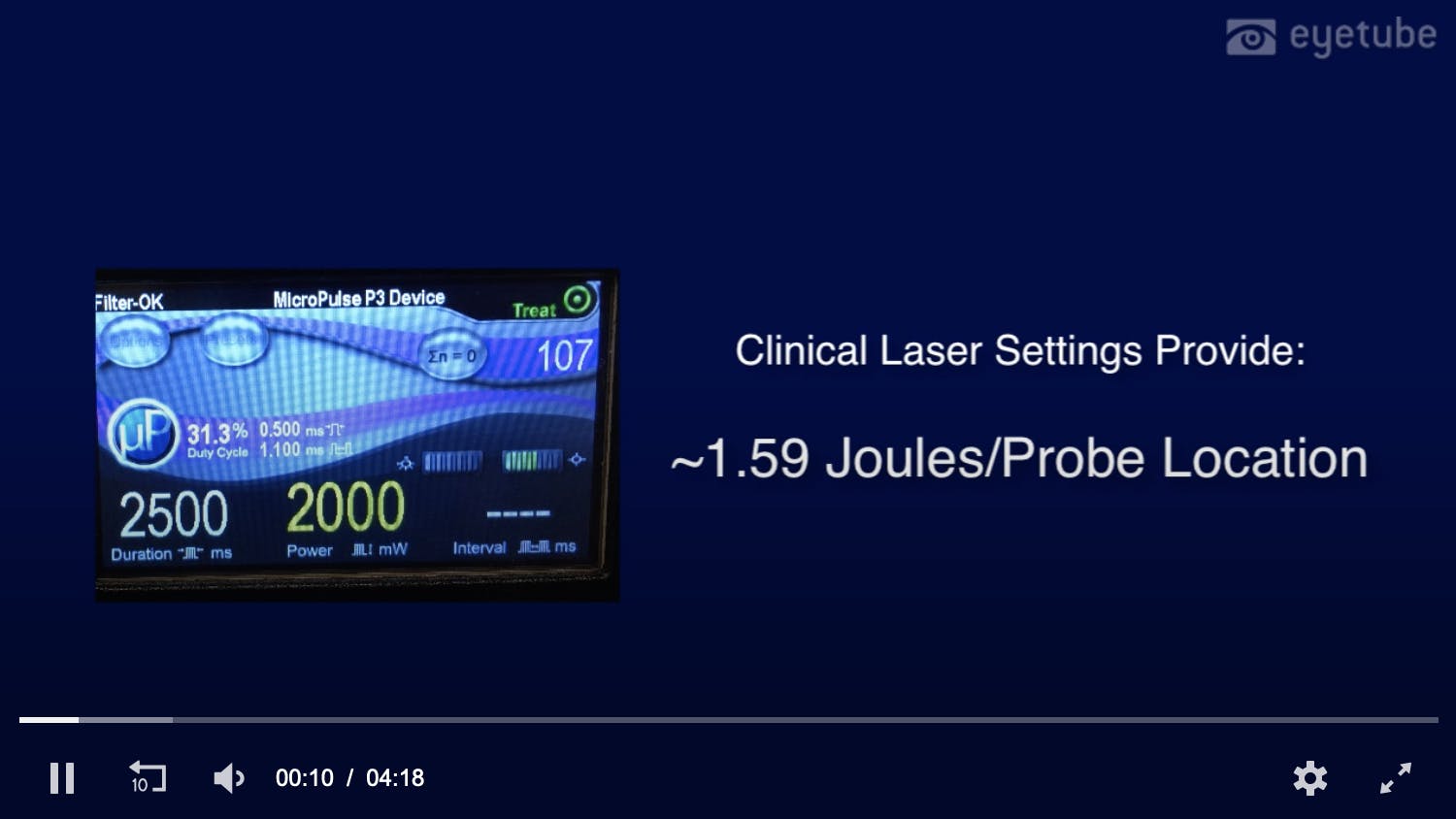
Transcleral Micropulse Laser Dynamically Alters Ciliary Muscle and Aqueous Outflow Pathways
Theoretically, HIFU and micropulse laser treatments may lead to increased trabecular or uveoscleral outflow, but is this the clinical reality?
RESEARCH ON HIFU AND MICROPULSE TREATMENTS
At St. Thomas’ Hospital, my colleagues and I have conducted many research studies on aqueous dynamics using (1) digital Schiotz tonography to measure trabecular outflow and (2) fluorophotometry to measure aqueous production. We conducted two separate washout studies in which all patients had POAG, were phakic, and received standalone treatment, thus avoiding any effects of cataract surgery on measurements. In the first study, patients received HIFU, and in the second study, patients received micropulse laser therapy. Following the washout period, patients’ baseline measurements were taken, and treatment was administered. Medication washout was done at 3 to 6 months, and then the measurements were taken again.
Effects on Aqueous Humor Dynamics
HIFU purely suppresses aqueous production—the treatment has no effect on tonographic outflow facility or uveoscleral outflow.3 Our study found that the aqueous flow rate (2.08 μL/min at baseline) was reduced by 16% at 3 months postoperatively.
Our study of micropulse laser therapy, which has not yet been published, showed similar results. The treatment had a significant effect only on aqueous flow rate, which was 2.34 μL/min at baseline and 1.74 μL/min at 6 months, representing a 26% reduction. No change in the trabecular and uveoscleral outflow pathways was observed.
Based on these findings, we concluded that HIFU and micropulse laser treatments of the ciliary body caused a reduction in aqueous production but did not affect either outflow pathway.
IOP Reduction in Washout Studies
In our washout studies, we found less than a 10% reduction in washout IOP at 3 to 6 months postoperatively. One problem with the HIFU study3 was the large number of treatment failures (and therefore patients who were unable to undergo washout); at 1 month postoperatively, five patients were administering three or four medications, including acetazolamide (Diamox, Wyeth Pharmaceuticals), due to increased IOP. With that considered, HIFU yielded a 7% reduction in IOP, from 30.2 mm Hg at baseline to 28.0 mm Hg at 3 months postoperatively. In the micropulse study, patients achieved a 10% reduction in IOP, from 25.08 mm Hg at baseline to 22.56 mm Hg at 6 months postoperatively.
Randomized Controlled Trials to Support the Treatment of POAG
The CONCEPT study is a double-blind randomized controlled trial designed to compare the effectiveness of phacoemulsification plus endoscopic cyclophotocoagulation (ECP) with phacoemulsification alone for the treatment of POAG in patients with cataract.4 This study included only patients with early to moderate OAG and cataract. Washout IOP was recorded at baseline, 1 year, and 2 years. A total of 162 participants were randomly assigned 1:1 to undergo phacoemulsification alone or phacoemulsification plus ECP.
Our latest data confirmed the effectiveness of cataract surgery for lowering IOP. Nearly all the data points at 12 months, whether for phacoemulsification alone or phacoemulsification plus ECP, demonstrated a lower IOP compared with baseline. In the phaco-only group, the median IOP was 19 mm Hg at the 1-year washout visit compared with 24.5 mm Hg at baseline. In the ECP arm, the median IOP was 17.5 mm Hg at the 1-year washout visit compared with 25 mm Hg at baseline. A significant reduction in IOP was therefore achieved in patients who underwent phacoemulsification plus ECP versus phacoemulsification alone. The median reduction of IOP at 12 months postoperatively was statistically significant in favor of ECP.
CONCLUSION
It is not necessary to fear the earlier use of ciliary body treatments for POAG, because they are likely to be safe. In clinical practice, ophthalmologists routinely suppress more than 50% of aqueous production with medication. Ciliary body treatment is unlikely to affect aqueous outflow pathways, and HIFU and micropulse treatments have been shown to yield less than a 10% reduction in IOP in washout studies.3 The CONCEPT study4 is the first randomized controlled trial to explore the use of a ciliary body treatment for POAG in patients with cataract, and 1-year results seem to favor the use of ECP.
1. Brubaker RF. Flow of aqueous humor in humans [The Friedenwald Lecture]. Invest Ophthalmol Vis Sci. 1991;32(13):3145-3166.
2. Mastropasqua R, Agnifili L, Fasanella V, et al. Uveo-scleral outflow pathways after ultrasonic cyclocoagulation in refractory glaucoma: an anterior segment optical coherence tomography and in vivo confocal study. Br J Ophthalmol. 2016;100(12):1668-1675.
3. Alaghband P, Galvis E, Ramirez A, et al. The effect of high-intensity focused ultrasound on aqueous humor dynamics in patients with glaucoma. Ophthalmol Glaucoma. 2020;3(2):122-129.
4. Sherman T, Rodrigues IAS, Goyal S, et al. Comparing the effectiveness of phacoemulsification + endoscopic cyclophotocoagulation laser versus phacoemulsification alone for the treatment of primary open angle glaucoma in patients with cataract (CONCEPT): study methodology. Ophthalmol Glaucoma. 2023;6(5):474-479.