


In 1830, a German anatomist by the name of Fredrich Schlemm first defined Schlemm’s canal (SC), which is located directly against the juxtacanalicular area of the trabecular meshwork (TM) that encircles the cornea.1 A great deal of work to define the anatomic and functional characteristics of this structure has been undertaken since then.
Signal differentiation molecules identified during SC development appear to imply that it may be vascular in origin, however, some molecular signaling factors seem to indicate partial lymphatic differentiation in terms of function.1 This transient lymphatic identity permits the proper function of SC in providing aqueous humor homeostasis.2,3
Physiologic arterial, venous, and capillary stability depends to a high degree on their endothelial health. Shear stress is an essential mechanical force that helps to maintain endothelial cell survival, without which the process of endothelial apoptosis begins; this leads to protrusion of the apoptotic endothelium into the vessel lumen, subsequent occlusion, and eventual involution of these vessels.4 “String vessels”, or an empty basement membrane tube, are markers of the previous existence of these ‘dead’ capillaries.5 Although the collector channels experience partial functional lymphatic differentiation, they share an origin with vascular structures; there is an analogous regression process with involution of vessels that is found in the distal outflow system of eyes with advanced glaucoma.6,7
With SC exhibiting functional lymphatic attributes, how then is intraocular pressure (IOP) maintained by the lymphatic-like complex of SC coupled with the TM? Present day research now supports that aqueous outflow and IOP homeostasis are highly dynamic, lymphatic-like, and pump-dependent. The discovery of valves and a tethering system, as well as pulsatile flow and shear stress that regulate aqueous outflow, are relatively recent important findings.8

The lumen of SC experiences pressure gradients from IOP externally, favoring closure of the lumen. The outflow system, therefore, requires unique adaptations to ensure that the SC lumen remains patent; this involves a number of processes that tether the TM lamellae, juxtacanalicular (JXT) cells, SC endothelium, and SC inner wall. This tethering system is fundamental to the aqueous outflow pump model and its ability to sense and control IOP.8
SC inlet valves arise from the SC inner wall endothelium, cross SC to the external wall, and are continuous with the JXT space of the TM (Figure 1; A). Aqueous passes from the anterior chamber to trabecular lamellae and into the JXT space. Tube-like SC inlet valves provide aqueous entry into the canal and are continuous with SC endothelium. The SC inlet valve connections link the TM to the hinged, mobile SC outlet valve. These outlet valve leaflets at the collector channels then control aqueous exit from SC (Figure 1; B).8
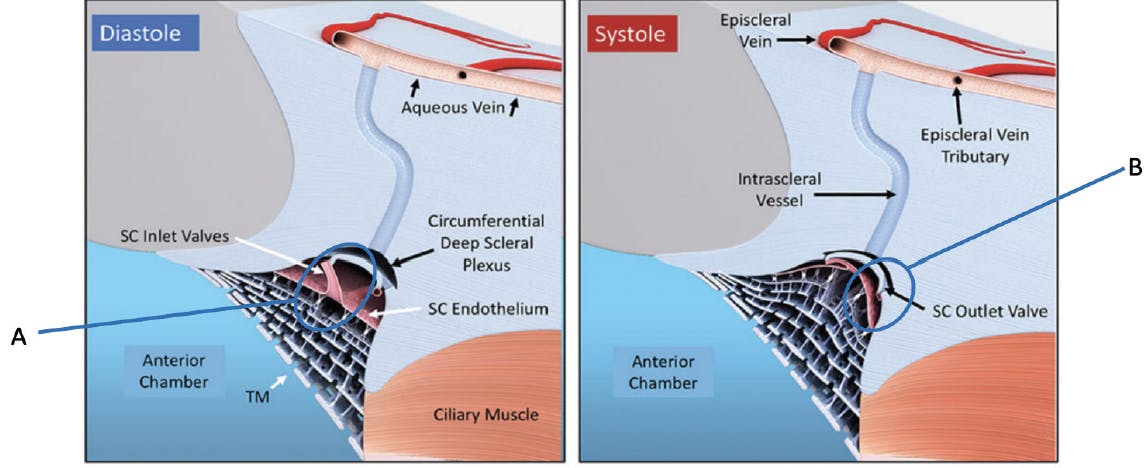
Figure 1. Pulsatile nature of aqueous flow driven by pressure changes in systole and diastole in the cardiovascular cycle (A); SC inlet and outlet valves shown (B). Adapted from Johnstone et al, 2021.8
Intrascleral vessels exit a circumferentially oriented deep scleral plexus (CDSP) and pass through sclera to the episcleral and aqueous veins. There are long, thin layers of collagenous tissue that appear as septa between SC and CDSP. Septal movement functions to result in a pressure-dependent compressible chamber by causing the lumen of the CDSP to open and close.8 Aqueous then returns to the vascular system as it flows from SC through collector channels into scleral channels, then into aqueous-filled veins. It then joins and mixes with blood-filled episcleral veins in a pulsatile manner (see the video, Pulsatile Flow Into The Aqueous Veins - Why It Happens, How To Recognize It, by visiting this link).8
TM stiffness is a key factor in the pathologic changes in glaucoma. This stiffness distends the TM outward towards the SC outer wall and leads to decreased motion and persistent SC wall apposition, adhesion, and herniation into collector channels as glaucoma progresses. Changes in cellularity and extracellular matrix elements are also associated with the glaucoma process.9 These include proliferation and swelling of endothelial cells, degeneration of collagen surrounding the channels, and obliteration of the distal channel lumen. As the TM loses its ability to withstand distending forces in glaucoma, this also results in decreased pulsatile aqueous flow with eventual loss of all TM motion.10 Restoration of the pulsatile flow can lead to transient recovery of TM motion.11
With this information in mind, it is important to consider how a selected treatment can affect the natural physiology of the TM and SC and its effect on overall long-term IOP-control efficacy.
Cataract Surgery
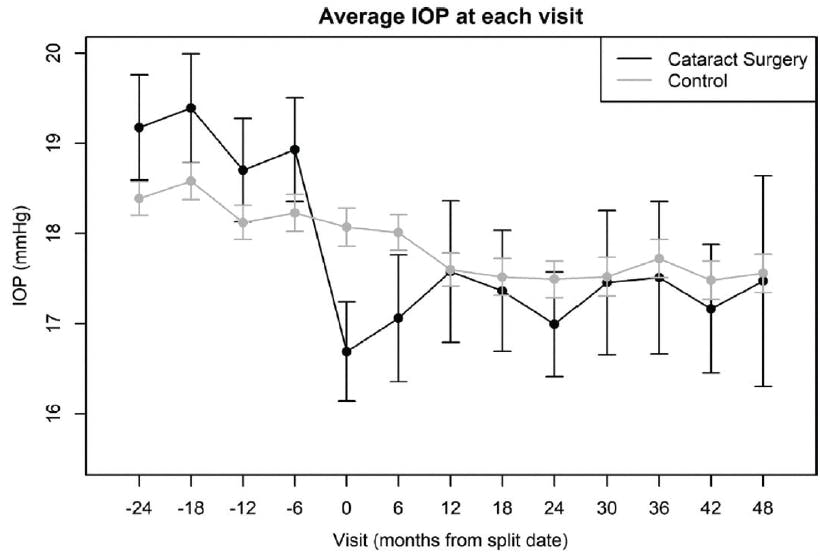
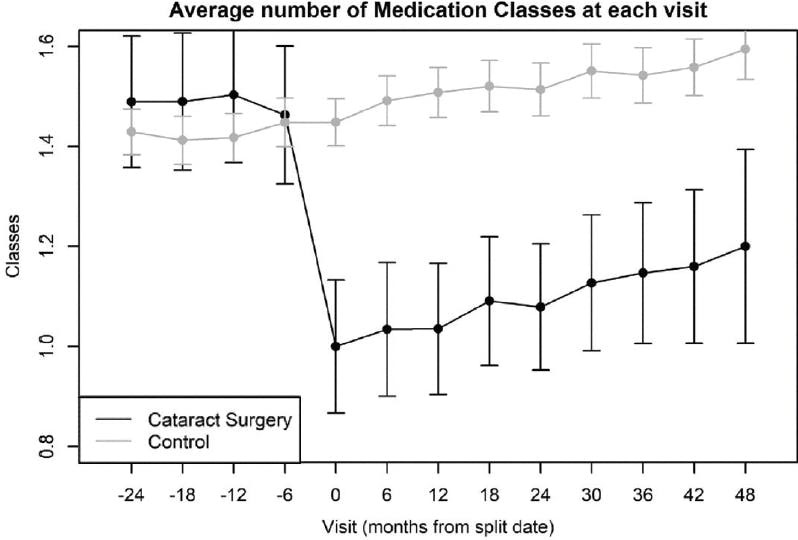
As the lens ages, it hardens, becomes opaque, and expands. These anatomic changes can have a significant effect on angle closure with subsequent ocular hypertension and glaucoma.12 With regards to its effect on SC, cataract surgery (CS), using OCT imaging, has been shown to substantially dilate SC, and this, in addition to its ability to reopen the angle structures of closed or narrow-angle eyes, may be the mode by which its clinical ability to reduce IOP may be derived.13,14 Using data from the Ocular Hypertension Treatment Study (OHTS), Mansberger et al compared the effect of CS on the IOP and medication outcomes of eyes in the medication group.15 There appears to be postoperative reduction, then return of IOP after 12 months to an IOP stabilization of up to 48 months in the CS group when compared to the medication (control) group (Figure 2). The total number of medication classes decreased postoperatively in the CS arm; however, the slope of the curve for the number of medication classes after CS remains parallel to the medication alone group (Figure 3).15 Notably, CS is the control arm in several clinical trials that evaluate the efficacy and safety of glaucoma devices.16-18
Goniotomy & Trabeculotomy
Grant’s original work (1958 and 1963) demonstrated that IOP control and loss of IOP regulation in glaucoma can be localized to the outflow system.19,20 He found that experimental 360-degree removal of the TM eliminated 75% of outflow resistance in normal eyes. This was later misinterpreted as 75% of outflow resistance was localized to the TM, specifically to the JXT portion of the TM, and was responsible for the increased resistance in glaucoma. These studies were later repeated by Ellingsen and Grant (1971) and demonstrated that trabeculotomy eliminated approximately 14% of the resistance under the condition of 5mmHg IOP ex vivo (estimated to be 13mmHg in vivo) and up to 27% of resistance with an ex vivo IOP of 10mmHg (estimated to be 18mmHg in vivo).21 Rosenquist et al (1989) also repeated these studies and showed that a lower (7mmHg) and higher (25mmHg) IOP reduced outflow resistance up to 49% and 75%, respectively.22 These studies concluded that at low IOPs, a relatively high portion of aqueous outflow resistance is situated downstream from SC but at higher IOPs this distal resistance is less important, and removal of TM at low IOP resulted in only minor improvements.23 Evidence now shows that outflow resistance is caused by the collapse of SC with subsequent distal resistance. Removing either the SC inner wall or the SC outer wall eliminated approximately 75% of outflow resistance by preventing apposition of these walls (Ellingsen and Grant).24 Unfortunately, Grant’s original work remains dogma in textbooks and is often cited in literature, remaining the premise of many 21st century ab interno trabeculotomy procedures, such as gonioscopic assisted transluminal trabeculotomy (GATT), Kahook Dual Blade (KDB) goniotomy, bent needle ab interno goniectomy (BANG), etc.
Procedures such as these should raise several questions: What occurs with the destruction of the TM, and are the adjacent tissues affected? What then happens to the TM tethering and valve system in the pump model that senses and maintains IOP homeostasis? How does it alter the pulsatile aqueous flow and shear stress-dependent nitric oxide signaling? Finally, with the lack of randomized clinical trials and only sparse long-term data available, what are the long-term effectiveness and safety of these procedures?
In these procedures, the TM is opened like a single or double door by blunt trauma from a metal probe, MVR blade, suture, or catheter, and the TM tissue is not removed during the procedure. In fact, Seibold et al. demonstrated that cuts in human cadaveric eyes with the MVR blade exhibited complete incision through the entire thickness of TM tissue, but lead to minimal removal of TM with large leaflets of tissue remaining over SC.25 It also showed that incisions extended deeply through the SC with obvious injury to the adjacent deep sclera. Postsurgical fusion of residual TM leaflets may lead to regeneration of the TM by fibrosis and a subsequent decrease in aqueous outflow. Other authors have also reported on histopathological reports that the canal opening by trabeculotomy was closed by granulation tissue within four months after surgery.26 Therefore, a turn-back elevation in IOP occurs as scarring develops in the operated area. In comparison, KDB uses a dual blade design that excises the TM without causing significant damage to the surrounding tissues and therefore may lead to longer IOP control. A retrospective study reported a similar success probability of 56.6% of achieving IOP reduction of 20% with 120 to 150 degrees of KDB with phacoemulsion at 2 years.26 The authors, however, were also concerned for a mild but significant ‘turn back elevation of the IOP’. Furthermore, a histological analysis of TM obtained from KDB showed Descemet membrane with nodular excrescences identified adjacent to TM tissue.27
In a meta-analysis of GATT,28 most studies published between 2014 to 2018 were retrospective case series (80%) and non-randomized prospective studies (20%) with follow-up periods varying between 2 months to 33 months. The criteria of successful IOP control were slightly different among each study, but they adopted similar criteria of IOP <21mmHg, IOP reduction >20%, or no further glaucoma surgeries. Overall, the meta-analysis showed significant IOP reduction and medication reduction from baseline, although most patients still needed glaucoma medications to achieve their target IOPs. The pooled surgical success rate was 85% but with a 20% reoperation rate. The most common complication observed in all studies was hyphema, with a pooled occurrence rate as high as 36.0%. Tanito et al, reported midterm results of his microhook ab interno trabeculotomy in 560 eyes.29 By life-table analysis with antiglaucoma medication use, the success rates of IOP control of 18mmHg or lower coupled with IOP reductions of 20% or more were 44.6% and 32.1% at postoperative years 1 and 2, respectively (N=379).
The most common complications of goniotomies and trabeculotomies are hyphemas and post-operative IOP spikes. As mentioned above, the pooled occurrence rate of hyphema is as high as 36.0%. IOP spikes for GATT and KDB are approximately 18% but can be as high as 32%.30 The reoperation rate for surgical failure following excisional goniotomy can also be relatively high, ranging from 2 to 22%.31 Based on Level 4 or lower evidence, goniotomies and trabeculotomies have variable reported success rates, relatively high post-operative complications, potential IOP turn-back elevation as scarring occurs, and relatively high re-operation rates. More research is warranted, but these outcomes are likely attributable to the effects of destroying the TM tethering system with subsequent changes to IOP regulation.
Microstents
A stent implant, by definition, must bypass aqueous from the anterior chamber into SC; this is the minimum effect that a stent implant must provide. As stated earlier, evidence demonstrates that the majority of outflow resistance is caused by the collapse of SC, TM herniation, and downstream resistance. There are two approved microinvasive glaucoma surgery (MIGS) stent implants approved in the US for primary open-angle glaucoma. The HYDRUS® MICROSTENT (Alcon Vision, LLC; Fort Worth, TX, USA), is unique in that it bypasses the stiffened (but preserved) TM and provides a scaffold that prevents SC closure; its effect also sups the quadrant in which the device is implanted.17 Johnstone et al., created a similar MIGS-like device and showed that holding SC open can improve aqueous flow to distal collector channel entrances. Interestingly, this effect was found beyond the device and still propagated pulse waves.23 Although the HYDRUS® Microstent can potentially disrupt the valves within SC for ~3 clock hours, much of the remaining TM and tethering system remain in its natural condition with preservation of aqueous outflow. The HYDRUS® Microstent is the only MIGS device with pivotal trial data showing sustained 5-year IOP-lowering effects with more than half of the subjects being medication free; there was also a low rate of surgical intervention, with 2.4% of subjects needing incisional secondary glaucoma IOP-lowering surgical interventions as compared to 5.3% in the CS control arm.32
The other device is the iStent Inject W and Infinite (Glaukos Corporation; Aliso Viejo, CA, USA), which provides 2 or 3 bypass channels through the TM for aqueous drainage from the anterior chamber into SC. In clinical studies, iStent Inject misplacement was reported in 39 to 72% of devices.33,34 It would presumably function solely as a bypass stent, however, prior and newly published data indicate that there is a relatively large proportion of iStent Inject implants that have been misplaced33,34 and that the approach angle and yaw angle needed for proper placement are problematic with the current delivery system.35 Even if properly placed within SC, there is a lack of data demonstrating a scaffolding effect beyond the immediate region of the conical head that is solely attributable to the stent.36 Since the majority of occlusion is beyond the TM, iStent Inject W and Infinite would presumably have a limited effect downstream, especially since CS alone has been attributed to result in circumferential SC dilation.13
Summary
SC physiology is altered in the glaucoma disease state and data suggest that most of the resistance in glaucoma is beyond the TM. The pulsatile quality of aqueous outflow mirrors that of the cardiovascular system, and mounting evidence suggests that improvement in outflow facility may be accomplished by preserving rather than destroying TM function to preserve pulsatile aqueous outflow and shear stress as early as possible. No current treatment has achieved the ability to restore normal flexibility and permeability of the TM and SC, or to rejuvenate the downstream collector system. Avoidance of herniation of the TM into the outer wall of SC to preserve the pulsatile nature of aqueous outflow may have a larger effect on IOP control than simply bypassing the TM. However, ongoing technological improvements will continue to bridge this gap as innovation continues. The HYDRUS® MICROSTENT uniquely combines the ability to bypass the diseased TM while maintaining the patency of SC throughout the length of the implant, minimizing tissue damage but also providing long-term sustained results while preserving the pulsatile nature of aqueous outflow.
1. Dautriche CN, Tian Y, Xie Y, Sharfstein ST. A Closer Look at Schlemm’s Canal Cell Physiology: Implications for Biomimetics. J Funct Biomater. 2015 Sep 21;6(3):963-85.
2. Aspelund A, Tammela T, Antila S, Nurmi H, Leppänen VM, Zarkada G, Stanczuk L, Francois M, Mäkinen T, Saharinen P, Immonen I, Alitalo K. The Schlemm’s canal is a VEGF-C/VEGFR-3-responsive lymphatic-like vessel. J Clin Invest. 2014 Sep;124(9):3975-86.
3. Park DY, Lee J, Park I, Choi D, Lee S, Song S, Hwang Y, Hong KY, Nakaoka Y, Makinen T, Kim P, Alitalo K, Hong YK, Koh GY. Lymphatic regulator PROX1 determines Schlemm’s canal integrity and identity. J Clin Invest. 2014 Sep;124(9):3960-74.
4. Meeson A, Palmer M, Calfon M, Lang R. A relationship between apoptosis and flow during programmed capillary regression is revealed by vital analysis. Development. 1996 Dec;122(12):3929-38.
5. Brown WR. A review of string vessels or collapsed, empty basement membrane tubes. J Alzheimers Dis. 2010;21(3):725-39.
6. Dvorak-Theobald G, Kirk HQ. Aqueous pathways in some cases of glaucoma. Am J Ophthalmol. 1956;41:11-21.
7. Teng CC, Paton RT, Katim HM. Primary degeneration in the vicinity of the chamber angle; as an etiologic factor in wide-angle glaucoma. Am J Ophthalmol. 1955;40:619-631
8. Johnstone M, Xin C, Tan J, Martin E, Wen J, Wang RK. Aqueous outflow regulation – 21st century concepts. Prog Retin Eye Res. 2021 Jul;83:100917.
9. Johnstone M, Xin C, Martin E, Wang R. Trabecular Meshwork Movement Controls Distal Valves and Chambers: New Glaucoma Medical and Surgical Targets. J Clin Med. 2023 Oct 18;12(20):6599.
10. Xin C, Song S, Johnstone M, Wang N, Wang RK. Quantification of Pulse-Dependent Trabecular Meshwork Motion in Normal Humans Using Phase-Sensitive OCT. Invest Ophthalmol Vis Sci. 2018 Jul 2;59(8):3675-3681.
11. Li P, Reif R, Zhi Z, Martin E, Shen TT, Johnstone M, Wang RK. Phase sensitive optical coherence tomography characterization of pulse-induced trabecular meshwork displacement in ex vivo nonhuman primate eyes. J Biomed Opt. 2012; 17: 076026.
12. Strenk SA, Strenk LM, Guo S. Magnetic resonance imaging of the anteroposterior position and thickness of the aging, accommodating, phakic, and pseudophakic ciliary muscle. J Cataract Refract Surg. 2010 Feb;36(2):235-41.
13. Zhao Z, Zhu X, He W, Jiang C, Lu Y. Schlemm’s Canal Expansion After Uncomplicated Phacoemulsification Surgery: An Optical Coherence Tomography Study. Invest Ophthalmol Vis Sci. 2016 Dec 1;57(15):6507-6512.
14. Shrivastava A, Singh K. The effect of cataract extraction on intraocular pressure. Curr Opin Ophthalmol. 2010 Mar;21(2):118-22.
15. Mansberger SL, Gardiner SK, Gordon M, Kass M, Ramulu P; Ocular Hypertension Treatment Study group. Cataract Surgery Lowers Intraocular Pressure and Medication Use in the Medication Group of the Ocular Hypertension Treatment Study. Am J Ophthalmol. 2022 Apr;236:53-62.
16. Craven ER, Katz LJ, Wells JM, Giamporcaro JE; iStent Study Group. Cataract surgery with trabecular micro-bypass stent implantation in patients with mild-to-moderate open-angle glaucoma and cataract: two-year follow-up. J Cataract Refract Surg. 2012 Aug;38(8):1339-45.
17. Samuelson TW, Chang DF, Marquis R, Flowers B, Lim KS, Ahmed IIK, Jampel HD, Aung T, Crandall AS, Singh K; HORIZON Investigators. A Schlemm Canal Microstent for Intraocular Pressure Reduction in Primary Open-Angle Glaucoma and Cataract: The HORIZON Study. Ophthalmology. 2019 Jan;126(1):29-37.
18. Samuelson TW, Sarkisian SR Jr, Lubeck DM, Stiles MC, Duh YJ, Romo EA, Giamporcaro JE, Hornbeak DM, Katz LJ; iStent inject Study Group. Prospective, Randomized, Controlled Pivotal Trial of an Ab Interno Implanted Trabecular Micro-Bypass in Primary Open-Angle Glaucoma and Cataract: Two-Year Results. Ophthalmology. 2019 Jun;126(6):811-821.
19. Grant WM. Further Studies on Facility of Flow Through the Trabecular Meshwork. AMA Arch Ophthalmol. 1958;60(4):523–533
20. Grant WM. Experimental Aqueous Perfusion in Enucleated Human Eyes. Arch Ophthalmol. 1963;69(6):783–801.
21. Ellingsen BA, Grant WM. The relationship of pressure and aqueous outflow in enucleated human eyes. Invest Ophthalmol. 1971 Jun;10(6):430-7.
22. Rosenquist R, Epstein D, Melamed S, Johnson M, Grant WM. Outflow resistance of enucleated human eyes at two different perfusion pressures and different extents of trabeculotomy. Curr Eye Res. 1989 Dec;8(12):1233-40.
23. Johnstone M, Xin C, Acott T, Vranka J, Wen J, Martin E, Wang RK. Valve-Like Outflow System Behavior With Motion Slowing in Glaucoma Eyes: Findings Using a Minimally Invasive Glaucoma Surgery-MIGS-Like Platform and Optical Coherence Tomography Imaging. Front Med (Lausanne). 2022 Apr 29;9:815866.
24. Ellingsen, B.A., Grant, W.M. Trabeculotomy and sinusotomy in enucleated human eyes. Invest Ophthalmol. 1972; 11, 21–28.
25. Seibold, Leonard K., et al. “Preclinical investigation of ab interno trabeculectomy using a novel dual-blade device.” American Journal of Ophthalmology. 155.3 (2013): 524-529.
26. Chihara E, Chihara T. Turn Back Elevation of Once Reduced IOP After Trabeculotomy Ab Externo and Kahook Dual Blade Surgeries Combined with Cataract Surgery. Clin Ophthalmol. 2020 Dec 10;14:4359-4368.
27. Swaminathan SS, Monsalve P, Zhou XY, Enriquez-Algeciras M, Bhattacharya SK, Dubovy SR, Junk AK. Histologic Analysis of Trabecular Meshwork Obtained From Kahook Dual Blade Goniotomy. Am J Ophthalmol. 2018 Aug;192:198-205.
28. Guo CY, Qi XH, Qi JM. Systematic review and Meta-analysis of treating open angle glaucoma with gonioscopy-assisted transluminal trabeculotomy. Int J Ophthalmol. 2020 Feb 18;13(2):317-324.
29. Tanito M, Sugihara K, Tsutsui A, Hara K, Manabe K, Matsuoka Y. Midterm Results of Microhook ab Interno Trabeculotomy in Initial 560 Eyes with Glaucoma. J Clin Med. 2021 Feb 17;10(4):814.
30. Rowson AC, Hogarty DT, Maher D, Liu L. Minimally Invasive Glaucoma Surgery: Safety of Individual Devices. J Clin Med. 2022 Nov 18;11(22):6833.
31. Dorairaj S, Radcliffe NM, Grover DS, Brubaker JW, Williamson BK. A Review of Excisional Goniotomy Performed with the Kahook Dual Blade for Glaucoma Management. J Curr Glaucoma Pract. 2022 Jan-Apr;16(1):59-64.
32. Ahmed IIK, De Francesco T, Rhee D, McCabe C, Flowers B, Gazzard G, Samuelson TW, Singh K; HORIZON Investigators. Long-term Outcomes from the HORIZON Randomized Trial for a Schlemm’s Canal Microstent in Combination Cataract and Glaucoma Surgery. Ophthalmology. 2022 Jul;129(7):742-751.
33. Zimmermann JA, Storp JJ, Merté RL, Heiduschka P, Eter N, Brücher VC. Position of the ISTENT Inject Trabecular Micro-Bypass System Visualized with the NIDEK GS-1 Gonioscope - A Postoperative Analysis. J Clin Med. 2023 Aug 8;12(16):5171.
34. Gillmann K, Bravetti GE, Mermoud A, Mansouri K. A Prospective Analysis of iStent Inject Microstent Positioning: Schlemm Canal Dilatation and Intraocular Pressure Correlations. J Glaucoma. 2019 Jul;28(7):613-621.
35. Gong Z, Johnstone MA, Wang RK. iStent insertion orientation and impact on trabecular meshwork motion resolved by optical coherence tomography imaging. J Biomed Opt. 2024 Jul;29(7):076008.
36. Bahler CK, Hann CR, Fjield T, Haffner D, Heitzmann H, Fautsch MP. Second-generation trabecular meshwork bypass stent (iStent inject) increases outflow facility in cultured human anterior segments. Am J Ophthalmol. 2012 Jun;153(6):1206-13.
Caution: Federal (USA) law restricts this device to sale by, or on the order of, a physician.
Hydrus® Microstent Important Safety Information
IMPORTANT PRODUCT INFORMATION
CAUTION: Federal law restricts this device to sale by or on the order of a physician.
INDICATIONS FOR USE:
The Hydrus Microstent is indicated for use in conjunction with cataract surgery for the reduction of intraocular pressure (IOP) in adult patients with mild to moderate primary open-angle glaucoma (POAG).
CONTRAINDICATIONS:
The Hydrus Microstent is contraindicated under the following circumstances or conditions: (1) In eyes with angle closure glaucoma; and (2) In eyes with traumatic, malignant, uveitic, or neovascular glaucoma or discernible congenital anomalies of the anterior chamber (AC) angle.
WARNINGS:
Clear media for adequate visualization is required. Conditions such as corneal haze, corneal opacity or other conditions may inhibit gonioscopic view of the intended implant location. Gonioscopy should be performed prior to surgery to exclude congenital anomalies of the angle, peripheral anterior synechiae (PAS), angle closure, rubeosis and any other angle abnormalities that could lead to improper placement of the stent and pose a hazard. The surgeon should monitor the patient postoperatively for proper maintenance of intraocular pressure. The surgeon should periodically monitor the status of the microstent with gonioscopy to assess for the development of PAS, obstruction of the inlet, migration, or device-iris or device-cornea touch. The Hydrus Microstent is intended for implantation in conjunction with cataract surgery, which may impact corneal health. Therefore, caution is indicated in eyes with evidence of corneal compromise or with risk factors for corneal compromise following cataract surgery. Prior to implantation, patients with history of allergic reactions to nitonal, nickel or titanium should be counseled on the materials contained in the device, as well as potential for allergy/hypersensitivity to these materials.
PRECAUTIONS:
If excessive resistance is encountered during the insertion of the microstent at any time during the procedure, discontinue use of the device. The safety and effectiveness of use of more than a single Hydrus Microstent has not been established. The safety and effectiveness of the Hydrus Microstent has not been established as an alternative to the primary treatment of glaucoma with medications, in patients 21 years or younger, eyes with significant prior trauma, eyes with abnormal anterior segment, eyes with chronic inflammation, eyes with glaucoma associated with vascular disorders, eyes with preexisting pseudophakia, eyes with pseudoexfoliative or pigmentary glaucoma, and when implantation is without concomitant cataract surgery with IOL implantation. Please see a complete list of Precautions in the Instructions for use.
ADVERSE EVENTS:
The most frequently reported finding in the randomized pivotal trial was peripheral anterior synechiae (PAS), with the cumulative rate at 5 years (14.6% vs 3.7% for cataract surgery alone). Other Hydrus postoperative adverse events reported at 5 years included partial or complete device obstruction (8.4%) and device malposition (1.4%). Additionally, there were no new reports of persistent anterior uveitis (2/369, 0.5% at 2 years) from 2 to 5 years postoperative. There were no reports of explanted Hydrus implants over the 5-year follow-up. For additional adverse event information, please refer to the Instructions for Use.
MRI INFORMATION:
The Hydrus Microstent is MR-Conditional meaning that the device is safe for use in a specified MR environment under specified conditions.
Please see the Instructions for Use for complete product information.
The views and opinions expressed here may not reflect those of Bryn Mawr Communications or Glaucoma Today.
Alcon medical device(s) comply with the current legislation for the medical devices. Please refer to relevant products instructions for use for complete list of indications, contraindications and warnings.
© 2025 Alcon Inc. 2/25 US-HDM-2500001
