Ready
PETER T. CHANG, MD
Several candidates for bleb surgery have entered the glaucoma space in recent years, including the Xen Gel Stent (AbbVie), Preserflo Microshunt (Glaukos/Santen), Calibreye System (Myra Vision), VisiPlate (Avisi Technologies), and minimally invasive microsclerostomy (Bausch + Lomb/Sanoculis). This discussion focuses on the Xen because the device is approved in the United States and a wealth of data on its use is available.
Evolution of Surgical Technique
The surgical technique for Xen implantation has evolved over time, as occurs with most glaucoma procedures. For example, I transitioned through multiple closure techniques, flap designs, and suture selections for trabeculectomy within my first 10 years of practice. The Xen’s FDA-approved, on-label use is via ab interno insertion (CPT 0449T). Many surgeons, however, perform ab externo insertion (CPT 66183), with a transconjunctival or open-conjunctival approach. After exploring various techniques, I have settled on an ab externo, open-conjunctival approach. This technique has allowed me to place the suprascleral portion of the stent in the sub-Tenon space confidently without any entanglement by the Tenon capsule, which has resulted in improved bleb function and has nearly eliminated the need for postoperative bleb needling.
Embracing New Technology
My colleagues and I conducted a retrospective review of eyes that I treated with standalone ab interno Xen implantation (n = 90) or trabeculectomy (n = 89) at our institution between 2014 and 2019.1 We found that the difference in postoperative mean IOP between groups was 2.7 mm Hg (10.8 ±4.8 mm Hg for trabeculectomy vs 13.5 ±5.9 mm Hg for the Xen). The mean difference in the number of postoperative medications between groups was 0.3 (0.8 ±1.4 for trabeculectomy vs 1.1 ±2.3 for the Xen). In my experience, Xen outcomes have improved since then, thanks to an improved understanding of appropriate antimetabolite application and evolutions in surgical technique.
The prospective Gold-Standard Pathway Study (GPS) compared the effectiveness and safety of the Xen Gel Stent to trabeculectomy.2 The GPS investigators found that, at month 12, the difference in mean IOP between groups (per least squares means analyses) was 2.8 mm Hg (10.8 ±4.8 mm Hg for trabeculectomy vs 13.5 ±5.9 mm Hg for the Xen). The mean difference in the number of postoperative medications between groups (per least squares means analyses) was 0.3 (0.3 ±0.6 for trabeculectomy vs 0.6 ±1.1 for the Xen). These data are consistent with longer-term data. In a 3-year, single-center, retrospective study, the difference in mean IOP reduction was 2.6 mm Hg between the trabeculectomy and Xen groups, and the difference in medication reduction was 0.5.3
Patient-Reported Outcomes
It is also important to consider an intervention’s effects on patients’ quality of life. In the GPS, patient-reported outcomes (local eye symptoms and visual function problems) favored the Xen over trabeculectomy at 6 months postoperatively for both frequency (P = .007) and bothersomeness (P = .022).2
Safety Outcomes
In the GPS, the rate of hypotony was 22.7% in patients treated with trabeculectomy and 1.1% in patients treated with the Xen. In a national survey conducted in the United Kingdom, hyphema (24.6%), a shallow anterior chamber (23.9%), and hypotony (24.3%) were the most frequently observed complications of first-time trabeculectomy for open-angle glaucoma.4 In contrast, clinically significant hypotony and flat anterior chambers rarely occur with Xen surgery. Are an extra 2 mm Hg of IOP lowering with trabeculectomy worth these risks? That depends on the individual patient and their disease process.
An analysis of data from the Italian Xen Glaucoma Treatment Registry found that the reduction in endothelial cell density was similar in the Xen plus phacoemulsification group and the phacoemulsification only group.5 In a prospective study, the endothelial cell density change rate of the trabeculectomy group (-10.0% ±9.7%) was statistically higher than in the Xen group (-2.1% ±13.8%; P = .002).6
Postoperative Modification or Adjustment
Some may defend trabeculectomy by claiming it is the only glaucoma surgery that can be modified or adjusted postoperatively. In the near future, however, the Calibreye System could enable surgeons to titrate outflow with valve-controlled channels that can be opened or closed repeatedly with an in-office laser treatment.
Skills Transfer
Not all ophthalmologists perform trabeculectomy. Maybe they were not trained to perform the procedure, do not feel comfortable performing it, or do not believe that the procedure’s risks outweigh its benefits. It typically takes years of training beyond glaucoma fellowship to become an expert in trabeculectomy. Learning the Xen procedure is relatively easier. Its results are also highly reproducible. Based on data from 50 of my most recent cases, I can almost be assured that the IOP will be between 4 and 8 mm Hg on postoperative day 1, 6 to 10 mm Hg at postoperative week 1, and 8 to 12 mm Hg at postoperative month 1.
SUMMARY
Similarities between my personal data and the published literature confirm the efficacy of both trabeculectomy and Xen implantation. The latter, however, has highly reproducible outcomes and greatly reduced risk of hypotony, positioning it well for prime-time use.
1. Sharpe R, Pham G, Chang P. Comparison of ab interno XEN gelatin stent vs trabeculectomy with mitomycin C: a retrospective study. J Curr Glaucoma Pract. 2020;14(3):87-92.
2. Sheybani A, Vera V, Grover DS, et al. Gel stent vs trabeculectomy: the randomized, multicenter, Gold-Standard Pathway Study (GPS) of effectiveness and safety at 12 months. Am J Ophthalmol. 2023;252:306-325.
3. Marcos-Parra MT, Mendoza-Moreira AL, Moreno-Castro L, et al. 3-year outcomes of XEN implant compared with trabeculectomy, with or without phacoemulsification for open angle glaucoma. J Glaucoma. 2022;31(10):826-833.
4. Edmunds B, Thompson JR, Salmon JF, Wormald RP. The National Survey of Trabeculectomy. III. Early and late complications. Eye (Lond). 2002;16(3):297-303.
5. Oddone F, Roberti G, Posarelli C, et al. Endothelial cell density after XEN implant surgery: short-term data from the Italian Xen Glaucoma Treatment Registry (XEN-GTR). J Glaucoma. 2021;30(7):559-565.
6. Olgun A, Duzgun E, Yildiz AM, Atmaca F, Yildiz AA, Sendul SY. XEN Gel Stent versus trabeculectomy: short-term effects on corneal endothelial cells. Eur J Ophthalmol. 2021;31(2):346-353.
Or Not
LEON W. HERNDON, MD
Is the Xen Gel Stent ready to replace the tried-and-true bleb procedure trabeculectomy? A case report and several studies emphasize why both procedures have a place in the current and future treatment paradigm.
IN MY PRACTICE
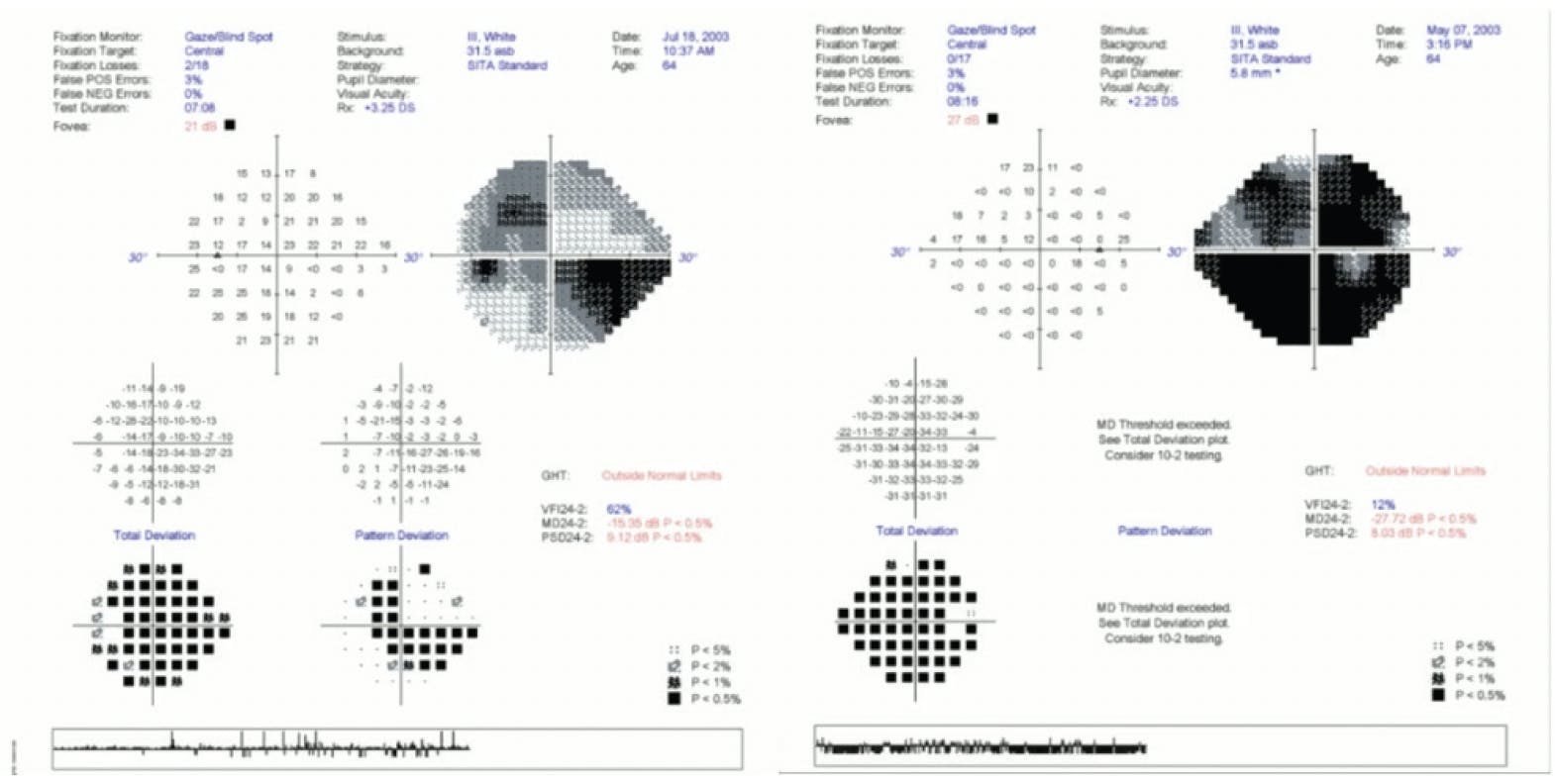
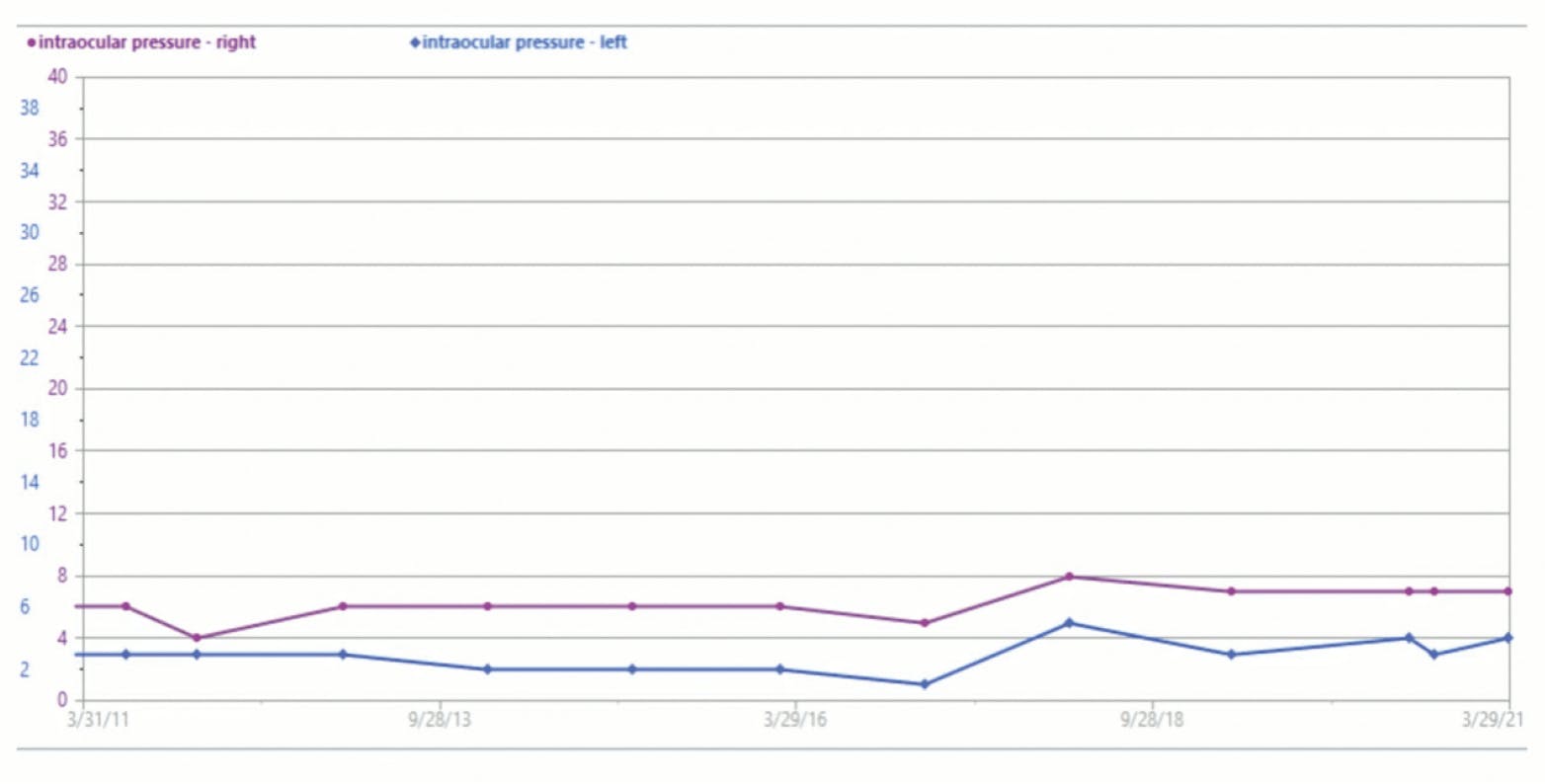
An 82-year-old patient presented to me in 2003 with severe visual field defects in both eyes (Figure 1). He underwent a trabeculectomy in each eye. For 10 years postoperatively, his IOP remained between 4 and 8 mm Hg OU (Figure 2), and his visual fields remained stable. This patient retained vision for the rest of his life. Like their surgeons, patients enjoy this disease stability. Can the same be achieved with the Xen in these types of cases?
A few years ago, my colleagues and I conducted a retrospective cohort study of patients I treated with ab externo Xen implantation between February 2019 and December 2020.1 Baseline IOP readings and medication regimens were compared to postoperative IOP and numbers of medications at postoperative day 1 and months 1, 3, 6, and 12. Primary outcomes were IOP and the use of glaucoma medications. Complete success was defined as greater than a 20% reduction in unmedicated IOP, qualified success was defined as greater than a 20% reduction in medicated IOP, and failure was defined as less than a 20% IOP reduction and no glaucoma drop reduction or as the need for additional surgery. Of the 38 patients enrolled in the study, 25 (65.8%) were White, and 13 (34.3%) were Black. At baseline, mean IOP was 20.6 ±7.2 mm Hg, and the mean number of medications was 2.5 ±1.2. The duration of mitomycin C application was about 1.7 minutes.
On postoperative day 1, patients had a mean unmedicated IOP of 12.2 ±7.2 mm Hg (40.8% reduction). Over time, however, an upward drift occurred. At 1 year, we observed a 42% failure rate with the Xen and a corresponding increase in the number of medications. A secondary analysis showed that, of 11 patients who required additional surgery, nine were White, and two were Black. Of the nine patients in whom the Xen failed to achieve more than a 20% IOP reduction, seven were White, and two were Black. Although racial differences in conjunctival histology may exist, the results of this study conflict with previous assertions that Black patients may be more prone to scarring and thus are at increased risk of failure in filtration surgeries.
IN THE LITERATURE
In a retrospective study conducted by Dr. Chang and colleagues,2 72 of the patients treated with the Xen were White, and four were Black. Of the patients treated with trabeculectomy, 34 were White, and 29 were Black. Ophthalmologists maintain some bias about which patients they believe will do well with these procedures. As with my data, on postoperative day 1, the IOP-lowering effect of the Xen was successful. There was a drift in IOP control, however, out to 6 months postoperatively; at this point, the mean IOP was 2.7 mm Hg lower in the trabeculectomy group compared to the Xen group (P < .003).
Another retrospective study in 701 eyes compared the use of the Xen (n = 308) and trabeculectomy (n = 393).3 Only three Black patients were included in each group. The investigators looked at three criteria for success: 15 mm Hg, 18 mm Hg, and 21 mm Hg. In each case, trabeculectomy performed better out to 24 months and beyond. The authors concluded that, “Both Xen and trabeculectomy significantly lowered IOP out to 3 years postoperatively compared with baseline, although greater surgical success was observed with trabeculectomy.”
Recently, a meta-analysis of 59 Xen studies (18 prospective and 41 retrospective) was conducted to “help increase understanding of postoperative outcomes based on clinical and patient factors.”4 Overall, the postoperative IOP with the Xen was 14.6 mm Hg. On postoperative day 1, the IOP was about 9.4 mm Hg based on 20 studies. At 36 months postoperatively, the IOP was around 14.4 mm Hg based on four studies, again showing that upward drift.
SUMMARY
It is important to remember that Xen implantation is bleb surgery and therefore carries its inherent risks. Some limitations of the Xen, such as long-term IOP instability, may preclude the device’s widespread use in patients with severe glaucoma. Overall, a better understanding of how filtration surgeries perform in patients of all races is required to inform surgeons’ decision-making.
1. Johnson NA, Liu JC, Li A, Herndon LW. Postoperative outcomes of open conjunctival ab externo Xen implantation with tenonectomy. J Clin Ophthalmol. 2021;5(7):504-509.
2. Sharpe R, Pham G, Chang P. Comparison of ab interno Xen gelatin stent vs trabeculectomy with mitomycin C: a retrospective study. J Curr Glaucoma Pract. 2020;14(3):87-92.
3. Tan JCK, Hashimoto Y, Gabrielle PH, et al. Outcomes and baseline predictors of failure in primary standalone Xen45 Gel Stent versus trabeculectomy for glaucoma. Ophthalmol Glaucoma. 2024;7(6):539-550.
4. Panarelli JF, Vera V, Sheybani A, et al. Intraocular pressure and medication changes associated with Xen Gel Stent: a systematic review of the literature. Clin Ophthalmol. 2023;17:25-46.