Subconjunctival stents such as the Xen Gel Stent (AbbVie) and the Preserflo MicroShunt (Santen/Glaukos) provide IOP control through the formation of a filtering bleb. Despite the efficacy of these devices, fibrosis, bleb failure, and the need for postoperative interventions such as bleb needling can occur. Prior to advances in surgical techniques, bleb-related intervention may have been required in up to 40% of Xen procedures and more than 30% of Preserflo surgeries.1,2
A surgical modification we call glaucoma intrascleral tube surgery (GITS) may help address these limitations. With this technique, a subconjunctival stent is embedded within a scleral lake (SL) beneath a partial-thickness scleral flap. This intrascleral passage alters aqueous flow dynamics and may shield the stent from fibrotic responses. Our experience with GITS suggests that it may improve surgical success and reduce postoperative complications associated with subconjunctival stent implantation.
RATIONALE AND DEVELOPMENT
The idea for GITS began with deep sclerectomy procedures, wherein fibrosis beneath the scleral flap is often less significant than in the subconjunctival space.3 This clinical observation led to the hypothesis that a similar approach to subconjunctival stent implantation could shield the devices from Tenon fibroblasts and subsequently lower the rates of scarring and failure. The SL that is created functions as a reservoir that promotes posterior and diffuse flow, reducing the formation of cystic blebs and jet-like mechanical stimulation believed to exacerbate fibrosis. This configuration may offer mechanical, hydraulic, and biochemical benefits compared to traditional stent placement.
SURGICAL TECHNIQUE
With GITS, a corneal traction suture is placed superiorly to enhance visualization. A fornix-based conjunctival incision is made, followed by an extensive posterior dissection beneath Tenon capsule. Any episcleral tissue remnants are removed, and gentle diathermy is applied.
Using a crescent blade, a square scleral flap measuring 4 x 4 mm at one-third depth is created 2 mm behind the limbus for the Xen Gel Stent. For the Preserflo MicroShunt, a flap measuring 4 x 4 mm at one-third depth is made with its anterior edge located 3 mm behind the limbus. With both devices, a second scleral flap measuring 3 x 3 mm is then fashioned in the deeper sclera to form an intrascleral lake, and then this smaller flap is excised.
Unlike conventional deep sclerectomy, no trabeculo-Descemet window is created, and the dissection is not extended forward to the scleral spur. Mitomycin C 0.2 mg/mL is applied with a sponge to the intrascleral lake and as far posteriorly as possible under the conjunctiva for 3 minutes to enhance posterior bleb formation and reduce the risk of small cystic bleb formation. The Xen Gel Stent or the Preserflo MicroShunt is then injected at the anterior edge of the flap. The superficial scleral flap is repositioned without sutures, and the conjunctiva is closed with two cardinal 8-0 and 10-0 polyglactin sutures. Subconjunctival injections of dexamethasone and cefuroxime are performed to complete the procedure.
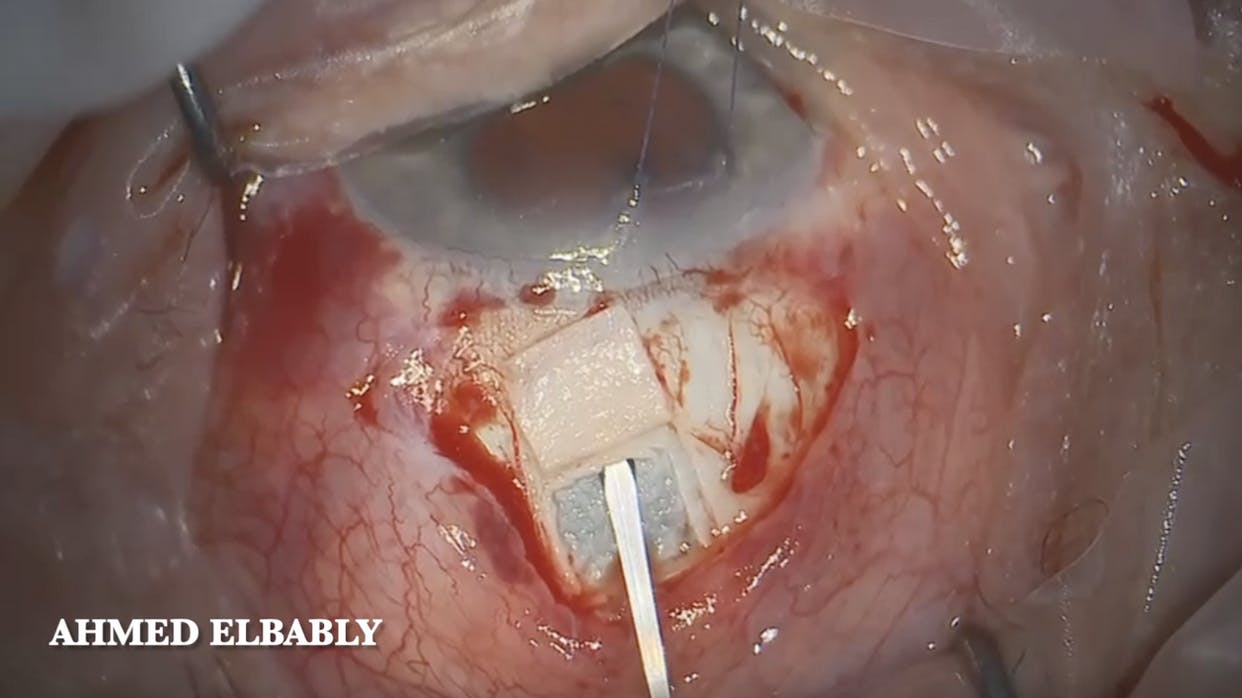
Glaucoma Intrascleral Tube Surgery
EARLY EXPERIENCE AND OUTCOMES
A study of 20 patients who underwent GITS with the Xen Gel Stent found that the IOP decreased from 24.5 ±7.96 mm Hg to 11.5 ±2.96 mm Hg over 6 months, representing a 51% reduction.4 Similarly, the average number of glaucoma medications decreased from 3.1 to 0.72. Most notably, no patient required bleb needling, and complications were minimal. Only two cases of choroidal effusion were documented, both of which resolved with conservative treatment. Patients’ visual acuity remained stable, with no cases progressing to light perception loss.
In a subsequent study, we applied the scleral lake technique to Preserflo MicroShunt implantation (unpublished data, 2025). The mean IOP of 11 patients decreased from 29.3 ±9.8 mm Hg to 10.2 ±2.2 mm Hg at 10 months, representing a 65% reduction. None of the patients required glaucoma medication at the last follow-up visit, and none required bleb needling. Complications were minor; they included two cases of choroidal effusion and one case requiring an anterior chamber OVD injection. Three patients lost 2 or more lines of Snellen visual acuity over the course of follow-up. No cases of stent erosion or vision-threating complications were reported.
The improved outcomes we observed with GITS may be the result of three interrelated mechanisms5,6:
No. 1: Mechanical protection. The scleral lake physically shields the distal end of the stent from Tenon capsule and its associated fibroblasts.
No. 2: Fluid dynamics. Aqueous humor entering the scleral lake may experience diffuse and posterior flow, reducing the amount of focal flow pressure.
No. 3: Biochemical modulation. By modifying aqueous exposure to Tenon tissue, the scleral lake may reduce the local concentration of profibrotic cytokines, although further studies are required to confirm this hypothesis.
These mechanisms may explain the lower bleb manipulation rates and enhanced pressure control observed with both stent procedures.
CLINICAL IMPLICATIONS AND FUTURE DIRECTIONS
GITS represents a new technique for subconjunctival device implantation. Its adoption could shift practice toward lower postoperative intervention rates with an enhanced safety profile, particularly in patients who are at high risk of fibrosis or have a history of surgical failure.
There is the potential for the device-agnostic application of the GITS technique. Any plateless subconjunctival stent—current or future—could theoretically be placed into a scleral lake. This opens the door to a new class of hybrid procedures that blend the microinvasive nature of MIGS with the structural strategies of deep sclerectomy.
Studies with longer follow-up and larger, randomized cohorts are required to confirm the approach’s long-term efficacy, safety, and applicability across patient subtypes. Comparative trials against standard Preserflo implantation, Xen implantation, trabeculectomy, and glaucoma drainage device surgery will be critical to determine the place of GITS in surgical glaucoma management.
CONCLUSION
In our experience, GITS may be a viable alternate technique for the surgical treatment of glaucoma. The potential advantages, when combined with current subconjunctival microstent procedures, may improve IOP control with less postoperative manipulation.
1. Karimi A, Lindfield D, Turnbull A, et al. A multi-centre interventional case series of 259 ab-interno Xen gel implants for glaucoma, with and without combined cataract surgery. Eye. 2019;33:469-477.
2. Tanner A, Haddad F, Fajardo-Sanchez J, et al. One-year surgical outcomes of the PreserFlo MicroShunt in glaucoma: a multicentre analysis. Br J Ophthalmol. 2023;107:1104-1111.
3. Roy S, Mermoud A. Deep sclerectomy. Dev Ophthalmol. 2017;59:36-42.
4. Elbably A, Richardson-May J, Amerasinghe N, et al. Xen-DS: a novel technique of ab externo Xen implantation augmented with a modified deep sclerectomy for surgical treatment of glaucoma. Eye (Lond). 2024;38(14):2775-2780.
5. van Mechelen RJS, Wolters JEJ, Herfs M, et al. Wound healing response after bleb-forming glaucoma surgery with a SIBS microshunt in rabbits. Transl Vis Sci Technol. 2022;11(8):29.
6. Atreides SP, Skuta GL, Reynolds AC. Wound healing modulation in glaucoma filtering surgery. Int Ophthalmol Clin. 2004;44(2):61-106.