CASE PRESENTATION
A 55-year-old man presents for an evaluation. The patient reports having blurry vision and episodes of elevated IOP in the right eye since undergoing cataract surgery 4 months ago. Uncomplicated cataract surgery was performed on the left eye 2 weeks after the procedure on the right eye. A Light Adjustable Lens (RxSight) was implanted in each eye, but the postoperative light treatments have been delayed owing to the problems in the right eye.
On presentation, the patient’s UCVA is 20/40 OD and 20/20 OS. His IOP is 36 mm Hg OD and 13 mm Hg OS. His current drug regimen consists of timolol and a fixed combination of brimonidine and brinzolamide, both administered twice a day in the right eye. Further discussion reveals that the patient chose dropless cataract surgery and therefore initially received no postoperative topical medication. It was only after the IOP in the right eye increased that therapy was initiated. He has a remote history of bilateral LASIK.
A slit-lamp examination finds evidence of LASIK, a deep and quiet anterior chamber, and a well-positioned posterior chamber three-piece IOL in each eye. Trace microcystic edema is observed in the right eye (Figure 1). A fundus examination finds small optic nerves with a cup-to-disc ratio of 0.2 OD and 0.15 OS. Gonioscopy reveals an unremarkable grade 4 angle in each eye and no retained lens fragments or debris. The results of OCT and visual field testing (Humphrey Field Analyzer, Carl Zeiss Meditec) are unremarkable in both eyes (Figures 2 and 3).
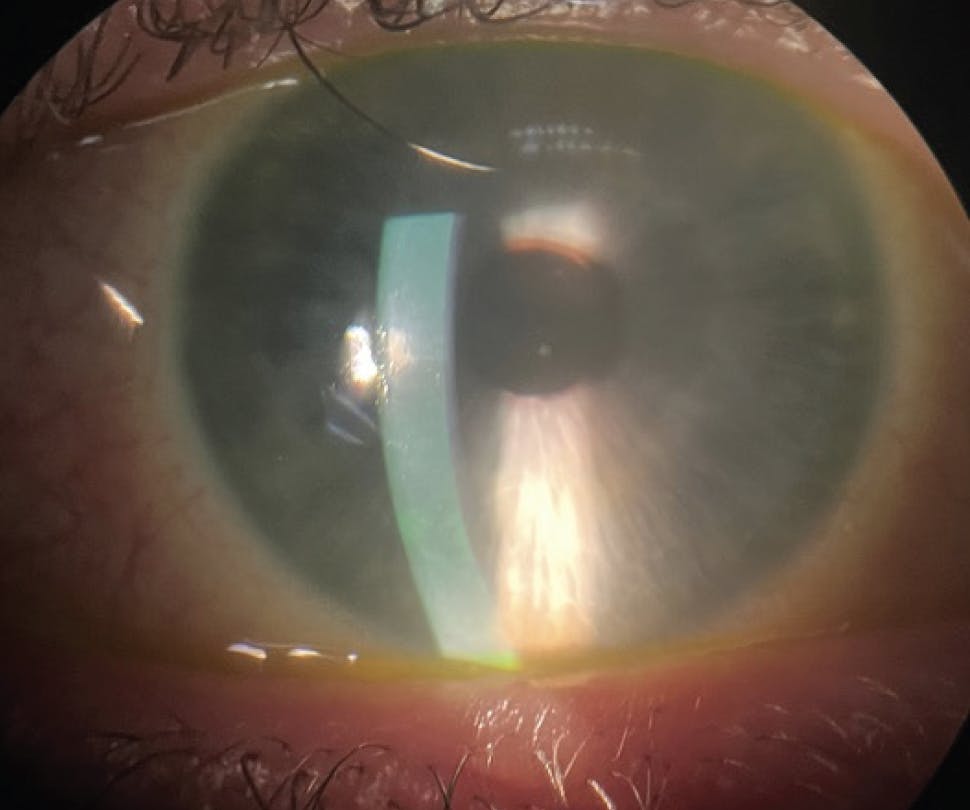
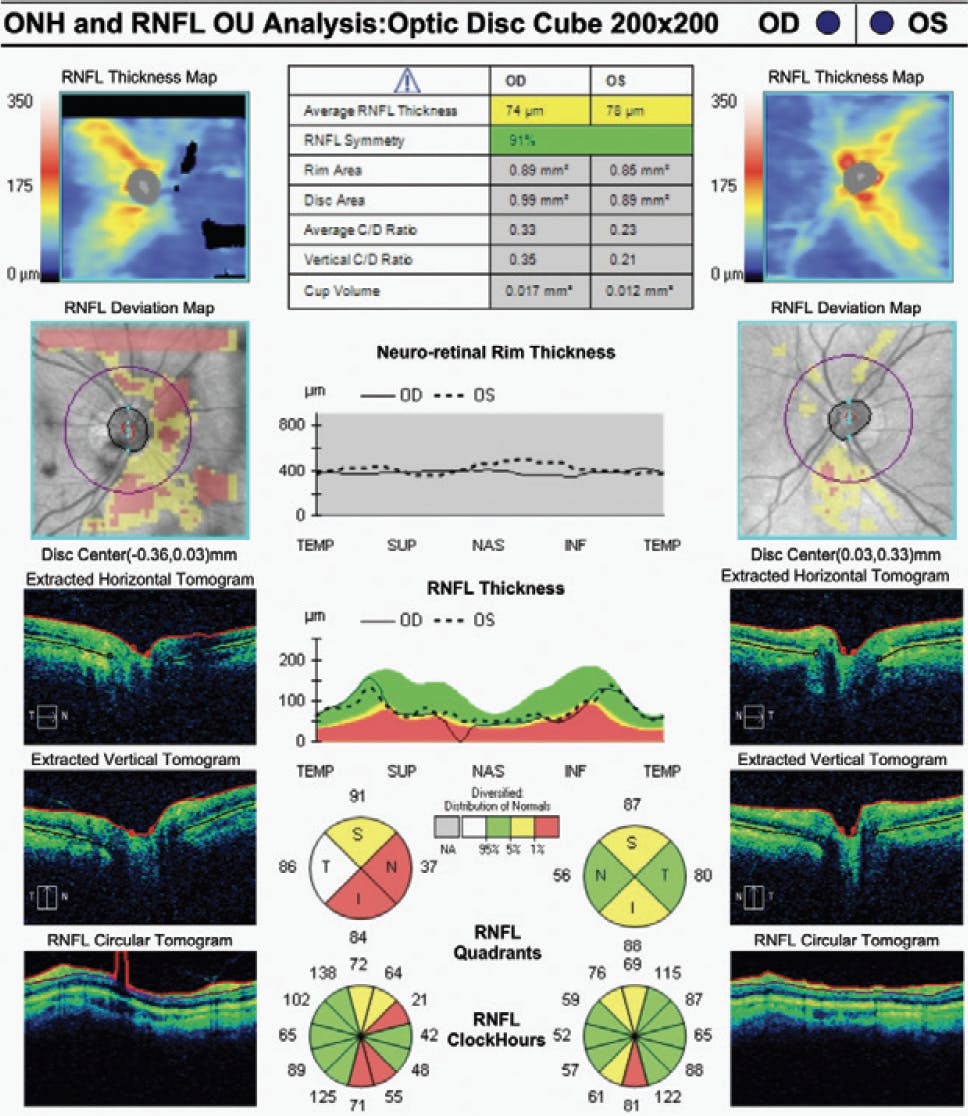
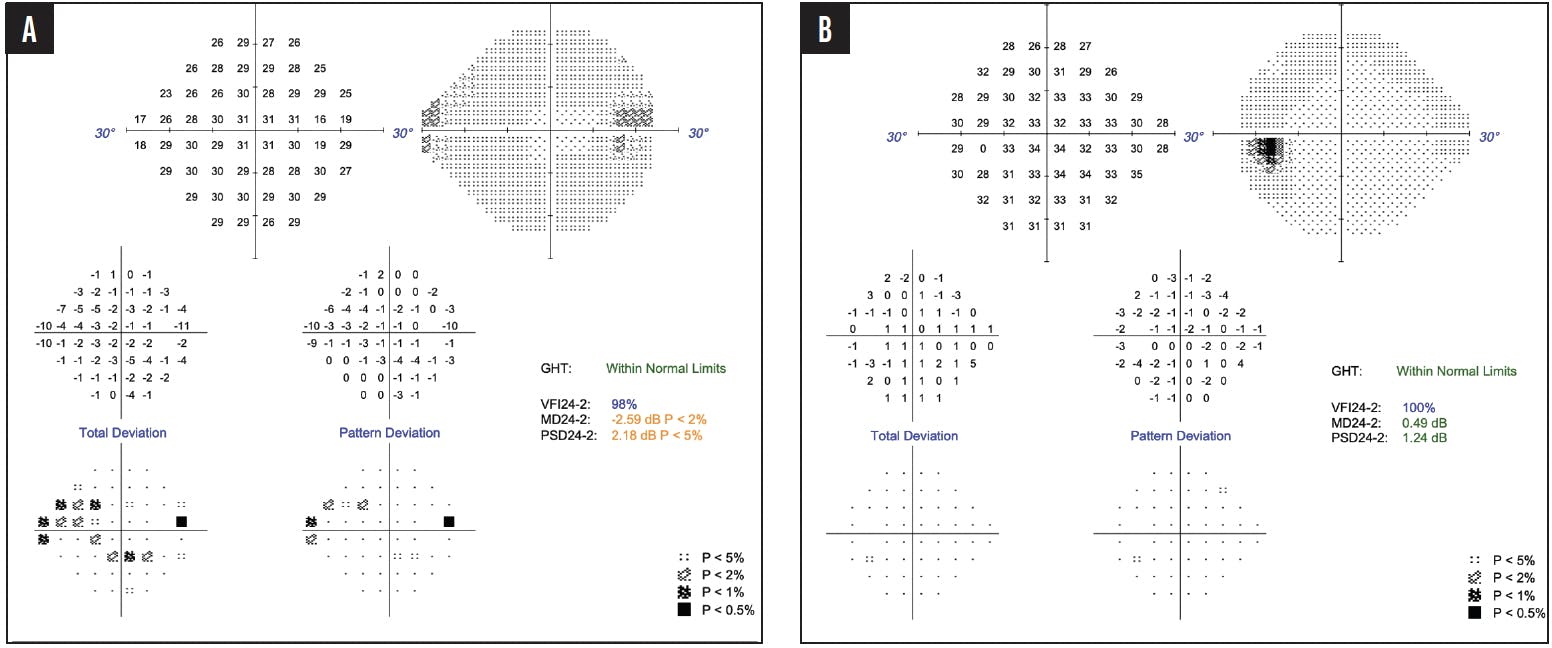
How would you proceed? What additional information would you request from the referring provider?
—Case prepared by Jacob Brubaker, MD
IAN CONNER, MD, PHD
Of greatest concern to me are the steroid response and interface fluid syndrome (also known as pressure-induced stromal keratopathy). Based on the patient’s history, I would request details on the dropless surgery—specifically, how the steroid was administered. Is there a depot of triamcinolone in the conjunctiva just behind the limbus? Was a depot injection delivered into the vitreous?
On examination, I would recheck the IOP with a pneumotonometer (Model 30 Pneumotonometer, Reichert) because acute flap interface edema can result in an underestimation of IOP with Goldmann applanation tonometry (the true IOP might be significantly higher than 35 mm Hg). Advanced imaging of the cornea with anterior segment OCT would be performed to determine whether fluid is present in the LASIK flap interface.
If this diagnosis is confirmed and the steroid depot can be removed (ie, a subconjunctival depot), then the residual steroid would be excised immediately. Aggressive management with all available aqueous suppressants, including acetazolamide, would then be initiated, and the patient would be monitored closely. Urgent filtration surgery might be necessary.
Fortunately, the OCT scans and visual field results provided reveal little to no preexisting glaucomatous damage.
ROMA PATEL, MD, MBA
The differential diagnosis for unilateral elevated IOP after dropless cataract surgery is broad and includes uncontrolled postoperative inflammation, a steroid response, a retained lens fragment, Posner-Schlossman syndrome, insidious Propionibacterium acnes endophthalmitis, a reactivation of herpetic uveitis, and uveitis-glaucoma-hyphema syndrome.
The patient’s history would be reviewed for prior steroid use, herpetic infection, previous IOP spikes, a family history of glaucoma, and details about the dropless regimen (especially steroid management). I would also like to know at what point postoperatively the IOP began to rise.
A quiet anterior chamber is reassuring and negates much of the differential diagnosis. I would like additional details from the fundus exam, including the status of the capsular bag, an evaluation for peripheral plaques, and an inspection of the sulcus for retained fragments. If pupillary dilation is poor, I would consider ordering ultrasound biomicroscopy or ultrasound. The presence of vitreous cells would also be informative.
LASIK likely resulted in thinner pachymetry readings and affected IOP measurements. OCT of the retinal nerve fiber layer (RNFL) is generally less reliable when the optic nerve is small, and the scan provided shows shifted peaks on the temporal-superior-nasal-inferior-temporal curve. Asymmetry in the cup-to-disc ratio, however, and possible early superior nasal visual field changes suggest evolving uncontrolled glaucoma that requires prompt treatment.
ZARMEENA VENDAL, MD
The OCT changes demonstrating some RNFL loss in both eyes are suspicious for primary open-angle glaucoma (POAG). Asymmetry in the cup-to-disc ratio also suggests a long-term IOP issue, which often escapes notice in patients who have a history of LASIK because thin corneas produce falsely normal IOP measurements. Taken together, these findings indicate that the patient is at increased risk of postoperative IOP elevation, particularly when corticosteroids are administered for a prolonged period or infectious or inflammatory issues arise.
The differential diagnosis would include a retained lens fragment, an undiagnosed P acnes infection, uveitis-glaucoma-hyphema syndrome, a remote history of undiagnosed herpes simplex virus that has flared up and is accompanied by corneal edema and elevated IOP, and steroid-induced glaucoma.
Given that there is no retained lens fragment or iritis and the angle is open and clear, I suspect that the patient is experiencing steroid-induced glaucoma but may also have mild POAG.
THE CASE CONTINUED
A further examination finds a white deposit deep in the inferior subconjunctival space (Figure 4). A subsequent discussion with the referring physician reveals that he routinely performs a subconjunctival injection of triamcinolone acetonide as part of dropless cataract surgery, including on both of the patient’s eyes. The surgeon says he has never encountered a persistent IOP spike like this one.
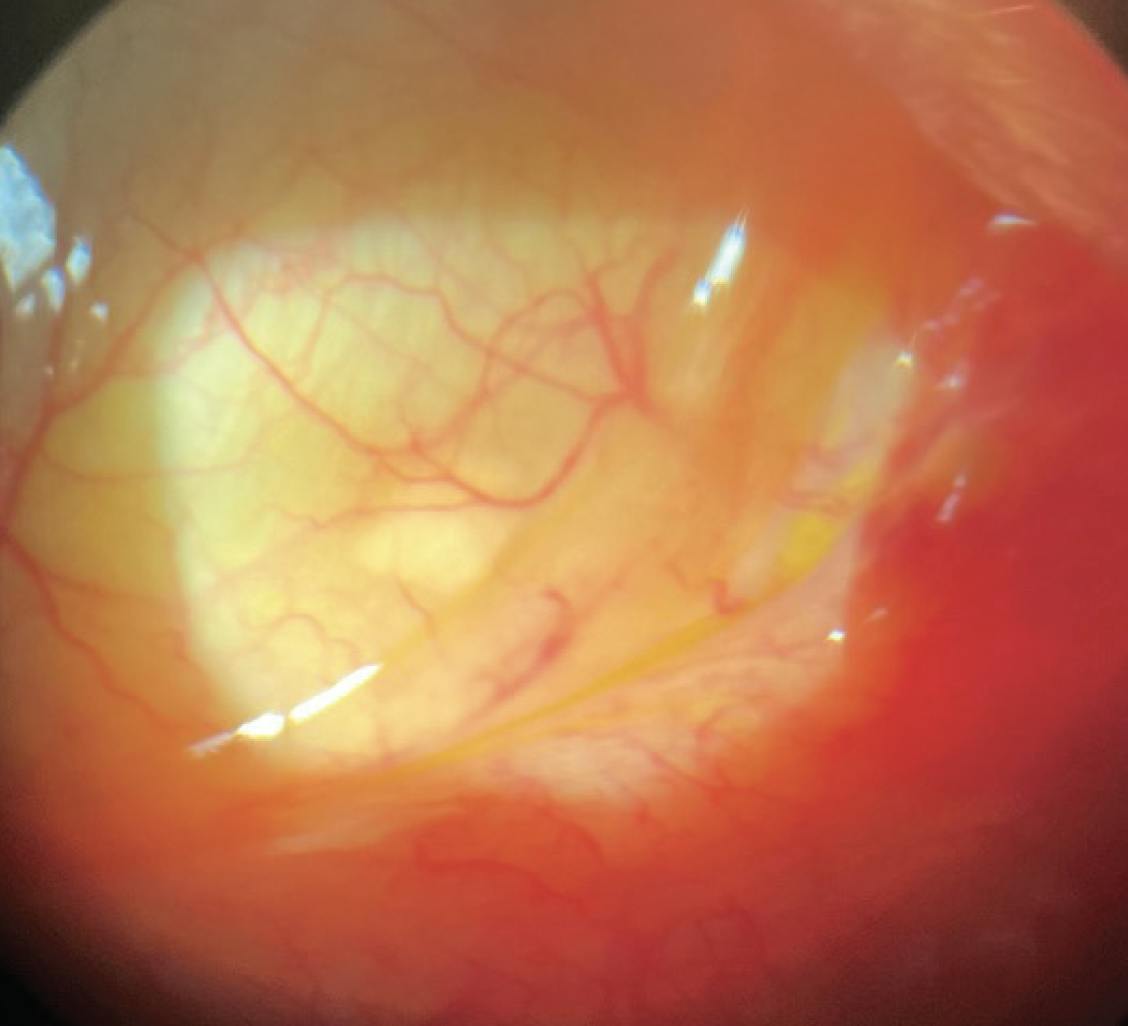
Would the new information change your approach? How would you proceed?
DR. CONNER
The additional information strengthens my suspicion that a steroid response to subconjunctival triamcinolone is the most likely cause of the unexpected postoperative increase in IOP. Several times in the past, I have been able to excise a triamcinolone deposit from the surrounding Tenon capsule and observed a rapid resolution of the IOP spike.
Given the deposit’s deep location near the fornix, surgical excision in the OR versus at the slit lamp or in a minor procedure room is likely required. In the meantime, aggressive aqueous suppression, including oral acetazolamide, would be initiated. If these measures prove insufficient, urgent filtration surgery would be scheduled.
When excising similar deposits, I have found it important to make every effort to remove them in total. Dissection around the often-encapsulated deposit may be required, much as when removing an epithelial inclusion cyst. Even a small amount of residual triamcinolone can perpetuate the steroid response.
Adequate removal of the deposit should reduce the IOP and resolve the corneal edema, including the presumed LASIK flap interface fluid syndrome.
DR. PATEL
Figure 4 shows a subconjunctival deposit of triamcinolone. These typically dissolve within 3 months, but the process sometimes takes longer.
I would remove the deposit with a conjunctival incision. The procedure could be performed in the clinic at the slit lamp or in the procedure room. If the patient cannot tolerate the intervention, then removal would be executed in the OR. In the interim, therapy with a prostaglandin analogue would be initiated to reduce the IOP.
The IOP usually decreases after removal of the steroid deposit. If further treatment is required, selective laser trabeculoplasty is often effective for the management of steroid-induced ocular hypertension.
DR. VENDAL
Up to 30% of patients without glaucoma can be steroid responders. The incidence of an IOP spike is significantly higher for POAG suspects, and nearly all patients with POAG demonstrate sensitivity to steroids. The risk of a steroid response, moreover, is directly correlated to the proximity of the agent’s administration to the eye.1,2
The RNFL analysis suggests that the patient in this case may be a POAG suspect. Not only was there probably preexisting resistance in the outflow pathway, but he is now also experiencing steroid-induced resistance to outflow after receiving a depot of triamcinolone as part of dropless cataract surgery. Furthermore, of all the possible routes of steroid administration, periocular methods (subconjunctival and sub-Tenon) are the most likely to induce prolonged IOP elevation.3,4
Possible treatment options include selective laser trabeculoplasty and MIGS alternatives such as a goniotomy. Because the patient presented with what appears to be a retained or persistent depot of the triamcinolone visible in the subconjunctival space, the best option would be to remove the deposit surgically, after which his steroid response will likely abate.
WHAT I DID: JACOB BRUBAKER, MD
This case speaks to the importance of a detailed history and physical examination. Only after a discussion of the patient’s postoperative regimen and a detailed examination looking for a possible steroid depot was the reason for his increased IOP discovered. There are many causes of IOP elevation after cataract surgery. With the right approach, most are easily discovered and treated.
After determining that the IOP elevation was due to a prolonged steroid response to subconjunctival triamcinolone, I discussed options for removal with the patient. I noted that it would be easy to remove the depot in the clinic. The patient began administering latanoprost at night as a temporizing measure before treatment. One week later, he returned to have the deposit removed.
In the minor procedure room, an injection of lidocaine with epinephrine was performed in the area of the depot, and an incision was made adjacent to it. The tissue planes around the depot were dissected, and it was removed in toto. The procedure was simple and quick (see Watch It Now).
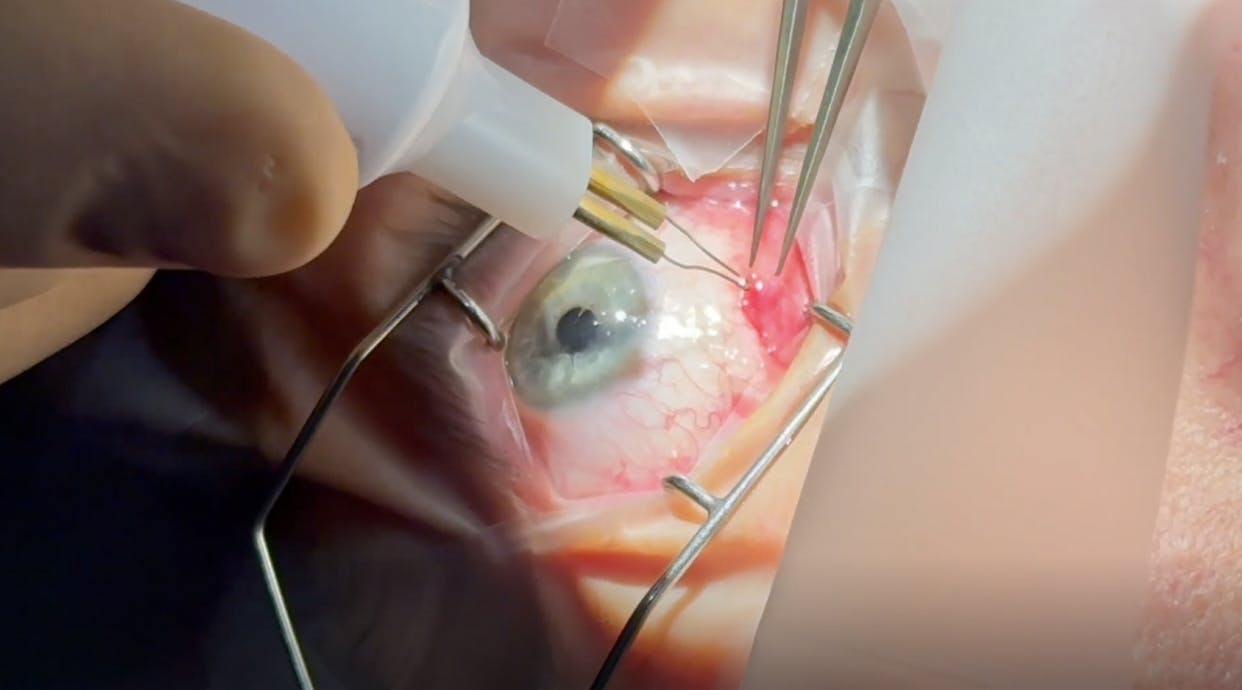
Subconjunctival Triamcinolone Removal
Postoperatively, the patient was instructed to administer ofloxacin for 1 week and latanoprost for 2 weeks. One month after surgery, his IOP was 12 mm Hg OD on a regimen of timolol and a fixed combination of brimonidine and brinzolamide. He subsequently discontinued these medications. Six weeks later, his unmedicated IOP was 17 mm Hg, and he was highly satisfied.
1. Armaly MF. Effect of corticosteroids on intraocular pressure and fluid dynamics. I. The effect of dexamethasone in the normal eye. Arch Ophthalmol. 1963;70:482-491.
2. Jones R 3rd, Rhee DJ. Corticosteroid-induced ocular hypertension and glaucoma: a brief review and update of the literature. Curr Opin Ophthalmol. 2006;17(2):163-167.
3. Phulke S, Kaushik S, Kaur S, Pandav SS. Steroid-induced glaucoma: an avoidable irreversible blindness. J Curr Glaucoma Pract. 2017;11(2):67-72.
4. Feroze KB, Zeppieri M, Khazaeni L. Steroid-induced glaucoma. In: StatPearls [internet]. StatPearls Publishing; 2025.