MIGS has transformed glaucoma care by enabling earlier surgical intervention, improved IOP control, and reduced dependence on long-term medical therapy. Although MIGS procedures that target the trabecular meshwork (TM) and Schlemm canal have gained widespread adoption owing to their favorable safety profile, their ability to lower IOP is often limited compared to bleb-forming procedures. In contrast, bleb-forming surgeries offer robust IOP reduction but may carry significant risks, including hypotony and bleb-related infection. The uveoscleral pathway offers an alternative route for MIGS procedures to increase outflow and lower the IOP.
THE UVEOSCLERAL OUTFLOW PATHWAY
Like the conventional trabecular pathway, the uveoscleral pathway is an important route of aqueous outflow in healthy eyes. Aqueous humour flows through the ciliary muscle into the supraciliary and suprachoroidal spaces before being absorbed into the sclera and episcleral tissues. Uveoscleral outflow, however, declines naturally with age, contributing to IOP elevation over time.1 The supraciliary space is a promising target for glaucoma surgery. It offers the potential to reduce IOP without being limited by episcleral venous pressure, does not require the creation of a bleb, and preserves the TM and Schlemm canal.
To date, devices targeting the supraciliary space have been placed in the anterior chamber, posing a risk to the corneal endothelium. In fact, all currently available MIGS devices and penetrating bleb-forming procedures require entry into the anterior chamber, which may compromise long-term corneal endothelial cell integrity, particularly when a foreign body is implanted in the chamber.
The Intercil Uveal Spacer (Ciliatech) is an innovative implant that lowers IOP without penetrating the anterior chamber or requiring subconjunctival filtration.
A NEW CLASS OF GLAUCOMA SURGERY
The Intercil Uveal Spacer represents a new class of glaucoma surgical implants known as cilioscleral interpositioning devices or CIDs. It features a 7 x 3.4 x 0.6–mm trapezoidal plate composed of 26% hydrophilic acrylic with a grooved corrugated surface that aims to maximize outflow from the anterior chamber to the suprachoroidal space (Figure). The material is highly biocompatible and resembles that used for IOLs. It provides the necessary flexibility to conform to the anatomic variations of the supraciliary space while maintaining sufficient rigidity to create a stable drainage channel.
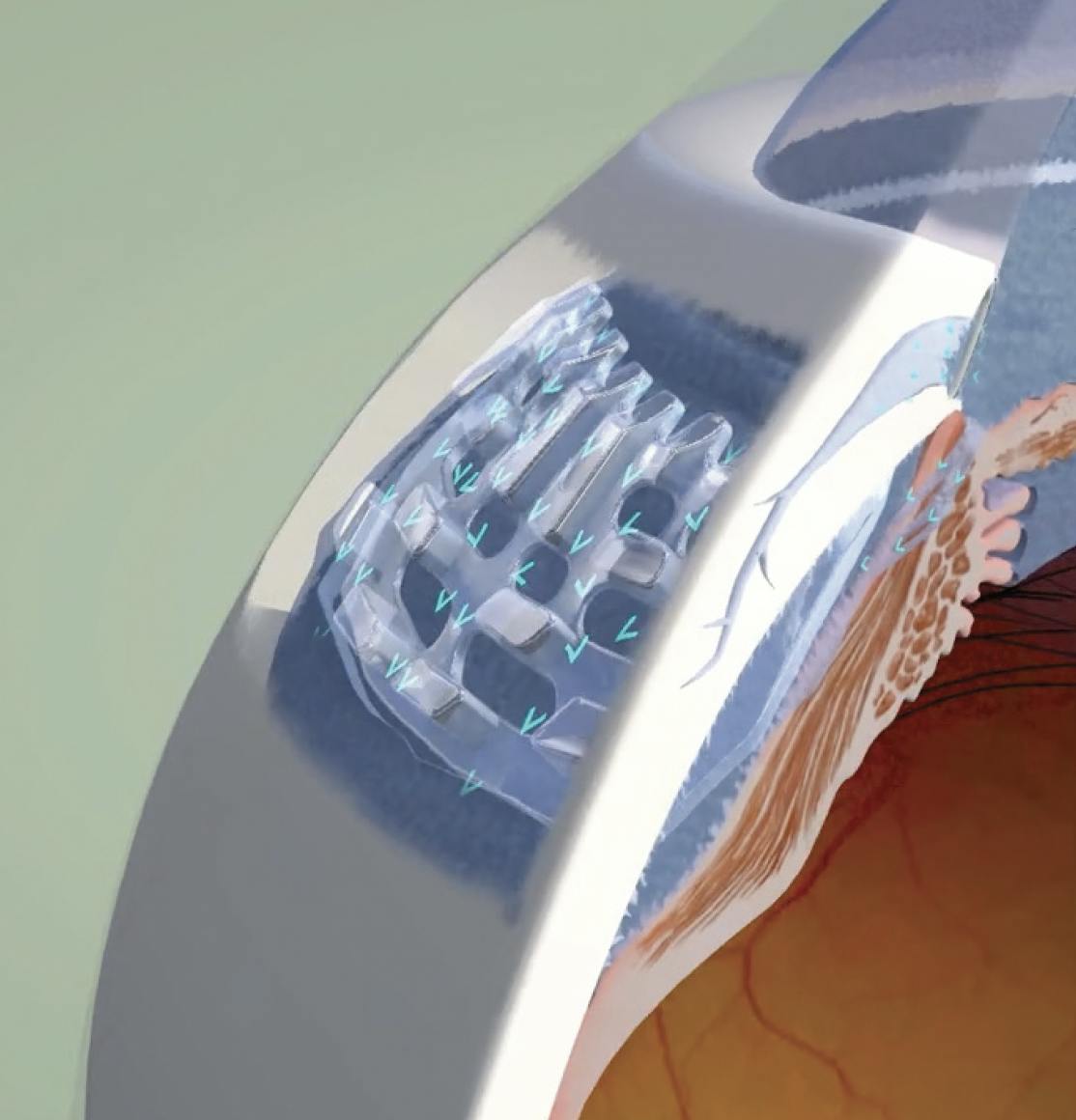
Figure. The Intercil Uveal Spacer is a novel supraciliary space implant that lowers IOP without penetrating the anterior chamber. It is composed of 26% hydrophilic acrylic and features a grooved corrugated surface to maximize aqueous outflow.
The Intercil targets the uveoscleral outflow pathway. The device is designed to create a localized gap between the ciliary muscle and sclera, decreasing resistance to aqueous outflow and enhancing uveoscleral flow to the choroidal circulation, without the need to open the anterior chamber or disinsert the iris root to create a cleft.
Surgical implantation of the Intercil is performed via an ab externo technique, which preserves the integrity of the anterior chamber and reduces the risk of corneal endothelial cell loss. The device is inserted through a 3.5-mm radial scleral incision located 2 mm from the limbus. Unlike some glaucoma drainage implants that require the use of antifibrotic agents such as mitomycin C to prevent excessive scarring, the Intercil is designed to maintain patency by leveraging the anatomy of the supraciliary space.
CLINICAL OUTCOMES
Clinical investigations of the Intercil have yielded promising results. The Supraciliary Filtration Alone Reduces IOP (SAFARI) clinical trial program has reported outcomes through 36 months.2 The SAFARI-1 and SAFARI-2 studies evaluated the first generation of the Intercil device in 42 patients with open-angle glaucoma. At 36 months, no patients required additional glaucoma surgery. Most patients had a sustained reduction in IOP, with an average IOP reduction of 8 mm Hg (33%) at 3 years. No major safety concerns were reported. Sixty-eight percent of participants remained medication-free following surgery.
The SAFARI-3 study commenced in May 2022 and recruited an additional 57 patients, half of whom have primary angle-closure glaucoma.3 All participants underwent standalone Intercil placement. Study enrollment was completed at the end of 2022. Interim results showed that 13 patients achieved a mean IOP reduction of 10.8 mm Hg (46%) at 2 years and 85% of eyes were medication-free. The study is expected to be completed in early 2026.
CONCLUSION
The supraciliary space offers a viable and advantageous target for glaucoma surgery. The Intercil Uveal Spacer exemplifies the potential of this approach, with early results indicating effective IOP reduction and a reduced risk of complications compared to anterior chamber implants or bleb-forming procedures. Because the Intercil preserves the TM, it may be effective even in eyes whose conventional outflow pathways are severely compromised. As the field of glaucoma surgery continues to advance, the need for innovative solutions that balance efficacy with safety is paramount, and the Intercil device may represent a potential step in that direction.
1. Toris CB, Yablonski ME, Wang Y, Camras CB. Aqueous humor dynamics in the aging human eye. Am J Ophthalmol. 1999;127(4):407-412.
2. Study of a novel interposition supraciliary implant in patients with open angle glaucoma (SAFARI 2). Clinicaltrials.gov identifier: NCT04770324. Updated February 13, 2023. Accessed April 3, 2025. https://clinicaltrials.gov/study/NCT04770324
3. Study of a cilioscleral interposition device (CID) SV22 in patients with primary open angle glaucoma (SAFARI 3). Clinicaltrials.gov identifier: NCT05236439. Updated March 20, 2023. Accessed April 3, 2025. https://clinicaltrials.gov/study/NCT05236439