CASE PRESENTATION
A 67-year-old woman with moderate myopia, borderline high IOP, and no known family history of glaucoma is referred by her optometrist for an evaluation. Optic disc drusen (ODD) have made assessing the patient’s optic nerves difficult. She reports intermittent episodes of blurred vision accompanied by a sensation of pressure in both eyes. The referring optometrist recorded IOPs of 22 mm Hg OD and 21 mm Hg OS.
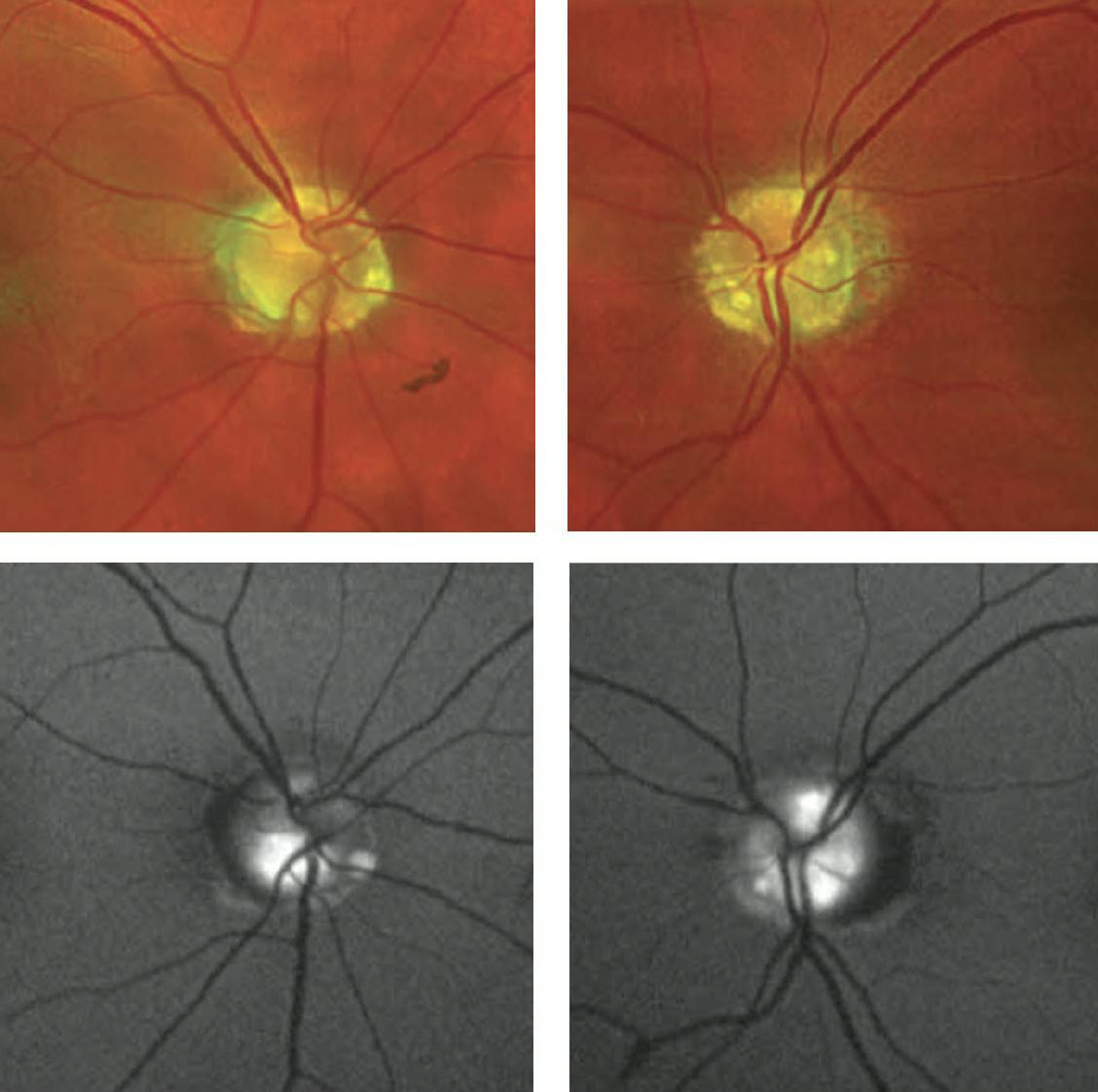
Upon presentation, the patient’s IOP measures 17 mm Hg OU. Central corneal thickness readings are 509 µm OD and 505 µm OS. Gonioscopy reveals open angles with no sign of pigment dispersion. Buried ODD are observed in both optic nerves and confirmed by autofluorescence imaging (Figure 1) and B-scan ultrasound. The optic nerve heads appear to be crowded by the ODD, and peripapillary atrophy is present bilaterally.
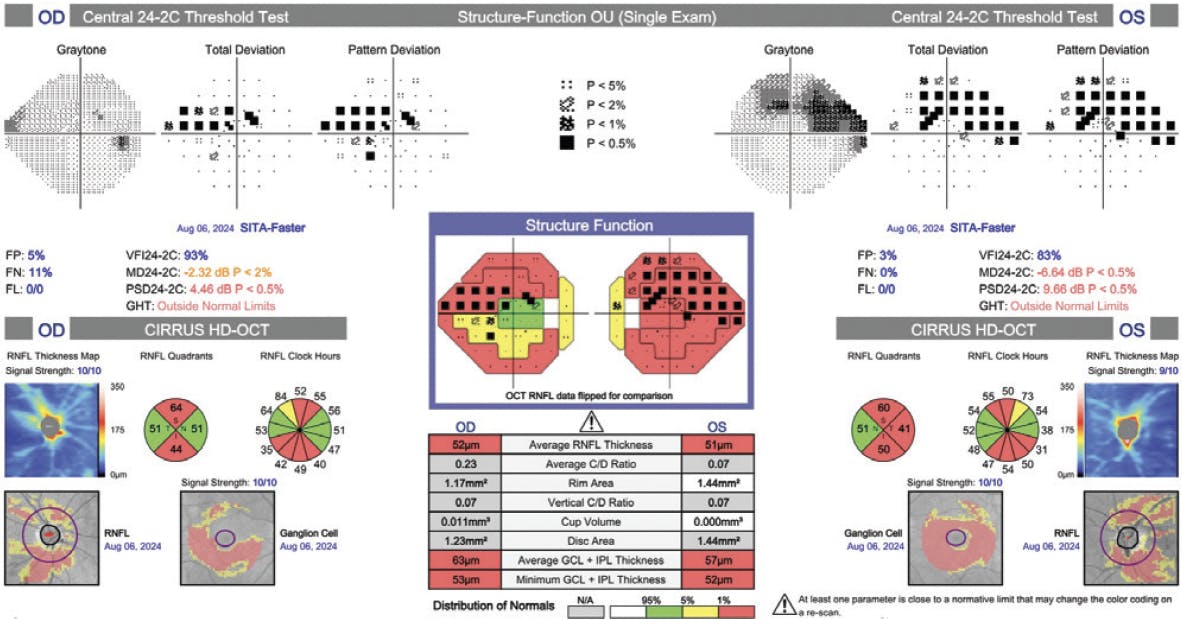
Visual field (VF) testing shows a repeatable superior nasal step in the right eye and a superior arcuate scotoma in the left eye; both defects extend toward fixation. OCT imaging finds extensive retinal nerve fiber layer (RNFL) thinning and ganglion cell layer loss, particularly in the inferior quadrants, that correspond to the VF defects (Figure 2). Unfortunately, no prior medical records are available, making it unclear whether these VF and RNFL changes are long-standing and static or progressive.
The patient expresses concern about her VF and optic nerve changes but is equally apprehensive about the possibility of lifelong medical therapy for glaucoma. What is your diagnosis? Would you initiate treatment, and what target IOP would you choose if so? How would you counsel the patient about her prognosis, and how frequently would you recommend follow-up?
—Case prepared by Devesh K. Varma, MD, FRCSC
REENA GARG, MD
Individuals with ODD often present a diagnostic dilemma for the clinician. I would inform the patient that her ODD, myopia, and RNFL thinning limit the ability of VF testing to determine whether she has glaucoma. I would advise her that she is at risk of ocular vascular events and that lowering her IOP might improve ocular blood flow, although definitive supporting evidence is lacking. I would also explain that there currently are no treatments for ODD. IOP lowering is the mainstay of therapy. She may experience transient visual obscurations from the ODD, and they may become more calcified with age, which could lead to VF progression.
Although relatively young, the patient has significant VF loss in both eyes that is encroaching on fixation. Her IOP is not low, so treatment is warranted. Her concerns about lifelong glaucoma therapy are reasonable given her age. I would therefore recommend selective laser trabeculoplasty (SLT) as first-line treatment and target a 20% to 30% IOP reduction from baseline (rather than highest measured IOP) to achieve a pressure in the low to midteens. If the target pressure is achieved, she would be asked to return for follow-up three times per year with biannual VF testing, including a 10-2 algorithm to monitor the central 10º of the field.
PAUL HARASYMOWYCZ, MD, FRCSC, MSC
The ODD diagnosis is evident from the fundus photographs, autofluorescence, and B-scan ultrasound images. Enhanced depth imaging and swept-source OCT are frequently used to facilitate ODD diagnosis and monitoring,1 so dense scans would be obtained through the optic nerve head tissue. These could also indicate whether some of the findings in the periphery of the disc may represent peripapillary hyperreflective ovoid mass-like structures.
Although the patient’s symptoms of transient visual obscuration are not uncommon, it is worrisome that the Humphrey 24-2C algorithm (Carl Zeiss Meditec) has detected VF defects close to fixation in the right eye. My colleagues and I often jointly evaluate patients like this one with our neuro-ophthalmology colleagues to determine if further testing is warranted.
Despite her lack of a family history of glaucoma, entering the patient’s age, significant superior VF loss (pattern standard deviation), history of borderline high IOP, and thin central corneal thickness measurements into the Ocular Hypertension Treatment Study (OHTS) risk calculator yields a 20% to 33% estimated 5-year risk of developing primary open-angle glaucoma.2 Given her significant VF damage and risk of VF progression, I would discuss two approaches to management with the patient and ask her preference. The first would be close observation with OCT imaging and VF testing, with treatment considered if glaucomatous progression is detected. The second option would be to lower the IOP with either topical medical therapy or first-line SLT. There is some evidence that patients with progressive VF damage due to ODD can benefit from IOP reduction.3
ANTHONY MARTE, MD, AND ANURAG SHRIVASTAVA, MD
The case presentation highlights the diagnostic and therapeutic challenges associated with managing a potentially complex, multifactorial optic neuropathy. The patient has independent risk factors for open-angle glaucoma, and ancillary testing demonstrates significant structural and functional damage in a pattern potentially consistent with asymmetric glaucomatous optic neuropathy. The presence of ODD, however, challenges a definitive single glaucomatous pathophysiology. ODD may increase the risk of vascular compromise, including ischemic optic neuropathy (ODD-associated nonarteritic anterior ischemic optic neuropathy) with subsequent pallor, paracentral hemifield VF loss, and focal structural damage, as seen on OCT.
The patient is rightfully concerned about the potential for progressive, severe functional vision loss given her relatively young age and the degree of reproducible loss seen on ancillary testing. The presence or absence of a relative afferent pupillary defect would be documented. Multifocal visual evoked potential and retinal angiography would be considered if clinical suspicion or progression warrants further investigation. RNFL Optical Texture Analysis might play a role in the diagnostic algorithm for this patient in the future as well.
She would be asked to return for follow-up every 2 to 3 months initially to assess the degree of IOP fluctuation and to undergo repeat ancillary testing to ensure appropriate disease monitoring. She would be counseled on the need for longitudinal testing to evaluate the rate of disease progression and guide subsequent discussions regarding the utility of lifelong IOP lowering. Given the severity of the defects, a therapeutic trial with a topical prostaglandin analogue would be recommended to assess the medication’s tolerability, limit IOP fluctuation, improve tissue perfusion, and reduce the patient’s IOP by 30% from baseline while progression rates are evaluated and further workup is performed.
If clinically indicated, additional treatment options include MIGS combined with cataract surgery, SLT, and possibly sustained-release drug delivery.
NATHAN RADCLIFFE, MD
There is no shortage of treatment dilemmas with atypical glaucoma suspects, so I try not to worry too much about whether the atypical findings are caused by elevated IOP and instead ask myself two questions.
Question No. 1: Does the Level of Risk Present Justify Treatment?
The level of risk to the patient appears to justify treatment. The OHTS calculator (ohts.wustl.edu/risk), which may or may not be appropriate to use here, suggests a 5-year risk of conversion to glaucoma of 20% to 33% (the risk is 10% even if a normal pattern standard deviation of 1.0 is entered for the fields).
Question No. 2: Can the Patient Be Monitored Safely Without Treatment, and Can Progression Be Detected if It Occurs?
OCT imaging essentially bottomed out in terms of RNFL thickness (51–52 µm), and the ODD prevent an accurate assessment of the vertical cup-to-disc ratio. OCT is therefore unlikely to help detect further progression. VF testing could show disease progression, but because the current defects are impinging on central vision, progression in that area would likely cause significant symptoms. I would therefore treat the patient’s risk without regard for whether the VF defects are caused by ODD or glaucoma.
Given the patient’s lifestyle preference, the choice of treatment is perhaps the easiest aspect of the case. A baseline IOP of 21 to 22 mm Hg will likely respond well to SLT and have no impact on her activities of daily living or eye symptoms.
WHAT I DID: DEVESH K. VARMA, MD, FRCSC
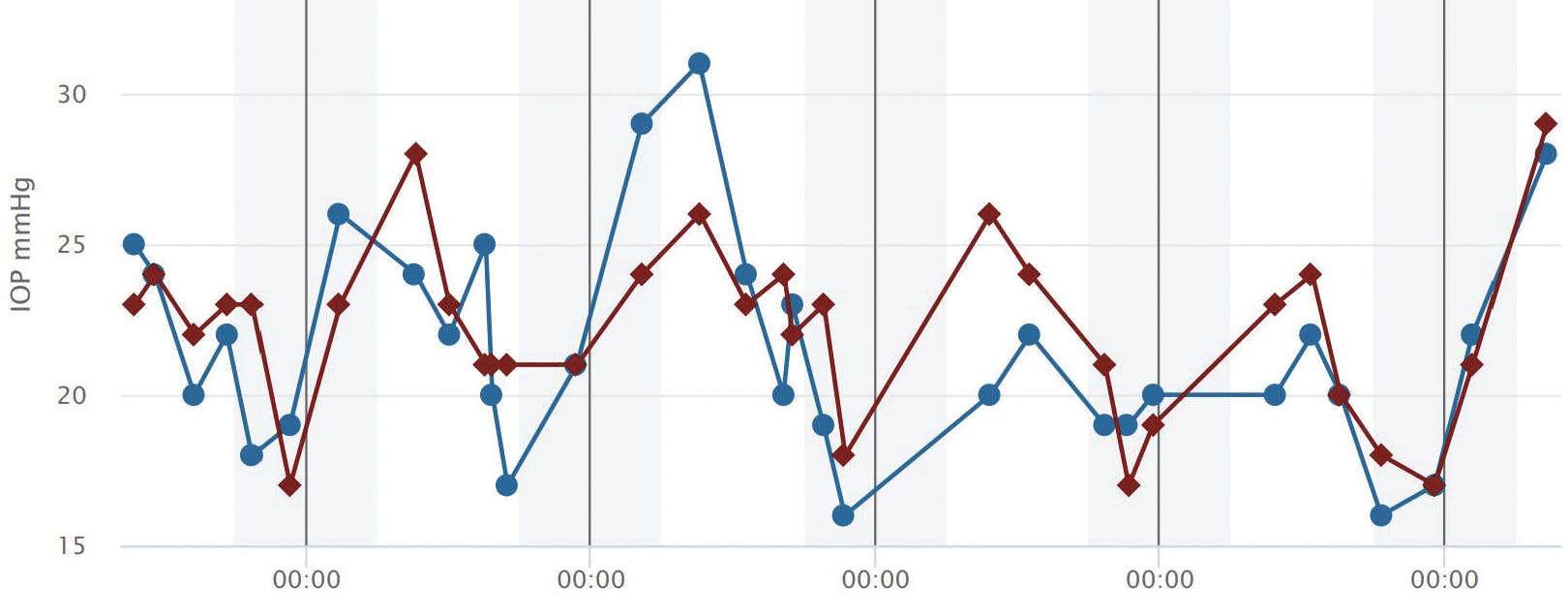
ODD can cause RNFL loss and VF defects that mimic glaucoma. The patient’s IOP was borderline when measured by the referring optometrist but normal when I examined her, which was not consistent with typical glaucoma. Nevertheless, the extent of RNFL thinning, presence of peripapillary atrophy, and highly suspicious VF defects gave me cause for concern. To explore the possibility of fluctuating IOP, she was sent home with instructions to use an iCare Home tonometer (Icare) for 1 week. Fluctuating IOP was revealed in both eyes, with peaks of 31 mm Hg OD and 29 mm Hg OS (Figure 3). The mean IOP was 21.6 mm Hg OD and 22.2 mm Hg OS.
Once elevated IOP had been confirmed, I rendered a diagnosis of open-angle glaucoma in addition to underlying ODD and recommended treatment. Glaucoma severity was difficult to determine because the ODD likely crowded the nerve, masking disc cupping, and were potentially contributing to the VF and RNFL changes. My initial aim was therefore to reduce the IOP by 30% from baseline rather than to a specific target IOP.
The patient and I discussed treatment options, including therapy with a prostaglandin analogue and SLT. She chose the latter and is currently awaiting treatment. Once the desired 30% reduction in IOP is achieved, another week of home tonometry may be considered. Regardless, she will be monitored for glaucomatous progression. Regular follow-up and timely treatment adjustments as necessary should provide her with a favorable long-term prognosis.
1. Youn S, Loshusan B, Armstrong JJ, Fraser JA, Hamann S, Bursztyn LLCD. A comparison of diagnostic accuracy of imaging modalities to detect optic disc drusen: the age of enhanced depth imaging optical coherence tomography. Am J Ophthalmol. 2023;248:137-144.
2. Point system for estimating 5-year risk of developing POAG. Washington University School of Medicine. 2006. Accessed February 11, 2025. https://ohts.wustl.edu/app/uploads/2017/02/Points-System.pdf
3. Kohli D, Chen JJ, Bhatti MT, Moore-Weiss JM, Roddy GW. Optic disc drusen in patients with ocular hypertension: a case series and review of the literature. J Neuroophthalmol. 2022;42(4):470-475.