Schlemm canal devices have demonstrated promise in glaucoma surgery by offering minimally invasive approaches to enhance aqueous humor outflow. The Eyeflow microstent system (Eyeflow) was developed to optimize the stenting of Schlemm canal while also providing a scaffold for targeted drug delivery. This innovative device has the potential to improve both the surgical and pharmacologic management of primary open-angle glaucoma (POAG).
PRINCIPLE OF OPERATION
The Eyeflow microstent dilates Schlemm canal for 4 clock hours, facilitating both transtrabecular and circumferential aqueous humor outflow and directing the fluid toward the collector channel openings within Schlemm canal.
The system consists of the custom-designed Eyeflow inserter, preloaded with the microstent. The inserter cannula has an outer diameter of less than 0.5 mm, which allows it to pass through the main clear corneal incision typically used for cataract surgery. This eliminates the need for an additional corneal incision when the microstent is implanted during cataract surgery. Alternatively, the system may be used in standalone surgery, in which case a 1.0-mm clear corneal incision is required.
DEVICE SPECIFICATIONS
The Eyeflow microstent is made of neurovascular-grade nitinol, a nickel-titanium alloy known for its biocompatibility and durability in neurovascular devices. The material has a history of successful human implantation and is well suited for devices implanted in Schlemm canal.
The microstent is composed of two parallel, arc-shaped rails connected by several vertical supports; tapered distal and proximal tips; and a completely open posterior channel that provides 4 clock hours of continuous dilation of Schlemm canal, allowing uninterrupted access to the collector channel openings that populate the posterior wall of the canal (Figure 1).
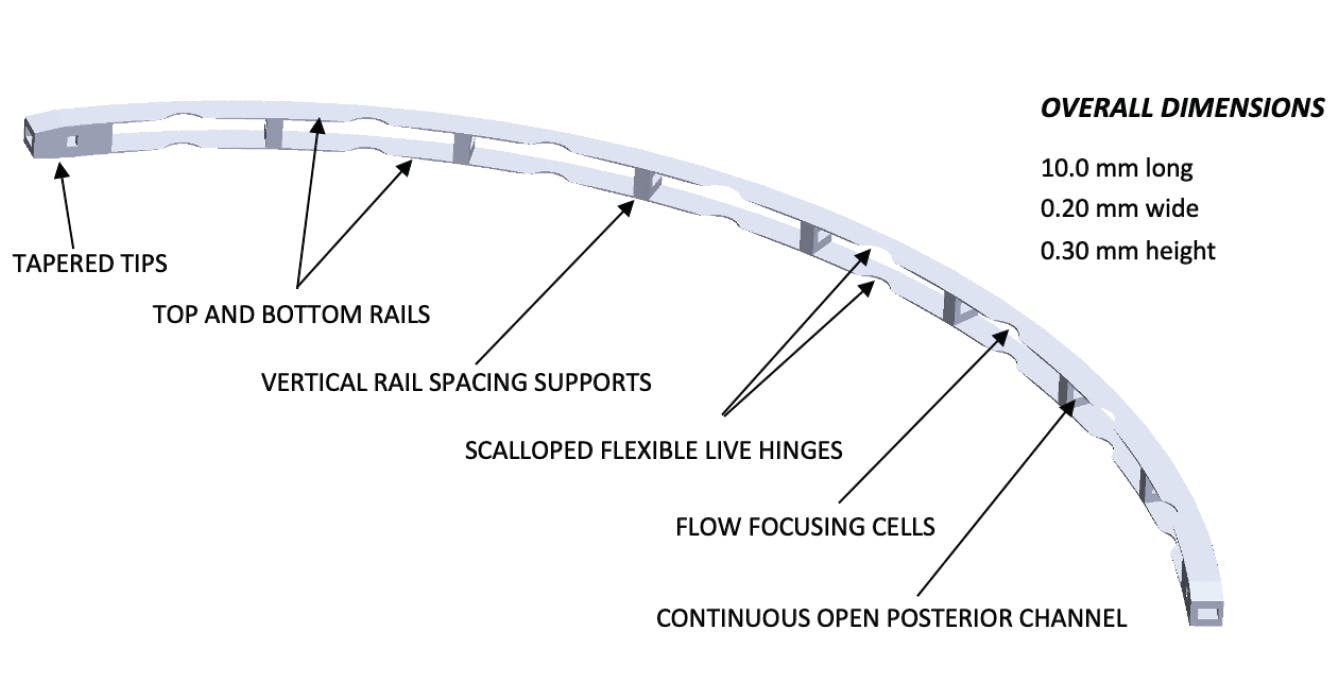
Figure 1. The Eyeflow microstent is composed of two parallel, arc-shaped rails connected by several vertical supports; tapered distal and proximal tips; and an open posterior channel that provides 4 clock hours of continuous dilation of Schlemm canal.
(Figures for illustration purposes only.)
The Eyeflow inserter is ergonomically designed for efficient microstent placement (Figure 2). It features a curvilinear cannula with a beveled tip for the trabecular meshwork incision to optimize stent placement. The finger slide mechanism smoothly advances and retracts the microstent from its preloaded position. The rotatable nose cone supports both right- and left-handed use, allowing forehand or backhand procedures. Once the inserter is flush against the posterior wall of Schlemm canal, the stent follows the eye’s curvature for seamless insertion.
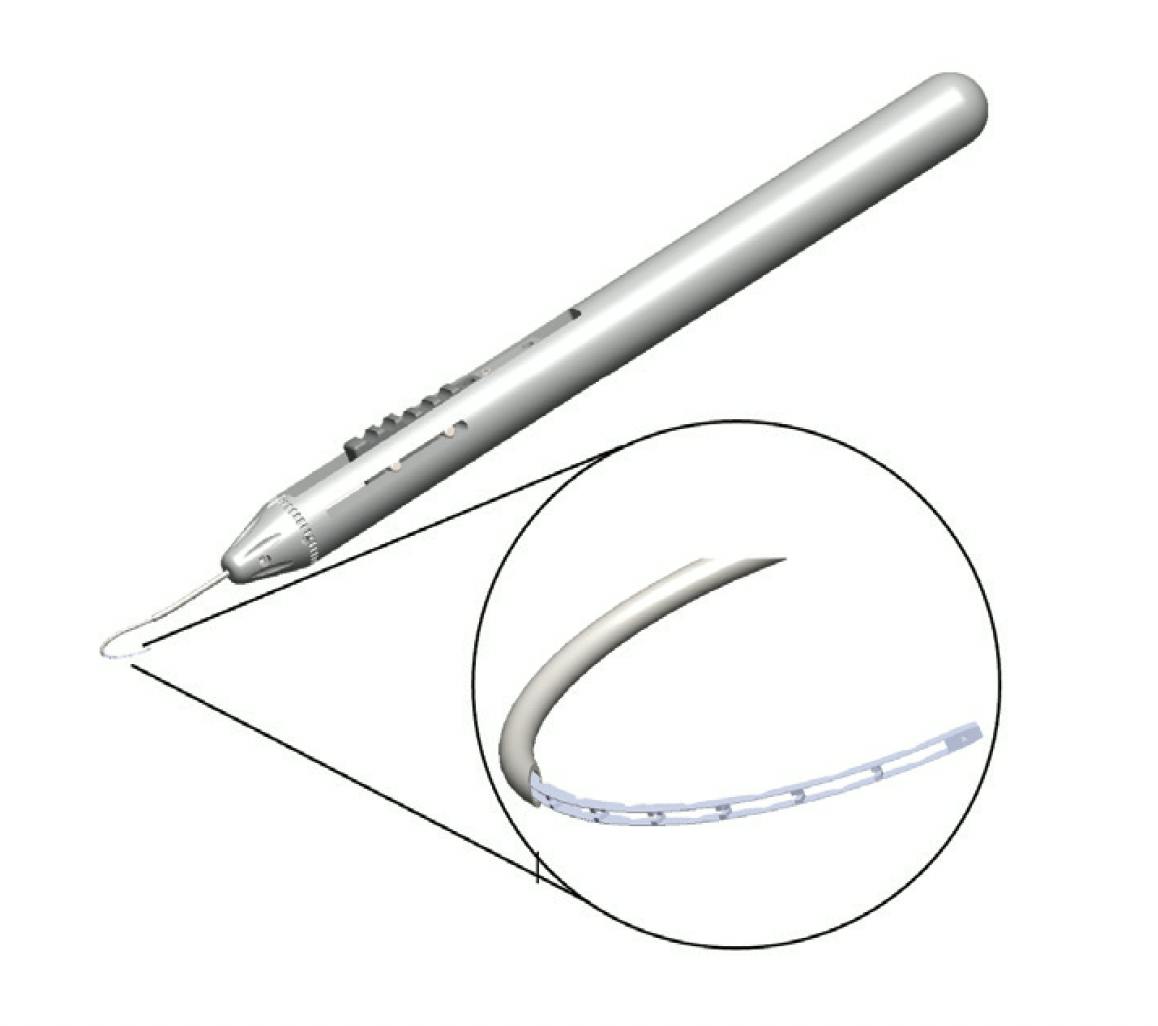
Figure 2. The Eyeflow inserter is designed for efficient microstent placement and features an ergonomic handle, beveled cannula tip, linear finger slide, and rotatable nose cone.
SURGICAL TECHNIQUE
The implantation of the Eyeflow microstent is a straightforward procedure, performed in conjunction with cataract surgery or as a standalone procedure for the treatment of glaucoma:
- Clear corneal incision. In cases of concurrent cataract surgery, the clear corneal incision made for cataract surgery is used for microstent insertion. During standalone surgery, a 1-mm keratome is used to create a temporal clear corneal incision.
- Patient positioning. The patient’s head is tilted 30º so that the nasal quadrant of the angle is visible through the operating microscope.
- Gonioprism placement. A small amount of an OVD is instilled on the surface of the cornea, and a gonioprism is placed over the OVD-coated cornea.
- Repositioning the gonioprism. If necessary, the gonioprism is repositioned to enable full visualization of the nasal quadrant of the trabecular meshwork.
- Cannula insertion. The Eyeflow inserter’s cannula is passed through the corneal incision and positioned at the 9 clock position in the nasal quadrant.
- Trabecular meshwork incision. The trabecular meshwork is incised with the beveled cannula tip.
- Microstent insertion. The cannula tip is positioned at the entrance of the incision, tangent to the curvature of the iridocorneal angle, and the microstent is injected into Schlemm canal.
- Final placement. Once the microstent’s location within Schlemm canal has been confirmed, the cannula is withdrawn.
Key Attributes
Key Attributes of the Eyeflow Microstent Design:
- Tapered tips. The microstent’s distal and proximal tips are shaped similarly to vascular introducers to facilitate atraumatic insertion into and passage through Schlemm canal. This is a novel design compared to current trabecular meshwork stents
- Parallel rails. The parallel top and bottom rails help minimize resistance from the Schlemm canal wall to allow smooth passage of the device
Key Attributes of the Eyeflow Inserter Design:
- Ergonomic handle. The inserter handle enables single-handed operation
- Beveled cannula tip. The beveled tip optimizes the trabecular meshwork incision for precise microstent placement
- Linear finger slide. The finger slide mechanism facilitates easy advancement and retraction of the microstent
- Rotatable nose cone. This feature supports both right- and left-handed use, accommodating forehand and backhand insertion
RESEARCH AND DEVELOPMENT
Benchtop Characterization
The Eyeflow system has been tested in laboratory settings on simulated human eyes, corneal rings, and full cadaver globes. These tests have validated the device’s dimensions and confirmed the effectiveness of its inserter system (data on file with company, 2022).
Preclinical Testing
Preclinical studies have demonstrated the system’s ability to achieve consistent dilation of Schlemm canal. Results have indicated an improvement in aqueous humor drainage and supported the device’s clinical use in glaucoma surgery (data on file with company, 2022).
Clinical Feasibility Studies
Clinical trials outside the United States are evaluating the Eyeflow microstent for the treatment of patients with POAG. The primary objective is to assess the device’s safety and efficacy. Results are nearing 2 years after implantation (data on file with company, 2025).
Platform Design for Ongoing Innovation
The patented microstent is designed to store and elute glaucoma medications within Schlemm canal and the anterior chamber. The device therefore has the potential to provide the dual benefits of improving aqueous humor outflow and providing sustained drug delivery. This could open up new possibilities for eliminating patients’ need for topical glaucoma drops in favor of a more efficient, localized approach to long-term glaucoma management.
CONCLUSION
The Eyeflow system represents a potential step forward in the evolution of MIGS. Clinical trials have demonstrated excellent safety and in situ performance of the microstent, as well as a consistent delivery system without stent migration when the device is placed in the correct surgical plane. Ongoing efforts are further evaluating its safety and efficacy in reducing IOP, both as a Schlemm canal microstent and a preloaded drug delivery device. Given its combination of trabecular meshwork outflow enhancement with drug delivery, the Eyeflow system has the potential to open new avenues for targeted therapies for patients with POAG.