
Elizabeth Martin, MD
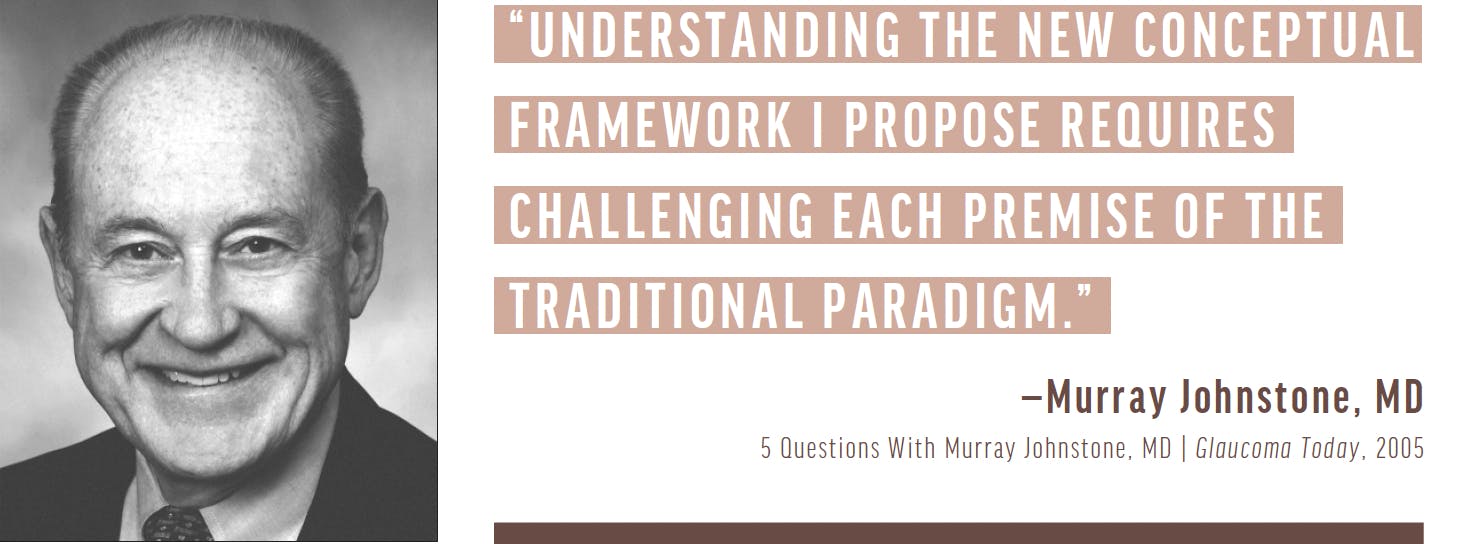
Murray Johnstone, MD, was the epitome of a clinician scientist. The world is so much dimmer without him in it. It is impossible to put into words the impact that Dr. Johnstone has had on the lives of those around him, especially mine.
I first met Dr. Johnstone in 2003, when I was 22 years old. He hired me as a technician, fresh out of college and with no experience. At that point, my future was an open book, but after 3 months with Dr. J, I knew what I wanted to do. I wanted to become an ophthalmologist, specifically a glaucoma specialist. Three months was all it took to cement my future, all because of him.
As a clinician, Dr. J was a perfectionist. He chased after every single mm Hg and every single decibel of vision on the field. Every day, every visit, he fought for his patients’ vision. He walked with his patients on their glaucoma journey, and they loved him for that. Education was important to Dr. Johnstone. As a technician, I was taught “talks” to give patients—glaucoma talks, IOP target talks, trab talks, etc. It was only as a resident that I realized Dr. J had taught all his technicians and patients the pearls of the Ocular Hypertension Treatment Study (OHTS), Early Manifest Glaucoma Trial (EMGT), and Collaborative Normal-Tension Glaucoma Study (CNTGS). He was a scientist who believed in translational medicine.
Dr. Johnstone’s clinic team included technicians who had been with him for nearly 20 years. These technicians stayed with him for their entire careers because he was kind and created a family atmosphere. He did this not only for his employees but also for his patients, because he believed consistency and a knowledgeable staff led to the best patient care. Every week, he had a staff member review the Seattle obituaries. When patients passed, their chart would be placed on his desk so that he could see their vision on their last visit. He was with them fighting until the end, making sure they had sight up until their last day.
As a scientist, Dr. Johnstone was just as fastidious. He trained with the Morton Grant, MD. In Dr. Johnstone’s time at the Howe Laboratory, he discovered components of the outflow system that had yet to be described, and he started to view aqueous outflow and the trabecular meshwork as pulsatile. This pursuit of proving pulsatile flow and trying to discover and better characterize conventional aqueous outflow became his North Star. I was 22 years old with just a bachelor’s degree, working toward a certified ophthalmic assistant degree, and Dr. Johnstone taught me how to conduct research. He taught me how to design a project, submit to an institutional review board, and execute. We first worked on aqueous vein studies in the office, which eventually turned into a research lab at the University of Washington in Seattle. There, we started doing tracer studies, dilating Schlemm canal in primate eyes, and further investigating outflow. Throughout all of it, Dr. J remained passionately focused on discovering the truths of aqueous outflow.
Just like with his patients, Dr. Johnstone fought for the truth. It was often lonely for him, but he continued to pursue and find new ways to look at outflow. It was tremendous to see his theory of pulsatile flow finally accepted and adopted. We worked together for 20 years, but it wasn’t long enough. I will miss his never-ending enthusiasm, the twinkle in his eye, and the pure excitement whenever he talked about his latest outflow experiment or research finding. Selfishly, I will miss his unwavering support and encouragement of my career. He was always by my side, every step, through medical school, ophthalmology residency, glaucoma fellowship, and my first years of practice, cheering me on. I could not have done any of it without him. His voice is the one I will always hear in my head. I hear him while in clinic as I talk to patients about the OHTS trial. I hear him exclaiming, “Wow, that’s beautiful,” at an especially prominent pulsatile aqueous vein. I miss him, and the field will miss him. We are so lucky to have interacted with such a brilliant mind and kind soul.
Thank you, Dr. J, for your direction, your support, and your love. Thank you, Dr. Murray Johnstone, for your unwavering, lifelong dedication to the eye, aqueous outflow, and the fight against glaucoma.

Steven R. Sarkisian Jr, MD
Murray Johnstone, MD, was a singular force in the world of glaucoma research—a rare luminary whose presence elevated every room he entered and every conversation he joined. As one of the last living connections to the legendary Morton Grant, MD, with whom he worked closely in the lab, Murray carried forward a lineage of scientific rigor and curiosity that shaped generations of clinicians and researchers.
I first came to know Dr. Johnstone through the Chandler-Grant Glaucoma Society, where his reputation preceded him, not just as a brilliant scientist but as someone deeply committed to the pursuit of understanding the outflow system. Over the years, we would speak several times annually at various meetings, and I came to observe, with growing admiration, the intensity and clarity of his purpose. Unlike many, Murray approached each day with a focused determination to unravel the mysteries of aqueous outflow—never distracted, never deterred, and never wasting time on the trivial.
At the 2024 AGS annual meeting, I had the privilege of having a deep conversation with him—not about the technical details of his work but about what drove him. It became clear to me that his dedication stemmed from a profound internal calling: a need to understand, to discover, to contribute something lasting. The conversation moved me deeply, and I told him what I saw—that his daily return to the lab was not just the act of a scientist but of someone fulfilling a mission.
Shortly after, on March 4, 2024, he texted me: “Hi Steve, I really enjoyed the chance to visit at the Chandler and Grant dinner. You surprised me when you clearly articulated why I am still involved with the outflow system work. You could explain it better than I could.”
That message captures so much of who Dr. Johnstone was: humble, focused, brilliant, and, above all, purpose-driven. His legacy will live on not just in his contributions to our understanding of glaucoma but in the example he set for how to live a life of meaningful, unwavering inquiry.
Leon Herndon, MD
I was so sorry to hear of Murray’s passing. Even though his career spanned 50 years, his research remained relevant. I am certain that every MIGS industry partner with an interest in the outflow space either consulted with Murray or referred to his research findings. Murray was always generous with his time and was so down-to-earth. When I was a young AGS member, I found Murray to be approachable—this giant in our field would often reach out at meetings to check on me, and he did so as recently as this year’s AGS meeting. Murray was a gentleman and a scholar, and he will be missed.

Leonard K. Seibold, MD
Dr. Johnstone’s work single-handedly changed how I look at angle anatomy and physiology and how best to address it with interventional glaucoma—all this while remaining a humble learner himself, eager to interact and learn right along with his colleagues.

Oluwatosin Smith, MD
Murray Johnstone, MD, was way ahead of us all in his knowledge of the outflow system, which we continually strive to better understand. His work was revolutionary and gave us the ability to try to piece things together. A brilliant scholar who leaves an indelible mark, his absence leaves a void—he will be so missed.
Reay Brown, MD
Three anecdotes come to mind when I think of Murray Johnstone, MD.
No. 1: Celebrating Latisse at the Bar
When Murray finalized the deal to sell his patent to Allergan, we were at the ASCRS annual meeting in San Francisco. He wanted to celebrate, so the two of us went to an upscale bar for a drink. Our bartender was young, friendly, and attractive. As we sat there talking about aqueous outflow, I couldn’t help but think: This woman might one day owe her eyelashes to the eccentric, bald guy sitting next to me. The irony was perfect—and very Murray.
No. 2: The First Purchase
What was the very first major purchase Murray made after his royalty checks from Allergan started coming in? An electron microscope. Not a car, not a vacation—an electron microscope. Because of course he did.
No. 3: The Frozen Body on Mount Rainier
When the ASCRS annual meeting was held in Seattle, Murray invited me to dinner at his home on Mercer Island. On the drive over, we had a clear view of Mount Rainier. I mentioned that a friend of mine had recently climbed it. Murray, completely deadpan, said: “I’ve climbed it, too.” Then he added, “But on the way down, we found a frozen body on the trail. I was the guy assigned to haul the body back down the mountain.” No drama—just Murray casually mentioning his dead body recovery mission, while I was still amazed that he’d climbed Mount Rainier at all.

Shan Lin, MD
I knew Murray for about 25 years. He was always kind and generous. It was a joy to talk with him about science and life. It is hard to accept that I will not be seeing him at the next meeting.

Arsham Sheybani, MD
Despite how influential and brilliant he was, he always took the time to make me feel like I was on his level. That was Murray. No arrogance, no flare—pure MJ.

Richard A. Lewis, MD
We are deeply saddened by the passing of Murray Johnstone, MD—a remarkable individual whose legacy in ophthalmology will endure for generations. A soft-spoken and unassuming gentleman, Murray exemplified humility, integrity, and quiet brilliance in every facet of his life and work.
As a pioneering glaucoma specialist and innovator, he transformed our understanding of aqueous outflow and its role in glaucoma. His groundbreaking research and clinical insights have shaped the field, and his contributions live on through the many patents he held, the surgical techniques he advanced, and the countless patients whose lives he improved.
Murray was the rare blend of scientist and surgeon—a true clinician driven by boundless curiosity and compassion. He was a scholar of the highest order, committed to academic excellence even within a private practice setting. His work bridged the gap between theory and practice, and he did it with unmatched dedication. In my career, it was his office I visited early on to learn how to blend clinical research into a private practice. He was the guy I called when I had clinical questions and problems. Perhaps most dramatically, 3 weeks before his death, Murray and I spent 2 full days driving to and lecturing at a meeting; our conversations in the car were so enlightening and inspiring that, in retrospect, I feel blessed to have been in his presence.
He was also a gifted teacher and international speaker, revered not only for his knowledge but also for the calm, generous way in which he shared it. Whether speaking to a room of global experts or mentoring a young resident, Murray gave of himself freely and graciously.
A man of great altruism, he embodied the qualities we all strive for—committed, kind, ethical, and endlessly curious. As a glaucoma patient himself, his empathy ran deep, making his care for others not only clinically precise but profoundly human.
Dr. Johnstone was, in every sense, the ophthalmologist’s ophthalmologist. We mourn the loss of a colleague, mentor, and friend, and we celebrate a life that enriched our profession and the world beyond it.

Carlos Buznego, MD
Dr. Johnstone reminded us all that the trabecular meshwork is not an inanimate sieve. It is a metabolically active biologic aqueous humor pump, and our interventions need to take that into account.

Shivani Kamat, MD
Murray Johnstone, MD, was a giant in our field and someone I feel so fortunate to have interacted with in the past few years. He forever changed my views on aqueous humor dynamics and how I treat patients today. His kind demeanor and constant willingness to share his wisdom will be deeply missed.