


Although topical medications have a role in glaucoma management, their use is often associated with patient noncompliance. There are many reasons for this noncompliance, some of which include cost concerns, adverse reactions, and patient forgetfulness. Regardless of the reason, noncompliance with topical therapy may consequently lead to disease progression and loss of vision.1 According to recent study results examining the association between patients lost to follow-up and incident blindness among patients with primary open-angle glaucoma (POAG) over a 6-year period, 4.2% of patients with POAG developed incident monocular blindness and 0.5% developed binocular blindness in 2019.2
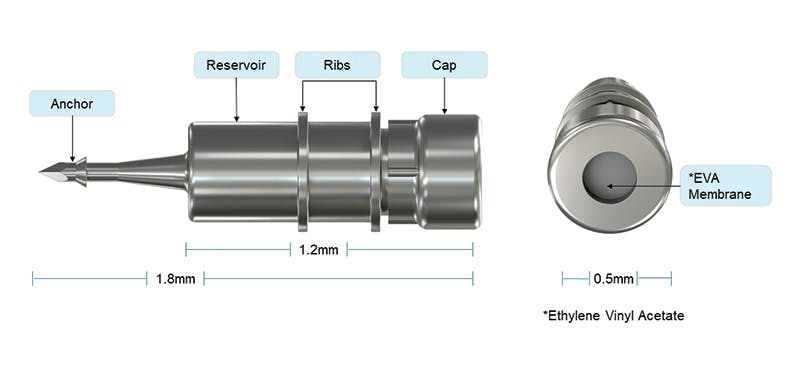
The emergence of interventional glaucoma suggests a different approach for management. Instead of topical drops being the mainstay of therapy, procedural pharmaceuticals, lasers, and MIGS are used proactively to improve IOP control, lower the risk of vision loss, and reduce reliance on eye drops, thereby improving patients’ quality of life. In the following case, I will discuss how cataract surgery in a patient with coexisting glaucoma presented an opportunity to address both issues with the use of iDose TR (Glaukos Corporation, Figure 1), at the time of IOL implantation.
Case Report
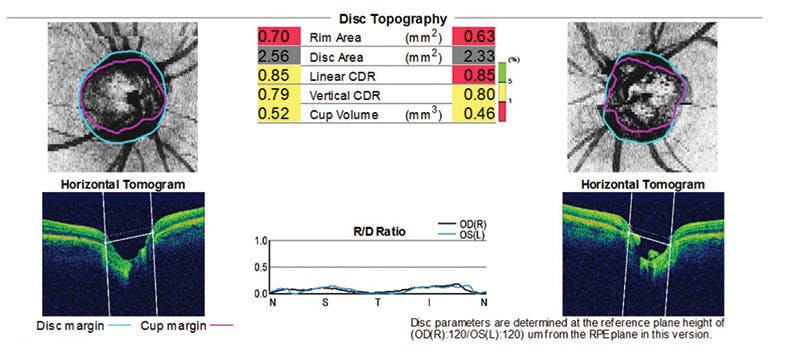
In March 2025, a 73-year-old male presented to our clinic for routine follow-up related to age-related cataracts OU. Imaging from 1 year prior demonstrated co-existing POAG OU (Figure 2). At presentation, the patient was using Refresh Tears 0.5% (AbbVie, 1 drop QAM OU) to treat preexisting dry eye, and timolol maleate 0.5% (1 drop QAM OU) and travoprost 0.004% (1 drop QHS OU) for management of his POAG. At this initial visit:
- The patient’s visual acuity measured 20/50 -1 Glare: 20/100 OD, 20/20 Glare: 20/40 OS.
- Manifest refraction measured -0.25 +1.00 X 173 OD and -0.25 +2.00 X 178 OS.
- A slit lamp examination demonstrated 2-3+ nuclear sclerosis in both the left and right lenses.
- IOP measured 17 mm Hg OD, 18 mm Hg OS.
- On ophthalmic examination, he was found to have a cup-to-disc ratio of 0.55 OU, which is consistent with intermediate stage glaucoma.
After counseling the patient, we decided to address both chief complaints (glaucoma and cataract) in a single setting. We would conduct femtosecond laser-assisted cataract surgery (FLACS) with a toric IOL and iDose TR OS, then evaluate OD. At this time, the patient was still using timolol maleate 0.5% and travoprost 0.004%.
After a successful cataract surgery OS, we proceeded with FLACS, toric IOL, and iDose TR OD. At the time of a postoperative follow-up exam in early May 2025, the patient’s visual acuity measured 20/25 +1 OD, 20/20 OS. IOP measured 12 mm Hg OD, 13 mm Hg OS. At this time, he no longer required travoprost 0.004% and only remained on timolol maleate 0.5%.
Following two successful procedures, the patient returned to me in August 2025 with a chief complaint of mild glare at distance OU. Visual acuity measured 20/20 -1 Glare: 20/40 OD, 20/20 Glare: 20/40. IOP was 11 mm Hg OD, 15 mm Hg OS. At this visit, the patient had discontinued use of all previous ophthalmic medications. After discussing treatment options with the patient—including YAG laser posterior capsulotomy—we ultimately decided to continue observation of both eyes. I recommended that the patient return in 6 months for an evaluation, and to call the office should posterior capsular opacification symptoms worsen.
Quality of Life
This case is an example of how the advent of procedural pharmaceuticals has added to the ability to individualize care of glaucoma patients. In the emerging interventional glaucoma paradigm, procedural pharmaceuticals can be used to reduce medication burden and take compliance out of patients’ hands. Furthermore, having a 24/7, long-duration PGA therapy in place may eliminate diurnal fluctuations of IOP. Emerging evidence indicates IOP fluctuation may be associated with faster glaucoma progression.3,4
In this patient case, we were able to address multiple issues simultaneously. The existence of a cataract presented an opportunity to proactively intervene and address the patient’s coexisting glaucoma. Additionally, this patient was also found to have astigmatism in both eyes. Although limbal relaxing incisions were a consideration, the patient’s manifest refraction suggested that a toric lens would be more suitable. Nevertheless, at the most recent follow-up visit, the patient’s IOP was under control, his visual acuity had improved to 20/20 OU, and his manifest refraction measured -0.25 + 0.75 X 155 OD and plano +0.75 X 180 OS.
It's important to note that at initial presentation, the patient was on two topical drops for treatment of POAG and was also being treated for symptoms of dry eye. As a result of having iDose TR implanted bilaterally at the time of cataract surgery, he was able to discontinue use of his glaucoma medications, thus removing an insult to the ocular surface. Therefore, in addition to reducing medication burden associated with the POAG, the patient was also able to discontinue use of medication for dry eye. Individual results may vary.
It is rewarding to not only relieve a patient of medication burden, but to alleviate their discomfort from multiple ocular issues.
1. Newman-Casey PA, Niziol LM, Gillespie BW, et al. The Association between medication adherence and visual field progression in the Collaborative Initial Glaucoma Treatment Study. Ophthalmology. 2020;127(4):477-483.
2. Williams AM, Liang HW, Lin HHS. Loss to follow-up and risk of incident blindness among patients with glaucoma in the IRIS® registry. Ophthalmol Glaucoma. 2025:S2589-4196(25)00104-108.
3. Asrani SG, McGlumphy EJ, Al-Aswad LA, Chaya CJ, Lin S, Musch DC, Pitha I, Robin AL, Wirostko B, Johnson TV. The relationship between intraocular pressure and glaucoma: an evolving concept. Prog Retin Eye Res. 2024;103:101303. doi:10.1016/j.preteyeres.2024.101303
4. Liu T, Cai YL, Hu MY, et al. The impact of intraocular pressure fluctuations on the progression of glaucoma and associated factors. Adv Ophthalmol Pract Res. 2025;5(2):142-148. doi:10.1016/j.aopr.2025.03.002.
INDICATIONS AND USAGE
iDose TR (travoprost intracameral implant) is indicated for the reduction of intraocular pressure (IOP) in patients with open angle glaucoma (OAG) or ocular hypertension (OHT).
IMPORTANT SAFETY INFORMATION
Dosage and Administration
For ophthalmic intracameral administration. The intracameral administration should be carried out under standard aseptic conditions.
Contraindications
iDose TR is contraindicated in patients with active or suspected ocular or periocular infections, patients with corneal endothelial cell dystrophy (e.g., Fuch’s Dystrophy, corneal guttatae), patients with prior corneal transplantation, or endothelial cell transplants (e.g., Descemet’s Stripping Automated Endothelial Keratoplasty [DSAEK]), patients with hypersensitivity to travoprost or to any other components of the product.
Warnings and Precautions
iDose TR should be used with caution in patients with narrow angles or other angle abnormalities. Monitor patients routinely to confirm the location of the iDose TR at the site of administration. Increased pigmentation of the iris can occur. Iris pigmentation is likely to be permanent.
Adverse Reactions
In controlled studies, the most common ocular adverse reactions reported in 2% to 6% of patients were increases in intraocular pressure, iritis, dry eye, visual field defects, eye pain, ocular hyperaemia, and reduced visual acuity.
Please see full Prescribing Information. https://www.glaukos.com/wp-content/uploads/2024/03/iDose-TR-Prescribing-Information.pdf
You are encouraged to report all side effects to the FDA. Visit www.fda.gov/medwatch, or call 1-800-FDA-1088. You may also call Glaukos at 1-888-404-1644.
Dr. Williamson has been compensated by Glaukos for his participation.
© 2025 Glaukos PM-US-3308

