CASE PRESENTATION
A 62-year-old White woman is referred for a glaucoma evaluation. In 2021, the patient underwent cataract surgery combined with ab interno canaloplasty and 360º ab interno goniotomy using the Omni Surgical System (Sight Sciences) in each eye. She underwent bilateral selective laser trabeculoplasty (SLT) in 2023 and received a bimatoprost implant (Durysta, AbbVie) in each eye in the middle of 2024. Six months ago, repeat 360º SLT was performed bilaterally.
The patient is intolerant of essentially all topical medications, including prostaglandin analogues and preservative-free agents. Her current drug regimen consists of twice-daily oral extended-release acetazolamide 500 mg, which she is tolerating well.
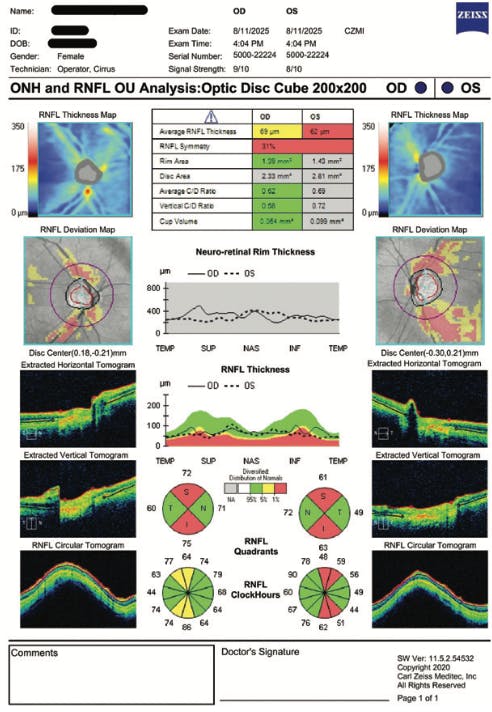
On examination, her BCVA is 20/20 OD and 20/25 OS. The IOP is 23 mm Hg OD and 10 mm Hg OS. Corneal thickness measurements are 594 µm OD and 584 µm OS. Gonioscopy finds open angles, but 360º of the trabecular meshwork is completely unroofed in each eye. Visual field testing detects early changes in the superior quadrant of the right eye and significant changes in the inferior quadrant of the left eye (Figure 1) that are mirrored by OCT (Figure 2).
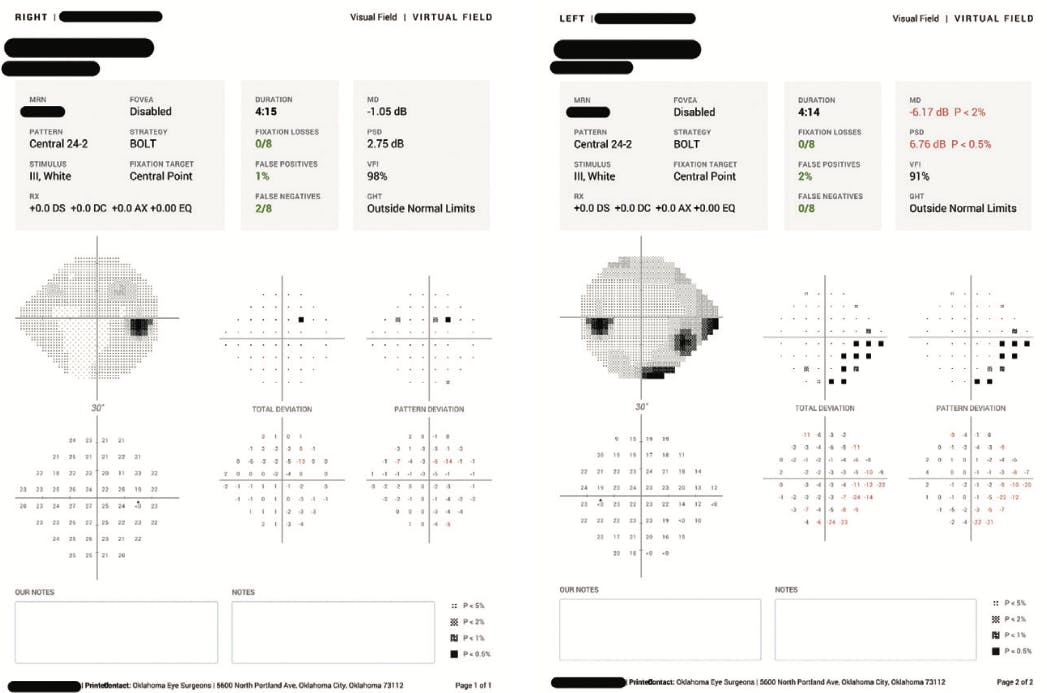
Figure 1. Visual field testing shows early changes to the superior quadrant in the right eye and significant inferior changes in the left eye.
The target IOP is in the midteens. How would you proceed?
—Case prepared by
Steven R. Sarkisian Jr, MD
Ticiana De Francesco, MD
The patient has mild glaucoma in the right eye that is uncontrolled despite maximum tolerated medical therapy. Because Schlemm canal has already been addressed surgically, the remaining minimally invasive options by which to lower the IOP are suprachoroidal MIGS and subconjunctival procedures such as minimally invasive bleb surgery (MIBS).
In this situation, I would favor a stepwise approach beginning with a suprachoroidal procedure such as the AlloFlo Uveo (Iantrek) in the right eye. Given the mild visual field damage, this option would offer a favorable safety profile, preserve conjunctiva for future surgery, and be less invasive than subconjunctival options. In a prospective study, nearly 80% of patients treated with the AlloFlo had an IOP of 15 mm Hg or lower at 2 years.1 These findings suggest a high likelihood of achieving the patient’s target IOP with the procedure.
Postoperatively, treatment with acetazolamide would be discontinued, and the IOP in the left eye would be monitored. If the IOP rises above target, the next step would be guided by the outcome in the right eye. If the suprachoroidal approach is successful, an AlloFlo would be implanted. Otherwise, given the more advanced disease and visual field loss in the left eye, MIBS would be performed.
The patient is an excellent candidate for suprachoroidal MIGS and has a strong likelihood of achieving IOPs in the midteens while preserving future surgical options.
Alexandros Pappas, DO
This is a familiar but challenging scenario: multiple prior interventions, an intolerance of topical therapy, and asymmetric disease progression with the IOP above target in the better-seeing eye. With a history of canaloplasty, goniotomy, two SLT procedures, and a bimatoprost implant, most of the patient’s angle-based and conservative options have been exhausted. Oral acetazolamide has provided good IOP control in the left eye, but the right eye remains undertreated. Systemic therapy alone, moreover, is not a durable solution.
With its better functional reserve, the right eye requires a filtering procedure to achieve long-term IOP control. A trabeculectomy with mitomycin C is the gold standard for reliably decreasing IOP into the midteens or lower, but the risks of hypotony, bleb leak, and bleb-related infection require a clear discussion. The placement of a Xen Gel Stent (AbbVie) with adjunctive mitomycin C would be a strong alternative in this setting—one that could offer a more controlled postoperative course with a lower risk of hypotony—but the need for postoperative needling and revisions is not uncommon. The decision between the two approaches would be based on tissue quality, the patient’s tolerance of risk, and the surgeon’s familiarity with each procedure.
For the left eye, continued monitoring on the current regimen is reasonable, but micropulse transscleral cyclophotoco- agulation (TSCPC) using the MicroPulse P3 (Iridex) could be considered to reduce her long-term reliance on systemic acet- azolamide. TSCPC has a safer profile than traditional cyclodestruction and would preserve conjunctiva for filtering surgery, should it become necessary in the future.
The immediate priority is securing long-term stability to preserve vision in the right eye while maintaining current IOP control and vigilant monitoring in the left eye.
Justin Spaulding, DO
This is a difficult but familiar scenario of refractory glaucoma after multiple inter- ventions. Because the patient has already exhausted one sustained-release intracameral pharmacologic, I would not consider adding a travoprost intracameral implant 75 µg (iDose, Glaukos).
With an IOP persistently above target and early field loss, the right eye is the greater concern. The IOP in the left eye remains on target, but advanced structural and functional damage is present. Trabecular outflow has been maximized, and repeat SLT is unlikely to help given the fully unroofed trabecular meshwork. At this stage, I believe a filtering procedure would be the most appropriate next step.
Between trabeculectomy and tube shunt surgery, I would favor the former. Trabeculectomy would be more likely to achieve an IOP in the mid- to low teens. It would also preserve conjunctival real estate and maintain the option of tube shunt surgery in the future if needed. Although trabeculectomy carries higher surgical risks, including hypotony and bleb-related complications, its efficacy is particularly important for a patient unable to tolerate adjunctive medications. The Xen Gel Stent has a more favorable safety profile, and its implantation would be less invasive. Compared with trabeculectomy, however, the Xen is associated with a less robust IOP reduction and higher rates of revision or escalation.
In an older individual who had a more limited life expectancy, the balance of risks and benefits might favor Xen implantation. Given the patient’s relative youth, need for reliable long-term IOP control, and poor tolerance of medications, however, trabeculectomy would be my preferred strategy.
H. George Tanaka, MD
The right eye has mild open-angle glaucoma, which is poorly controlled despite prior MIGS, a procedural pharmaceutical, two SLT treatments, and maximum tolerated medical therapy with an oral carbonic anhydrase inhibitor. A travoprost intracameral implant or TSCPC using the MicroPulse P3 could be considered to reduce the acetazolamide dosage. The patient, however, would be better served by surgical rather than medical treatment to avoid potential adherence issues and electrolyte disturbances.
MIBS such as a Xen Gel Stent or AquaLumen (PLU Ophthalmic) might achieve the target IOP, but the patient’s young age increases the risk of failure. The Primary Tube Versus Trabeculectomy (PTVT) Study found that both trabeculectomy and tube shunt implantation can achieve favorable IOP outcomes with minimal medications, but the risk of serious complications (hypotony maculopathy, endophthalmitis, tube erosion, diplopia, corneal decompensation) would not justify such invasive surgeries.2
The patient has mild disease and excellent central visual acuity. I would therefore proceed with cyclodialysis cleft creation and scleral reinforcement with the AlloFlo Uveo system, the only suprachoroidal MIGS procedure currently available in the United States, where I practice. Intraoperatively, I would create a moderately sized cleft, perform adequate posterior viscodis- section, and place two scleral spacers 1 mm apart. With the AlloFlo Uveo system, I have been able to achieve IOPs in the mid- to low teens on minimal or no medication with rapid postoperative visual recovery and a low risk of vision- threatening complications.
WHAT I DID: Steven R. Sarkisian Jr, MD
This case illustrates a common yet underdiscussed scenario: a patient with mild glaucoma by visual field criteria whose disease remains refractory to conventional therapy. Glaucoma is not a disease that can be easily protocolized; according to a current interventional glaucoma treatment algorithm that I follow, however, SLT is first-line therapy, and sustained-release medications are second-line options along with or before topical eye drops. Canal-based MIGS is generally offered as second- or third-line treatment depending on the patient’s preference, IOP, and medication tolerance.
Thus, this patient needed what I would consider a fourth-line intervention. Two of the panelists recommended a filtering procedure, specifically a Xen Gel Stent, and the other two suggested opening the suprachoroidal space with an AlloFlo Uveo. Although trabeculectomy was mentioned, only one of the panelists recommended it due to the patient’s age. Her target IOP was in the midteens, and the other modalities carry a lower risk of hypotony than traditional filtering surgery.
After careful consideration of the options, including the Xen and AlloFlo Uveo, and a detailed discussion with the patient, the decision was made to proceed with 360º of endoscopic cyclophotocoagulation plus (ECP plus) using the Leos system (BVI Medical). This updated ECP platform features a disposable, single-use curved probe that provides clear visualization, auto- focus, light adjustment, and the ability to rotate the image using a footpedal. I have found these are significant improvements over the original system developed several decades ago, which remains in use worldwide.
The ciliary sulcus was dilated with an OVD. Next, ECP plus was performed, with laser energy applied to more than just the most anterior surface of the ciliary processes in order to achieve a lower IOP. There was minimal inflammation at 1 week postoperatively and none at 1 month. Three months postoperatively, the IOP was 14 mm Hg OD. The patient elected to continue treatment with acetazolamide because she was tolerating it well and maintained systemic monitoring by her primary care physician.
This case underscores the importance of individualized glaucoma management. There is a range of appropriate options depending on surgeon and patient preferences that are revealed during the informed consent process. This case also highlights the potential of ECP plus to achieve favorable outcomes in select situations.
1. Calvo E, De Francesco T, Vera L, Tyson F, Weinreb RN. Bio-interventional uveoscleral outflow enhancement surgery for primary open-angle glaucoma: 2-year results of cyclodialysis with scleral allograft reinforcement. Ophthalmol Sci. 2025;5(4):100727.
2. Gedde SJ, Feuer WJ, Lim KS, et al; Primary Tube Versus Trabeculectomy Study Group. Treatment outcomes in the Primary Tube Versus Trabeculectomy Study after 5 years of follow-up. Ophthalmology. 2022;129(12):1344-1356.
_1754918026.png?auto=compress,format)