


Glaucoma drainage devices, also known as tube shunts, are most commonly used in the context of refractory and medically uncontrolled glaucoma. The two most frequently used tube shunts are the Ahmed Glaucoma Valve (AGV; New World Medical) and the Baerveldt Glaucoma Implant (BGI; Johnson & Johnson Vision). Both were introduced in the 1990s and have undergone minimal to no design changes in more than 20 years. Comparative studies have found that the BGI has a lower failure rate but a significantly higher risk of hypotony than the AGV.1 The superior efficacy of the BGI is thought to be related to its larger endplate surface area compared with the AGV (350 mm2 vs 184 mm2).
CHARACTERISTICS OF THE PAUL GLAUCOMA IMPLANT
When deciding between an AGV and a BGI, surgeons must choose between the higher safety profile of the former and the superior efficacy of the latter. The Paul Glaucoma Implant (PGI; Advanced Ophthalmic Innovations) was designed to fulfill the unmet need for a tube shunt with greater efficacy but a lower risk of hypotony than the available options. The PGI was developed by surgeons at the National University Hospital in Singapore and Moorfields Eye Hospital in London. It has CE Mark approval and is commercially available in parts of Europe and Asia.
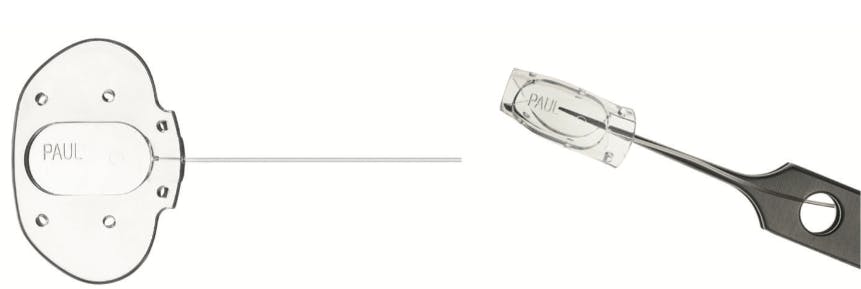
Like the AGV and BGI, the PGI is made of medical-grade silicone. It is a nonvalved tube implant with an endplate surface area similar to that of the BGI and larger than that of the AGV. A unique feature of the PGI is its smaller tube, which has an internal diameter of 127 µm. This is significantly smaller than those of the BGI and AGV, which have internal tube diameters of 300 µm (Figure 1). The smaller lumen size may reduce the risk of persistent hypotony.2 The tube also occupies less space in the anterior chamber, theoretically minimizing the risk of endothelial cell loss, although more studies are required to support this claim. Another distinguishing feature of the PGI is its pliability, which allows for flexibility in placement of the plate under the muscles, especially in complex cases of eyes with a history of filtration surgery (Figure 2).
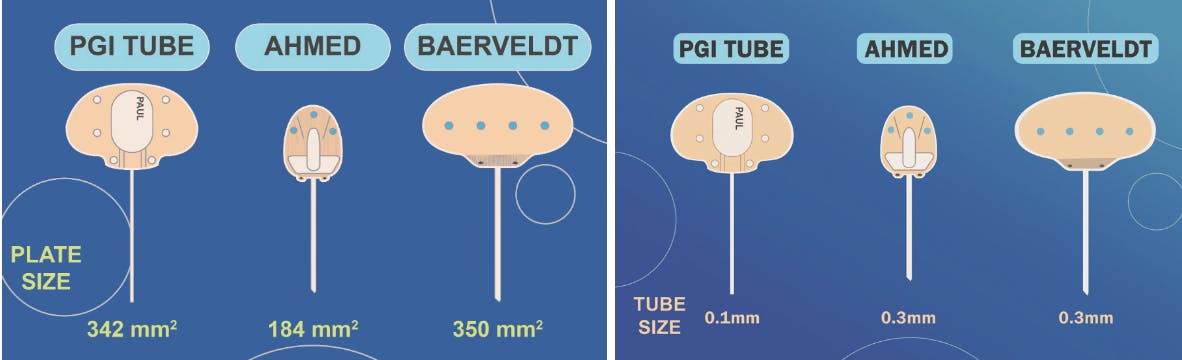
Figure 1. The PGI has an endplate surface area similar to that of the BGI and larger than that of the AGV and a smaller tube size than either of them.
SURGICAL TECHNIQUE AND POSTOPERATIVE MANAGEMENT
The surgical procedure to implant a PGI should feel familiar to glaucoma surgeons because it follows the standard principles of tube shunt surgery. Various techniques for implanting nonvalved tube shunts are in use, but in my experience, inserting an intraluminal stent (usually a 6-0 polypropylene suture) into the PGI tube lumen provides the most predictable outcomes. The stent does not completely occlude the tube lumen and allows early aqueous flow through it, thus avoiding early postoperative IOP spikes. The technique also provides sufficient flow resistance to minimize the risk of early hypotony. If the patient’s IOP subsequently rises, the stent can be easily removed at the slit lamp, increasing aqueous flow through the tube. In this way, surgeons can tailor postoperative management to each patient’s response. With this surgical technique, I have found the postoperative course of the PGI to be more straightforward than that of other tube shunts, with fewer early postoperative complications that necessitate repeat surgery.
The use of adjunctive mitomycin C and anti-VEGF drugs in tube shunt surgery for primary open-angle glaucoma is not well established. These agents may have a role in patients who scar aggressively and in those with advanced glaucoma who require a very low target IOP. Further research is warranted.
CLINICAL DATA
All clinical studies conducted to date have reported that the PGI is effective for decreasing IOP and reducing patients' need for IOP-lowering medications.2 These results have been sustained for at least 3 years in patients with primary open-angle glaucoma,3-5 and 5-year data should be available soon. Tan et al reported that, at 3 years after PGI implantation, mean IOP was 14.9 mm Hg compared with 32.6 mm Hg at baseline, with a reduction in glaucoma medications from 3.13 at baseline to 0.17 at 3 years (Figure 3).5 The PGI has also been shown to be effective in eyes with uveitic, neovascular, and pediatric glaucoma as well as in combination with cataract surgery.6-9
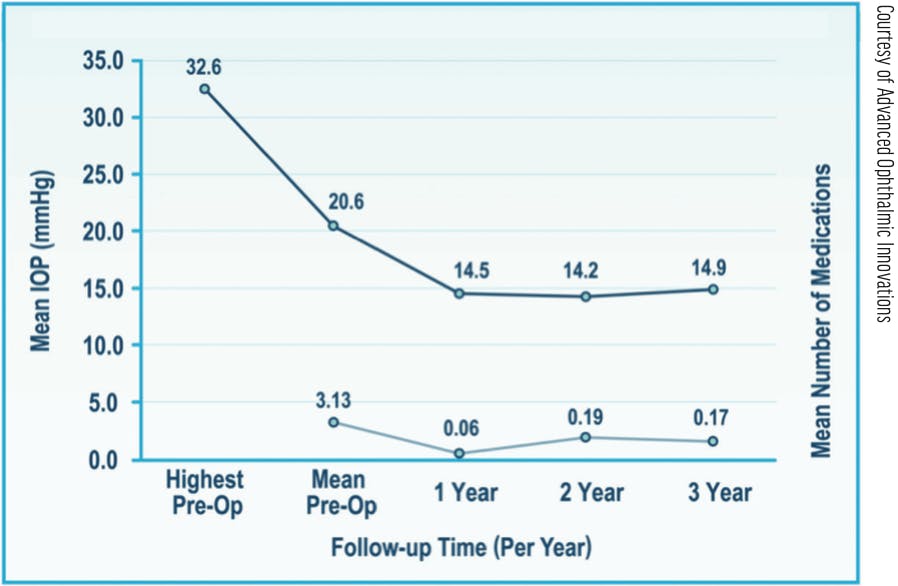
Figure 3. Three-year outcomes of the PGI reported by Tan et al demonstrated a reduction in mean IOP and number of glaucoma medications.5
Studies directly comparing the PGI with other tube shunts are limited. Berteloot et al reported that the PGI and BGI have similar success rates (91% and 89%, respectively).10 The PGI demonstrated superior early postoperative IOP control with less early postoperative hypotony than the BGI, likely because of its smaller tube diameter. Other studies comparing the PGI to the AGV found potentially reduced complications in the PGI group, although these studies are limited by their small sample sizes.11,12
A systematic review of 18 studies with moderate- to good-quality evidence reported that the PGI consistently demonstrated significant IOP reduction across various studies and glaucoma subtypes. Mean IOP reductions ranged from 14.8 to 19.1 mm Hg, with qualified success rates of up to 93.2% and potentially fewer early complications compared with other glaucoma drainage devices.2
CONCLUSION
Less than 6 years since its introduction in the United Kingdom, the PGI is used in more than 60 countries and is becoming a valued tool for many glaucoma surgeons. Its large endplate surface area combined with a smaller tube lumen than those of the BGI and AGV may give the PGI superior efficacy and reduces the risk of complications, especially hypotony. More prospective, comparative, randomized studies are required.
1. Budenz DL, Barton K, Gedde SJ, et al. Five-year treatment outcomes in the Ahmed Baerveldt comparison study. Ophthalmology. 2015;122:308-316.
2. Carla MM, Gambini G, Boselli, et al. The Paul Glaucoma Implant: a systematic review of safety, efficacy, and emerging applications. Graefes Arch Clin Exp Ophthalmol. 2025;263:2447-2459.
3. Koh V, Chew P, Triolo G, Lim KS, Barton K; Paul Glaucoma Implant Study Group. Treatment outcomes using the Paul Glaucoma Implant to control intraocular pressure in eyes with refractory glaucoma. Ophthalmol Glaucoma. 2020;3(5):350-359.
4. Weber C, Hundertmark S, Stasik I, Holz FG, Mercieca K. Two-year clinical outcomes of the Paul Glaucoma Implant in White patients with refractory glaucoma. J Glaucoma. 2024;33(10):808-814.
5. Tan MCJ, Ong CW, Aquino MC, et al. Three-year outcomes of the Paul Glaucoma Implant for treatment of glaucoma. J Glaucoma. 2024;33(7):478-485.
6. Richardson J, Tacea F, Yu J, Yau K, Fenerty C, Au L. The Paul Glaucoma Implant in the management of uveitic glaucoma-3-year follow-up. Eye (Lond). 2025;39(5):931-937.
7. Olgun A, Karapapak M. Impact of mitomycin C on surgical outcomes of Paul Glaucoma Implant in neovascular glaucoma: 12-month follow-up results. Eur J Ophthalmol. 2025;35(4):1305-1313.
8. Vallabh NA, Mohindra R, Drysdale E, Mason F, Fenerty CH, Yau K. The Paul Glaucoma Implant: 1-year results of a novel glaucoma drainage device in a pediatric cohort. Graefes Arch Clin Exp Ophthalmol. 2023;261(8):2351-2358.
9. Karapapak M, Olgun A. One-year outcomes of the Paul Glaucoma Implant compared with the Ahmed Glaucoma Valve for the treatment of silicone oil glaucoma. J Glaucoma. 2024;33(5):310-316.
10. Berteloot S, Correia Barão R, Abegão Pinto L, Vandewalle E, Stalmans I, Lemmens S. Treatment outcomes comparing the Paul and Baerveldt Glaucoma Implants after one year of follow up. J Glaucoma. 2024;33:594-600.
11. Elhusseiny AM, Khaled OM, Chauhan MZ, Sayed MS, Shaarawy T. Initial results of the Paul Ahmed Comparison (PAC) study in refractory childhood glaucoma. Am J Ophthalmol. 2025;271:71-78.
12. Bamefleh D, Alabduljabbar K, Alkhodier A. Comparative outcomes of Ahmed Glaucoma Valve implant and Paul Glaucoma Implant in managing aphakic glaucoma: a case report. Int J Surg Case Rep. 2025;130:111316.

