CASE PRESENTATION
A 68-year-old White woman is referred for the management of advanced glaucoma in her only seeing eye. The eye has a moderate nuclear sclerotic cataract, high axial myopia with a spherical equivalent of -19.50 D, an axial length of 30.5 mm, and signs of myopic macular degeneration. The patient underwent a laser peripheral iridotomy (LPI) a year ago but has no other history of laser or incisional treatment.
On presentation, the IOP is 32 mm Hg on maximum tolerated medical therapy, which includes four classes of topical drops and oral acetazolamide 125 mg dosed twice daily. Her BCVA is 20/80. A potential acuity meter suggests an improvement to 20/30 following cataract extraction, but this is limited by both glaucomatous and myopic macular changes.
A slit-lamp examination reveals a moderate nuclear sclerotic cataract and iris transillumination defects but no posterior bowing, consistent with a patent iridotomy. The trabecular meshwork shows minimal pigmentation, and no Krukenberg spindle is evident. Marked cupping of the optic disc is observed; the cup-to-disc ratio is 0.9, and there is significant peripapillary atrophy (Figure 1). Corneal hysteresis is 6.4, suggesting that the true IOP may be higher than the measured IOP.
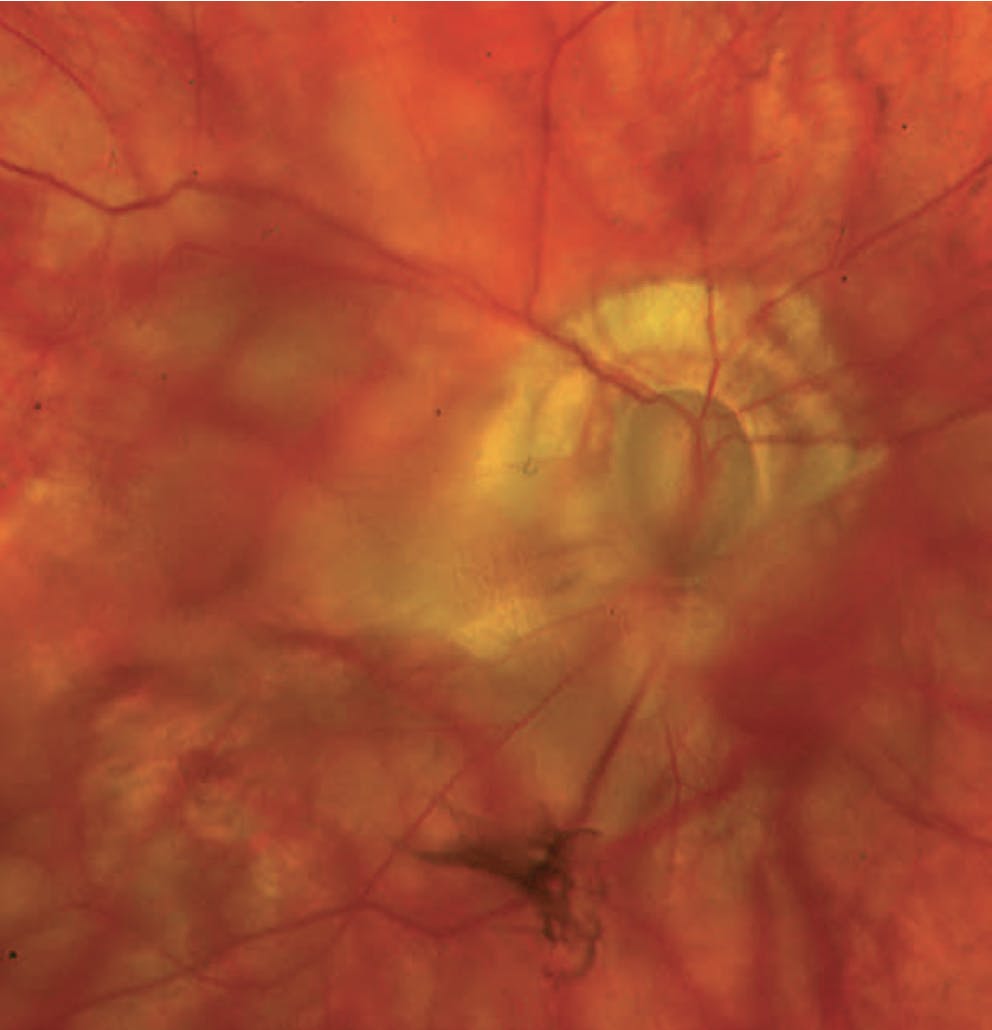
Figure 1. Fundus photography shows marked cupping, peripapillary atrophy, and media opacity from a cataract.
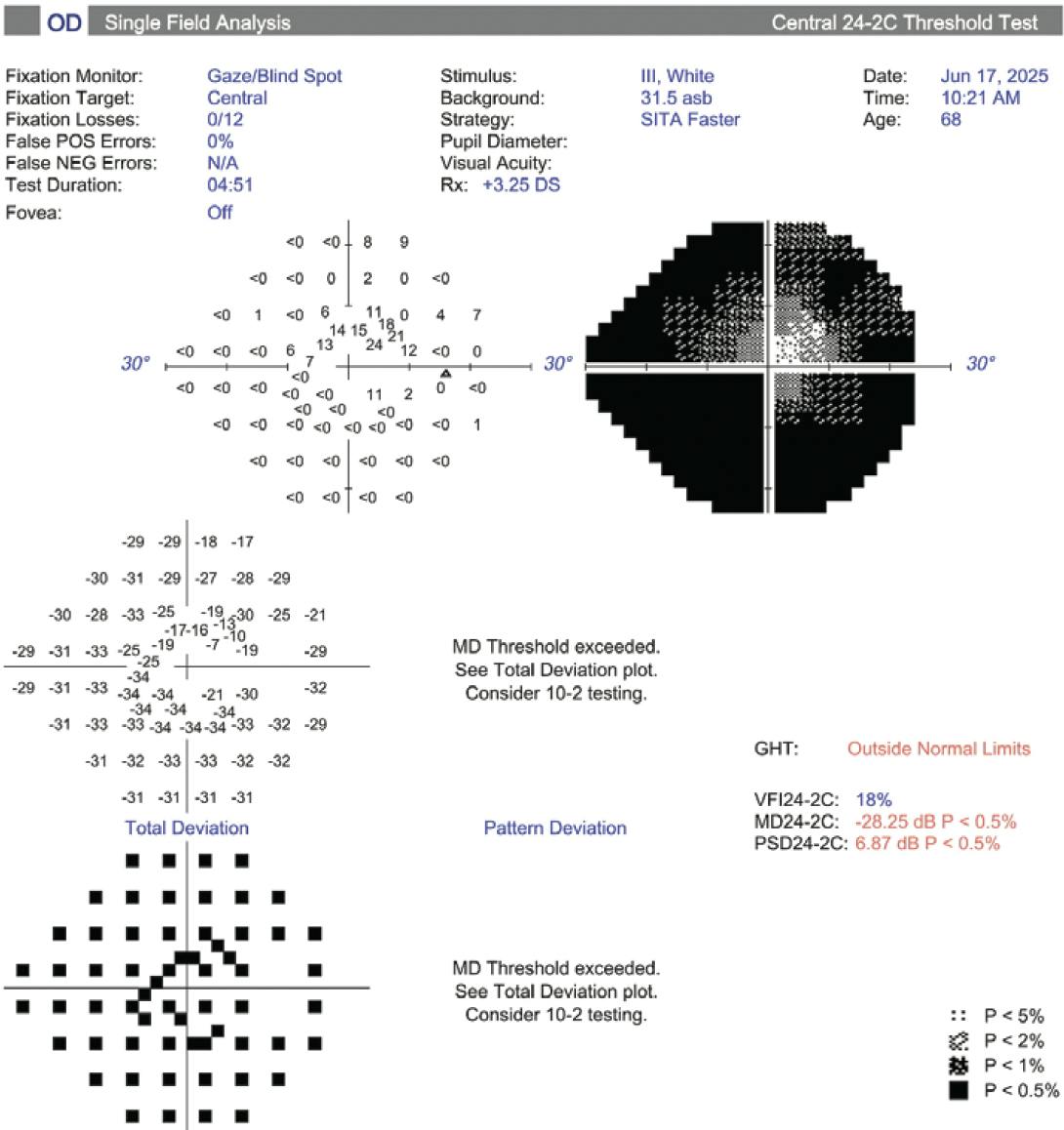
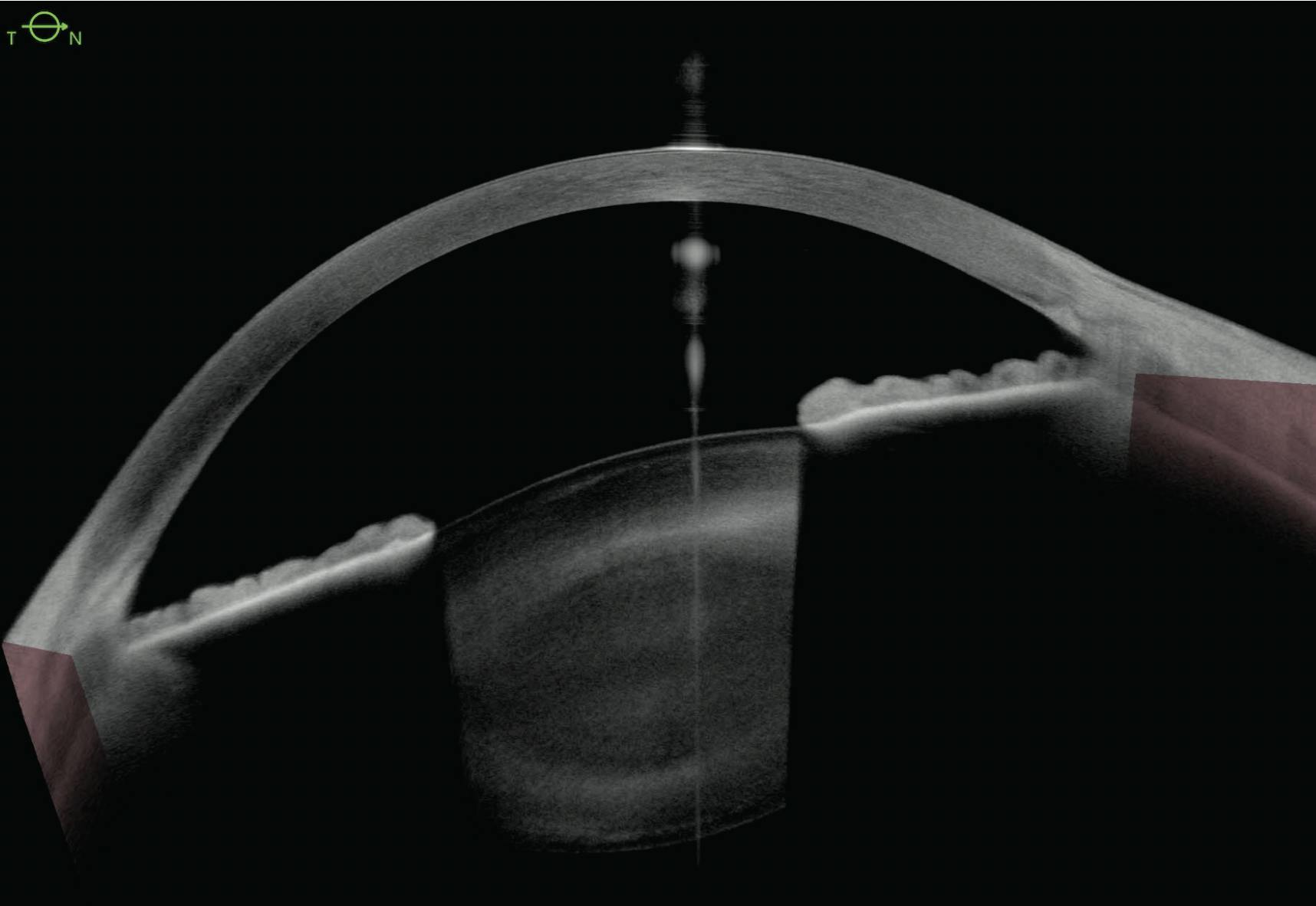
Visual field testing shows severe constriction, with fixation affected in all four quadrants and no remaining pattern deviation (Figure 2). OCT imaging is unreliable owing to signal loss and peripapillary atrophy. Anterior segment OCT confirms the absence of posterior iris bowing (Figure 3). Ultrasound biomicroscopy reveals moderate diffuse zonulopathy.
How would you proceed? Would you offer to perform surgery? If so, which approach would you choose? What specific risks would you counsel the patient on given her axial length, visual reserve, and zonular status?
—Case prepared by
Devesh K. Varma, MD, FRCSC
VICTOR KOH, MBBS, MMED(OPHTH), MRCSED, MSC, FAMS
The patient has advanced glaucoma, uncontrolled IOP, a visually significant cataract, and high myopia—all in her only functioning eye. The cataract and the glaucoma must be addressed concurrently. High myopia increases the risk of zonular weakness and postoperative hypotony, making surgical planning and visual recovery key considerations.
The target IOP should be low for long-term glaucoma control. My preference would be to combine cataract and glaucoma surgery under general anesthesia with perioperative mannitol to reduce vitreous pressure and decrease the risk of intraoperative complications such as an expulsive hemorrhage.
During cataract surgery, anterior chamber (AC) stability would be maintained with either an AC maintainer or the frequent intracameral instillation of an OVD. The capsulorhexis would be enlarged slightly to help minimize zonular stress and subsequent capsular phimosis. Capsular hooks would be placed to provide equatorial support, and a capsular tension ring would be inserted to distribute zonular support evenly. A three-piece IOL would be my preference for its versatility and capsular support, with the option for sulcus or scleral fixation if needed.
For IOP lowering and AC stability in this situation, I would favor a tube shunt such as the Paul Glaucoma Implant (Advanced Ophthalmic Innovations) or the Ahmed Glaucoma Valve (New World Medical). In my experience, stenting a Paul Glaucoma Implant with a 6-0 polypropylene suture provides predictable early postoperative outcomes. I have found that the valved design of the Ahmed Glaucoma Valve and the intracameral injection of a dispersive OVD at the end of surgery reduces the risk of hypotony.
Minimally invasive bleb surgery with microshunts such as the Preserflo MicroShunt (Santen) would be a safer surgical alternative but might not achieve an IOP in the low teens, which is required to address the patient’s advanced glaucoma. Though effective, trabeculectomy would carry a higher risk of hypotony than tube shunt surgery and would be associated with slower postoperative recovery in this highly myopic eye.
SARWAT SALIM, MD, FACS
The etiology of the patient’s glaucoma is unclear. Given her age, race, and diffuse zonulopathy, she likely has advanced pseudoexfoliative glaucoma rather than pigmentary glaucoma. Pseudoexfoliative glaucoma is the most common identifiable form of secondary open-angle glaucoma, and approximately 9% to 18% of these patients can have occludable angles due to the anterior migration of the crystalline lens caused by zonular laxity.1 It is possible that she recently required an LPI for this reason.
Given the eye’s spherical equivalent and axial length, cataract and glaucoma management present diagnostic and surgical challenges. Combined cataract and glaucoma surgery would be my preferred approach because of the patient’s high IOP on maximum tolerated medical therapy, diffuse visual field loss, visually significant cataract, and monocular status. Preoperatively, she and I would have a detailed conversation about the severity of her glaucoma, the eye’s limited visual potential due to myopic macular degeneration, the increased risk of surgical complications, and the potential need for additional medical therapy or surgery.
Cataract surgery on highly myopic eyes entails multiple pre-, intra-, and postoperative considerations.2 Several novel IOL formulas such as the Barrett Universal II and Kane were developed to optimize refractive outcomes in this patient population. In lieu of a retrobulbar or peribulbar injection, sub-Tenon anesthesia would be administered to prevent ocular perforation. Should lens-iris diaphragm retropulsion syndrome occur intraoperatively, the iris would be elevated with a second instrument to allow fluid to pass through the pupil, thereby equalizing the pressure between the anterior and posterior chambers. Alternatively, an iris hook could be placed at the beginning of the case to prevent the condition.
Because of the AC depth in this highly myopic eye, a chopping technique would be used instead of divide and conquer to minimize pressure on weak zonules and reduce the risk of posterior capsular rupture. If necessary, a capsular tension ring could be placed to stabilize the capsular bag, facilitate lens rotation and removal, and avoid IOL instability. The AC would be polished to reduce the risk of AC contraction syndrome and IOL subluxation. Based on the axial length, a zero-powered IOL would be implanted as opposed to leaving the eye aphakic; the lens implant would provide a barrier between the anterior and posterior chambers and reduce the risk of vitreous prolapse.
The choice of glaucoma surgery for a highly myopic eye must strike a balance between safety and efficacy.3 MIGS might not reduce the IOP sufficiently to address the patient’s advanced glaucoma. I would avoid glaucoma filtration surgery owing to the decreased scleral rigidity and increased risk of hypotony and hypotony-related complications in highly myopic eyes. My preferred approach would therefore be to place a valved glaucoma drainage device (GDD).
Once the IOP stabilizes postoperatively, the patient would be referred for low vision services. Only 10% of patients with low vision receive such referrals.4 The vast majority of them have age-related macular degeneration, whereas 14% have been diagnosed with glaucoma.5
KATEKI VINOD, MD
This high-stakes clinical scenario involving a monocular patient with a visually significant cataract, marked zonulopathy, uncontrolled IOP, and fixation-threatening glaucoma warrants careful preoperative planning and counseling. Given her age, high myopia, iris transillumination defects, absent Krukenberg spindle, and minimal trabecular pigmentation, the possibility of burned-out pigmentary glaucoma must be considered. Before surgical intervention, the patient would be referred to a vitreoretinal specialist for the identification and treatment of any preexisting peripheral retinal pathology.
Selective laser trabeculoplasty would likely be less effective in this situation because of the minimal trabecular pigmentation and advanced glaucoma on maximum tolerated medical therapy. Surgical intervention—ideally a combined approach that addresses both the glaucoma and cataract—is indicated but entails a high risk of vitreous prolapse, retinal complications, and postoperative hypotony. Snuff-out phenomenon, moreover, is a risk in an eye with fixation-threatening disease, but the patient’s glaucoma would inevitably progress without surgery. Phaco cataract surgery combined with MIGS might offer a better safety profile than traditional glaucoma surgery but would also be less effective. Extensive preoperative counseling of this monocular patient is required.
I would favor combining phacoemulsification with a three-piece IOL and the placement of either a valved GDD or a nonvalved GDD with a smaller surface area. Capsule retractors, a vitrectomy, and scleral IOL fixation might be required. Coordination with a vitreoretinal surgeon would be important in case a pars plana vitrectomy is necessary. If a nonvalved GDD is implanted, spontaneous tube opening should be avoided postoperatively; instead, I would plan a laser tube ligature release with an intracameral injection of a cohesive OVD. Phacoemulsification combined with trabeculectomy using multiple tight flap sutures could also be considered, but filtration surgery is associated with a high risk of hypotony maculopathy in highly myopic eyes.
CHUNGKWON YOO, MD, PHD
First, I would request the patient’s previous medical records and check whether her corrected visual acuity and refractive error have changed significantly during the past few years. If so, I would recommend cataract surgery combined with angle-targeted MIGS as the initial option.
The iStent infinite (Glaukos) is the only device available for this kind of MIGS procedure in South Korea, where I practice. This implant has been shown to be efficacious in achieving a significant IOP reduction in patients with advanced glaucoma in whom prior medical and surgical treatment has failed.6 Given the patient’s advanced glaucoma, however, I would explain that the approach might not achieve an IOP in the low teens, in which case a second filtration procedure (eg, trabeculectomy or subconjunctival MIGS) would be required.
In this regard, primary filtration surgery might be a better option, but the risk of postoperative vision-threatening complications is higher in eyes that have a very long axial length. The patient would therefore be fully educated on the postoperative risks.
For filtration surgery, the implantation of an A-stream Glaucoma Shunt (Microt) would be my first choice.7 This stent has a ripcord intraluminal suture preplaced inside, which minimizes the risk of postoperative hypotony and offers an opportunity to lower IOP further when it rises again in the postoperative period. I am achieving good outcomes using the A-stream in similar situations.
WHAT I DID: DEVESH K. VARMA, MD, FRCSC
The patient was at high risk of glaucomatous progression and potential snuff-out. We discussed filtration surgery and cyclodestructive options. Because the eye had a visually significant cataract and preserved central acuity potential, we elected to pursue combined cataract and glaucoma surgery.
Given the iris transillumination defects, I considered a pigmentary mechanism and briefly entertained the idea of an angle-based procedure such as goniotomy or goniotomy-assisted transluminal trabeculotomy, which can be effective in pigment dispersion glaucoma. The AC was largely clear of pigment, however, and the trabecular meshwork was only minimally pigmented. It is possible that heavy pigmentation had cleared since the LPI a year earlier. The persistent IOP elevation despite reduced trabecular meshwork pigmentation might have been an indication of deeper trabecular meshwork resistance or distal outflow reduction.
Because of the eye’s high axial myopia and fragility, I was concerned about the risk of hypotony associated with traditional trabeculectomy or the implantation of a Preserflo MicroShunt. I opted instead to combine the placement of a Xen45 Gel Stent (AbbVie) with intraoperative mitomycin C (0.04 mg/mL), phacoemulsification, primary needling to sweep Tenon capsule away from the stent, and the implantation of a 3.00 D Sensar IOL (model AR40e, Johnson & Johnson Vision) with a distance refractive target.
Postoperatively, the patient maintained fixation. Her BCVA was 20/60, and her IOP stabilized at 12 mm Hg on a single topical agent.
1. Damji K, Abtahi M. Update on pseudoexfoliative glaucoma. AAO Focal Points. 2019. www.aao.org
2. Elhusseiny AM, Salim S. Cataract surgery in myopic eyes. Curr Opin Ophthalmol. 2023;34(1):64-70.
3. Vinod K, Salim S. Addressing glaucoma in myopic eyes: diagnostic and surgical challenges. Bioengineering (Basel). 2023;10(11):1260.
4. Shi A, Salim S. Vision rehabilitation in glaucoma patients. Curr Opin Ophthalmol. 2023;34(2):109-115.
5. Owsley C, McGwin G Jr, Lee PP, Wasserman N, Searcey K. Characteristics of low-vision rehabilitation services in the United States. Arch Ophthalmol. 2009;127(5):681-689.
6. Sarkisian SR Jr, Grover DS, Gallardo MJ, et al; iStent infinite Study Group. Effectiveness and safety of iStent Infinite trabecular micro-bypass for uncontrolled glaucoma. J Glaucoma. 2023;32(1):9-18.
7. Park HM, Lee EJ, Han JC, Rho S, Shin JH, Park DY. Short-term efficacy and safety of A-stream glaucoma shunt: a 6-month study. Eye (Lond). 2025;39(8):1584-1591.