A new surgical approach for the treatment of glaucoma uses a biotissue implant to improve outflow in the uveoscleral pathway and lower IOP. The AlloFlo Uveo (Iantrek) is a biointerventional technique and a novel surgical solution targeting the uveoscleral space.
The technology is unique in that it does not refer to an actual device but instead to a type of surgical procedure performed in the supraciliary space. The biotissue is sclera that has been processed into spacers as a “device” to buttress and open the uveoscleral space. Some advantages to working with this material include the following:
No. 1. It is not rigid. Ophthalmologists are accustomed to using this material for other applications. It is malleable and compatible with the surrounding structures. The spacers can be tucked deep down away from the cornea, eliminating any issues with endothelial cell touch.
No. 2. It is porous. Following surgery, the spacers may move closer together over time, but a reduction in IOP can still be observed. This may be because fluid can still travel through the scleral tissue, indicating there is utility to using this material.
PATIENT SELECTION
The AlloFlo Uveo procedure may be appropriate for a patient with mild to moderate glaucoma with a history of failed MIGS whose disease requires additional intervention but does not yet warrant a full incisional procedure, such as a trabeculectomy or tube shunt surgery. Some patients already have a history of failed incisional surgery and are left with the options of a diode laser treatment or a second tube shunt. This is where the biointerventional AlloFlo procedure has fit nicely into my practice—that space where both incisional surgery and MIGS have been unable to control the patient’s IOP but I want to reserve more invasive surgical options for the future. Although all the AlloFlo Uveo cases I have performed have been standalone procedures, other ophthalmologists have used the technology in combination with cataract surgery.
SURGICAL TECHNIQUE
When performing the AlloFlo Uveo procedure, I first create a cyclodialysis cleft using an OVD cannula. I make the cleft approximately 2.0 to 2.5 mm in length. Injecting an OVD during this process helps to separate the tissue plane and provides a good view of the scleral wall. Once I am comfortable with the cleft created, I place the AlloFlo Uveo spacers like bookends of a bookshelf (see Watch Now: Surgical Insights and Patient Selection for AlloFlo).
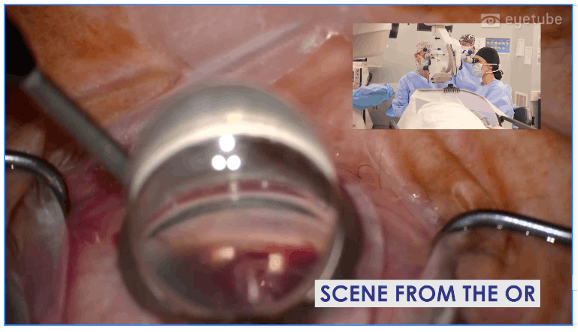
Surgical Insights and Patient Selection for AlloFlo
One benefit of this approach is that it is titratable. For a patient in the early stages of disease, the surgeon can implant just one spacer. If the surgeon feels that further intervention is needed, two spacers can be placed. Currently, on average, I implant two spacers for my patients. Each spacer is approximately 5 x 0.5 mm and has a somewhat square tip. I implant one spacer on either side of the cleft, resulting in approximately 0.5 mm of intervening space between them. Over time, the spacers tend to move closer together, and the space may contract in the months after surgery.
Surgical Insights for the AlloFlo Uveo Procedure
Surgeons weigh in on their techniques and approaches to patient selection.
By Jella An, MD, MBA; Billy Pan, MD; and Arkadiy Yadgarov, MD

Jella An, MD, MBA
When performing the AlloFlo Uveo procedure (Iantrek), I typically precreate a cleft using an OVD cannula, which allows for easier placement of the implant. I prefer to use two scleral spacers, leaving at least one spacer-sized space between them for a large and stable cleft formation. I also inject a generous amount of OVD into the cleft to help maintain the space and tamponade any early postoperative hemorrhage.
I generally reserve this procedure for patients whose glaucoma is refractory to maximum tolerated medical therapy and who have a history of failed trabeculectomy or tube shunt surgery. Although the long-term outcomes of suprachoroidal procedures can be unpredictable, I have found the IOP- and medication-lowering effects of this approach to be reasonable for this challenging population. The procedure serves as a valuable bridge option to consider before a second tube shunt or cyclophotocoagulation, particularly given its conjunctiva-sparing nature and minimal risk profile and patients’ rapid visual recovery.

Billy Pan, MD
For me, the key to reproducibility with this procedure has been gaining confidence with creating the cyclodialysis cleft. I use the scleral wall as my guide and carefully disinsert the tissue posteriorly until the white band of sclera is visible. I also utilize an OVD to gently expand the space in a controlled fashion and tamponade any bleeding (see Watch Now: AlloFlo: Spatulated Cannula for Cleft Creation).
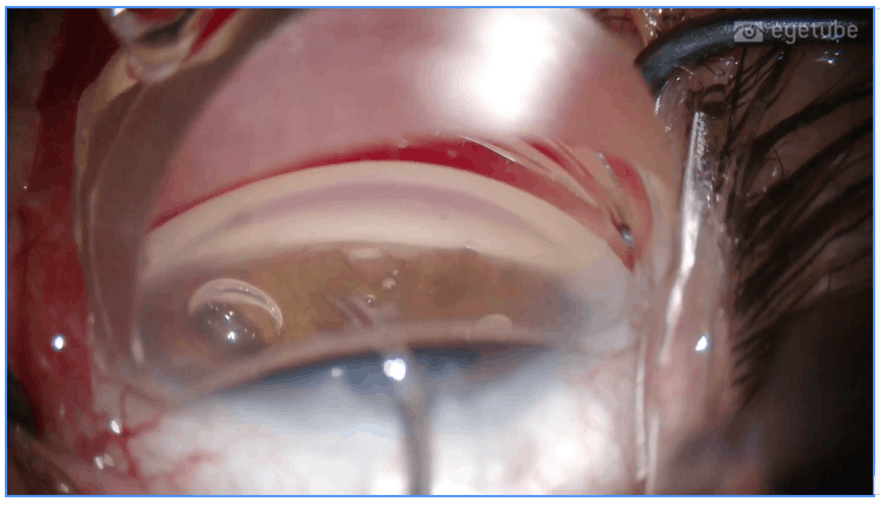
AlloFlo: Spatulated Cannula for Cleft Creation
This procedure has been especially valuable for patients who have previously undergone trabecular meshwork–based interventions and are experiencing waning efficacy but do not yet warrant a subconjunctival bleb-forming procedure. In this way, AlloFlo Uveo allows me to extend surgical intervention to a group of patients who otherwise would have few options beyond continuing medications or undergoing a more invasive filtering surgery.

Arkadiy Yadgarov, MD
For the AlloFlo Uveo procedure, I recommend using an OVD cannula to create the cleft, positioning it against the scleral spur, and making small downward motions into the ciliary body while intermittently injecting an OVD. This both tamponades bleeding and expands the cleft. I recommend performing this step through a paracentesis incision to avoid iris prolapse, which can occur through a larger wound. Once an adequate cleft is created, I introduce two AlloFlo Uveo spacers through the main incision, placed approximately 1.0 to 1.5 mm apart. Each spacer is 0.5 mm wide and can be used for reference to size the cleft. (See Watch Now: AlloFlo Supraciliary Procedure in Eye With Previous Surgery).
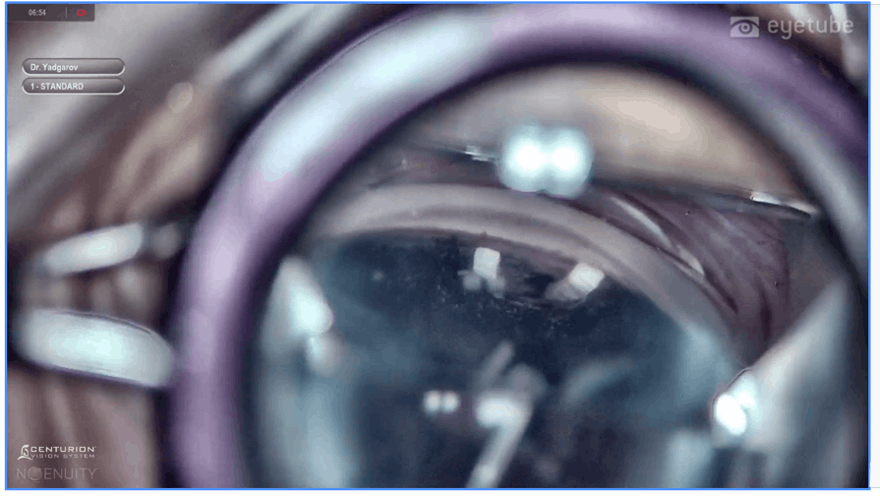
AlloFlo Supraciliary Procedure in Eye With Previous Surgery
I prefer to perform this as a standalone procedure in patients with refractory glaucoma who may want to avoid a subconjunctival procedure or have a history of a failed one. I combine AlloFlo Uveo with phacoemulsification in eyes with baseline significant ganglion cell complex or retinal nerve fiber layer loss because, with this procedure, conventional outflow pathways may be less functional and respond less predictably to trabecular meshwork–based MIGS
Jella An, MD, MBA
Professor of Ophthalmology, Storm Eye Institute, Medical University of South Carolina, Charleston, South Carolina
anjel@musc.edu
Financial disclosure: Consultant (AbbVie, Alcon, New World Medical, PLU Ophthalmic, Sight Sciences); Grant support (PLU Ophthalmic); Lecture fees (Alcon)
Billy Pan, MD
Beverly Hills Institute of Ophthalmology, Beverly Hills and Torrance, California
billyxiapan@gmail.com
Financial disclosure: Consultant (AbbVie, Alcon, Bausch + Lomb, Glaukos, Iantrek, Nova Eye Medical); Research support (iStar Medical)
Arkadiy Yadgarov, MD
Cataract and glaucoma surgeon, Omni Eye Services, Atlanta
yadgarovmd@gmail.com
Financial disclosure: Consultant (Iantrek)
POSTOPERATIVE MANAGEMENT
Postoperatively, some patients experience IOP spikes, but these elevations in pressure tend to be managed successfully with medications. I have not observed profound, prolonged hypotony; however, some patients have experienced a myopic shift following surgery.
One unique factor is that patients treated with AlloFlo Uveo seem to be more responsive to steroids than other MIGS patients. This may be because, once the cleft begins to contract after surgery, dual outflow occurs through both the uveoscleral pathway and traditional pathway. I am therefore starting to taper steroids more quickly than I would in a traditional cataract case. Some of my patients whose IOP increased dramatically around 2 to 3 weeks postoperatively achieved an abrupt lowering of pressure once steroid therapy was reduced or stopped.