In the Innovation Journal Club (IJC) series on Eyetube.net, host I. Paul Singh, MD, of The Eye Centers of Racine & Kenosha in Wisconsin, interviews leading experts from across eye care subspecialties about emerging innovations and technologies that may prove influential to the real-world practice of ophthalmology. The series is editorially independent (supported by advertising from multiple companies), which allows the discussions to be broad in scope and candid in presentation. The following is a summary of three episodes in which Dr. Singh spoke with Marjan Farid, MD, about why eyecare providers may want to re-evaluate the role of pharmaceuticals in the management of presbyopia; with William F. Wiley, MD, about the future of lens-based refractive surgery; and with Christine M. Funke, MD, about a protocol for integrating interventional glaucoma into real-world practice.
Low-Dose Pilocarpine Brings New Promise for Presbyopia Management
With Marjan Farid, MD
Presbyopia remains a universal consequence of aging, an inevitable point when near vision declines and tasks like reading menus, phone screens, or patient charts become noticeably more difficult. Although the condition has traditionally been managed with reading glasses or surgical approaches, recent pharmaceutical advances may cause clinicians to rethink presbyopia treatment.
While earlier pharmacologic efforts in this category launched with excitement, they also came with challenges, particularly around tolerability, headaches, and ocular surface discomfort. According to Marjan Farid, MD, however, low-dose pilocarpine solutions now entering formularies are reshaping the landscape of presbyopia care.
“It’s a space that we sort of started opening a couple of years ago and maybe got off to a rocky start. And I think the horizon is even better now,” Dr. Farid said.
The newest presbyopia drop formulation, preservative-free 0.4% pilocarpine (Qlosi, Orasis), has demonstrated impressive results through both phase 2B1 and phase 3 clinical trials.2 The phase 3 trial met its primary endpoint in showing a significantly greater percentage of responders in the Qlosi group (40.1%) versus vehicle (19.1%; P < .0001) on day 8 at 1 hour post dose 1. In addition, in an exploratory analysis, a greater percentage of patients in the active treatment arm achieved a three-line or better improvement in distance-corrected near visual acuity (Figure 1). Even more impactful, there were relatively few reports of headaches and brow ache, and overall, tolerability was excellent.
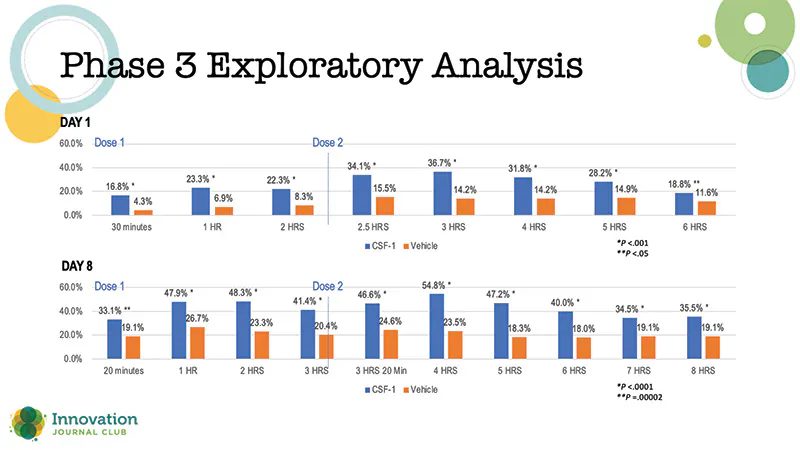
Figure 1. Percentage of responders with ≥ 3-line gain in distance-corrected near visual acuity at day 1 and day 8 in the phase 3 trial of 0.4% pilocarpine (Qlosi, Orasis).
“What really impresses me about the 0.4% pilocarpine formulation, that’s actually now commercially available as Qlosi, is the comfort level. The comfort level is huge, because with the earlier formulation that came out, there was a lot of headaches, there was a lot of irritation to the ocular surface. And I think this proprietary formula being preservative-free is a huge advantage. The comfort level is through the roof,” Dr. Farid said.
Safety remains another central consideration. Although historical use of higher-dose pilocarpine did not show significant increases in retinal detachment risk except among high-risk individuals, responsible prescribing is still key. Access to Qlosi is restricted to eyecare professionals to ensure appropriate screening. For the right patient—Dr. Farid suggested targeting early presbyopes aged 40 to 60—the therapy can offer a nonsurgical bridge before cataract or lens-based options become appropriate.
In addition to selecting the right patients, Dr. Farid said, providers should encourage recipients to give 0.4% pilocarpine time to have its maximum effect. Similar to previous pilocarpine formulations, the effects improve with continued use.
“The study did show that the effects continue to improve over time. There is a little bit of that adjustment,” Dr. Farid said. “I think you tell patients, keep doing it, because it’s going to work even better the longer you’re on it.”
Lens-Based Refractive Surgery
With William F. Wiley, MD
In a recent episode of Innovation Journal Club, William F. Wiley, MD, discussed the evolution of Implantable Collamer Lens (ICL) technology, particularly the impact of the recently available EVO ICL (STAAR Surgical).
Dr. Wiley, an early adopter of ICLs since their FDA approval, reflected on how the procedure has transformed over the past decade-plus. In its early years, ICL implantation was considered a niche option, offered primarily to patients with extreme myopia who were not good candidates for corneal refractive surgery. At the time, surgeons often pushed the limits of LASIK and PRK, treating patients in the range of -10.00 D to -11.00 D, while reserving ICLs only for the most severe refractive errors.
The introduction of the EVO ICL caused Dr. Wiley to rethink this approach. Designed with central flow ports that eliminate the need for preoperative peripheral iridotomies, EVO significantly reduced procedural discomfort and improved safety. Dr. Wiley emphasized how meaningful this change was: not only did it remove one of the most challenging and uncomfortable preoperative steps, but it also made the lens more forgiving by improving aqueous flow dynamics. As a result, surgeons now experience fewer concerns about vaulting, pupillary block, or lens-related complications. Because of these advancements, Dr. Wiley said he has steadily lowered the refractive threshold for offering EVO ICLs.
“Now, we’re really comfortable offering it for any patient that fits within the criteria. So, at -3.00 D and above, we’re offering EVO,” Dr. Wiley said.
EVO ICL offers several advantages compared with corneal refractive surgery. Since the cornea is left untouched, there is no tissue removal, no nerve transection, and no unpredictable healing response. Patients avoid dry eye complications and achieve highly predictable results, often within hours of surgery. Dr. Wiley noted that unlike LASIK, after which eyes may show regression due to corneal remodeling, EVO outcomes remain remarkably stable.
These clinical impressions were recently confirmed in a 3-year study of EVO ICL implantations, which showed excellent long-term predictability and efficacy (Figures 2 and 3).3 The study also demonstrated the stability of the EVO platform: mean spherical equivalent was -7.62 D preoperatively, -0.10 D at 12 months, -0.11 D at 24 months, and -0.12 D at 36 months.
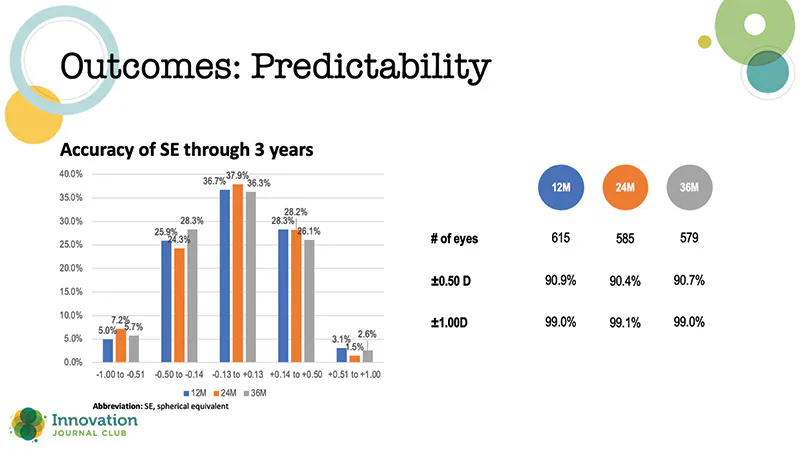
Figure 2. Continued follow-up of the EVO ICL pivotal trial cohort demonstrated excellent predictability in refractive outcomes through 3 years.
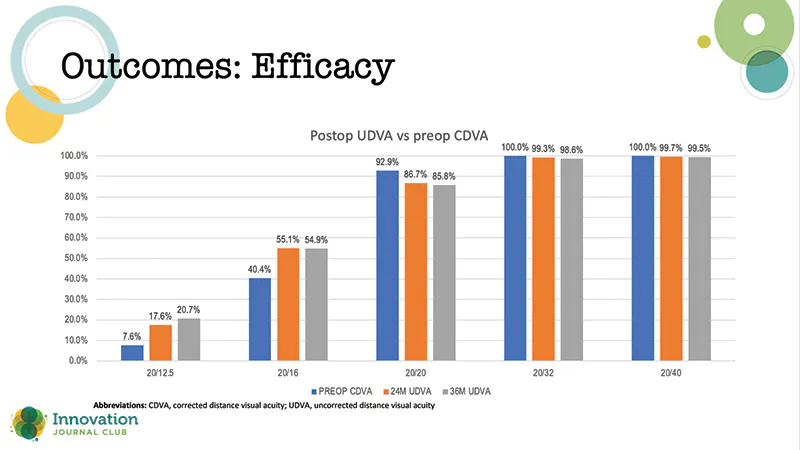
Figure 3. After 3 years of follow-up of the cohort from the EVO ICL pivotal trial, a greater percentage of patients achieved better than 20/20 UCDVA compared to preoperative BCDVA.
“The study shows that at 3 years out, patients saw better than they did initially or before surgery. So not only did it stay stable, but there was some slight improvement over time, which is amazing,” Dr. Wiley said.
A Suggested Protocol for Implementing Interventional Glaucoma
With Christine M. Funke, MD
As the number of procedural options for managing glaucoma continue to expand, clinicians may feel overwhelmed about how to implement interventional glaucoma principles. A consensus panel of 12 glaucoma specialists and anterior segment surgeons set out to change that by developing a consensus-based protocol aimed at simplifying treatment pathways for real-world practices.4
The panel aimed to provide a consensus opinion on the preferred treatment protocol for patients at each stage of the disease, from ocular hypertension to severe glaucoma, with the primary goal of helping clinicians deliver care that maximizes safety and quality of life for patients without compromising efficacy (Figure 4).4
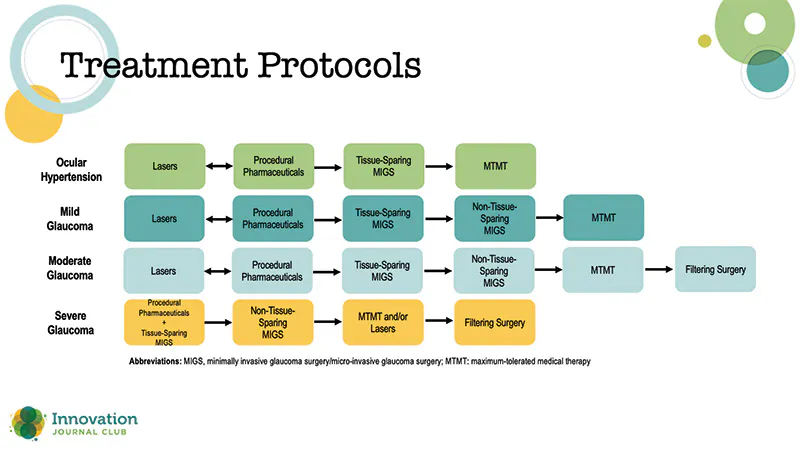
Figure 4. Suggested treatment protocols for implementing interventional glaucoma principles from a consensus panel of 12 ophthalmic surgeons, comprising glaucoma specialists and anterior segment surgeons.
“This [protocol] is not rigid; you have to go step by step, this is the only way to do it. It is more of a framework, a model that you can work within,” said Christine M. Funke, MD, one of the panel members, during an episode of IJC.
Dr. Funke explained that the project began with the recognition that despite the breadth of treatment choices, many providers—particularly those in private or solo practice—struggle to adopt an interventional mindset confidently. To tackle this, each panelist first analyzed their own practice patterns. Surprisingly, many discovered that their approaches were more structured than expected, revealing opportunities to incorporate broader interventions.
“I say for anybody out there, make your own protocol,” Dr. Funke said. “It forces you to analyze yourself a lot more and really push yourself to be the best version of yourself with each and every interaction.”
The group ultimately focused on four patient categories: ocular hypertension and mild, moderate, and severe primary open-angle glaucoma. For each, they asked a simple question: “For 90% of patients walking into the clinic for the first time, what is the most reasonable starting point?” From there, they organized treatment options into “buckets,” including laser procedures, drug-delivery methods, tissue-sparing MIGS, non–tissue-sparing MIGS, and traditional filtration surgery. Safety and tissue preservation became the guiding principles, recognizing that most patients will require multiple interventions across their lifetime.
One of the clearest consensus points was the role of selective laser trabeculoplasty (SLT). For ocular hypertensive and mild to moderate glaucoma patients, SLT emerged as the preferred first-line treatment. With strong evidence supporting its effectiveness, especially when used early, and growing data showing that patients who receive procedures tend to be more compliant with follow-up versus those on medications, the panel viewed SLT as a “slam dunk” for initial therapy. Medications still play an important role, Dr. Funke emphasized, but increasingly as interim bridges rather than long-term solutions.
“We're not saying medications are going to go away. We're never going to stop using them, but we have to use them with a lighter touch,” Dr. Funke said.
1. Farid M, Rowen SL, Moshirfar M, et al. Combination low-dose pilocarpine/diclofenac sodium and pilocarpine alone for presbyopia: results of a randomized phase 2b clinical trial. Clin Ophthalmol. 2024;18:3425-3439.
2. Holland E, Karpecki P, Fingeret M, et al. Efficacy and safety of CSF-1 (0.4% pilocarpine hydrochloride) in presbyopia: pooled results of the NEAR phase 3 randomized, clinical trials. Clin Ther. 2024;46(2):104-113.
3. Parkhurst G, Brinton JP, Faulkner A, et al. Three year results from the United States FDA prospective multicenter clinical study of the EVO/EVO+ Implantable Collamer Lens. Clin Ophthalmol. 2025;19:3237-3248.
4. Funke CM, Ristvedt D, Yadgarov A, Micheletti JM. Interventional glaucoma consensus treatment protocol. Ex Rev Ophthalmol. 2025;20(2):79-87.