As of 2020, approximately 76 million individuals globally had been diagnosed with glaucoma, with an estimated 4.5 million of them experiencing moderate to severe visual impairment.1 The number of individuals with glaucoma is expected to increase to 111.8 million by 2040, making the disease a leading cause of irreversible blindness. With the increasing prevalence of the disease and necessity of treatment, the use of topical glaucoma therapies is pervasive. Prescribed pharmaceutical classes include prostaglandin analogues, beta blockers, alpha-2 agonists, carbonic anhydrase inhibitors, and Rho kinase inhibitors.
The downsides of topical glaucoma therapy are well known.2 Poor medication adherence among patients is a critical barrier to care. The hand-eye motor coordination required to administer eye drops is another obstacle, especially among elderly patients, and can lead to incorrect instillation. The side effect profile of drops is clinically significant, with potential for damage to the ocular surface as well as systemic adverse reactions. These factors have helped precipitate a movement toward interventional glaucoma care, which favors the use of procedural approaches such as laser therapy, sustained drug delivery, and surgery.
This article examines the current literature on the most severe systemic adverse effects of topical glaucoma therapy, particularly those associated with the use of beta-blocking and alpha-2 agonistic classes of topical medications.
BETA BLOCKERS
In a 2024 analysis, investigators evaluated the FDA’s Federal Adverse Event Reporting System database for adverse event reports over an 18-year period.3 More than 10 million adverse events were identified, with 8,793 cases reporting topical beta-blocking therapy as the primary suspect. Of those 8,793 cases, severe adverse effects with sequelae, including disability, occurred in 165 (1.88%), hospitalization in 671 (7.63%), and other unspecified complications in 1,934 (21.99%). A total of 256 cases (2.91%) of subsequent death were documented. The most severe adverse events were associated with arrhythmias, such as bradycardia in 145 cases (1.64%), complete atrioventricular block in 38 cases (0.43%), and bronchospasm in 23 cases (0.26%). Timolol and levobunolol were the two agents most frequently associated with adverse effects, given the nonselective nature of beta-receptors blockade. As such, these medications are contraindicated in patients with underlying cardiovascular or pulmonary comorbidities.
Beta blocker use in glaucoma therapy is rarely associated with serious systemic side effects. That said, keeping these rare adverse effects in mind is especially important when prescribing therapy for patients with complex medical histories and comorbidities that may include heart failure, sinus bradycardia, chronic obstructive pulmonary disease, and asthma.4
ALPHA-2 ADRENERGIC AGONISTS
General systemic side effects of alpha-2 agonists in adults primarily include somnolence and dizziness. Adverse effects of dizziness have also been reported in patients administering a fixed combination of brinzolamide and brimonidine tartrate (Simbrinza, Novartis).5 In the long term, these side effects can affect tolerability and patient adherence.
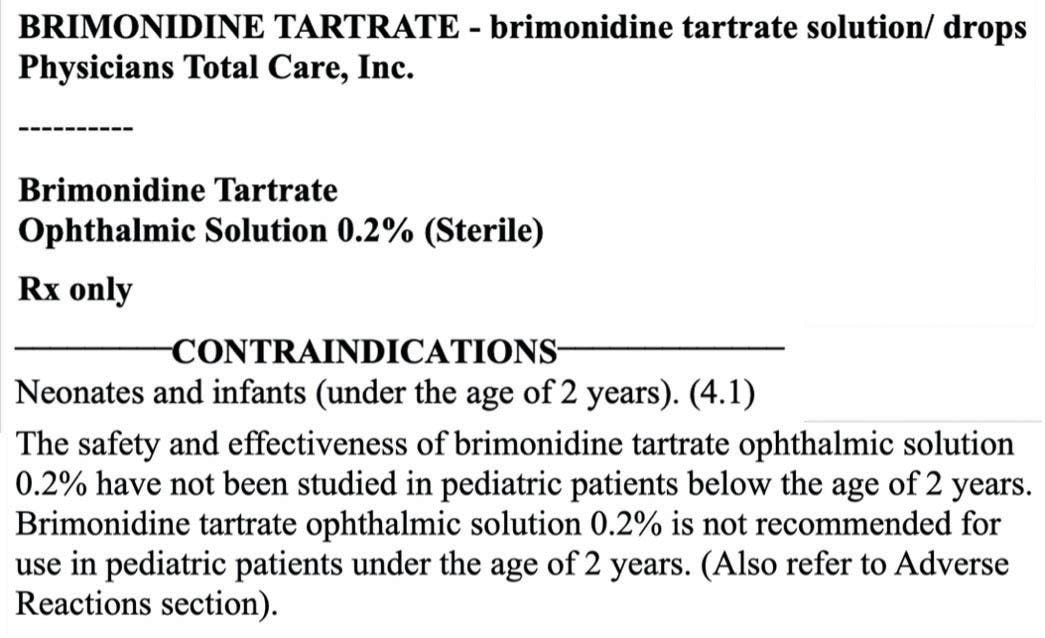
The FDA has issued a clear warning against the use of alpha-2 agonists in young patients, particularly infants (Figure). In one analysis, investigators examined 19 years of data in the Federal Adverse Event Reporting System database and performed a search for adverse event reports associated with brimonidine in infants aged 24 months and younger.6 A total of 35 reports were identified, implying erroneous or inadvertent off-label use of brimonidine in infants despite the strict contraindication and warning from the FDA. The magnitude of infant toxicity cannot be understated, with 27 of the 35 identified patients requiring hospitalization (77.14%) and 13 cases involving life-threatening complications (37.14%).6 Life-threatening presentations included features such as hypothermia (42.86%), lethargy (34.29%), and apnea (34.29%). Because brimonidine is capable of crossing the blood-brain barrier, adverse effects such as hypotension (25.71%) and bradycardia (22.86%) may also be observed in newborns.6,7 Infant exposure to brimonidine was found to involve ophthalmic routes less than one-third of the time, indicating the possibility that infants were unintentionally exposed to the drug.6 This finding underscores a critical patient safety failure, where a contraindicated medication harmed the most vulnerable individuals, and indicates a need for more rigorous warnings.
Recommendations on the use of glaucoma medications in pregnancy and postpartum are available through the AAO.8
CONCLUSION
Topical glaucoma therapy, while generally safe, can carry risks of significant adverse effects. Each medication class has its own variety of systemic interactions. Beta blockers and alpha-2 agonists are particularly associated with the most severe adverse events, with emerging evidence on systemic effects in high-risk populations.
Physicians should perform a thorough patient-specific risk assessment before initiating therapy. Although topical therapies have historically been the mainstay of glaucoma treatment, increasing adoption of procedural interventions may minimize patients’ medication dependence and preclude potential serious adverse effects of some topical agents. Risks inherent to any intervention must be carefully considered.
1. Sridharan K. Systemic adverse drug events to topical prostaglandin analogs for treating glaucoma: a retrospective focused pharmacovigilance study. BMC Ophthalmol. 2024;24(1):554.
2. Stewart WC, Garrison PM. Β-blocker–induced complications and the patient with glaucoma: newer treatments to help reduce systemic adverse events. Arch Intern Med. 1998;158(3):221-226.
3. Aftab OM, Khan H, Sangani R, Khouri AS. A national analysis of systemic adverse events of beta-blockers used for glaucoma therapy. Cutan Ocul Toxicol. 2024;43(4):293-298.
4. Zimmerman TJ. Topical ophthalmic beta blockers: a comparative review. J Ocul Pharmacol. 1993;9(4):373-384.
5. Lusthaus JA, Goldberg I. Brimonidine and brinzolamide for treating glaucoma and ocular hypertension; a safety evaluation. Expert Opin Drug Saf. 2017;16(9):1071-1078.
6. Aftab OM, Khan H, Bargoud A, Khouri AS. Are alpha-2 adrenergic agonists being used in infants? J Ocul Pharmacol Ther. 2025;41(2):75-78.
7. Bowman RJ, Cope J, Nischal KK. Ocular and systemic side effects of brimonidine 0.2% eye drops (Alphagan) in children. Eye (Lond). 2004;18(1):24-26.
8. Glaucoma management in pregnancy and postpartum. AAO. January 14, 2022. Accessed January 14, 2026. https://eyewiki.org/Glaucoma_Management_in_Pregnancy_and_Postpartum