

If you had asked me 5 years ago how I approached mild-to-moderate glaucoma, my answer probably would have sounded very similar to that of most glaucoma specialists: start with drops, escalate when needed, and focus primarily on IOP reduction. That was the paradigm many of us were trained in: prescribe medication to lower the pressure, add another drop if necessary, move to laser or surgery later in the disease course.
But over the past several years, my thinking has changed dramatically. Today, I consider myself firmly in the interventional glaucoma (IG) camp, not because of industry trends or procedural economics, but because I genuinely believe it offers better care for many patients.
Along the way, I have been pleasantly surprised to find out that in addition to the advantages for my patients, there are also benefits for my practice in adopting an IG mindset.
My IG Epiphany
The LiGHT trial heavily influenced my thinking with respect to using procedural interventions early in the disease course. After 3 years of follow-up, the trial demonstrated that treatment-naïve patients started on selective laser trabeculoplasty (SLT) were more likely to have stable disease than patients started on a prostaglandin analogue. Additionally, SLT was deemed to be more cost-effective than eye drops.1 Based on the fact that SLT provided superior disease stability compared to drops, and because 74% of patients in the SLT group were successfully controlled at 3 years without topical therapy, the authors recommended that SLT be offered as a first-line treatment for open-angle glaucoma and ocular hypertension.
By 6 years of follow-up, the difference in treatment groups was even more obvious: First-line SLT was associated with a reduced need for incisional glaucoma surgery compared to medicated eyes.2
Taken together, the evidence from LiGHT showed that first-line SLT yielded superior disease control versus drop therapy, which caused me to wonder why I was reflexively starting patients on pharmaceutical management.
At the same time, I was performing more combined cataract-MIGS procedures and noticing something else that fundamentally changed how I viewed glaucoma treatment: Patients cared deeply about reducing their medication burden. As glaucoma specialists, we tend to focus on pressure reduction, because that is what the literature and treatment guidelines emphasize. But patients experience glaucoma differently. They experience burning, redness, ocular surface desiccation, refill hassles, cost burden, compliance fatigue, and dexterity limitations associated with topical therapy. They experience the frustration of carrying drops everywhere and organizing their lives around medications.
What surprised me was that patients were often more excited about stopping drops than about achieving a lower IOP. When I would tell a patient after cataract surgery and MIGS that they could discontinue one or two medications, the response was overwhelmingly positive. That was an “a-ha” moment for me. I realized that medication reduction improved quality of life in a way that traditional glaucoma metrics do not always capture.
Changing My Approach
Today, the treatment journey for newly diagnosed glaucoma patients is remarkably different than it was previously. In large part because of the data from the LiGHT trial, I start patients with ocular hypertension warranting treatment or with mild-to-moderate glaucoma on SLT if they are an appropriate candidate. If SLT is unsuccessful or insufficient, I may introduce medications, but I often frame them as a bridge strategy rather than a permanent endpoint (Figure).3 During follow-up visits, I actively evaluate whether that patient is an appropriate candidate for sustained drug delivery or another procedural option, particularly if there are complaints of redness, irritation, dry eye exacerbation, dexterity issues, forgetfulness, or the myriad other issues associated with drop therapy.
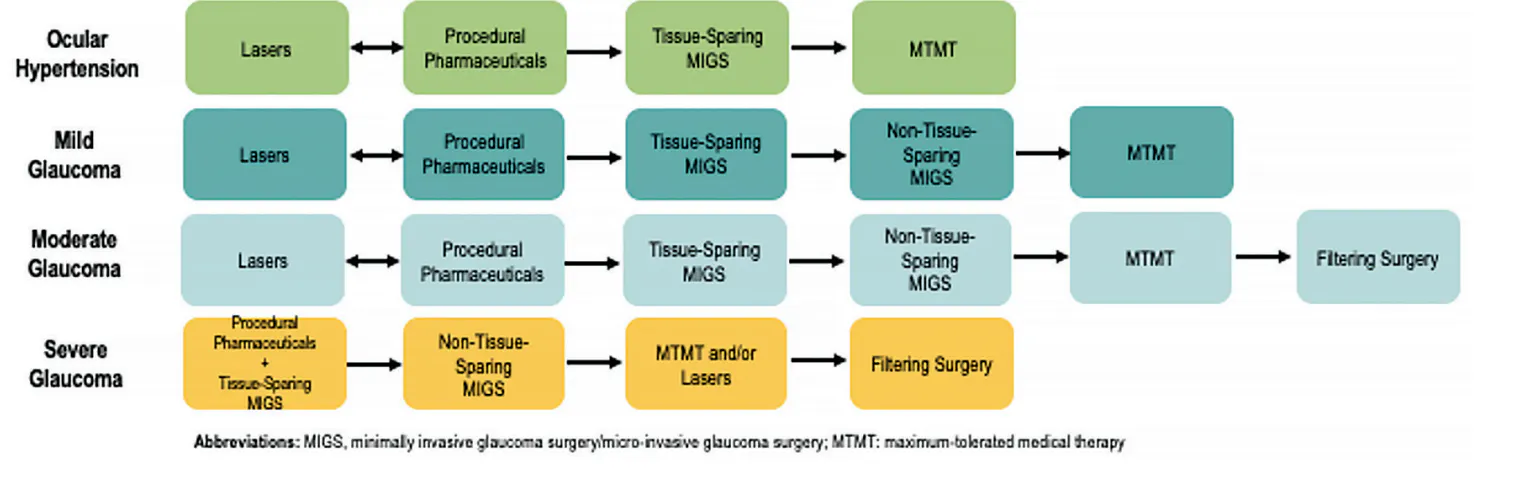
Figure. A suggested treatment algorithm for incorporating interventional glaucoma according to glaucoma severity. The protocol assumes a previously undiagnosed and untreated patient with no other significant ocular comorbidities, and that topical therapy and/or selective laser trabeculoplasty are available throughout as a bridge and supplemental therapy.
Adapted from: Funke et al.Exp Rev Ophthalmol. 2025;20(2):79-87.
Even when patients report doing well on topical therapy, I still educate them about alternatives. Many patients minimize their symptoms or simply assume irritation is unavoidable. Instead of asking yes/no questions such as, “Is the pressure controlled?” I also ask:
- Is the patient tolerating therapy?
- Are they truly compliant?
- Is ocular surface disease worsening?
- Are dexterity issues affecting administration?
- Is the treatment sustainable in the long term?
The goal is not necessarily to make every patient completely dropless forever; that is unrealistic in some cases. But the possibility of safely reducing the medication burden while maintaining disease control represents meaningful progress for both the patient and physician.
It Takes a Team
One of the biggest lessons I have learned is that IG cannot be physician-driven alone. Your technicians and staff are essential. In many practices, technicians spend more time with patients than physicians do. They are often the first to hear complaints about drops such as burning, redness, blurry vision, or adherence challenges. Historically, those comments might simply get documented in the chart, but in an interventional practice, those conversations become opportunities for education.
Now, when a patient mentions discomfort with drops, my staff may introduce the idea of SLT before I even enter the room. They might provide a handout or briefly explain that there are alternatives to chronic topical therapy. That small amount of education changes the entire dynamic of the visit, because the patient is already thinking procedurally before I enter the room and begin the conversation.
Having staff participate in the IG conversation with patients is a subtle but impactful change. Anyone managing a high-volume clinic understands how much chair time gets consumed by medication management, including reviewing pharmacies, discussing refill requests, clarifying instructions, and troubleshooting adherence issues. Procedural care simplifies those interactions considerably, and therein lies one of the advantages of running a practice that adopts IG principles. Namely, when staff time is occupied with following up on medication use, the practice sacrifices not only efficiency, but also real dollars in terms of wasted overhead. What if, instead, the time technicians spend with patients was dedicated to education about interventional options? Considering that the practice generates revenue from procedural options, as opposed to the revenue-neutral or revenue-negative practice of prescribing drops, that staff time is now contributing to the bottom line.
Conclusion
I understand why some ophthalmologists remain hesitant about adopting a more interventional approach to glaucoma management. Habit is powerful, especially when something has worked reasonably well for years. There is also understandable concern about complications associated with standalone MIGS procedures, and no one wants to create unnecessary risk in mild disease.
That is why I often tell colleagues to start with SLT, which is an ideal entry point into IG because it is safe, familiar, efficient, and evidence-based. Once you become comfortable discussing procedural intervention earlier in the disease process, the rest of the philosophy evolves naturally. Indeed, you begin asking yourself different questions:
- What other tools are available?
- Which patients are ideal procedural candidates?
- How can I reduce or avoid medication dependence safely and earlier?
The transition does not happen overnight. It certainly did not for me. My own evolution toward IG happened gradually over several years.
I do not believe medications are disappearing from glaucoma management. There will always be patients who do well with drops and prefer them. Additionally, interventional procedures may not always achieve success, and their therapeutic effects may diminish over time. Importantly, glaucoma medications are not perfect either. Some patients fail to achieve adequate IOP reduction on medications, efficacy may wane, compliance declines over time, patients miss their eye with their drops, ocular surface disease worsens, and some patients have side effects that obviate the use of topical therapy. We sometimes hold procedures to an unrealistically high standard while overlooking the very real limitations of chronic medical therapy.
For me, IG represents a broader shift in philosophy. Instead of reacting to progression after years of topical therapy, we now have an opportunity to intervene earlier, reduce treatment burden, and potentially improve both disease control and patient quality of life.
1. Gazzard G, Konstantakopoulou E, Garway-Heath D, et al; LiGHT Trial Study Group. Selective laser trabeculoplasty versus eye drops for first-line treatment of ocular hypertension and glaucoma (LiGHT): a multicentre randomised controlled trial. Lancet. 2019;393(10180):1505-1516.
2. Gazzard G, Konstantakopoulou E, Garway-Heath D, et al; LiGHT Trial Study Group. Laser in Glaucoma and Ocular Hypertension (LiGHT) trial: six-year results of primary selective laser trabeculoplasty versus eye drops for the treatment of glaucoma and ocular hypertension. Ophthalmology. 2023;130(2):139-151.
3. Funke CM, Ristvedt D, Yadgarov A, Micheletti JM. Interventional glaucoma consensus treatment protocol. Exp Rev Ophthalmol. 2025;20(2):79-87.