Key Takeaways
- As the only modifiable risk factor in glaucoma, elevated IOP should be addressed to slow disease progression.
- Because patients have difficulty adhering to prescribed treatment regimens and because IOP is inherently variable, a single in-office IOP measurement fails to capture a true picture of their glaucoma.
- The risk of decreasing the IOP more than is necessary should be a concern.
Why is IOP one of the rare variables in the human body that is targeted below physiologic values? Is this approach truly necessary? Is it safe? Are glaucoma specialists actively considering the downsides of bringing the IOP lower than 10 mm Hg?
As the only modifiable risk factor in glaucoma, elevated IOP should be addressed to slow disease progression. However, because patients have difficulty adhering to prescribed treatment regimens and because IOP is inherently variable, a single in-office IOP measurement fails to capture a true picture of their glaucoma. IOP fluctuates throughout the day with blinking, eye movement, postural changes, and circadian rhythm. Diurnal IOP fluctuation itself is not an independent risk factor for glaucomatous visual field loss in high-risk ocular hypertension.1 Significant fluctuations, however, are more harmful in patients with low mean IOPs.2
Hypotony and its side effects are concerning (perhaps even more concerning than hypertension), considering the risks of hypotony maculopathy and choroidal detachment, especially in young patients. Saeedi et al showed that the most common physical signs of low IOP include choroidal detachment, a shallow anterior chamber, and hypotony maculopathy.3 They also established that the risk of choroidal detachment and a shallow anterior chamber decreases with the presence of hypotony maculopathy.3
Several landmark studies—the Ocular Hypertension Treatment Study (OHTS), the Collaborative Initial Glaucoma Treatment Study (CIGTS), the United Kingdom Glaucoma Treatment Study (UKGTS), and the Collaborative Normal Tension Glaucoma Study (CNTGS)—have established that lowering IOP via medical or surgical intervention can slow glaucomatous progression.4 When we strive to achieve subphysiologic IOPs, however, we run the risk of negatively affecting patients’ quality of life with surgeries and/or complications. Many patients, moreover, may achieve disease stability without aggressive IOP goals.
One of the main goals of glaucoma treatment is to preserve the patient’s quality of life. A key consideration, then, is whether the benefit of IOP reduction always outweighs the risk. Would it be less harmful to maintain an IOP in the low normal range? A widely held belief is that patients with advanced disease require a low target IOP because, for every 1 dB of worsening in mean deviation, visual field progression increases by 11%.4 IOP levels are associated not only with the functional progression assessed by visual field testing but also with structural progression observed with OCT, specifically changes in retinal nerve fiber layer thickness.4
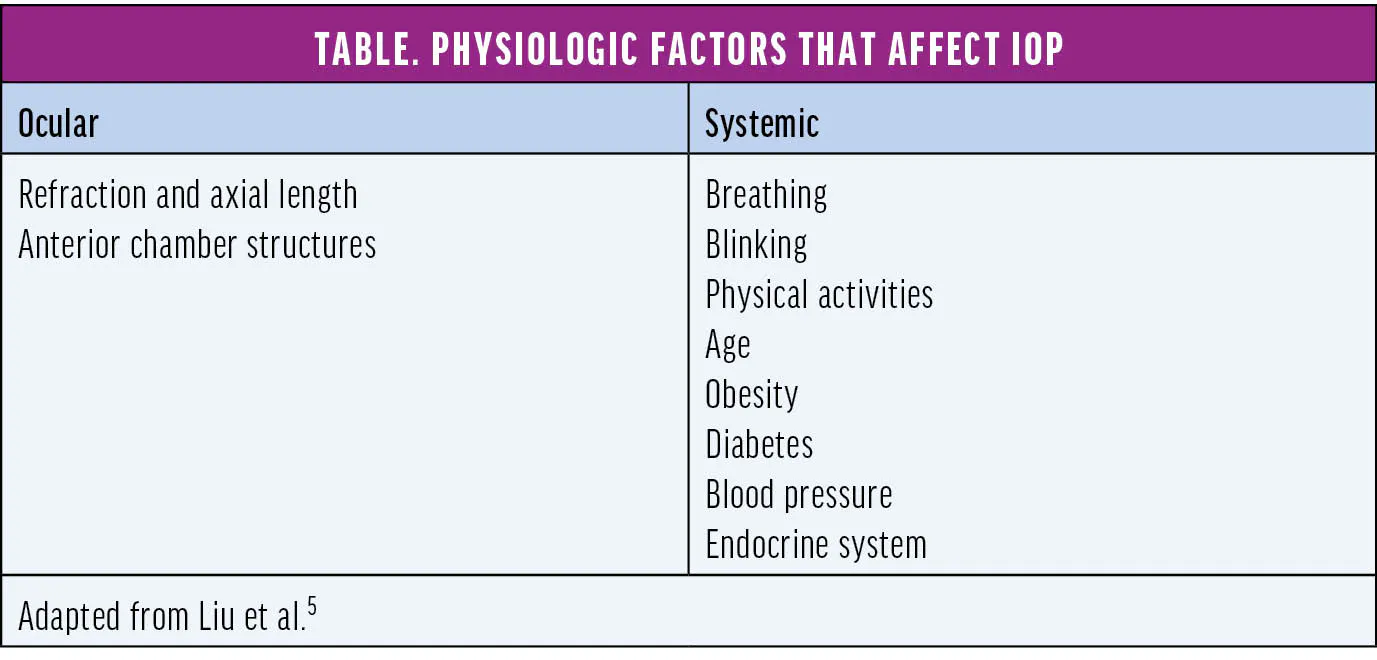
Most patients do not need a subphysiologically low IOP but a normal yet stable IOP. Prioritizing this objective would change how the treatment target is set. IOP fluctuations may have an impact on glaucomatous progression through mechanisms independent of IOP elevation.5 They have a greater impact on disease progression in patients with primary open-angle glaucoma or primary angle-closure glaucoma.5 One pathophysiologic theory on the harm of IOP fluctuation is explained by the fact that there is a regulatory dysfunction that disrupts the homeostasis of retinal ganglion cells and potentially exacerbates glaucomatous neurodegeneration independently of IOP elevation.5 IOP varies owing to multiple physiologic factors that can be ocular or systemic (Table).5
Do a patient’s pressure readings captured in the office and the resultant mean IOP accurately reflect their IOP? Has the patient been using their hypotensive agents as prescribed, or did they instill their medication just before their appointment? We should keep these questions top of mind. Multiple studies have shown that a patient’s in-office IOP measurements tend to be lower than their mean IOP given the fluctuations that occur throughout the day.6,7 This may lead us to set overly aggressive IOP targets in patients who may not require those values. Setting a low target is not entirely unfounded, but appropriateness must be confirmed, as it is with blood pressure or sugar. Patients who require subphysiologically low IOP targets may be less common than we assume.
IOP measurements captured in daily practice tend to be lower than what patients experience at home. In the management of other diseases controlled by quantitative variables such as diabetes and arterial hypertension, physicians now design trials to reduce the risk of overtreatment and focus on achieving physiologic goals. Otherwise, those patients may encounter complications that lead to hospitalizations, such as hypoglycemia and hypotension. In glaucoma, the risk of decreasing the IOP more than is necessary should be a concern as well. In the management of IOP fluctuation amplitude, we should assess duration and frequency not only to prevent complications but also to decrease the risk of hypotony.5
1. Bengtsson B, Heijl A. A visual field index for calculation of glaucoma rate of progression. Am J Ophthalmol. 2008;145(2):343-53. doi:10.1016/j.ajo.2007.09.038
2. Kim JH, Caprioli J. Intraocular pressure fluctuation: Is it important? J Ophthalmic Vis Res. 2018;13(2):170-174. doi:10.4103/jovr.jovr_35_18
3. Saeedi OJ, Jefferys JL, Solus JF, Jampel HD, Quigley HA. Risk factors for adverse consequences of low intraocular pressure after trabeculectomy. J Glaucoma. 2014;23(1):e60-68. doi:10.1097/IJG.0000000000000008
4. Jayaram H. Intraocular pressure reduction in glaucoma: Does every mmHg count? Taiwan J Ophthalmol. 2020;10(4):255-258. doi:10.4103/tjo.tjo_63_20
5. Liu T, Cai Y, Hu M, et al. The impact of intraocular pressure fluctuations on the progression of glaucoma and associated factors. Adv Ophthalmol Pract Res. 2025;5(2):142-148. doi:10.1016/j.aopr.2025.03.002
6. Konstas AG, Kahook MY, Araie M, et al. Diurnal and 24-h intraocular pressures in glaucoma: monitoring strategies and impact on prognosis and treatment. Adv Ther. 2018;35(11):1775-1804. doi:10.1007/s12325-018-0812-z
7. Hughes E, Spry P, Diamond J. 24-hour monitoring of intraocular pressure in glaucoma management: a retrospective review. J Glaucoma. 2003;12(3):232-236. doi:10.1097/00061198-200306000-00009