Key Takeaways
- Bleb needling is an integral component of subconjunctival glaucoma surgery, not just a rescue procedure.
- Success depends on appropriate patient selection, early recognition of subconjunctival fibrosis, meticulous technique, and aggressive modulation of wound healing.
- Performed thoughtfully, needling can restore filtration, prolong bleb function, and reduce the need for additional surgery.
Needling is an essential component of management after subconjunctival glaucoma surgery. Postoperative fibrosis is an expected aspect of wound healing, and timely needling can improve IOP, restore aqueous outflow, prolong bleb function, and reduce the need for additional surgery. Needling tends to be most successful during the active phase of wound remodeling, before dense collagen maturation. Both the Xen Gel Stent (AbbVie) and the Preserflo MicroShunt (Santen/Glaukos) depend on a functioning subconjunctival bleb; when subconjunctival or sub-Tenon fibrosis limits posterior flow, needling with an antimetabolite can restore filtration and may delay or avoid the necessity of bleb revision or further glaucoma surgery.
INDICATIONS
The decision to perform needling is not based on the bleb’s appearance alone. Needling merits consideration when the IOP is above target, the patient’s medication burden is increasing, and the bleb shows reduced filtration, such as increased vascularity, thickening, localization, encapsulation, flattening, or a loss of microcysts. Before needling, the surgeon should confirm via gonioscopy that the implant is patent and correctly positioned, without occlusion by iris tissue, pigment, or vitreous.1-5
TIMING
There is no universally accepted single time point for optimal needling. Although subconjunctival fibrosis often becomes apparent around 6 to 8 weeks postoperatively, needling should be performed whenever clinically significant fibrosis limits filtration and the eye has healed enough to tolerate intervention. Intervening too late (ie, once fibrosis has matured) may be less effective, and needling too early may be unnecessary if the IOP is low and the bleb is still remodeling.
APPROACH
Needling is commonly performed at the slit lamp or in a minor procedure room. After the administration of topical anesthesia and povidone-iodine preparation, 0.15 to 0.2 mL of mitomycin C (MMC) 0.4 mg/mL is typically injected posteriorly and away from the limbus through a separate entry site. Some surgeons prefer 5-fluorouracil, but it is generally considered to be less effective at fibrosis suppression than MMC. Although topical anesthesia is often sufficient, many surgeons also perform a subconjunctival injection of lidocaine to improve patient comfort and establish a working plane for needle entry. A 27- or 30-gauge needle is advanced bevel up into the subconjunctival/sub-Tenon space (Figure).
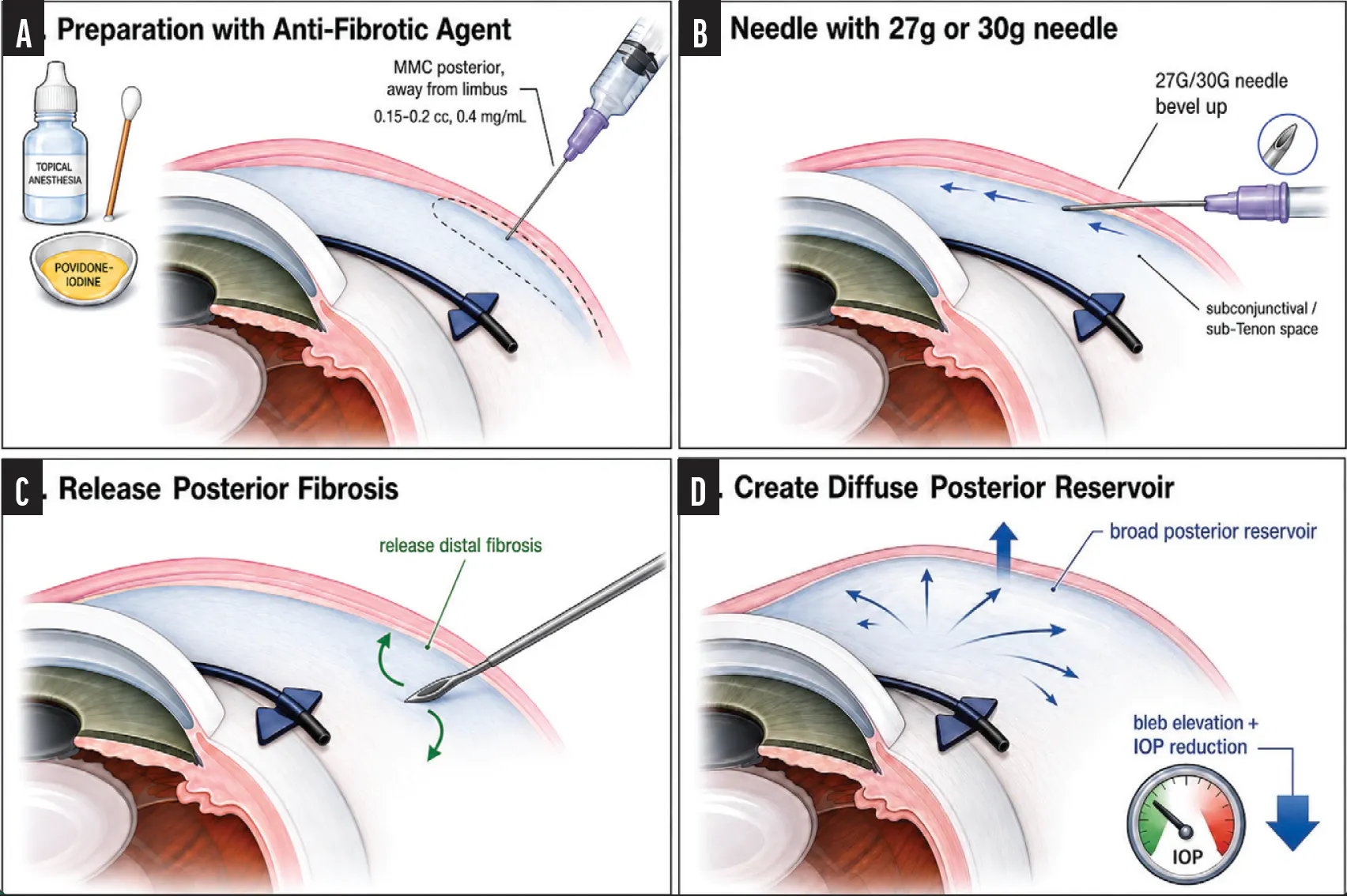
With the Xen, care must be taken to lyse fibrotic bands around the distal tip of the implant and redirect aqueous posteriorly. When fibrosis is present both anteriorly and posteriorly to the distal tip of the implant, we generally release the anterior adhesions first because an early subconjunctival hemorrhage may otherwise obscure visualization of the distal implant. It is imperative that the soft gelatin implant not be cut or displaced.
The Preserflo MicroShunt is longer and more rigid than the Xen. The former is positioned with its fins near the scleral entry point and a distal tube beneath the conjunctiva and Tenon capsule. Preserflo needling is focused on releasing subconjunctival and sub-Tenon fibrosis around the distal drainage pathway while avoiding disruption of the scleral fixation site. The goal is to create a diffuse posterior reservoir through the broad lysis of adhesions. Immediate bleb elevation, posterior diffusion, and IOP reduction suggest success. If the device is embedded in Tenon tissue, it is surrounded by dense fibrosis, or it cannot be confidently visualized, an open revision in the OR may yield more predictable results.6-9
Complications of needling include a hemorrhage, hypotony, a bleb leak, a conjunctival buttonhole, and implant displacement or exposure. The bleeding risk may be higher with antithrombotic therapy, and withholding these agents should be discussed on a case-by-case basis with the prescribing physician.10
OUTCOMES
It is important to frame the expected results of needling realistically to patients. In a prospective series of MMC-augmented Xen needling cases, mean IOP decreased from 23.6 ±8.9 mm Hg before needling to 14.3 ±4.1 mm Hg at 17 months after needling; however, 39% of the eyes required more than one needling procedure, and 25% required a reoperation.2 A meta-analysis reported that 35% of eyes that received a Xen required at least one needling procedure, 5% required Xen revision or a second Xen implantation, and 11% required another glaucoma procedure.3,4
Needling-specific outcomes are less defined for the Preserflo. Published studies have generally reported postoperative IOPs in the low- to midteens with a reduced number of medications, and comparative series have suggested lower needling rates compared to the Xen, although open revision was still sometimes required.6,9
After needling, we typically restart or intensify topical antiinflammatory therapy to suppress wound healing. A practical regimen is prednisolone acetate 1% or dexamethasone administered four to six times daily for the first week, followed by a 2- to 4-week taper if the bleb is quiet and the IOP is stable. Marked injection or early reencapsulation of the bleb may necessitate a slower taper. Patients who experience a steroid response require closer IOP monitoring. NSAIDs can be considered for patients who are experiencing ocular discomfort, who are at increased risk of developing cystoid macular edema, or who are exhibiting steroid intolerance, but routine NSAID use solely to improve bleb survival is not strongly supported.
CONCLUSION
Bleb needling is an integral component of subconjunctival glaucoma surgery, not just a rescue procedure. Success depends on appropriate patient selection, early recognition of subconjunctival fibrosis, meticulous technique, and aggressive modulation of wound healing. Performed thoughtfully, needling can restore filtration, prolong bleb function, and reduce the need for additional surgery.
1. Arnljots TS, Kasina R, Bykov VJN, et al. Needling with 5-fluorouracil after Xen gel stent implantation: 6-month outcomes. J Glaucoma. 2018;27(10):893-899. doi:10.1097/IJG.0000000000001052
2. Midha N, Gillmann K, Chaudhary A, et al. Efficacy of needling revision after Xen gel stent implantation: a prospective study. J Glaucoma. 2020;29(1):11-14. doi:10.1097/IJG.0000000000001394
3. Steiner S, Resch H, Kiss B, et al. Needling and open filtering bleb revision after Xen-45 implantation. Graefes Arch Clin Exp Ophthalmol. 2021;259(9):2761-2770. doi:10.1007/s00417-021-05204-1
4. Betzler BK, Lim SY, Lim BA, et al. Complications and post-operative interventions in Xen45 gel stent implantation: a systematic review and meta-analysis. Eye (Lond). 2023;37(6):1047-1060. doi:10.1038/s41433-022-02022-5
5. Ventura-Abreu N, Dotti-Boada M, Muniesa-Royo MJ, et al. Xen45 real-life evaluation: survival analysis with bleb needling and major revision outcomes. Eur J Ophthalmol. 2021;32(2). doi:10.1177/11206721211012847
6. Pietris J, Casson R. One-year outcomes of PreserFlo MicroShunt for primary open-angle glaucoma: a systematic review and meta-analysis. J Glaucoma. 2024;33:e27-e34. doi:10.1097/IJG.0000000000002419
7. Strzalkowska A, Strzalkowski P, Hoffmann EM, Pfeiffer N, Schuster AK. Outcomes of open bleb revision after PreserFlo MicroShunt failure in patients with glaucoma. J Glaucoma. 2023;32(8):681-685. doi:10.1097/IJG.0000000000002246
8. Theilig T, Rehak M, Busch C, et al. Outcomes of open bleb revision after failed Xen gel stent and PreserFlo MicroShunt implantation. Graefes Arch Clin Exp Ophthalmol. 2023;261(11):3249-3255. doi:10.1097/IJG.0000000000002246
9. Figus M, Palma A, Covello G, et al. Two-year efficacy and safety of bleb-forming devices in uncontrolled glaucoma. Graefes Arch Clin Exp Ophthalmol. Published online April 20, 2026. doi:10.1007/s00417-026-07249-6
10. Chen X, Suo L, Hong Y, Zhang C. Safety and efficacy of bleb needling with antimetabolite after trabeculectomy failure in glaucoma patients: a systemic review and meta-analysis. J Ophthalmol. 2020;2020:4310258. doi:10.1155/2020/4310258