Key Takeaways
- Bleb leaks are a potentially vision-threatening complication of trabeculectomy and other filtering procedures, especially when adjunctive antimetabolites, such as mitomycin C, are used.
- Early detection, timely intervention, and individualized surgical planning are essential to prevent vision-threatening sequelae.
- Bleb leak management strategies are dictated by a leak’s timing, size, and location and by the presences of hypotony or infection.
Trabeculectomy is a cornerstone of surgical glaucoma management, particularly for patients who require a low target IOP. The adjunctive use of antimetabolites, such as mitomycin C (MMC), has improved long-term surgical outcomes by reducing scarring but has also increased the incidence of thin, avascular blebs and associated complications.1 Bleb leaks are a potentially vision-threatening complication of trabeculectomy and other filtering procedures. These leaks may present early or late in the postoperative course and may lead to chronic bleb failure and increase the risk of infection.2 This article discusses the detection, prevention, and management of bleb leaks.
DEFINITION AND CLASSIFICATION
A bleb leak is defined as one or multiple areas of aqueous leakage from an existing bleb, and it is confirmed by a positive Seidel test. Early bleb leaks occur within the first 3 months following surgery.3,4 They are most commonly associated with wound leaks, conjunctival buttonholes, and inadequate conjunctival closure. Several studies have indicated that early leaks do not necessarily compromise long-term surgical outcomes,5 but prompt recognition is required because persistent leakage may predispose the eye to hypotony or bleb-related infection.5
Late bleb leaks, which present 4 or more months after surgery, typically occur in patients with thin, avascular, ischemic blebs.1 A population-based study from Olmsted County, Minnesota, found bleb leaks to be the most frequent late complication of trabeculectomy and noted an association between bleb leaks and endophthalmitis in both adult and pediatric patients.6 Close monitoring of blebs, even years after surgery, is therefore imperative to preventing vision-threatening complications.
CLINICAL PRESENTATION
Patients with a bleb leak after trabeculectomy may present with a range of ocular symptoms. The flow of aqueous across the surface of the cornea may lead to fluctuating vision and epiphora.7 Patients may also present with decreased visual acuity related to hypotony, corneal folds, or maculopathy.8,9
Late bleb leaks are often associated with large, overhanging, thin-walled, or cystic blebs, which can develop a pinpoint breakdown of thinned epithelium. These blebs may become avascular and ischemic and can overlie a scleral melt or fistula, which appears as a graying area beneath the thin conjunctival epithelium.10
Given the range of presentations, Seidel testing remains the gold standard for detecting bleb leaks. With a positive test, a stream of clear aqueous dilutes the fluorescein and appears as a dark stream against the bright green background.11
Persistent bleb leaks increase the risk of bleb-associated infection, which may present with nonspecific symptoms such as conjunctival hyperemia, discharge, foreign body sensation, lid swelling, irritation, and pain.9,12 Overdrainage may also result in hypotony, leading to complications such as maculopathy, which can manifest as macular and foveal striae, choroidal folds, disc edema, macular edema, and tortuosity of the retinal vessels.13
Bleb leaks can also be asymptomatic, so the true incidence of this complication may be difficult to determine.14 It is strongly recommended to look for leaks at the conclusion of the trabeculectomy surgery. A careful slit-lamp examination to assess the eye for leaks should be performed during follow-up visits.15
PATHOPHYSIOLOGY AND CLINICAL SIGNIFICANCE
Bleb leaks arise from compromised conjunctival tissue, most commonly following the application of an antimetabolite that triggers an aberrant wound-healing response. MMC, for example, can lead to fibroblast depletion and damage, resulting in an insufficient extracellular matrix that lacks the structural strength to prevent leakage.16 These areas of reduced tensile strength can create focal points of weakness where aqueous can leak, sometimes through microscopic areas that do not produce a clinically detectable positive Seidel test.16
When antimetabolites are not used during surgery, bleb leaks occur primarily from early surgical trauma to the conjunctiva or, less commonly, from late spontaneous breakdown. Early postoperative leaks result from conjunctival manipulation that creates defects in the tissue integrity, allowing aqueous to flow. Careful surgical technique can prevent such complications.17 Late spontaneous leaks are driven by focal conjunctival epithelial thinning or underlying stromal degeneration.18 If not addressed promptly, bleb leaks, particularly late ones, are a major risk factor for vision-threatening sequelae such as endophthalmitis because disruption of the ocular surface barrier facilitates direct entry of pathogenic organisms.19
Other potential consequences of bleb leaks include shallowing of the anterior chamber (AC) with the risk of peripheral anterior synechiae formation, chronic hypotony with hypotony maculopathy, choroidal effusions or detachments, and cataract formation. Hypotony occurs when aqueous fluid leaks at a rate greater than its production, resulting in low IOP. Factors contributing to hypotony in trabeculectomy patients include bleb leaks and prior mechanical or inflammatory damage to the ciliary body. Hypotony causes AC shallowing, which permits iris contact with the peripheral cornea and may lead to the development of peripheral anterior synechiae.20 Chronic hypotony can result in hypotony maculopathy through choroidal expansion and scleral infolding, choroidal effusion and detachments as fluid accumulates in the suprachoroidal space, and lens-cornea contact that results in altered lens metabolism and cataract formation.20
EPIDEMIOLOGY AND RISK FACTORS
The reported incidence of bleb leaks varies with MMC use and concentration, surgical procedure and technique, individual wound-healing response, and length of follow-up. Reported leak rates are affected by differences in sample size, how aqueous leakage is defined, spontaneous versus provoked leak detection, and filtering bleb location.20 Early bleb leaks have been reported in 0% to 30% of eyes following trabeculectomy.3,4 Late bleb leaks occur in roughly 2% to 18% of eyes after trabeculectomy with MMC, with higher rates seen in long-term studies, highlighting a lifelong risk.1,20,21 In a UK multicenter analysis, bleb leaks were observed in 14% of the 428 trabeculectomies performed with antifibrotics; 95% of these leaks occurred within the first 3 months.22
Bleb leaks result from a convergence of patient, surgical, and bleb-related factors (Figure). Patient risks include younger age, high myopia, inflammatory eye disease, long-term topical medication use, and prior bleb infection.23 Contributing surgical factors include higher-dose or prolonged MMC exposure, fornix-based conjunctival flaps, thin conjunctiva or Tenon layer, and inferior bleb placement. MMC confers an approximately threefold greater risk of leakage compared with 5-fluorouracil, and a bleb leak is the most common complication following trabeculectomy with adjunctive MMC.20, 24-27
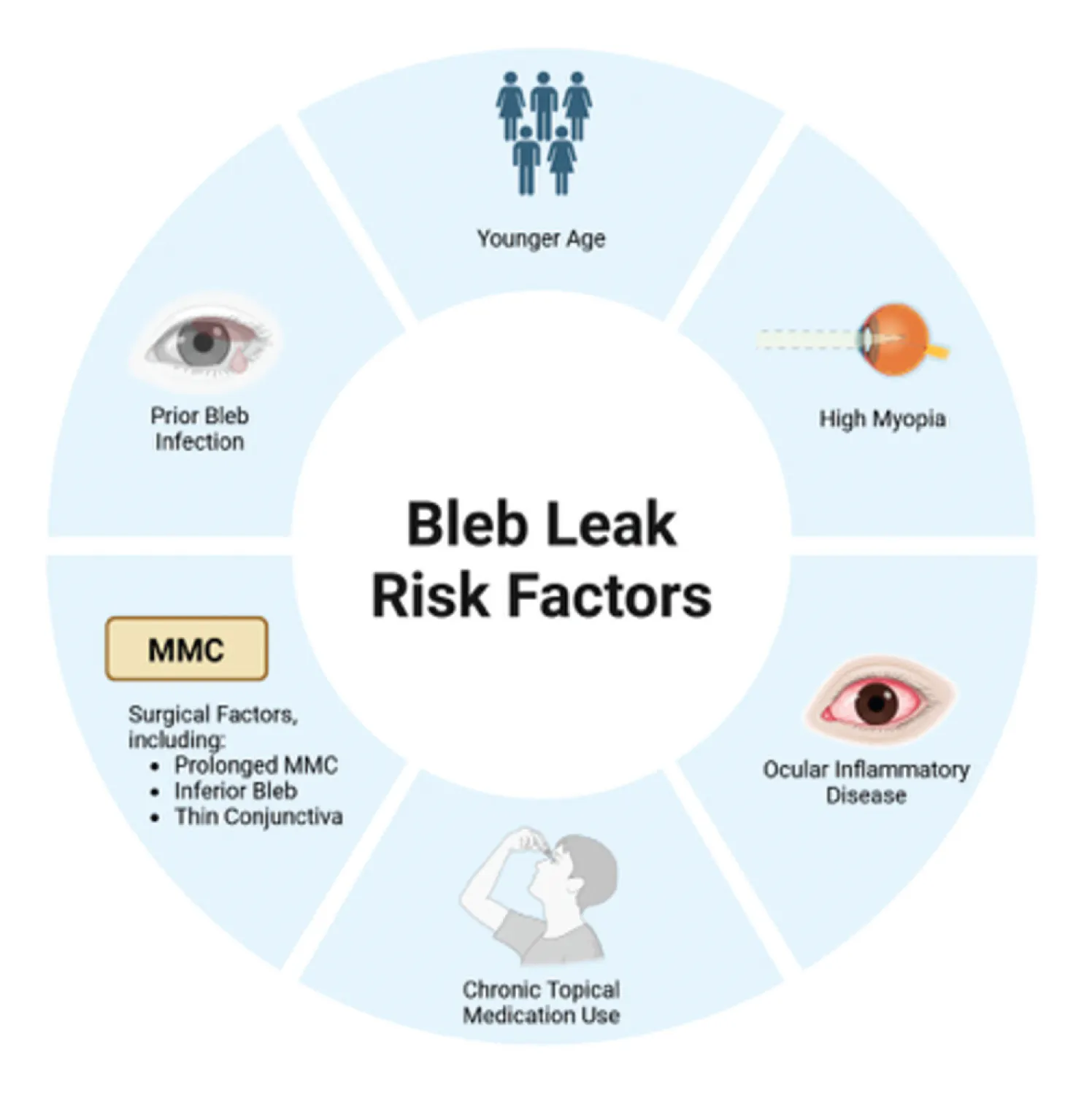
These associations should inform intraoperative choices and long-term surveillance to mitigate sight-threatening sequelae.
PREVENTION STRATEGIES
Bleb leak prevention involves surgical technique and judicious use of MMC (dose, duration, and application). The AAO recommends the use of a fornix-based conjunctival flap with broad MMC application to reduce the risk of bleb-related complications.28 Surgical advancement of Tenon tissue has been associated with improved bleb morphology—characterized by diffuse, nonischemic blebs—compared with traditional techniques.29
Tailoring MMC application is an important determinant of the success of trabeculectomy and bleb integrity. Patients should be stratified according to their risk of postoperative scarring and surgical history. For standard-risk patients, such as older individuals with primary open-angle glaucoma and no history of conjunctival surgery, a regimen of 0.2 mg/mL MMC applied for 2 to 3 minutes is generally appropriate.30,31 In younger patients and those with mild conjunctival inflammation related to long-term exposure to topical medication or other etiologies, a higher concentration of 0.3 mg/mL may provide more effective antifibrotic control. Patients with multiple risk factors for scarring, including those with uveitic glaucoma, neovascular glaucoma, or a history of failed trabeculectomy, may require a higher concentration and longer exposure time, such as 0.4 mg/mL for approximately 3 to 4 minutes.30,31 Additional considerations include the posterior placement of MMC sponges to promote the formation of a diffuse posterior bleb and reduce cystic bleb formation as well as copious irrigation following sponge removal to limit unintended toxicity to adjacent tissues.31
Avoiding inferior bleb placement when feasible reduces the risk of mechanical complications and infection because superior blebs have better coverage by the upper eyelid. Meticulous conjunctival and Tenon closure as well as careful scleral flap design and tension can aid in preventing early postoperative leaks.32 In the postoperative period, large-diameter soft bandage contact lenses may be used adjunctively to provide mechanical protection and promote epithelial healing.33 Emerging approaches such as conjunctival collagen crosslinking have shown promise in strengthening structurally compromised bleb tissue by increasing stromal rigidity.34
Ongoing surveillance of bleb morphology is critical, and patients should be counseled about symptoms of potential infection, including ocular pain, redness, and vision changes, to facilitate early intervention.
MANAGEMENT
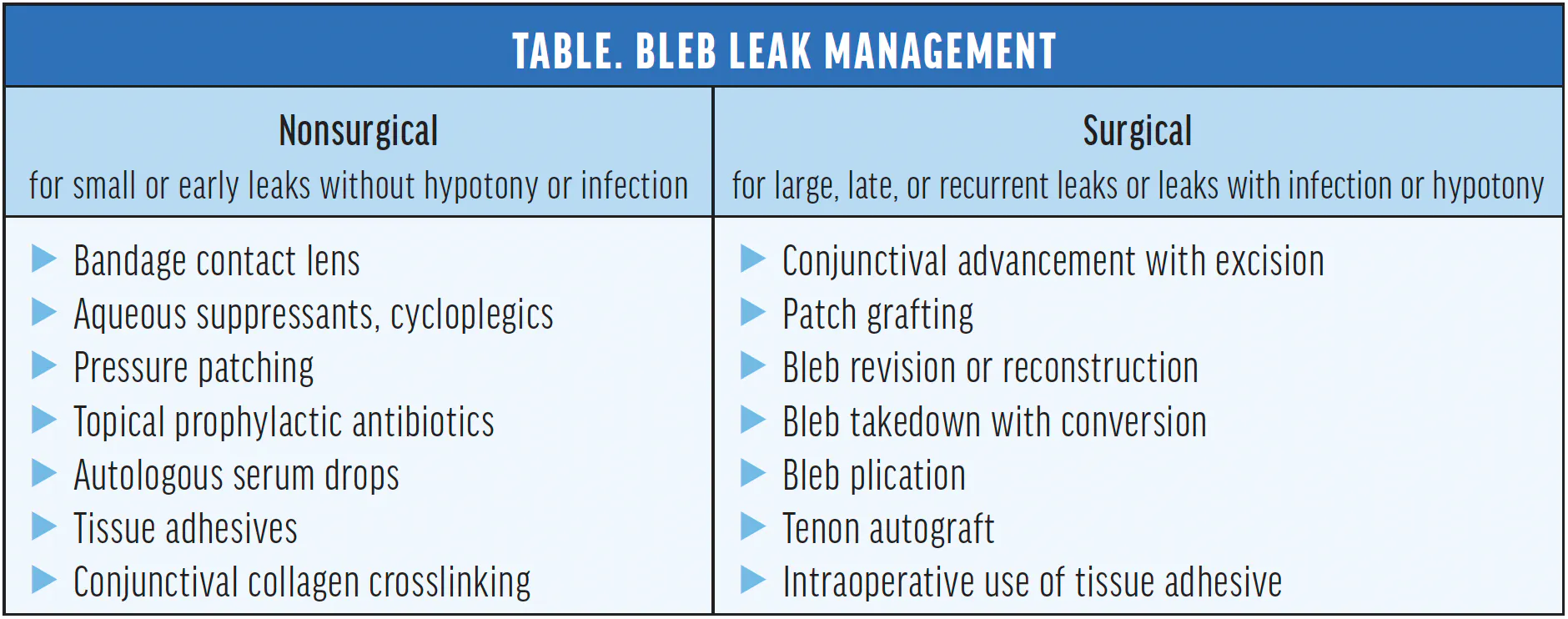
Management of bleb leaks is dictated by their timing, size, and location and by the presence of hypotony or infection (Table). Small or early leaks without significant hypotony or infection may be managed conservatively in the office. Large, late, or recurrent leaks or leaks associated with infection or sight-threatening hypotony require surgical intervention. Topical antibiotics alone are inadequate for persistent leaks. Despite limited data on the management of bleb leaks in monocular patients, surgeons may adopt a lower threshold for surgical intervention to mitigate the risk of hypotony and infection in the only functional eye.
Nonsurgical
Nonsurgical measures include bandage contact lenses, aqueous suppressants and cycloplegics to reduce flow and stabilize the AC, pressure patching, topical prophylactic antibiotics, autologous serum drops, autologous blood injection, and tissue adhesives such as cyanoacrylate and fibrin glue.14 Conjunctival collagen crosslinking and large-diameter soft bandage contact lenses are emerging adjunctive options. These approaches can seal small leaks or temporize while definitive treatment is planned.
Surgical
Surgical intervention is indicated for persistent, late, or complicated leaks. Procedures are selected based on bleb morphology and prior interventions. The most common and effective approach for late leaks is conjunctival advancement with excision of ischemic bleb tissue and advancement of healthy conjunctiva.32 Alternatively, conjunctiva can be advanced over the existing bleb to maintain a watertight seal at the limbus. In the latter approach, the old bleb and peripheral cornea must be deepithelialized to promote proper adherence of the advanced conjunctiva.35 Patch grafting using sclera, cornea, pericardium, or amniotic membrane, often combined with conjunctival advancement, can provide structural support for large defects.32 Bleb revision or reconstruction (including scleral flap revision or reinforcement) can reshape or downsize an overfiltering bleb while attempting to preserve IOP control.
In cases of recurrent leaks or infection, bleb takedown with conversion to an alternative glaucoma procedure (ie, tube shunt or nonpenetrating surgery) may be required. Less invasive or adjunctive surgical techniques reported in the literature include bleb plication, Tenon autograft (rotation or hinge flap), and intraoperative use of tissue adhesive.36-40
The treatment choice should balance the restoration of globe integrity and infection control against the preservation of filtration and IOP control. Individualized planning and long-term surveillance are essential.
OUTCOMES
The recurrence rates of bleb leaks vary by technique. Compared with nonoperative techniques, however, conjunctival advancement has shown the lowest recurrence rate in most series, and it has been associated with a lower incidence of serious intraocular infections.41 IOP control and patients’ visual acuity have also been shown to improve when conjunctival advancement was used in the management of late-onset hypotony after a trabeculectomy with MMC.42 In a retrospective analysis of bleb revisions, the cumulative success rates at 1, 2, 5, and 10 years were 80%, 75%, 50%, and 41%, respectively.43
Regardless of approach, long-term follow-up is critical because of the lifelong risk of late leaks and bleb-related infection.
CONCLUSION
Bleb leaks are a significant complication of trabeculectomy, especially when adjunctive antimetabolites are used. Early recognition, timely intervention, and individualized surgical planning are essential to prevent vision-threatening sequelae.
Ongoing research is needed to refine bleb management techniques. Future options for management may include minimally invasive approaches for bleb leak repair. In addition, sustained-release antifibrotic-delivery platforms may emerge as alternatives to single-dose antimetabolites for glaucoma filtration surgery.44 Additionally, preclinical models have developed a novel in situ light-activated hydrogel system that responds to reactive oxygen species and delivers sustained antifibrotic therapy to reduce inflammation and scarring. These innovations aim to enhance bleb durability while minimizing bleb-related complications.44
1. Anand N, Arora S, Clowes M. Mitomycin C augmented glaucoma surgery: evolution of filtering bleb avascularity, transconjunctival oozing, and leaks. Br J Ophthalmol. 2006;90(2):175-180.
2. Beckers HJM, Kinders KC, Webers CAB. Five-year results of trabeculectomy with mitomycin C. Graefes Arch Clin Exp Ophthalmol. 2003;241(2):106-110.
3. Batterbury M, Wishart PK. Is high initial outflow of benefit in trabeculectomy? Eye (Lond). 1993;7(pt 1):109-112.
4. Munden PM, Alward WL. Combined phacoemulsification, posterior chamber intraocular lens implantation, and trabeculectomy with mitomycin C. Am J Ophthalmol. 1995;119(1):20-29.
5. Henderson HWA, Ezra E, Murdoch IE. Early postoperative trabeculectomy leakage: incidence, time course, severity, and impact on surgical outcome. Br J Ophthalmol. 2004;88(5):626-629.
6. Olayanju JA, Hassan MB, Hodge DO, Khanna CL. Trabeculectomy-related complications in Olmsted County, Minnesota, 1985 through 2010. JAMA Ophthalmol. 2015;133(5):574-580.
7. Grigorian AP, Spaeth G. An explanation of transient visual loss associated with leaking filtering bleb. Am J Ophthalmol. 2004;138(5):869-870.
8. Dunnington JH, Regan EF. Late fistulization of operative wounds; diagnosis and treatment. Arch Ophthalmol. 1950;43(3):407-418.
9. Tang AC, Teh SS, Yong GY, Tan ZH, Yong XR. The art of fixing a ticking time bomb: combined phacoemulsification and amniotic membrane transplantation. Taiwan J Ophthalmol. 2023;14(2):275-278.
10. Pathak Ray V, Badakere SV. Long-term outcomes of blebs repaired with scleral patch graft and conjunctival advancement in late-onset leak post-trabeculectomy. Indian J Ophthalmol. 2021;69(9):2496-2501.
11. Lambat SP, Surana N, Nangia PV, Nangia VB. Pinpointing a leaky bleb with a blue surgical skin marker. Indian J Ophthalmol. 2025;73(10):1527-1529.
12. Razeghinejad MR, Havens SJ, Katz LJ. Trabeculectomy bleb-associated infections. Surv Ophthalmol. 2017;62(5):591-610.
13. Bitrian E, Song BJ, Caprioli J. Bleb revision for resolution of hypotony maculopathy following primary trabeculectomy. Am J Ophthalmol. 2014;158(3):597-604.e1.
14. DeBry PW, Perkins TW, Heatley G, Kaufman P, Brumback LC. Incidence of late-onset bleb-related complications following trabeculectomy with mitomycin. Arch Ophthalmol. 2002;120(3):297-300.
15. Vijaya L, Manish P, Ronnie G, Shantha B. Management of complications in glaucoma surgery. Indian J Ophthalmol. 2011;59(suppl1):S131-140.
16. Elner VM, Newman-Casey PA, Patil AJ, et al. Aberrant wound-healing response in mitomycin C–treated leaking blebs: a histopathologic study. Arch Ophthalmol. 2009;127(8):1036-1042.
17. Loane ME, Galanopoulos A. The surgical management of leaking filtering blebs. Curr Opin Ophthalmol. 1999;10(2):121-125.
18. Francis BA, Du LT, Najafi K, et al. Histopathologic features of conjunctival filtering blebs. Arch Ophthalmol. 2005;123(2):166-170.
19. Mott M. A ticking time bomb: how to fix a leaking bleb. EyeNet Magazine. AAO. November 2018:31-32. https://www.aao.org/eyenet/article/how-to-fix-a-leaking-bleb. Accessed March 16, 2026.
20. Greenfield DS, Liebmann JM, Jee J, Ritch R. Late-onset bleb leaks after glaucoma filtering surgery. Arch Ophthalmol. 1998;116(4):443-447.
21. Alwitry A, King AJ. Surveillance of late-onset bleb leak, blebitis and bleb-related endophthalmitis: a UK incidence study. Graefes Arch Clin Exp Ophthalmol. 2012;250(8):1231-1236.
22. Kirwan JF, Lockwood AJ, Shah P, et al. Trabeculectomy in the 21st century: a multicenter analysis. Ophthalmology. 2013;120(12):2532-2539.
23. Karolina C, Baril C, Bourret-Massicotte D, et al. Risk factors for a severe bleb leak following trabeculectomy: a retrospective case-control study. J Glaucoma. 2015;24(7):493-497.
24. Beck AD, Wilson WR, Lynch MG, Lynn MJ, Noe R. Trabeculectomy with adjunctive mitomycin C in pediatric glaucoma. Am J Ophthalmol. 1998;126(5):648-657.
25. Solomon A, Ticho U, Frucht-Pery J. Late-onset, bleb-associated endophthalmitis following glaucoma filtering surgery with or without antifibrotic agents. J Ocul Pharmacol Ther. 1999;15(4):283-293.
26. Shigeeda T, Tomidokoro A, Chen YN, Shirato S, Araie M. Long-term follow-up of initial trabeculectomy with mitomycin C for primary open-angle glaucoma in Japanese patients. J Glaucoma. 2006;15(3):195-199.
27. Giampani J Jr, Borges-Giampani AS, Carani JCE, Oltrogge EW, Susanna R Jr. Efficacy and safety of trabeculectomy with mitomycin C for childhood glaucoma: a study of results with long-term follow-up. Clinics (Sao Paulo). 2008;63(4):421-426.
28. Gedde SJ, Vinod K, Wright MM, et al. Primary open-angle glaucoma preferred practice pattern. Ophthalmology. 2021;128(1):P71-P150.
29. Roddy GW, Sit AJ. Surgical advancement of Tenon’s layer during trabeculectomy improves bleb morphology. J Glaucoma. 2022;31(6):e32-e36.
30. Palmer SS. Mitomycin as adjunct chemotherapy with trabeculectomy. Ophthalmology. 1991;98(3):317-321.
31. Reyes M, Fox JA, Khaimi MA. Trabeculectomy surgery: decision making and technique. In: Kahook MY, ed. Kahook’s Essentials of Glaucoma Therapy. April 23, 2021. https://www.keogt.com/Trabeculectomy_Surgery:_Decision_Making_and_Technique#Mitomycin_C. Accessed March 23, 2026.
32. Bochmann F, Azuara-Blanco A. Interventions for late trabeculectomy bleb leak. Cochrane Database Syst Rev. 2012;(9):CD006769.
33. Gollakota S, Garudadri CS, Mohamed A, Senthil S. Intermediate-term outcomes of early posttrabeculectomy bleb leaks managed by large-diameter soft bandage contact lens. J Glaucoma. 2017;26(9):816-821.
34. Cai Y, Choy BNK, Zhu MM, et al. Prospective study on a novel treatment for leaking cystic bleb: efficacy and safety of collagen crosslinking. Clin Exp Ophthalmol. 2019;47(6):749-756.
35. Catoira Y, Wudunn D, Cantor LB. Revision of dysfunctional filtering blebs by conjunctival advancement with bleb preservation. Am J Ophthalmol. 2000;130(5):574-579.
36. Sugimoto K, Murata H, Yamashita T, Asaoka R. Bleb plication: a minimally invasive repair method for a leaking ischemic bleb after trabeculectomy. Sci Rep. 2020;10(1):14978.
37. Maheshwari D, Tara TD, Madhavi R, Pawar N, Ramakrishnan R. Bleb revision with bleborhexis and clear corneal lamellar patch graft for overhanging cystic bleb. Indian J Ophthalmol. 2022;70(4):1438.
38. Lázaro-Rodríguez V, Casado-López D, Ruiz Tolosa F. Conjunctival collagen crosslinking for the management of bleb leak. Indian J Ophthalmol. 2023;71(1):276-279.
39. van de Geijn EJ, Lemij HG, de Vries J, de Waard PWT. Surgical revision of filtration blebs: a follow-up study. J Glaucoma. 2002;11(4):300-305.
40. Chen LE, Yee P, Smith AK, Fox A, Mosaed S. Bleb leak revision with Tenon’s autograft. Am J Ophthalmol Case Rep. 2024;36:102141.
41. Burnstein AL, WuDunn D, Knotts SL, Catoira Y, Cantor LB. Conjunctival advancement versus nonincisional treatment for late-onset glaucoma filtering bleb leaks. Ophthalmology. 2002;109(1):71-75.
42. Prokosch-Willing V, Lamparter J, Ul Hassan SN, Toshev AP, Pfeiffer N, Hoffmann EM. Results of an adaptive surgical approach for managing late-onset hypotony after trabeculectomy with mitomycin C. J Glaucoma. 2018;27(4):307-314.
43. Radhakrishnan S, Quigley HA, Jampel HD, et al. Outcomes of surgical bleb revision for complications of trabeculectomy. Ophthalmology. 2009;116(9):1713-1718.
44. Sun J, Liu X, Lei Y, et al. Sustained subconjunctival delivery of cyclosporine A using thermogelling polymers for glaucoma filtration surgery. J Mater Chem B. 2017;5(31):6400-6411.