Key Takeaways
- Trabecular bypass MIGS can produce dramatically different IOP responses in patients with similar anatomy and glaucoma severity.
- The episcleral venous system’s ability to accommodate increased postsurgical aqueous outflow may determine the success or failure of trabecular bypass.
- Episcleral angiography might allow surgeons to identify which patients are likely to benefit from trabecular bypass MIGS.
By offering a modest reduction in IOP and a favorable safety profile,1 MIGS procedures have enabled earlier surgical intervention and broadened the treatment algorithm for patients with mild to moderate glaucoma. Many MIGS options are available, but trabecular bypass procedures are the most commonly performed. Despite a strong mechanistic rationale for and widespread adoption of these surgeries, clinical outcomes remain highly variable.2-4 Two patients with similar anatomy and disease severity who both undergo technically successful trabecular bypass MIGS may have dramatically different IOP responses.
The surgical placement of a trabecular bypass implant is driven largely by anatomy.5 Angle configuration, trabecular pigmentation, lens status, and disease stage are evaluated, but the approach does not account for the functional capacity of the distal aqueous outflow system—the final common pathway through which aqueous humor exits the eye. As a result, surgeons often perform trabecular bypass procedures without knowing whether the episcleral venous system can accommodate increased flow. This physiologic blind spot may be a fundamental barrier to precision glaucoma surgery (Figure 1).6
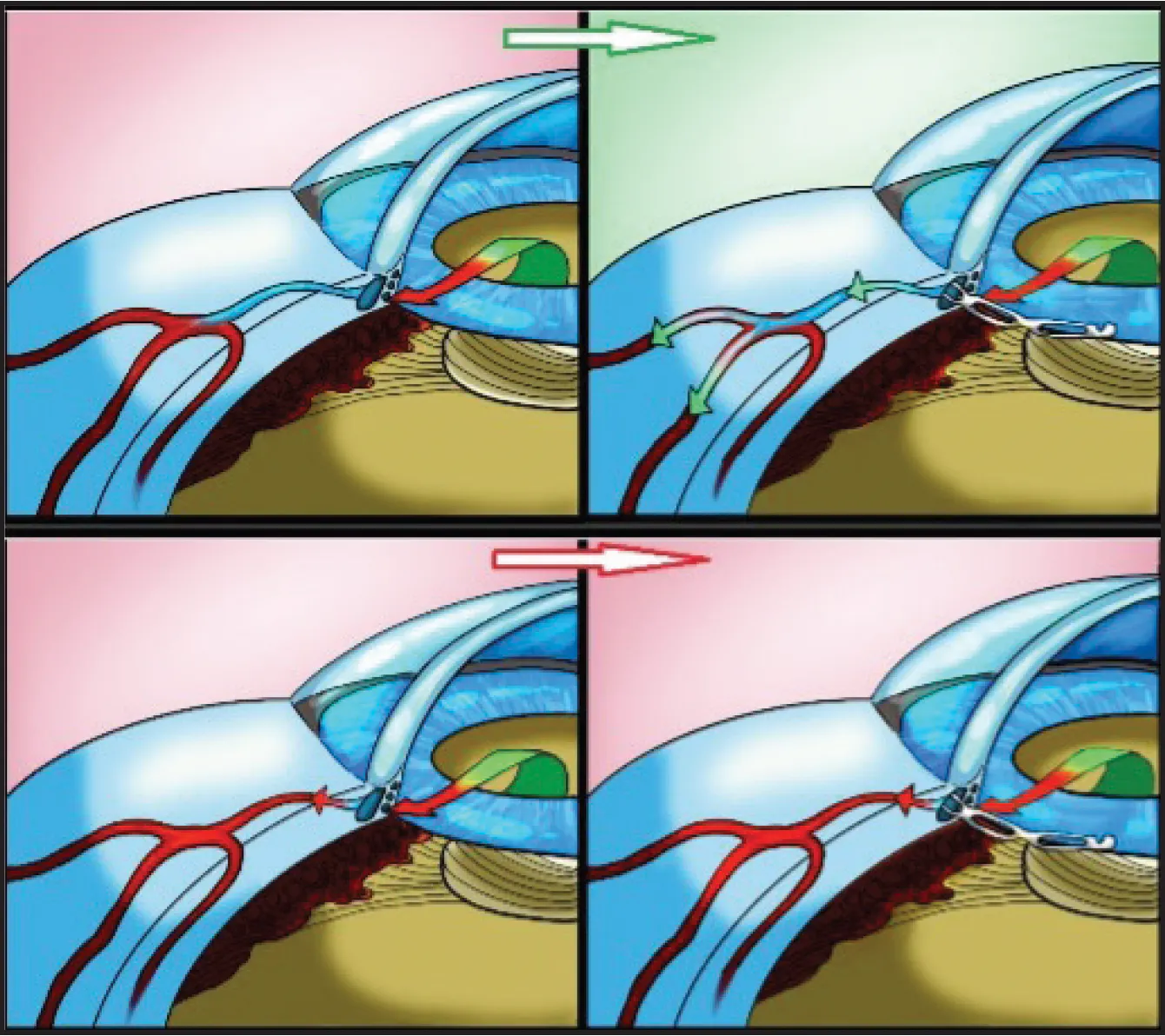
Figure 1. A functional episcleral venous system permits increased aqueous outflow following trabecular bypass, resulting in enhanced distal flow and reduced IOP (top row). A dysfunctional episcleral venous system limits distal outflow capacity. Trabecular bypass fails to increase flow, and IOP is unchanged (bottom row).
THE DISTAL OUTFLOW SYSTEM: THE MISSING VARIABLE
Ex vivo perfusion models consistently demonstrate that bypassing the trabecular meshwork increases outflow facility, but these models do not replicate in vivo conditions. Episcleral venous pressure is effectively zero in laboratory systems, and episcleral flow is absent. In contrast, the episcleral venous system accounts for a substantial portion of steady-state IOP in the living human eye. The magnitude of distal resistance may either facilitate or limit the effect of trabecular bypass.6
Despite the importance of distal outflow function, there is not currently a widely adopted clinical method to assess it. Episcleral venous pressure measurement is technically challenging, and readings can vary. What has been lacking is a dynamic, reproducible method by which to quantify episcleral venous flow directly.
EPISCLERAL FLOW AS A DIAGNOSTIC TARGET
Episcleral venous flow provides a physiologically meaningful readout of distal outflow capacity. Erythrocyte-mediated angiography (EMA) is a technique our group developed that allows direct quantification of absolute episcleral venous flow in human eyes. EMA measures erythrocyte velocity and vessel diameter to calculate volumetric blood flow within individual episcleral venous vessels (Figure 2). This provides a dynamic and quantitative assessment of distal outflow physiology in vivo.7
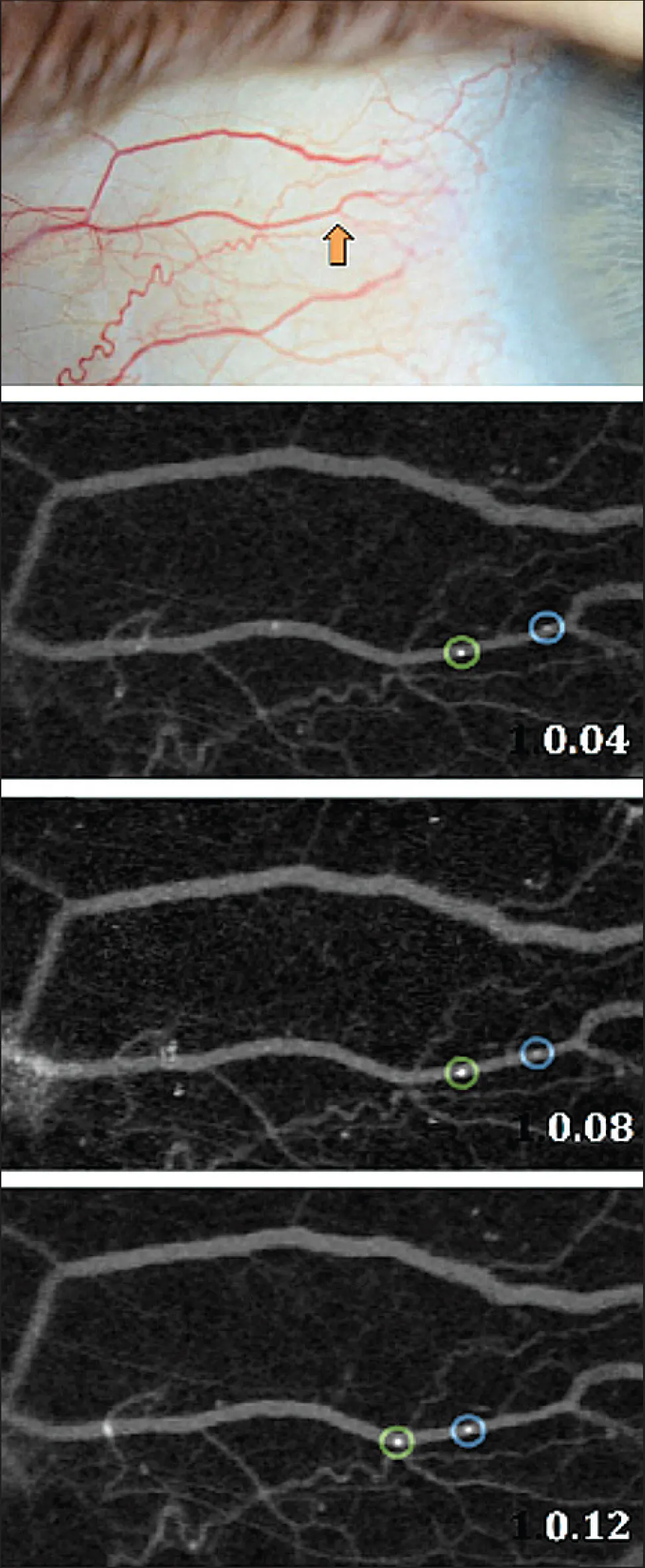
Figure 2. EMA demonstrates erythrocyte tracking at the convergence point (orange arrow) between proximal aqueous-containing vessels emerging from the limbus and distal episcleral vessels.
We have shown that episcleral flow can be pharmacologically modulated. In a clinical study evaluating netarsudil, EMA revealed measurable changes in episcleral venous flow rates, demonstrating that distal outflow is not fixed but physiologically responsive.8 Further, we noted a spectrum of baseline episcleral flow rates.
These findings support the idea that distal outflow capacity is biologically heterogeneous and may represent a previously unrecognized determinant of MIGS success or failure.
SCALING PHYSIOLOGY TO CLINICAL PRACTICE
Our group is collaborating with Vasoptic Medical on the development of laser speckle contrast imaging, a noninvasive method for assessing relative episcleral flow patterns. Image acquisition is rapid, and the technology may enable longitudinal tracking of flow dynamics in routine clinical settings (Figure 3).9 Further, laser speckle contrast imaging can be utilized intraoperatively and has the potential to aid stent placement for trabecular bypass, thereby providing real-time feedback on procedural efficacy.
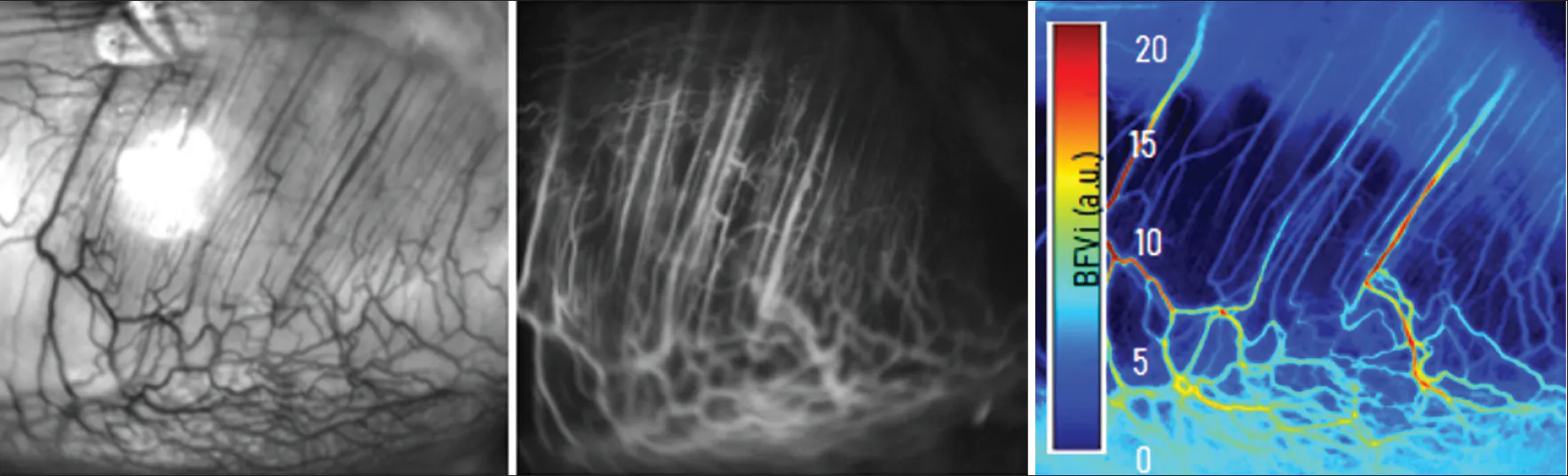
Figure 3. EMA of rabbit episclera: infrared image shows the episcleral vasculature (left); indocyanine green angiography identifies the episcleral vessels (center); and quantitative flow map using laser speckle contrast imaging (VasoVue, Vasoptic) illustrates calculated flow rates within the episcleral vascular network (right).
A CHANGING APPROACH
The central question regarding MIGS trabecular bypass is no longer whether it can lower IOP but for whom it will be effective and durable. Patients with preserved episcleral flow reserve may experience robust augmentation following trabecular bypass, whereas those with impaired distal outflow may have an attenuated response, suggesting the latter group might be better served by alternative strategies. Phenotyping patients according to their baseline distal outflow capacity might be able to distinguish surgical responders from nonresponders before surgery.
A PRECISION FRAMEWORK FOR MIGS
Episcleral angiography could introduce a precision medicine framework for glaucoma surgery. Instead of applying trabecular MIGS uniformly, surgeons may one day match procedures to underlying outflow physiology. Such an approach could improve surgical predictability, reduce failure rates, and optimize IOP control earlier in the disease course.
As diagnostic technologies evolve, the ability to visualize and quantify distal outflow could become an integral component of patient selection, intraoperative device placement, and postoperative outcomes measurement.
1. Schehlein EM, Kaleem MA, Swamy R, Saeedi OJ. Microinvasive glaucoma surgery: an evidence-based assessment. Expert Rev Ophthalmol. 2017;12(4):331-343.
2. Ahmed IIK, Fea A, Au L, et al. A prospective randomized trial comparing Hydrus and iStent microinvasive glaucoma surgery implants for standalone treatment of open-angle glaucoma: the COMPARE study. Ophthalmology. 2020;127(1):52-61.
3. Samuelson TW, Sarkisian SR Jr, Lubeck DM, et al. Prospective, randomized, controlled pivotal trial of an ab interno implanted trabecular micro-bypass in primary open-angle glaucoma and cataract: two-year results. Ophthalmology. 2019;126(6):811-821.
4. Paletta Guedes RA, Gravina DM, Paletta Guedes VM, Chaoubah A. Factors associated with unqualified success after trabecular bypass surgery: a case-control study. J Glaucoma. 2020;29(11):1082-1087.
5. Richter GM, Takusagawa HL, Sit AJ, et al. Trabecular procedures combined with cataract surgery for open-angle glaucoma: a report by the American Academy of Ophthalmology. Ophthalmology. 2024;131(3):370-382.
6. Strohmaier CA, Kallab M, Oechsli S, Huang AS, Saeedi OJ. Minimally invasive glaucoma surgery and the distal aqueous outflow system: The final frontier? Ophthalmol Glaucoma. 2025;8(3):209-212.
7. Asanad S, Park A, Pottenburgh J, Siddiqui A, Mayo L, Saeedi OJ. Erythrocyte-mediated angiography: quantifying absolute episcleral blood flow in humans. Ophthalmology. 2021;128(5):799-801.
8. Kim S, Chen V, Pottenburgh J, et al. Netarsudil 0.02% alters episcleral venous flowrates: a clinical trial using erythrocyte-mediated angiography. Ophthalmol Sci. 2024;4(5):100533.
9. Oechsli S, Gill A, Mansoor S, Sinha A, Rege A, Saeedi OJ. Reproducibility of laser speckle contrast imaging as a method for quantifying episcleral venous outflow. Invest Ophthalmol Vis Sci. 2024;65(7):1266.