Key Takeaways
- Traditional methods for grading the appearance of a postoperative filtering bleb offer limited insight into its internal structure and function.
- Anterior segment OCT provides detailed insight into bleb architecture, allowing ophthalmologists to objectively quantify bleb appearance.
- Quantitative bleb metrics correlate with surgical outcomes, and the use of anterior segment OCT for bleb assessment may enhance postoperative care.
Glaucoma filtration surgery, including trabeculectomy and deep sclerectomy, succeeds or fails based largely on the health of the postoperative filtering bleb. Clinicians have traditionally graded the bleb’s appearance at the slit lamp using subjective scales, such as the Indiana Bleb Appearance Grading Scale and Moorfields Bleb Grading System, that note the bleb’s height, area, and vascularity.1,2 These external assessments, however, offer limited insight into the bleb’s internal structure and function.
In contrast, anterior segment OCT (AS-OCT) can provide high-resolution cross-sectional images of blebs in vivo. The technology allows ophthalmologists to objectively quantify bleb morphology and visualize intricate structural details beneath the conjunctiva that were previously invisible.3,4 Our group has developed approaches to bleb assessment that use AS-OCT to enhance postoperative evaluation and establish correlations between bleb features and surgical outcomes.
VISUALIZING BLEB MICROSTRUCTURE WITH AS-OCT
AS-OCT provides detailed insight into bleb architecture, including key components of the filtration pathway and routes of aqueous outflow after surgery. The modality can delineate the internal bleb cavity (or bleb lake), the thickness of the bleb walls, and even the position of surgical elements such as the scleral flap and sclerostomy (Figure 1).4 Swept-source AS-OCT enables visualization of microcysts, fluid-filled cavities, and tissue interfaces in higher resolution.
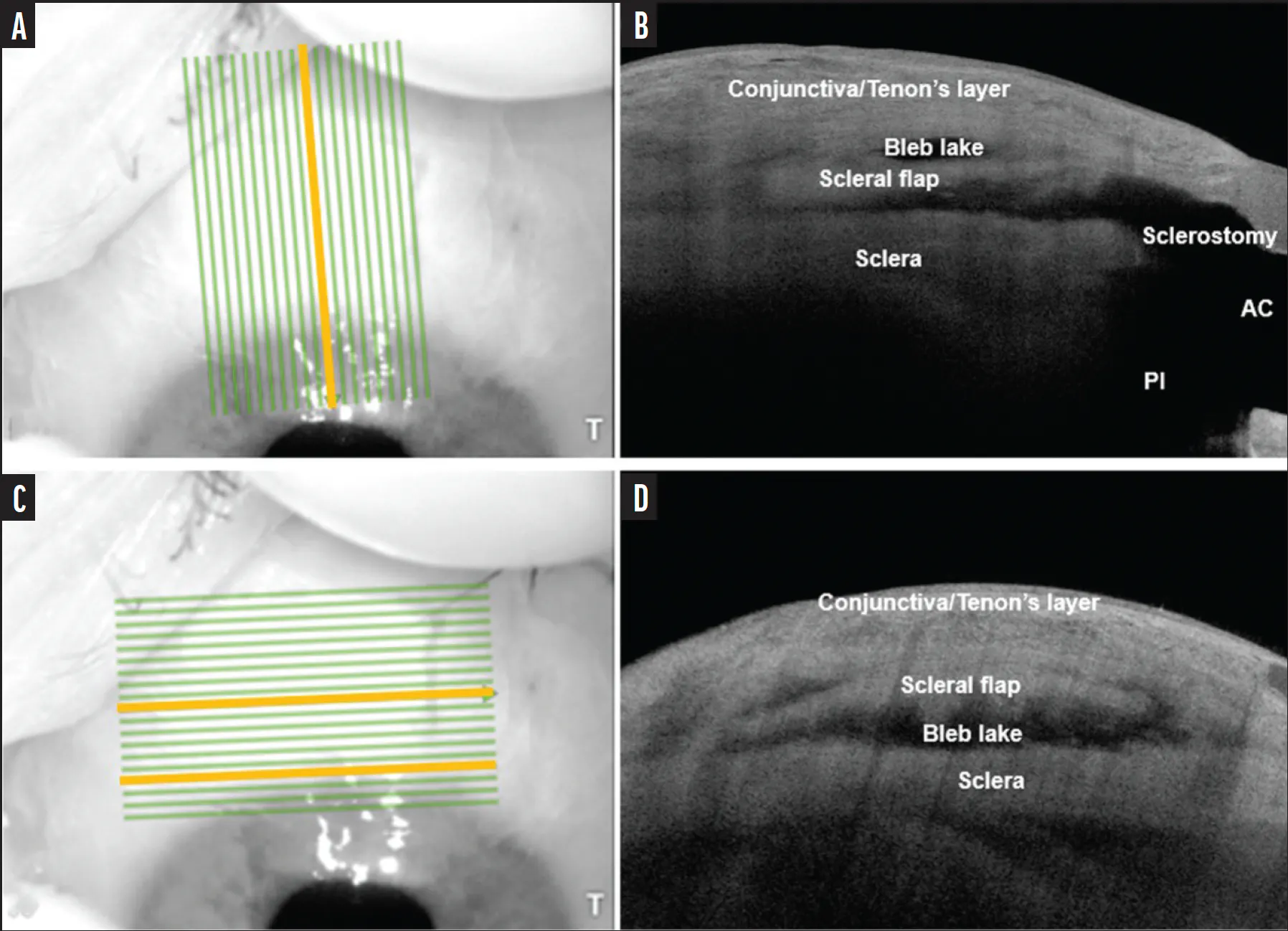
Figure 1. Representative en face and corresponding sagittal (A and B) and en face and corresponding coronal (C and D) AS-OCT images of a well-functioning trabeculectomy bleb, with the structures labeled. The yellow lines in the en face images (A and C) represent the slices of interest within the raster block, which captures the anatomy of the scleral flap and sclerostomy within the filtering bleb. Abbreviations: AC, anterior chamber; PI, peripheral iridotomy.
QUANTITATIVE BLEB METRICS CORRELATE WITH SURGICAL OUTCOMES
A major advantage of AS-OCT is its ability to measure bleb dimensions, turning the bleb’s appearance into quantifiable data.5
Bleb Height
Studies using spectral-domain OCT have shown associations between IOP and internal bleb morphology, such as the height and thickness of the conjunctival/Tenon layer,6,7 bleb cavity,6-8 and presence of microcysts,7 which reflect the aqueous dynamics induced by the drainage outflow channel.
Similarly, we found on AS-OCT that successful blebs were significantly taller than failing ones4,9—a logical finding given that a well-functioning bleb would be expected to have increased aqueous flow. For instance, in a cross-sectional study of filtration blebs with at least 12 months of follow-up, we found that the maximum internal bleb height in eyes with complete surgical success was around 1.5 to 1.7 mm compared with approximately 1.1 to 1.2 mm in blebs defined as failures.4,9 This trend held true for both deep sclerectomy and trabeculectomy blebs, underscoring the notion that a higher bleb typically indicated better surgical success.
Bleb Wall Reflectivity
We have also found that bleb wall reflectivity on AS-OCT may act as a proxy for tissue density or fibrosis. A healthier, functioning bleb tended to have a dark, low-reflective interior (likely indicating lower tissue density), whereas a failing bleb often appeared hyperreflective (possibly suggesting the presence of fibrous tissue).
We measured pixel intensity within bleb images and found that mean internal reflectivity was markedly lower in successful versus failed blebs (as defined by World Glaucoma Association success criteria).3 For instance, the reported average pixel intensity value on a grayscale of 0 to 255 was approximately 150 in blebs with complete surgical success compared with approximately 167 in failed blebs.3 In practical terms, the failing blebs were brighter on OCT, consistent with more scar tissue.
Not only were these differences significant, but they might also be diagnostically useful: metrics such as the standard deviation of bleb pixel intensity (a measure of reflectivity heterogeneity) and maximal bleb height showed a strong ability to discriminate between functioning and nonfunctioning blebs (area under the curve ≥ 0.75).3 Taken together, these findings suggest that taller, hollower blebs with low reflectivity may correspond with better IOP control, whereas flatter, highly reflective blebs may be quantifiable indicators of underperformance.3
Aqueous Outflow
AS-OCT can also be used to assess the integrity of the surgical outflow pathway by visualizing scleral flap and ostium patency. Using AS-OCT-based classification of flap configuration, we found that blebs with a clearly open and nonadherent scleral flap were strongly associated with surgical success, whereas blebs with poorly visualized or scarred-down flaps were more commonly associated with failure (Figure 2).4 This supports the concept that preserved flap and sclerostomy patency is a key determinant of effective aqueous outflow and long-term bleb function.
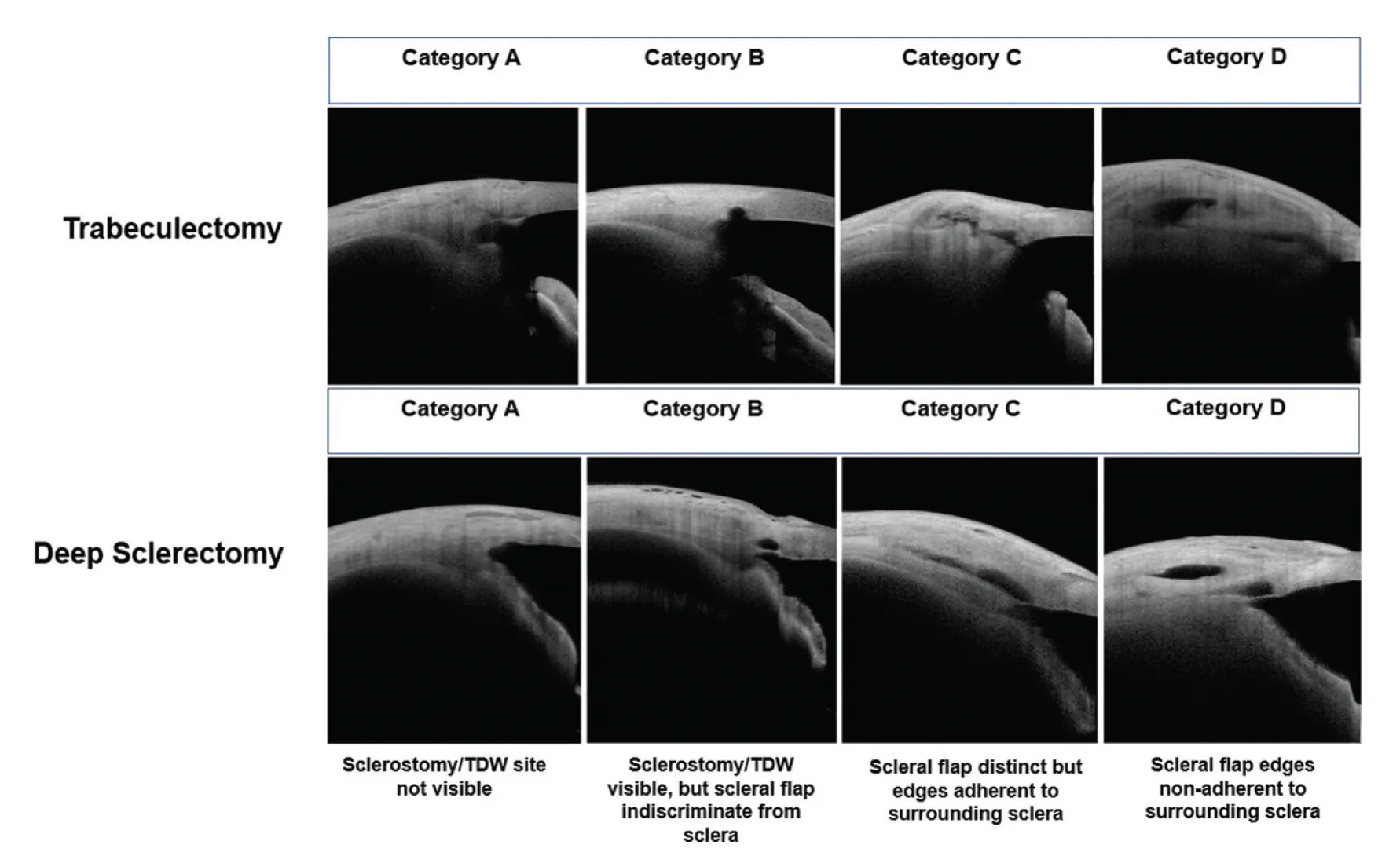
Figure 2. Representative sagittal AS-OCT images of trabeculectomy and deep sclerectomy blebs across the four categories of classification of sclerostomy and scleral flap patency, with descriptions of each category in the bottom row. Abbreviation: TDW, trabeculo-Descemet window.
CLINICAL UTILITY: IMPROVING POSTOPERATIVE MANAGEMENT
The incorporation of AS-OCT into postoperative care could enhance decision-making and personalize follow-up. For instance, if an early posttrabeculectomy AS-OCT scan shows a shallow bleb with an adherent scleral flap and high reflectivity (suggesting dense tissue), the surgeon might pursue measures such as needling with antifibrotic administration or more aggressive bleb massage instead of waiting for the IOP to rise. Conversely, an OCT-confirmed robust bleb with ample internal cystic spaces might reassure the clinician that the filtration surgery is less likely to fail. Longitudinal studies evaluating the correlation of these OCT metrics with IOP control and efficacy outcomes over time are required to assess the use of AS-OCT in postoperative care.
A recent meta-analysis of 11 studies found that AS-OCT bleb features, including greater height, thicker walls, and lower internal reflectivity, were consistently associated with trabeculectomy success and that early postoperative AS-OCT findings could predict bleb outcomes for up to 12 months.10 This predictive power could allow ophthalmologists to stratify patients by risk and rescue a bleb before it fails. Moreover, the quantitative nature of AS-OCT allows bleb changes to be tracked over time. For example, a diminishing bleb height or increasing reflectivity on serial scans might signal progressive scarring, prompting earlier intervention compared with standard care.
From a scientific standpoint, AS-OCT provides valuable endpoints for quality improvement and research. Surgeons could use this form of imaging to objectively compare surgical techniques by examining resulting bleb morphology. Such insights could be incorporated into surgical planning (eg, optimizing flap size or confirming the importance of sufficient dissection). Measurable bleb parameters would also allow clinical trials of new surgical procedures or wound-healing modulators to use bleb quality as an outcome in addition to IOP, possibly better explaining why certain surgeries succeed or fail.
A limitation in this field of research is the use of different AS-OCT devices and measures of surgical success across studies and clinics, which could affect the comparability of measurements— highlighting the need for future standardization.11 In addition, standardization of image acquisition and reporting in line with the Advised Protocol for OCT Study Terminology and Elements (APOSTEL) guidelines merits consideration.12
FUTURE OUTLOOK: SMARTER BLEB IMAGING
The role of AS-OCT in glaucoma surgery is likely to expand as the technology becomes more widely available. One exciting frontier is combining structural imaging with vascular imaging of the bleb. Early studies suggest that AS-OCT angiography can map bleb perfusion and vascular characteristics, including avascularity and vessel ingrowth, which might influence surgical outcomes.11 Integrating AS-OCT and AS-OCT angiography could provide a comprehensive bleb report that shows both the fluid outflow anatomy and the vascular healing response.
In the future, machine learning might be used to develop algorithms for the classification of bleb images. Currently, bleb imaging is not automated on AS-OCT instruments. Developing this capability is key to improving clinical utility. (This article does not address the analysis of bleb-forming devices such as the Xen Gel Stent [AbbVie] or Preserflo MicroShunt [Santen].11)
CONCLUSION
AS-OCT is evolving from an experimental imaging modality to a practical tool that could augment clinical judgment in glaucoma filtration surgery. By quantifying bleb morphology and revealing hidden details of the surgical site, AS-OCT could help clinicians ensure that a bleb both looks good on the outside and is functionally robust on the inside. As technology and understanding advance, AS-OCT–guided management may lead to more durable surgical outcomes.
The authors would like to acknowledge support from Matthew Roney, Carl Sheridan and Yalin Zheng.
1. Cantor LB, Mantravadi A, WuDunn D, Swamynathan K, Cortes A. Morphologic classification of filtering blebs after glaucoma filtration surgery: the Indiana Bleb Appearance Grading Scale. J Glaucoma. 2003;12(3):266-271.
2. Wells AP, Crowston JG, Marks J, et al. A pilot study of a system for grading of drainage blebs after glaucoma surgery. J Glaucoma. 2004;13(6):454-460.
3. Tan JCK, Roney M, Posarelli M, Ansari AS, Batterbury M, Vallabh NA. Discriminatory power of trabeculectomy bleb internal reflectivity and morphology in surgical success using anterior segment optical coherence tomography. BMC Ophthalmol. 2025;25(1):52.
4. Tan JCK, Roney M, Choudhary A, Batterbury M, Vallabh NA. Visualization of scleral flap patency in glaucoma filtering blebs using OCT. Ophthalmol Sci. 2024;5(1):100604.
5. Wang D, Lin S. New developments in anterior segment optical coherence tomography for glaucoma. Curr Opin Ophthalmol. 2016;27(2):111-117.
6. Oh LJ, Wong E, Lam J, Clement CI. Comparison of bleb morphology between trabeculectomy and deep sclerectomy using a clinical grading scale and anterior segment optical coherence tomography. Clin Exp Ophthalmol. 2017;45(7):701-707.
7. Konstantopoulos A, Yadegarfar ME, Yadegarfar G, et al. Deep sclerectomy versus trabeculectomy: a morphological study with anterior segment optical coherence tomography. Br J Ophthalmol. 2013;97(6):708-714.
8. Miura M, Kawana K, Iwasaki T, et al. Three-dimensional anterior segment optical coherence tomography of filtering blebs after trabeculectomy. J Glaucoma. 2008;17(3):193-196.
9. Tan JCK, Muntasser H, Choudhary A, Batterbury M, Vallabh NA. Swept-source anterior segment optical coherence tomography imaging and quantification of bleb parameters in glaucoma filtration surgery. Bioengineering (Basel). 2023;10(10):1186.
10. Sim JJL, Betzler BK, Dorairaj S, Dada T, Ang BCH. Trabeculectomy bleb characteristics in relation to bleb success using anterior segment optical coherence tomography-a systematic review and meta-analysis. J Glaucoma. 2025;34(9):679-687.
11. Kallab M, Huang AS, Bolz M, Strohmaier CA. Anterior segment optical coherence tomography and anterior segment optical coherence tomography angiography after bleb forming glaucoma surgeries: a systematic review. Clin Exp Ophthalmol. 2025;53(9):1136-1147.
12. Solebo AL, Ang M, Bellchambers A, et al. Development of the advised protocol for OCT study terminology and elements anterior segment OCT extension reporting guidelines (APOSTEL-AS): study protocol. PLoS One. 2025;20(11):e0331272.