KEY TAKEAWAYS
- Ophthalmologists discuss their approaches to managing a teenager with elevated IOP, peripheral anterior synechiae, and a family history of Axenfeld-Rieger syndrome.
- Anterior segment dysgenesis increases patients’ lifetime risk of glaucoma.
- The management of patients with Axenfeld-Rieger syndrome requires a multidisciplinary approach.
CASE PRESENTATION
A 16-year-old boy is referred for a consultation by his mother. The patient has been experiencing headache and intermittent pain in his left eye for the past several months. His mother has a history of Axenfeld-Rieger syndrome (ARS) and glaucoma in her left eye that was diagnosed when she was 18 months of age and treated with goniotomy.
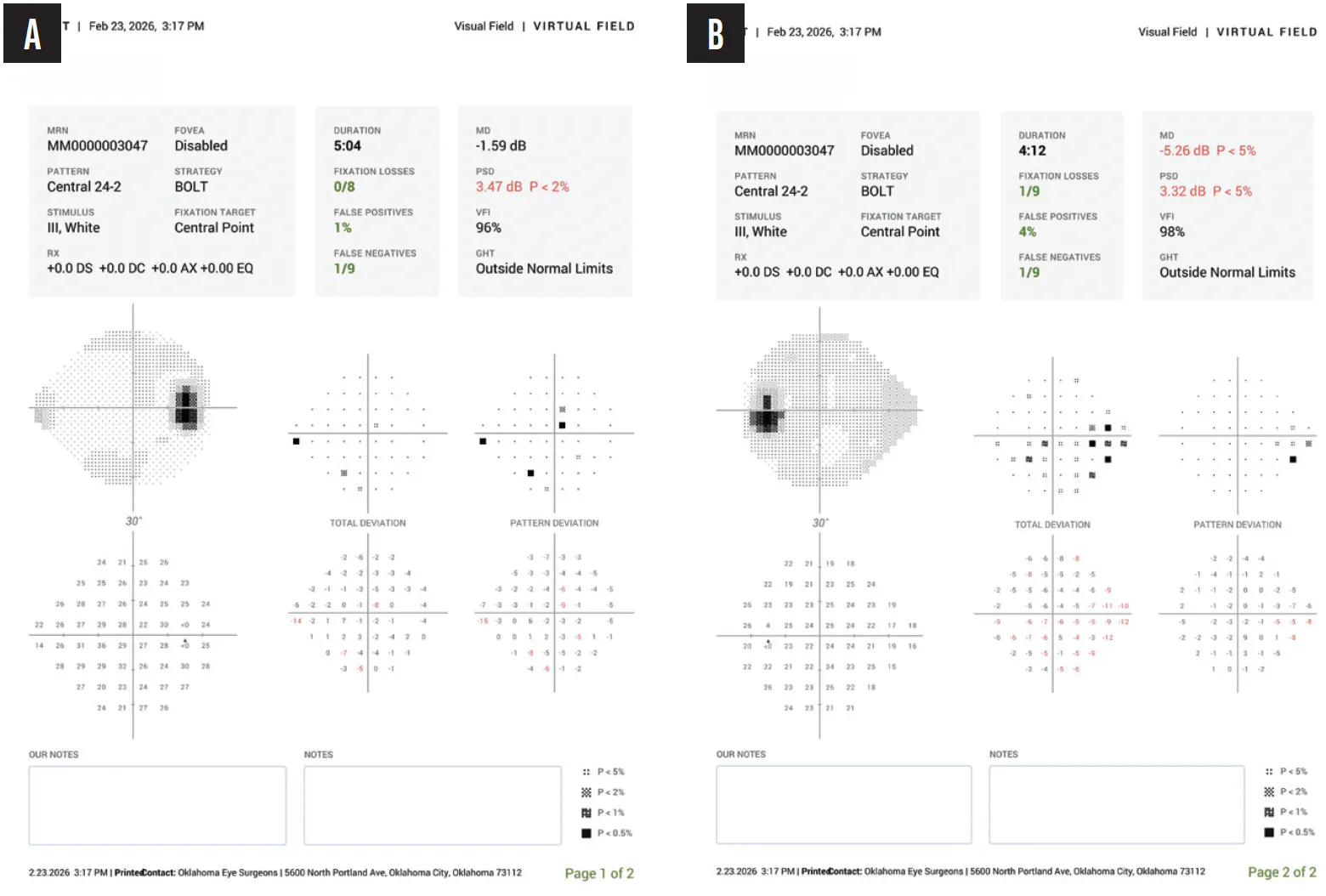
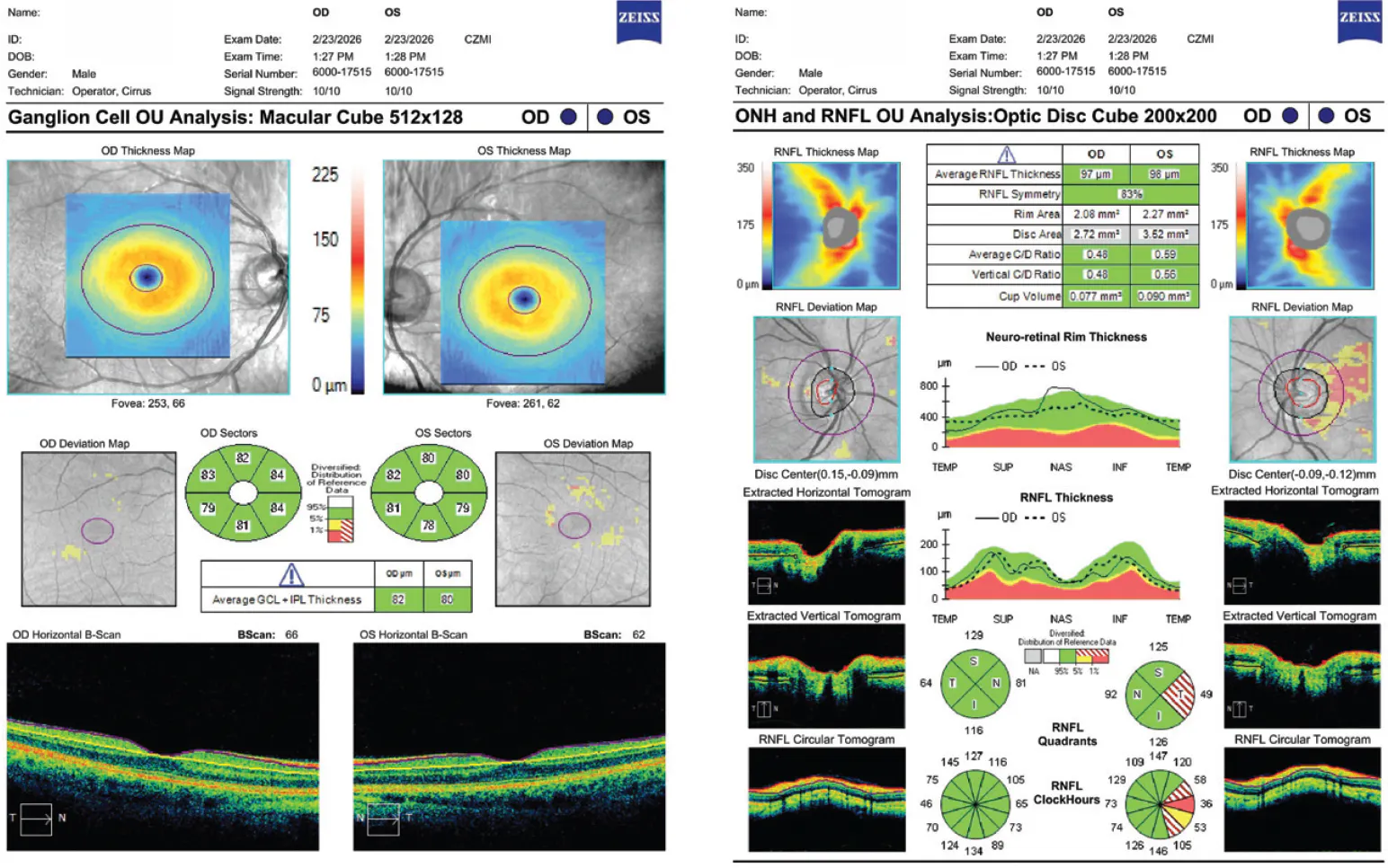
On examination, the patient’s IOP is 14 mm Hg OD and 26 mm Hg OS. The anterior segment examination is significant for posterior embryotoxon in each eye. Otherwise, the irides and pupils are normal in appearance. Gonioscopy reveals several small areas of peripheral anterior synechiae (PAS) in each eye that stop at Schwalbe line. His UCVA is 20/20 OU. Corneal thickness measures 535 µm OD and 540 µm OS. A fundus examination finds asymmetric optic nerve cupping that is also evident with OCT (Figures 1 and 2).
How would you proceed?
—Case prepared by Steven R. Sarkisian Jr, MD
LAUREN S. BLIEDEN, MD
The presence of posterior embryotoxon and PAS on examination confirms the diagnosis of ARS. The dysgenesis spectrum varies from very subtle to extreme anterior segment findings. Although the degree of dysgenesis is assumed to correlate with the risk of glaucoma, everyone on this spectrum has an increased lifetime risk of glaucoma. In my experience, the genetic mutation for ARS is usually dominant, but there are recessive and spontaneous forms.
Given the IOP elevation in the patient’s left eye, treatment is warranted. Considering his age, topical therapy would be initiated, and angle surgery would be scheduled for a school holiday. Although angle surgery is the primary choice for this form of glaucoma, patients’ responses are not as predictable as they are for other forms of congenital glaucoma, and there is a greater risk that additional topical treatment or surgery such as glaucoma drainage device (GDD) placement will be required in eyes with any anterior segment dysgenesis.1,2
Goniotomy using a microvitreoretinal blade or 23-gauge needle is my preferred approach to ARS-associated glaucoma because it allows me to work around the PAS, which can be firmly adherent to the endothelium. (There have been case reports of complete Descemet detachment with suture trabeculotomy because the procedure pulled the PAS and the endothelium along with them!3) Direct visualization allows adjustment if the PAS are firmly adherent focally. I would attempt to break the PAS and then perform the goniotomy behind them. Based on my experience, if a lot of resistance is encountered in the PAS, it is best to leave them alone.
Other considerations for this family would be genetic counseling and testing. Dental issues and hearing loss are often associated with ARS—particularly with the FOXC1 mutation.
ABDELRAHMAN M. ELHUSSEINY, MD, MSC
The patient presents with a family history of ARS following an autosomal dominant inheritance pattern as well as clinical findings of posterior embryotoxon and PAS to Schwalbe line bilaterally, consistent with AR anomaly. Genetic testing for PITX2 and FOXC1 mutations could be performed to confirm the diagnosis, although it is not positive in all cases.1
ARS requires a multidisciplinary approach involving pediatrics and genetics for systemic evaluation. Systemic manifestations, including dental, facial midline, and cardiac anomalies, occur in a meaningful subset of patients and have direct implications for glaucoma management, including anesthesia planning for surgical intervention and caution with topical beta-blockers.
The clinical examination, OCT, and visual field tests demonstrate early glaucomatous changes in the left eye. Although initiating topical glaucoma therapy would be a reasonable first step, medical therapy is generally inadequate for long-term IOP control in AR anomaly–associated glaucoma, and surgical intervention is typically required. My preferred approach would be ab interno gonioscopy-assisted transluminal trabeculotomy, with concurrent limited goniosynechialysis, given the few small areas of PAS on gonioscopy in the patient. When extensive PAS or significant angle dysgenesis precludes gonioscopy-assisted transluminal trabeculotomy, multisite goniotomy is a reasonable alternative. The long-term success of angle surgery in ARS is approximately 30% to 40% at 3 years, and many patients ultimately require GDD implantation.1
Although the IOP in the right eye is currently within a normal range, close monitoring with repeat visual field testing and OCT is warranted, and my threshold for treatment would be low given the bilateral anterior segment findings and possible early scotomas on visual field testing.
ANDREW R. LEE, MD
The patient’s family history, elevated IOP, posterior embryotoxon, and PAS are highly suspicious for ARS-associated glaucoma. His symptoms raise concern for intermittent angle closure. Although OCT shows a normal average retinal nerve fiber layer thickness in each eye, temporal thinning in the left eye may suggest early glaucomatous optic neuropathy, and visual field testing shows corresponding nasal step field defects.
Topical IOP-lowering therapy with a fixed combination of dorzolamide and timolol would be initiated in the left eye. An alpha agonist, prostaglandin analogue, and/or Rho kinase inhibitor could be added if the initial response to treatment is inadequate. In this patient, medical management could fail for several reasons: persistent episodes of angle closure, poor adherence, or inadequate IOP control even with maximally tolerated medical therapy. The success of angle surgery such as goniotomy and trabeculotomy can be limited in eyes with ARS, whereas GDDs and trabeculectomy have higher reported success rates.2 If surgery is indicated, I would favor GDD placement over trabeculectomy owing to the higher risk of trabeculectomy failure in young patients.
The patient and his family would be counseled on the lifelong nature of glaucoma, his need for consistent IOP monitoring, and the risks of untreated glaucoma. Follow-up and medication adherence can be challenging for teenagers with glaucoma as they transition to adulthood. I have found that identifying and addressing barriers to effective care are as essential to preserving a child’s long-term vision as any medical or surgical intervention.
WHAT I DID: STEVEN R. SARKISIAN JR, MD
As the panelists elucidate well, surgical management is the first-line treatment for most forms of pediatric glaucoma, and glaucoma secondary to ARS is no exception.
A regimen of topical dorzolamide dosed twice per day was initiated in the patient’s left eye, and he was asked to return to the clinic in 3 to 4 weeks for an IOP check, with a plan to schedule surgery during his summer vacation. Upon follow-up (Figure 3), his IOP was 20 mm Hg OS, and the patient’s father reported that his son had not administered the drops reliably owing to burning and irritation. Treatment was switched to timolol, and the patient has been scheduled for a goniotomy using the Omni Surgical System (Sight Sciences) during the first week of his upcoming summer break.
1. Seresirikachorn K, Thiamthat W, Bitrian E, Chang TCP. Surgical outcomes in Axenfeld-Rieger syndrome: a multicenter retrospective analysis. Am J Ophthalmol. 2026;282:120-127.
2. Zepeda EM, Branham K, Moroi SE, Bohnsack BL. Surgical outcomes of glaucoma associated with Axenfeld-Rieger syndrome. BMC Ophthalmol. 2020;20(1):172.
3. Liu SS, Liu LM, Fan XJ, et al. Bedside anterior segment optical coherence tomography-assisted reattachment of severe hemorrhagic Descemet's membrane detachment after ab externo 360-degree suture trabeculotomy combined with trabeculectomy. Int J Ophthalmol. 2023;16(2):316-319.
_1754918026.png?auto=compress,format)