KEY TAKEAWAYS
- SpyGlass Pharma’s BIM-IOL System is a first-in-class solution that aims to treat cataracts and elevated IOP with a single intervention.
- The BIM-IOL System features two drug-eluting pads attached to a standard IOL and is designed to be placed during routine cataract surgery and deliver bimatoprost continuously for 3 years.
- By enabling patients to receive multiyear therapy for IOP control at the time of cataract surgery, the system has potential to alleviate the burden of topical drops and provide surgeons with a streamlined approach to glaucoma treatment.
The majority of patients with mild to moderate glaucoma do not undergo combined glaucoma and cataract surgery,1 meaning most surgeons do not take the opportunity to address patients’ IOP—or the potential burden of topical drops—at the time of cataract surgery. A system that features drug-eluting pads attached to an IOL might provide a streamlined approach for cataract surgeons to treat glaucoma.
AN IOL FOR GLAUCOMA
SpyGlass Pharma’s Bimatoprost Drug Pad–IOL (BIM-IOL) System is a first-in-class solution that aims to treat cataracts and elevated IOP with a single intervention, thus alleviating some of the pain points associated with current drug delivery and MIGS procedures. The system can be used during routine cataract surgery, either with MIGS or as a standalone procedure, in patients with open-angle glaucoma (OAG) or ocular hypertension (OHT).
The BIM-IOL System contains a one-piece hydrophobic acrylic lens that is modified at the haptic-optic junction to receive two drug dispensers (Figure). The implantation technique should be familiar to most cataract surgeons and does not require a change in the positioning of the microscope or the patient’s head. The IOL is folded and loaded into an off-the-shelf injector and then inserted into the capsular bag through a standard clear corneal incision, similar to standard cataract surgery. The drug pads are designed to deliver bimatoprost continuously for 3 years (click here for more about the BIM-IOL).
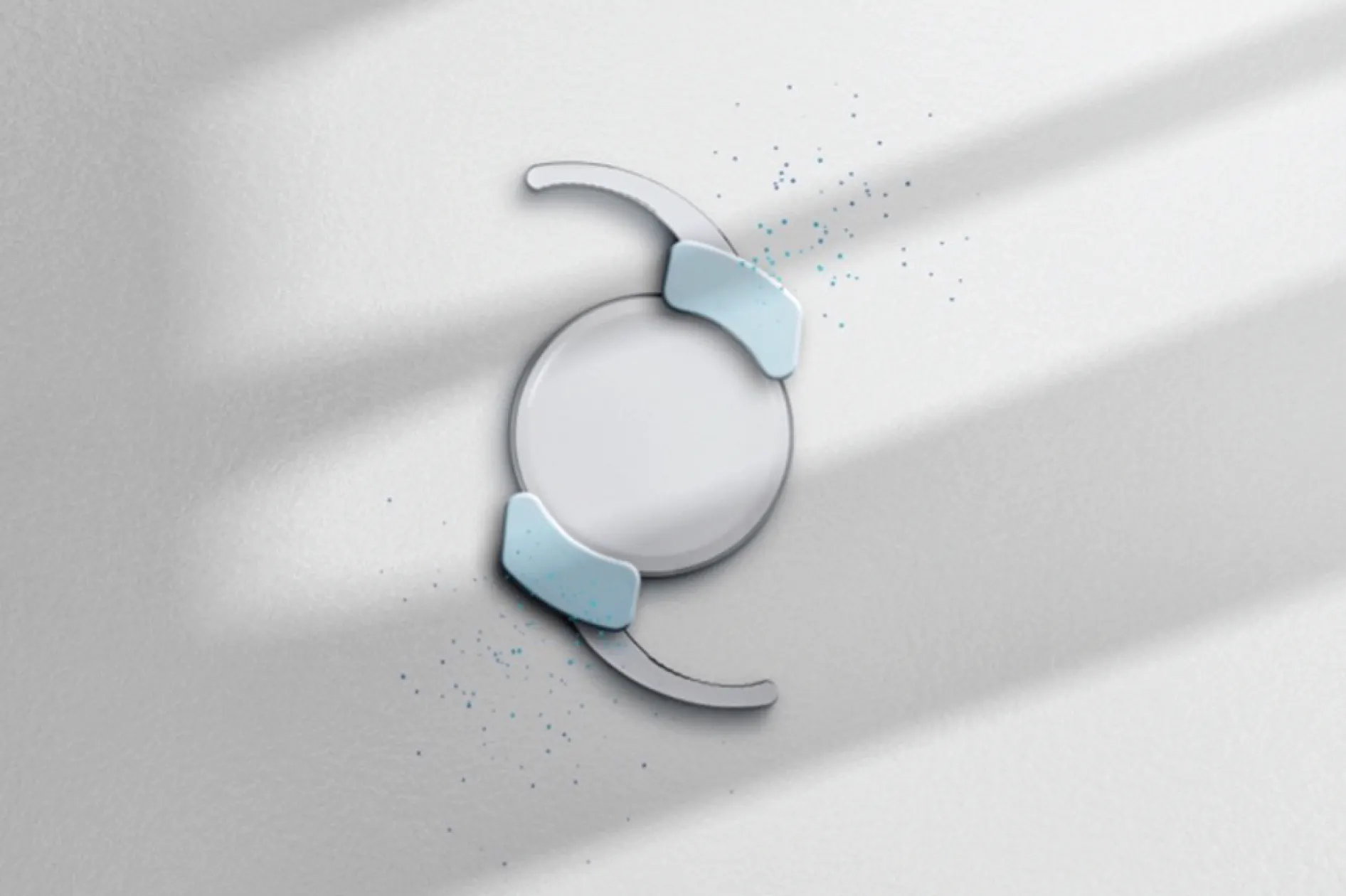
Figure. The BIM-IOL System consists of a one-piece hydrophobic acrylic lens that is modified at the haptic-optic junction to receive two drug dispensers.
Placement of the BIM-IOL System can enable patients to receive multiyear therapy for IOP control through routine cataract surgery, alleviating medication compliance challenges. In addition, the simplicity of the procedure has potential to allow a greater number of surgeons to address glaucoma in the OR without disrupting their typical workflow.
CLINICAL EVIDENCE
First-in-Human Feasibility Trial
The first-in-human (FIH) study of the BIM-IOL System was a single-center, prospective trial conducted in Central America to evaluate safety and efficacy. The investigation included 23 patients previously diagnosed with OAG or OHT and a concomitant cataract who were receiving treatment with one to three topical IOP-lowering medications. Patients were sequentially assigned to receive the BIM-IOL with one of three bimatoprost doses: low (n = 8), medium (n = 8), or high (n = 7). All doses were within the range of what is known to be effective for bimatoprost, so the goal was to identify the most effective dose to use in the phase 1/2 study.
At 24 months, 100% of patients had discontinued topical IOP-lowering therapy, a 42% mean reduction in IOP was achieved across all three bimatoprost doses, and 100% of patients had a distance BCVA of 20/30 or better. The adverse event profile was comparable to that of routine cataract surgery.
At 36 months, 95% of patients were off topical IOP-lowering therapy, and there was a 37% mean reduction in IOP across all three doses. Again, 100% of patients had a distance BCVA of 20/30 or better, and the adverse event profile was comparable to that of routine cataract surgery.
Phase 1/2 Trial
A randomized phase 1/2 clinical trial evaluated the safety and efficacy of the BIM-IOL System in patients with OAG or OHT compared with a control group receiving a commercially available IOL followed by twice-daily administration of topical timolol. The study included 104 patients, with one group (n = 51) receiving 78 µg of bimatoprost, another (n = 23) receiving 39 µg, and a control group (n = 30) receiving a commercial IOL and timolol drops.
The primary efficacy endpoint was time-matched IOP reduction (with IOP taken at 8 am and 10 am) at 2, 6, and 12 weeks. Secondary endpoints included IOP reduction out to 3 years, visual performance, and safety of both the medication and the IOL.
At 3 months, the mean IOP reduction observed across both BIM-IOL system doses was 37%, matching the sustained IOP reduction observed in the FIH trial at 3 years. Additionally, 97% of patients who received the BIM-IOL had discontinued all topical IOP-lowering therapy, 100% had a distance BCVA of 20/40 or better, and the mean distance BCVA was 20/20 across all study arms.
The latest available phase 1/2 data showed that, at 12 months, patients achieved a mean IOP reduction of 34% and 42% in the 78-µg and 39-µg dose groups, respectively, compared to a 35% reduction in the control group. In addition, 97% of patients who received the BIM-IOL had discontinued all topical IOP-lowering therapy, 100% achieved a distance BCVA of 20/32 or better, and the mean distance BCVA was equivalent to 20/20 vision.
Overall safety results at 3 and 12 months were comparable to those of routine cataract surgery. Adverse event rates were similar across all study arms, and no serious ocular adverse events were observed.
CONCLUSION
The BIM-IOL System offers a single intervention to address cataracts as well as elevated IOP and the associated burden of topical drops. Both the 36-month FIH data and the 12-month phase 1/2 data indicate that the system can achieve a sustained IOP reduction, eliminate the need for topical drops in most patients, and improve their vision with a safety profile comparable to that of routine cataract surgery. The drug-eluting lens might be a solution for both patients and surgeons that addresses IOP elevation at the time of cataract surgery with a streamlined approach that could be integrated into a surgeon’s existing workflow.
1. Clare W, Chen D, Fasika W. Prevalence of and patient characteristics associated with minimally-invasive glaucoma surgery (MIGS) use at the time of cataract surgery: a Medicare analysis. Invest Ophthalmol Vis Sci. 2025;66(8):1696.