


The concept of interventional glaucoma (IG) has advanced the treatment landscape in glaucoma. Broadly speaking, IG is not defined by performing a particular procedure; rather, it is a proactive, evidence-informed philosophy that puts patient benefit first. Whether lasers, surgeries, procedural pharmaceuticals, or new non-invasive approaches are used to reduce the burdens or inadequacy of topical drop therapy as a mainstay of disease management. Furthermore, IG is inherently an individualized approach where the physician can think about how best to stage interventions to keep future options viable. Indeed, because of the expanded toolkit for addressing the anatomy at different points along the complex aqueous drainage pathway, glaucoma management can be personalized while considering the impact of treatment on quality of life.
Adopting the IG Mindset
In my experience, treatment decisions should be guided by two questions: “What would I want if it was my eye?” and “How can clinicians help patients continue living their best lives?” To this end, I consider multiple factors, including cost, the potential for treatment-related adverse events, and the balance between risk and expected benefit. I don’t specifically use the word interventional when counseling patients about their options; instead, I let them know that this is a journey, and we will be shoulder-to-shoulder with them every step of the way. Part of the education is letting them know that most people will need additional treatments over time. Overall, when I am talking to the patient in the chair in front of me, I consider what will be the safest, most tolerable, and most effective approach to managing their glaucoma today, while ensuring that future options remain available.
One of the important reasons why I focus on interventional options is that studies have shown topical medical therapy to be an unreliable form of glaucoma treatment because of poor adherence to the prescribed drug regimen. For instance, a literature review of 34 articles found that up to 80% of patients demonstrated noncompliance.1 As well, nearly 50% of patients on drop therapy discontinue all topical ocular hypertensive therapy within 6 months.2 Consequently, poor compliance, regardless of the cause, is associated with glaucomatous progression and increased complication rates.3
But the danger of poor compliance with drops is only part of the story, because patients followed with medical management are also more likely to be lost to follow-up altogether. Recent data demonstrate that approximately 90% of patients are noncompliant with medication use and 65% of patients primarily treated with topical drop therapy lapse from the practice for >12 months.2,4-6 These risks are also evident from another study that demonstrated the risk of developing blindness in at least one eye is 2.2 times higher among patients lost to follow-up for a minimum of 3 years.7
“There is now well-established evidence that interventions should be preferred as first-line treatment in glaucoma.”
IG and the Patient Journey
There is now well-established evidence that interventions should be preferred as first-line treatment in glaucoma.
The LiGHT study established that treatment-naïve patients offered selective laser trabeculoplasty (SLT) were more likely to achieve disease stabilization after 3 years of follow-up compared to patients started on a prostaglandin analogue drop.8 After 6 years of follow-up, the SLT group demonstrated a reduced need for incisional glaucoma surgery and better preservation of visual field compared to the group of patients initially started on drop therapy.9 Taken together, the evidence from this study definitively showed that a first-line interventional option resulted in better disease control than pharmaceutical management.
The question we need to ask, though, is “What do we do next for the patient who does not respond to SLT or for whom the beneficial effects have waned?” Repeating SLT is an option. As well, starting with laser means that we have kept the entire array of angle-based procedures available if the decision is made to elevate care—and the beauty of angle-based procedures is that they preserve subconjunctival procedures should they become necessary later down the line.
The Role of Procedural Pharmaceuticals
The emergence of procedural pharmaceuticals further expands the ability to stage procedures over a patient’s lifetime journey with glaucoma. Because they deliver a drug known to be effective directly to the intended site, they have the obvious benefits of freeing patients from daily eye drop administration, reducing side effects of topical therapy, and lowering rates of glaucoma progression and glaucoma surgery.10,11 Moreover, they are broadly applicable in many scenarios: In my practice, I use iDose TR (travoprost intracameral implant) 75 mcg (Glaukos) as a standalone procedure and in combination with cataract surgery, with or without MIGS (Figure). When deciding whether a patient is a candidate to receive iDose TR, my considerations include a known favorable IOP response to a prostaglandin, difficulty adhering to topical treatment, or a desire for a longer-lasting option after a favorable response to another procedural pharmaceutical.
“…starting with laser means that we have kept the entire array of angle-based procedures available if the decision is made to elevate care.”
In my clinical experience, implementing iDose TR requires skills similar to those used in MIGS. As such, the learning curve is relatively short for surgeons who are already comfortable with MIGS. For clinicians who are less experienced, I believe it can be learned and is a good starting point for surgeons not as familiar with angle-based procedures.
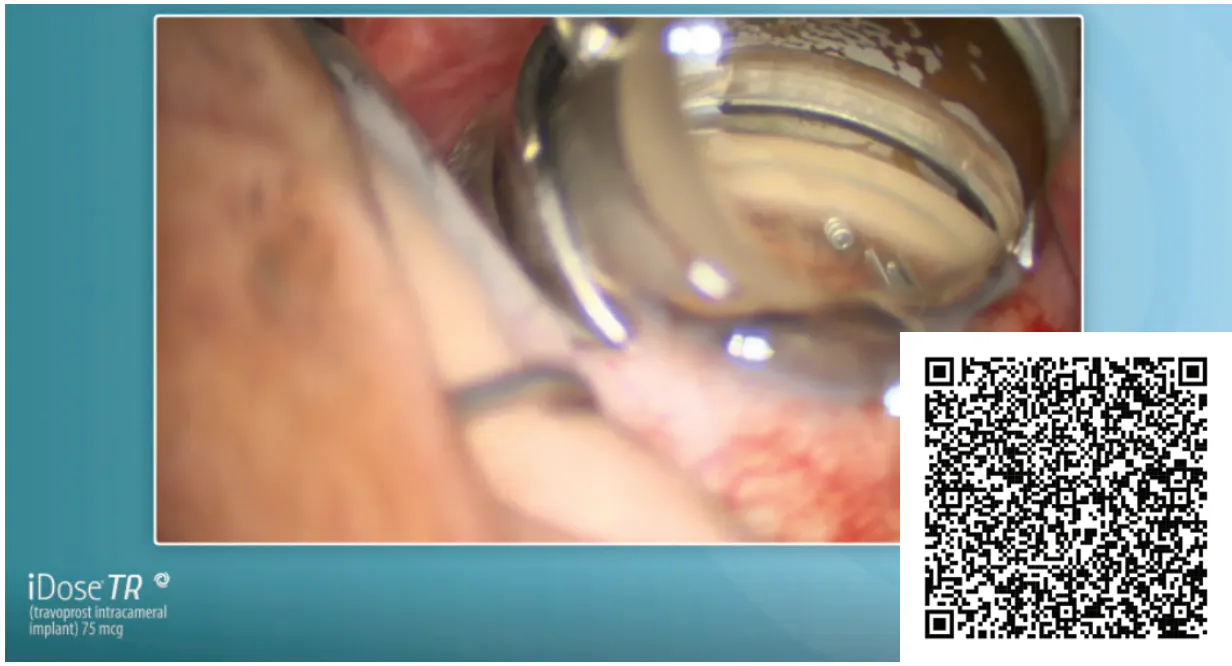
Figure. An image taken from a surgical implantation video of an iDose TR procedure. Scan the QR code to watch the full video.
Putting the Philosophy Into Practice
Before adopting interventional procedures, I advise practitioners to first clarify their own treatment philosophy, examine the evidence supporting each intervention, and understand the available technologies at their disposal. Once an individual treatment philosophy has been established, distinct technologies can be positioned within a staged treatment pathway rather than viewed as isolated procedures. Overall, we must truly believe in interventional methods ourselves before introducing them into our own practices and communities. It is easy to forget, in the grind of a day, how much of an honor it is to be entrusted with people’s most precious sense. That responsibility should remain at the center of our treatment philosophy from the beginning.
1. Olthoff CM, Schouten JS, van de Borne BW, Webers CA. Noncompliance with ocular hypotensive treatment in patients with glaucoma or ocular hypertension an evidence-based review. Ophthalmology. 2005;112(6):953-961. doi: 10.1016/j.ophtha.2004.12.035
2. Nordstrom BL, Friedman DS, Mozaffari E, Quigley HA, Walker AM. Persistence and adherence with topical glaucoma therapy. Am J Ophthalmol. 2005;140(4):598-606. doi: 10.1016/j.ajo.2005.04.051
3. Quaranta L, Novella A, Tettamanti M, Pasina L, Weinreb RN, Nobili A. Adherence and persistence to medical therapy in glaucoma: An overview. Ophthalmol Ther. 2023;12(5):2227-2240. doi: 10.1007/s40123-023-00730-z
4. Analysis of Market, Claims, and Compliance Data. Data on file. Glaukos Corporation.
5. Sarkisian SR Jr, Ang RE, Lee AM, et al. Phase 3 randomized clinical trial of the safety and efficacy of travoprost intraocular implant in patients with open-angle glaucoma or ocular hypertension. Ophthalmology. 2024;131(9):1021-1032. doi: 10.1016/j.ophtha.2024.02.022
6. Sarkisian SR, Ang RE, Lee AM, et al. Travoprost intracameral implant for open-angle glaucoma or ocular hypertension: 12-month results of a randomized, double-masked trial. Ophthalmol Ther. 2024;13(4):995-1014. doi: 10.1007/s40123-024-00898-y
7. Williams AM, Wasser LM, Cassidy J, Lin HS. Loss to follow up among glaucoma patients: An IRIS® Registry (Intelligent Research in Sight) retrospective cohort analysis. Semin Ophthalmol. 2025;40(3):188-195. doi: 10.1080/08820538.2024.2391826
8. Gazzard G, Konstantakopoulou E, Garway-Heath D, et al. LiGHT trial study group. Selective laser trabeculoplasty versus eye drops for first-line treatment of ocular hypertension and glaucoma (LiGHT): A multicentre randomised controlled trial. Lancet. 2019;393(10180):1505-1516. doi: 10.1016/S0140-6736(18)32213-X
9. Gazzard G, Konstantakopoulou E, Garway-Heath D, et al. LiGHT trial study group. Laser in glaucoma and ocular hypertension (LiGHT) trial: Six-year results of primary selective laser trabeculoplasty versus eye drops for the treatment of glaucoma and ocular hypertension. Ophthalmology. 2023;130(2):139-151. doi: 10.1016/j.ophtha.2022.09.009
10. Bedrood S, Berdahl J, Sheybani A, Singh IP. Alternatives to topical glaucoma medication for glaucoma management. Clin Ophthalmol. 2023;17:3899-3913. doi: 10.2147/OPTH.S439457
11. Kolko M, Gazzard G, Baudouin C, et al. Impact of glaucoma medications on the ocular surface and how ocular surface disease can influence glaucoma treatment. Ocular Surface. 2023;29:456–468. doi: 10.1016/j.jtos.2023.05.012
IMPORTANT SAFETY INFORMATION
Dosage and Administration
For ophthalmic intracameral administration. The intracameral administration should be carried out under standard aseptic conditions.
Contraindications
iDose TR is contraindicated in patients with active or suspected ocular or periocular infections, patients with corneal endothelial cell dystrophy (e.g., Fuch’s Dystrophy, corneal guttatae), patients with prior corneal transplantation, or endothelial cell transplants (e.g., Descemet’s Stripping Automated Endothelial Keratoplasty [DSAEK]), patients with hypersensitivity to travoprost or to any other components of the product.
Warnings and Precautions
iDose TR should be used with caution in patients with narrow angles or other angle abnormalities. Monitor patients routinely to confirm the location of the iDose TR at the site of administration. Increased pigmentation of the iris can occur. Iris pigmentation is likely to be permanent.
Adverse Reactions
In controlled studies, the most common ocular adverse reactions reported in 2% to 6% of patients were increases in intraocular pressure, iritis, dry eye, visual field defects, eye pain, ocular hyperaemia, and reduced visual acuity.
Indications and Usage
iDose TR (travoprost intracameral implant) is indicated for the reduction of intraocular pressure (IOP) in patients with open-angle glaucoma (OAG) or ocular hypertension (OHT).
Please see full Prescribing Information.
You are encouraged to report all side effects to the FDA. Visit www.fda.gov/medwatch, or call 1-800-FDA-1088.
You may also call Glaukos at 1-888-404-1644.

