Ten international glaucoma experts met as a Delphi Panel to provide guidelines on the use of MicroPulse® Transscleral Laser Therapy (TLT) with the revised MicroPulse P3® Probe. Their findings were first presented in a series of webinars, and more recently published in the peer-reviewed literature.1 “Based on the available knowledge to date, this consensus process has helped us better understand and optimize MicroPulse TLT in its role in the glaucoma continuum of care,” says Tomás M Grippo, MD, and panel co-chair. Experts concluded that MicroPulse TLT, when used within recommended guidelines, is a safe and effective treatment for many glaucomas and is an indispensable addition to the glaucoma armamentarium.1
MicroPulse TLT offers clinicians a unique non-incisional option to manage their glaucoma patients, achieving intraocular pressure (IOP) reductions of approximately 27.8% to 57.2% with very good safety and durability.1 Brian A Francis, MD, MS, suggests, “Come into this without preconceptions about how patients will respond based on previous iterations of cyclophotocoagulation. This is an innovative approach with an excellent safety profile.”
Understanding MicroPulse TLT
MicroPulse TLT in the past was referred to as transscleral cyclophotocoagulation (TSCPC) in MicroPulse mode. CW-TSCPC is delivered with discrete spots using the G-Probe® Delivery Device and typically reserved for later-stage glaucoma. MicroPulse TLT is delivered in a “sweeping” motion using the MicroPulse P3 Probe. Lower temperature targets and greater thermal control with MicroPulse TLT contribute to lower risk of complications compared to CW-TSCPC,2,3 allowing it to be used earlier in the glaucoma treatment algorithm.
Johnstone demonstrated that MicroPulse TLT causes ciliary muscle to contract, rotating the scleral spur posteriorly which increases trabecular and uveoscleral outflow, and that the contraction of the muscle fibers could be permanent or partially reversible depending on the amount of energy delivered.4
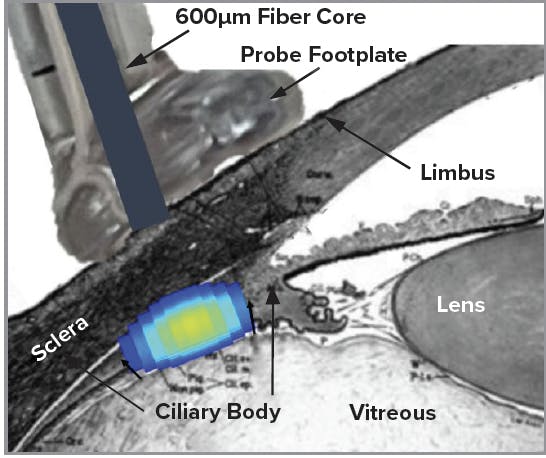
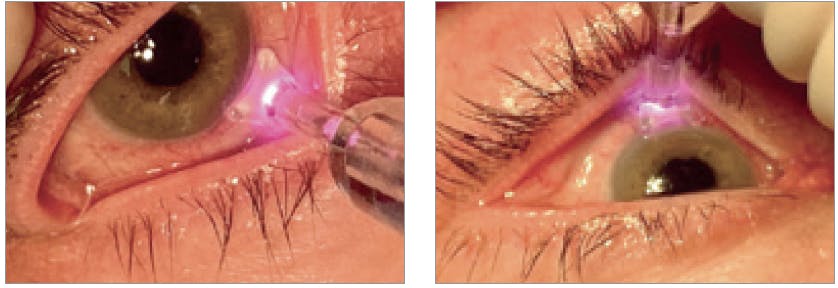
Thermal zone in the pars plana tissue during MicroPulse TLT using a 31.3 % duty cycle, 2500mW, and a 20-second sweep per hemisphere. The edge of the revised MicroPulse P3 Probe is positioned at the limbus.
Patient selection
Based on peer-reviewed evidence and experience, the panel suggests that clinicians should consider MicroPulse TLT after medications and laser trabeculoplasty have failed to control the disease.
MicroPulse TLT is most typically used in:
- Patients with poor IOP control who are not good candidates for, or do not wish to undergo, incisional glaucoma surgery.
- Patients who failed to achieve good IOP control with prior incisional glaucoma surgery.
As experience and expertise build, clinicians may expand the use of MicroPulse TLT to include patients instead of incisional surgery or patients with stable glaucoma on maximally tolerated medical therapy with a desire for a reduction in glaucoma medication. “I have been using MicroPulse TLT for about 7 years. After participating in this panel, I’m more comfortable with the safety profile and have migrated to using MicroPulse TLT in patients with milder and earlier-stage glaucoma,” says Jacob Brubaker, MD.
Moderate Glaucoma: MicroPulse TLT post failed Xen
Case Example by Robert J Noecker, MD, MBA
An 87-year-old Caucasian female presented with moderate primary open-angle glaucoma (POAG) status post (S/P) Xen (Allergan Inc., CA, USA) in both eyes, using latanoprost and timolol/brimonidine in the left eye. Central corneal thickness (CCT) 540 and 525µm, best-corrected visual acuity (BCVA) 20/30 in both eyes, pseudophakic, with progressive retinal nerve fiber layer (RNFL) loss in the left eye. IOP 14/25mmHg OD/OS. Functioning Xen in the right eye, failed Xen in the left eye. IOP presumed at target in the right eye and above target in the left eye. Surgical options were considered and MicroPulse TLT was recommended for the left eye and was performed uneventfully in the operating room (OR) under block anesthesia.
Settings: 2500mW, 31.3% duty cycle, 80 seconds per hemisphere (4 sweeps at 20 seconds per sweep).
At 6 months, IOP is 15/14mmHg OD/OS on timolol BID in the xleft eye. BCVA remained unchanged at 20/30 in both eyes.
Mild Glaucoma: MicroPulse TLT retreatment to sustain low IOP over 4 years
Case Example by Marc Toeteberg-Harms, MD
A 69-year-old Caucasian male presented with mild POAG/normal-tension glaucoma on no drops. CCT 590 and 585µm, BCVA 20/20 in both eyes, phakic, and progressive RNFL loss in both eyes. The patient refused topical therapy due to a potential decrease in quality of life and was treated uneventfully with MicroPulse TLT in the right eye and 2 weeks later in the left eye. IOP reduced from mid-teens (OD 15 and OS 16mmHg) to the low teens with stable RNFL. After four years, IOP increased to mid-teens in both eyes and they were retreated with MicroPulse TLT. IOP was again reduced to the low teens.
Two years later, IOP was 15/16mmHg OD/OS, BCVA 20/20 in both eyes, phakic. New RNFL loss in the left eye was confirmed by OCT. The patient again refused topical therapy. Discussed efficacy and sustainability of re-treating with MicroPulse TLT (3rd treatment in the left eye). MicroPulse TLT was performed in the left eye under topical anesthesia uneventfully.
Settings: 2500mW, 31.3% duty cycle, 80 seconds per hemisphere (4 sweeps at 20 seconds per sweep).
IOP decreased by approximately 35% after six months. IOP 15/11mmHg OD/OS on no drops. BCVA remained unchanged at 20/20 OD/OS.
Treatment parameters and the importance of sweep velocity
The published Delphi Panel recommendations are intended to be used as a starting point. In clinical practice, many patients need lower target pressures and due to the safety profile of the revised MicroPulse P3 Probe, more aggressive settings can be used.
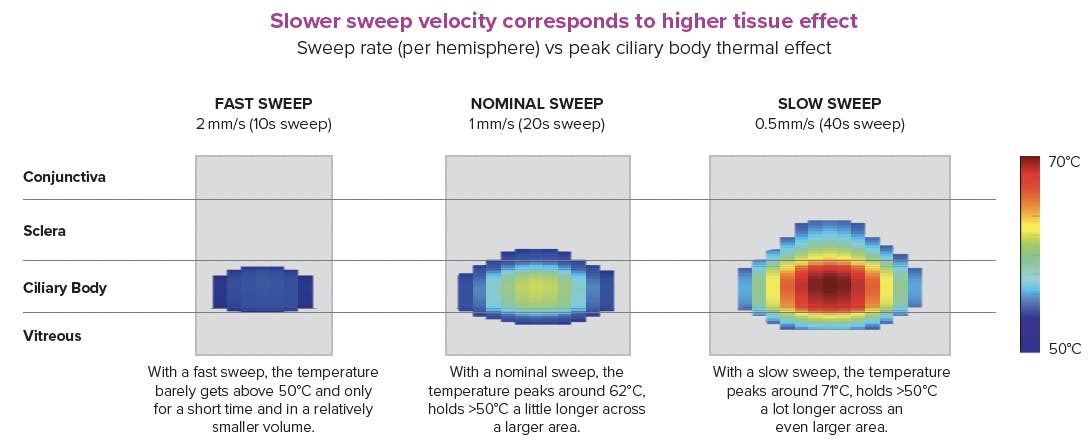
It is important to understand MicroPulse TLT treatment parameters that impact the therapeutic response. Power, duty cycle, sweep velocity, and the number of sweeps all factor into the success of the procedure. In the past, sweep velocity has been the least controlled parameter. “Think of moving your finger in and out of a candle flame. The slower you move your finger the higher the tissue temperature. This can be compared to MicroPulse TLT: when we slow down, we deliver more heating to that tissue,” says Michael C Giovingo, MD. He continues, “Sweep velocity is probably the most under-appreciated and significant factor to consider with MicroPulse TLT, and we see correlation between slower sweep duration and greater IOP reduction.”
As a starting point, the panel recommends the following settings:
- Power: 2500 milliwatts (mW)
- MicroPulse duty cycle: 31.3%
- Sweep velocity: 4 sweeps of 20 seconds each per hemisphere, or 4 sweeps of 10 seconds each per quadrant
Dose escalation
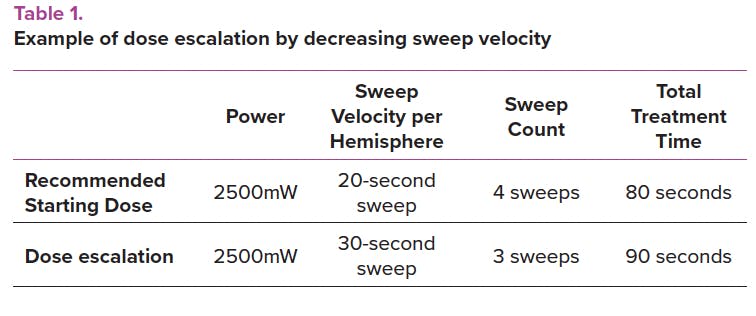
When more aggressive treatment is desired, the expert panel recommends an escalation of approximately 25% in energy delivery. This can be achieved by decreasing sweep velocity, increasing power and/or increasing the number of sweeps. Slower sweep velocity equates to higher energy delivered per area with corresponding more tissue effect (See Table 1).5
“I treat my mild glaucoma patients with the initial consensus settings and titrate up with more severe disease. Currently, I escalate my dose in those patients 25% by doing five 20- second sweeps instead of 4,” notes Dr. Francis. Dr. de Crom, who has a practice with mostly Caucasian patients with moderate to severe glaucoma, comments, “I still use four 20-second sweeps as my starting dose in most patients, but use five 20-second sweeps in patients with higher IOP (>30mmHg).” Robert J Noecker, MD, MBA, and panel co-chair, escalates treatment by decreasing sweep velocity as shown in Table 1. The upper limit of dose escalation has not been well explored and further research into higher dosing is needed.
Severe Glaucoma: MicroPulse TLT post trabeculectomy
Case Example by Michael C Giovingo, MD
A 56-year-old male presented with end-stage open-angle glaucoma; VA 20/60 OD, no light perception OS; history of trabeculectomy in 1998. IOP ranged between 9 and 12mmHg off drops. The bleb appearance became avascular and cystic over the 20 years following surgery, and a bleb leak was noted in mid-2020 with mild hypotony.
Autologous blood injection was performed without improvement, bleb suturing without improvement, and full bleb revision performed. IOP increased to the high 20s despite suture lysis and digital ocular massage. Bleb needling was unsuccessful. IOP was 23mmHg on multiple meds, and decided to perform MicroPulse TLT.
Settings: 2500mW power, 31.3% duty cycle, 100 seconds of treatment per hemisphere (5 sweeps at 20 seconds per sweep). The leading edge of the probe was held at the limbus; 3 and 9 o’clock positions were spared. Treatment was performed over the trabeculectomy site.
Postop month 2, IOP 11mmHg, vision stable at 20/50 on 4 meds.
Anesthesia methods and treatment environment
While it is possible to perform MicroPulse TLT in the office, the OR is more comfortable for the patient and physician.The preferred anesthesia techniques are topical with sedation or a block. Marc Toeteberg-Harms, MD, says, “When using topical plus sedation, I request that the anesthesiologist use fentanyl to allow the patient to stay awake with pain control and reduced anxiety. Fentanyl can be titrated up for patients experiencing high anxiety, dosing is quick, and recovery is fast.” In general, post-operative pain is minimal.
Precautions
Caution should be exercised in patients with scleral thinning, history of uveitis, and prior surgery. It is also important to understand underlying systemic disorders which may contribute to negative outcomes. In patients with scleral thinning, the eye may respond less predictably and may be more prone to side effects. When MicroPulse TLT can be used in thinner sclera, energy should be reduced as there will be more transmission into the eye through the thinned sclera.
When using MicroPulse TLT in patients with glaucoma after other surgical interventions, “One may treat over areas of prior surgery and scleral patches if the conjunctiva and sclera are normal in appearance and contour, but one should avoid avascular areas, including over blebs or tubes, or patches of thin sclera,” says Ronald de Crom, MD.
Surgical technique
Dr. Giovingo summarizes the Delphi Panel recommendations regarding surgical technique, “Always use a coupling agent for more effective power transmission. I most commonly use lidocaine gel because of the availability in the OR but any ophthalmic gel works equally well. It’s generally applied over the treatment area just before starting, and I reapply as needed during the procedure. I use a lid speculum and a wet cotton swab to hold the eye in position, however muscle hooks, and indentation instruments may also be used to manipulate the eye.”
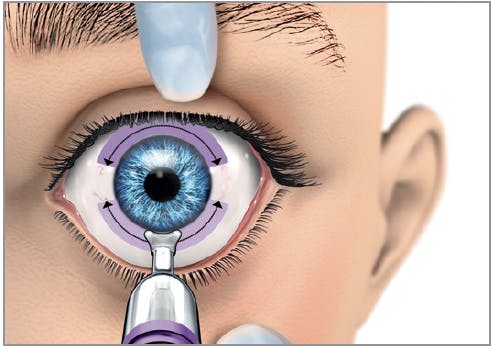
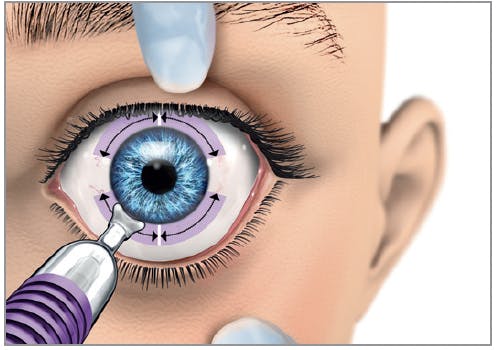
One should place the footplate of the revised MicroPulse P3 Probe with its “bunny ears” at the limbus, or err posterior to the limbus if it is not clearly defined.
One should apply moderate pressure evenly across the footplate (with a posterior bias) and gently compress the conjunctiva for optimal laser transmission. Most consensus members sweep the MicroPulse P3 Probe per hemisphere, excluding 3 o’clock and 9 o’clock hour locations, and then reverse direction in a pendular back-and-forth manner. Treating by quadrants is also an option. During treatment, stop and reposition the probe as needed.
Post-op care
Since MicroPulse TLT is a non-incisional procedure, antibiotics are not necessary. However, antibiotics may be advisable if there is a risk of infection due to another condition such as the presence of a K-Pro, bleb, or disrupted conjunctiva or corneal epithelium. Post-op pain and inflammation are usually minimal; and therefore, cycloplegia or pain medication is rarely used. The panel recommends topical NSAIDS and/or topical steroids with dosage for 1 to 4 weeks for most cases. Dr. Brubaker comments, “I use fewer steroids and no longer use atropine which simplifies post-op care.”
Except for acetazolamide, which is often discontinued immediately after treatment, topical hypotensive medications are maintained until the response to MicroPulse TLT permits tapering. A meaningful effect of MicroPulse TLT is usually seen at one-week follow-up, with the full effect typically established at 1 month once steroids are discontinued.
Post-op patient visits are based on individual patient characteristics, i.e., IOP and risk of visual field loss. Typical post-op intervals are at 1 week, 1 month, and then based on clinical response.
Expected outcomes and duration of effect
MicroPulse TLT using the original MicroPulse P3 Probe with treatment parameters in the higher range resulted in pressure lowering of approximately 30%-50%.1 The success of medication reduction is not clearly reported in the initial MicroPulse TLT literature.
Sweep velocity was frequently not reported in the literature with the original probe. Therapeutic outcomes are significantly influenced by dosing and sweep velocity.5 Undertreatment results in less efficacy and shorter durability.6 “There is a lower limit of total energy delivery to the eye below which there is a lack of IOP-lowering or sustainability of effect. This could be because the total energy delivered is too low to create a significant tissue effect or because the tissue effect is reversible and therefore short-lived,” says Dr. Grippo.
Jella An, MD, MBA, adds, “Over time it became evident that there was much more room to increase energy and decrease sweep speed. Once I made these changes, I started getting better outcomes with sustainable significant IOP lowering.”
Syril Dorairaj, MD, conducted a prospective, non-comparative case study on 61 eyes of 40 glaucoma patients treated with the revised MicroPulse P3 Probe using 2500mW and 31.3% duty cycle.7 He compared the results of 50- and 60-second applications, respectively, per hemisphere using 3 sweeps (16.5-second sweep and 20-second sweep), 4 sweeps (12.5-second sweep and 15-second sweep) and 5 sweeps (10-second sweeps and 12-second sweeps). At 12 months, the average mean IOP decrease across all treatment groups was 44.7%.
More significant IOP reductions were generally associated with slower sweep velocity. Dr. Dorairaj commented, “The IOP reductions have been sustained over almost 20 months, and 90% of patients haven’t required further intervention. The most important factor for me was that MicroPulse TLT satisfied my primary goal of safety. Based on the absence of complications associated with the 60-second application, I am now using 80- to 100-second applications using 4 to 5 sweeps respectively.”
Using the revised MicroPulse P3 Probe at the recommended starting dose of 2500mW, 31.3% duty cycle, and 4 sweeps per hemisphere with a sweep velocity of 20 seconds each, clinicians can expect to see IOP reductions of approximately 25%-35%.
Retreatment and enhancement
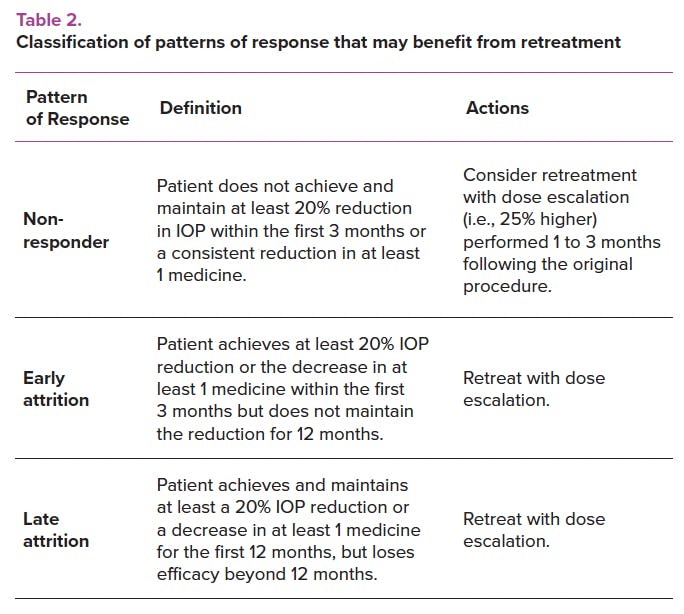
MicroPulse TLT is a titratable procedure that can be performed repeatedly without limiting the use of other therapies. Lower energy used and higher baseline IOPs have been found to correlate to a greater likelihood of retreatment. Retreatment or enhancement is usually performed from 1 month or more after the initial treatment. Dr. de Crom comments, “While the effect of treatment may diminish over time, retreatment has a good chance of success.” Dr. Noecker continues, “There is no shame in retreatment if the patient had a safe experience but needs more effect. One should be consistent and compulsive with the technique and pay attention to the details. Also, therapeutic judgment should be made once the patient is off steroids and a steroid response has been ruled out.”
The panel proposed a classification of responses and corresponding retreatment actions. (See Table 2)
“Regarding enhancements, if a patient has an initial satisfactory response to MicroPulse TLT, but has not reached their target IOP, MicroPulse TLT can be performed with the same or an increase in laser energy delivery to enhance the effect,” says Dr. de Crom.
Minimal complications
Due to its favorable safety profile, MicroPulse TLT can be used in any part of the glaucoma treatment algorithm.1 Undesirable side effects, such as inflammation, are in most cases transient. The revised MicroPulse P3 Probe treats more posteriorly and the prevalence of side effects appears to be lower than with the original MicroPulse P3 Probe.7 The design of the revised MicroPulse P3 Probe allows the probe positioning to remain stable throughout the procedure, directing laser energy away from the anterior structures of the eye, reducing side effects such as cataract progression, mydriasis, and inflammation. Brian Jerkins, MD, states, “Complications described in the early literature with the original MicroPulse P3 Probe can in many cases be attributed to an excess energy use or suboptimal surgical technique. With better understanding of dosimetry and surgical technique, as well as the revised probe that allows for more posterior and stable treatment, many side effects can be prevented or minimized.”
Summary
When used within the recommended guidelines stated in this paper, MicroPulse TLT can be a safe and effective treatment for a wide range of glaucoma patients. It can be performed without affecting outcomes of other procedures, such as trabeculectomies or tubes. “MicroPulse TLT is a powerful tool that can help us to preserve our patients‘ vision as they proceed through the glaucoma journey,” says Dr. Jerkins. Nathan Radcliffe, MD, concludes, “MicroPulse TLT is an exciting technology, and we are just scratching the surface of what we can achieve with it.”
MicroPulse TLT Benefits at a Glance
- Non-incisional, efficient procedure with minimal patient downtime
- May be used before or after other glaucoma therapies
- Favorable safety profile
- Repeatable and titratable
1. Grippo TM, et al: Evidence-Based Consensus Guidelines Series for MicroPulse Transscleral Laser Therapy: Dosimetry and Patient Selection. Clin Ophthalmol 2022;16:1837-1846.
2. Aquino MC, et al: Micropulse Versus Continuous Wave Transscleral Diode Cyclophotocoagulation in Refractory Glaucoma: A Randomized Exploratory Study. Clin Exp Ophthalmol 2015.
3. Nguyen AT, et al: Early Results of Micropulse Transscleral Cyclophotocoagulation for the Treatment of Glaucoma. European Journal of Ophthalmology 2020;30(4):700-705.
4. Johnstone MA, et al. Transcleral Micropulse Laser (TML) & Pilocarpine: Effects on Sclera, Ciliary Body (CB), Suprachoroidal Space (SCS) & Aqueous Outflow System. Micropulse Laser: Outflow System Effects. Poster. American Society of Cataract and Refractive Surgery. 2020.
5. Grippo TM, et al: MicroPulse® Transscleral Laser Therapy - Fluence May Explain Variability in Clinical Outcomes: A Literature Review and Analysis. Clin Ophthalmol 2021;15:2411-2419.
6. Grippo TM, et al: Letter to the Editor: One-Year Outcomes of Micropulse Cyclophototherapy for Primary Open-Angle Glaucoma. J Glaucoma 2022;31(6):e41-e42.
7. Checo L, et al. Prospective Comparison of Different Energy Parameters of MicroPulse Transscleral Laser Therapy. Poster. American Glaucoma Society. 2022.
The MicroPulse P3 Probe indications include, but are not limited to, transscleral cyclophotocoagulation for the treatment of primary open-angle glaucoma, closed-angle glaucoma, and refractory glaucoma.
Iridex, the Iridex logo, MicroPulse, Cyclo G6, MicroPulse P3 and G-Probe are registered trademarks of Iridex Corporation. All other trademarks are the property of their respective owners.
Iridex | 1212 Terra Bella Avenue | Mountain View, CA 94043 | 800.388.4747 (U.S. Inquiries) info@iridex.com (U.S. & Int’l Inquiries) | www.iridex.com
LT0757 08.22