Glaucoma is a lifelong disease that requires continual monitoring and management. For many patients, glaucoma can be controlled medically—at least for a time—but the treatment is far from perfect. Complications, side effects, and compliance are common issues for those who rely on eye drops to control IOP. Other barriers to medical treatment include nonresponse to a medication, tachyphylaxis, and financial burden.
WHY SLT?
Compliance among glaucoma patients generally is poor. Published studies suggest that between 20% to 66% do not use their medication as prescribed.1-3 Laser treatment such as selective laser trabeculoplasty (SLT), on the other hand, has a 100% compliance rate. SLT uses nanosecond low-energy light, undertaken in single-shot mode, with 50 confluent spots placed over each hemisphere of the trabecular meshwork (TM). The nanosecond delivery of pulses ensures that the treatment is localized, controlled, and gentle and that it avoids damage to the surrounding tissue.
Compared to other laser trabeculoplasty procedures, SLT uses a much larger spot size and a lower power density, resulting in relatively little thermal energy damage to surrounding tissue (Figure 1). The average laser power in standard argon laser trabeculoplasty (ALT) with 50-μm spots and a 100-ms pulse duration is 0.33 W, 10 times higher energy and 40 times higher irradiance than patterned laser trabeculoplasty (PLT). Because PLT involves approximately 10 times more spots per area of the TM, however, the average energy per unit length of the TM is similar in both procedures—approximately 3.5 J for 360° treatment. Micropulse diode laser trabeculoplasty (MDLT) has higher energy per pulse (60 mJ), higher irradiance (191 J/cm2), and higher average energy per segment of the TM (approximately 4.2 J per 180°) than PLT.
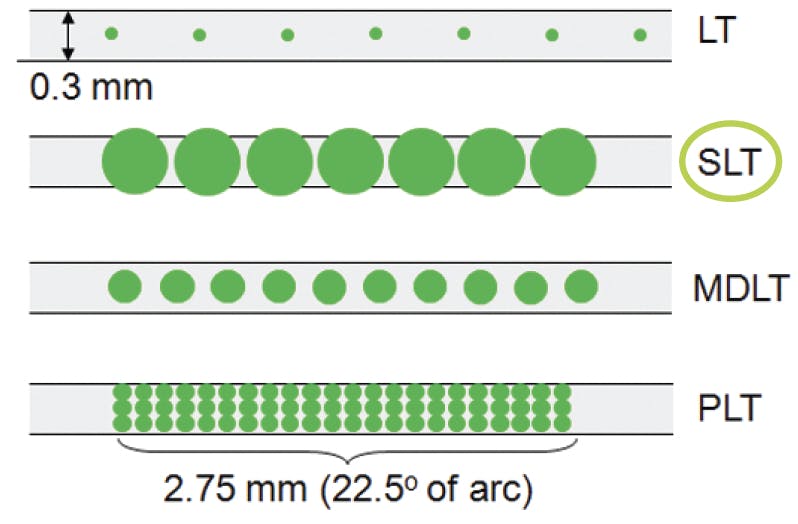
*Figure 1. Diagram illustrating the relative size of the laser spots and their placement on the TM for various approaches to trabeculoplasty: laser trabeculoplasty (LT), SLT, MDLT, and PLT.
SLT, on the other hand, has much lower energy per pulse (approximately 1 mJ) with a corresponding irradiance of 0.8 J/cm2 and a total energy of 0.1 J per 360° of the TM. The much lower energy requirements for SLT compared to other laser treatments are due to different mechanisms of cellular damage produced by nanosecond and millisecond pulses. With sub-microsecond pulses, the heat does not diffuse beyond 1 μm; thus, the damage can be confined within a cell. With pulses of 5 ms in duration, heat can diffuse to distances of approximately 50 μm and can affect the cells surrounding the pigmented structures. With 100-ms exposures in standard laser trabeculoplasty, the heat diffusion zone can reach 220 μm, covering nearly the whole width of TM.
One critical difference between newer laser treatments and SLT is repeatability. When the pulse duration of micropulse lasers changes, for example, the response of the tissue to thermal energy absorption changes. Additionally, although these other laser treatments can be effective, there is no long-term evidence for how well and how long they work.
THE IMPORTANCE OF THE LIGHT STUDY
The clinical outcomes of the LiGHT study have led to a paradigm shift in glaucoma care. Here, the 3- and 6-year study results are summarized.
Three-year results. The LiGHT study was designed to determine the health-related quality of life for two treatment pathways—laser versus medical treatment.4 The 3-year (2012 to 2014) multicenter, randomized controlled trial was funded by the National Institute for Health and Care Research. A total of 718 patients with mild to moderate glaucoma were enrolled. The primary outcome measure was health-related quality of life. Other study outcome measures included IOP control, disease control, medication-free IOP control, and need for surgery.
Approximately half of patients received SLT treatment first and the other half received medication first. It is important to note that the study was designed with a “treat in pursuit of target” protocol to guide treatment choice.
RETREATMENT ANALYSIS
Patients enrolled in the LiGHT study who required retreatment were also studied. A total of 115 eyes of 90 patients were included. We found that a slightly greater energy level was required for the retreatment selective laser trabeculoplasty (SLT). Although the reason is unknown, we believe it may be that the trabecular meshwork was slightly less pigmented because of the prior laser treatment. Compared to the retreatment, the 2-month IOP reduction was slightly greater after the initial SLT procedure. The 2-month adjusted IOP reduction, however, was slightly greater after the repeat SLT. This suggests that repeat SLT works at least as well in terms of absolute IOP reduction. Around 60% of patients continued to meet target IOP without eye drops after the second laser treatment, which is quite novel.
Further, treatment was increased incrementally to mimic how target IOP is approached in a real-world clinic. All laser treatments were performed 360º to minimize the number of visits patients needed. Ninety-one percent of patients were available for the 3-year follow-up. Objective criteria for reintervention included severity of visual field loss, target pressure (severity and starting IOP), and definition of disease deterioration.
In short, 78% of eyes that underwent primary SLT as the first intervention were drop- and surgery-free at 3 years, and 77% of controlled SLT-first eyes needed only one SLT treatment. The number of eyes that maintained the target IOP at each visit gradually decreased over time, indicating that the effect of the SLT wears off. Repeat SLT treatment was effective, however, with a similar rate of IOP-lowering effect to the initial treatment but with a longer duration of effect (see Retreatment Analysis). Additionally, fewer patients in the SLT-first group experienced moderate to fast deterioration of their visual field compared to patients in the medication-first group.
Six-year study results. Eighty-eight percent of LiGHT study patients were enrolled in a 6-year extension study.5 In this setting, patients from the SLT-first group were permitted to have up to three SLT treatments and patients from the drops-first group were permitted to crossover and undergo SLT. About 70% in the SLT-first group were controlled to their target IOP without medications (Figure 2), whereas most in the medication-first group elected to have SLT.
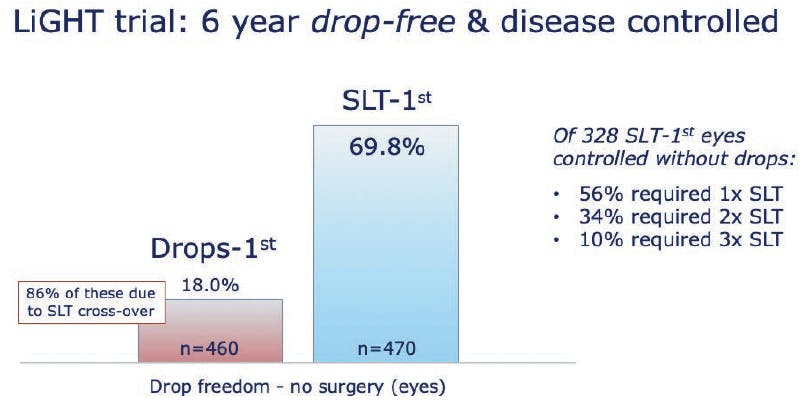
The extension study also showed a significant difference in disease progression between the two treatment arms. There was both less disease progression and greater time to surgery in the SLT arm than in the drops arm. As a result, the cumulative trabeculectomy rate was much greater in the drops-first arm, even for those who elected to undergo SLT as a crossover treatment. This is an interesting point because it indicates that early treatment in the disease course may affect the rate of disease progression in the TM.
By 6 years, 979 laser procedures had been performed. Of those, the IOP rose by more than 5 mm Hg for only 10 eyes.
CONCLUSION
In terms of balance and risk and benefit, SLT has been shown to control IOP safely and effectively in patients with mild to moderate open-angle glaucoma. The 3-year results of the LiGHT study showed that most eyes treated with SLT as the primary intervention were drop- and surgery-free and that most controlled eyes needed only one treatment. The 6-year extension study built upon the promising 3-year results, again showing that the majority in the SLT-first group were controlled to their target IOP without medications.
Questions still remain, such as how often and when should SLT be repeated, what is the best treatment endpoint, and is there a better postlaser drug regimen? One thing, however, is clear: SLT should certainly be considered for our newly diagnosed patients or patients within 1 to 2 years of diagnosis.
*Source: Gazzard G. Selective laser trabeculoplasty—how the treatment paradigm has changed.
Moorfields Eye Hospital NHS Foundation Trust. Presented at: AAO; Chicago; 2022.
1. Omoti AE, Ukponmwan CU. Compliance with new drugs in glaucoma therapy in Benin-city, Nigeria. Seguimiento Farmacoterapéutico. 2005;3:135-143.
2. Reardon G, Kotak S, Schwartz GF. Objective assessment of compliance and persistence among patients treated for glaucoma and ocular hypertension: a systematic review. Patient Prefer Adherence. 2011;5:441-463.
3. Ajit R, Fenerty C, Henson D. Patterns and rate of adherence to glaucoma therapy using an electronic dosing aid. Eye. 2010:24:1338-1343.
4. Gazzard G, Konstantakopoulou E, Garway-Heath D, Garg A, et al. the LiGHT Trial Study Group. Selective laser trabeculoplasty versus eye drops for first-line treatment of ocular hypertension and glaucoma (LiGHT): a multicentre randomized controlled trial. Lancet. 2019;393(10180):1505-1516.
5. Gazzard G, Konstantakopoulou E, Garway-Heath D, et al. LiGHT trial: 6-year results of primary selective laser trabeculoplasty versus eye drops for the treatment of glaucoma and ocular hypertension. Ophthalmology. 2022;16:S0161-6420(22)00732-1.