


The glaucoma surgical landscape is evolving and changing dramatically as we move forward in the era of interventional glaucoma. The interventional glaucoma mindset represents a significant paradigm shift in patient care, taking the treatment burden out of the patient’s hands and placing more emphasis on earlier laser intervention. Relieving patients from drop regimens helps them maintain a better quality of life and a higher degree of independence from the disease and its treatment.
ADDRESSING THE SHORTCOMINGS
Topical therapy is still considered a first-line treatment for glaucoma. Compliance and adherence with medications such as prostaglandins, alpha agonists, and carbonic anhydrase inhibitors, however, is generally low. In a 2005 systematic review of 34 studies,1 nonadherence to topical glaucoma drops ranged from 4.6% to 80%. Additionally, in several retrospective cohort studies using survival analyses, fewer than 25% of patients were persistent with their drop therapy over a period of 12 months.2-4
Compliance issues such as not taking medications or missing doses can correlate to disease progression and increased costs for glaucoma care.4-6 One impetus for the drive toward interventional glaucoma therefore is to address the shortcomings of drop therapies. Laser intervention performed early in the treatment paradigm can be a safer, more efficient way to reach the target IOP safely, achieve optimal 24-hour pressure control, and reduce the need for further invasive procedures such as bleb and trabeculectomy surgeries. By intervening with laser earlier when the IOP is lower, we can safely change the trajectory of the rate of disease progression and address patient adherence head-on.7
ADVANTAGES OF SLT
There is growing evidence that, compared to topical drop therapy, selective laser trabeculoplasty (SLT) can provide additional benefits.8 The Laser in Glaucoma and Ocular Hypertension (LiGHT) trial showed that, even when the pressure lowering was the same after SLT and topical drop therapies, patients experienced less field progression (Figure 1) and a less rapid progression rate with SLT as an initial therapy (4.6% vs 7.2%;
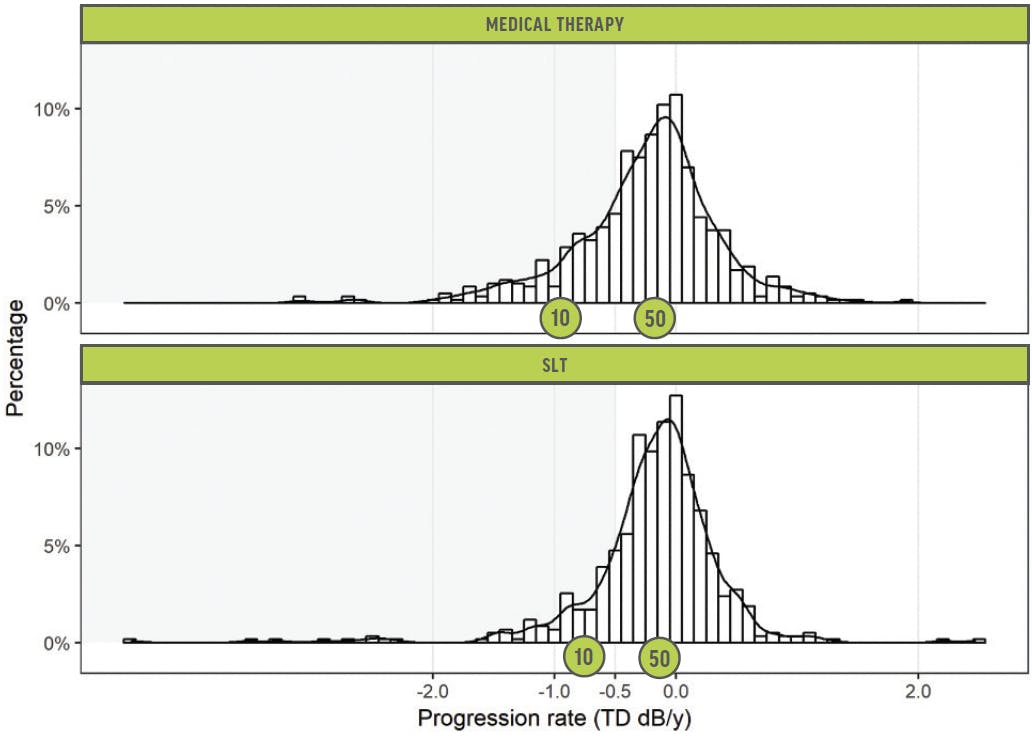
Figure 1. Visual field outcomes from the LiGHT study showed that patients experienced less visual field progression and less rapid progression with SLT versus medication as a first-line treatment.
Adapted from Wright et al. Ophthalmology. 2020.
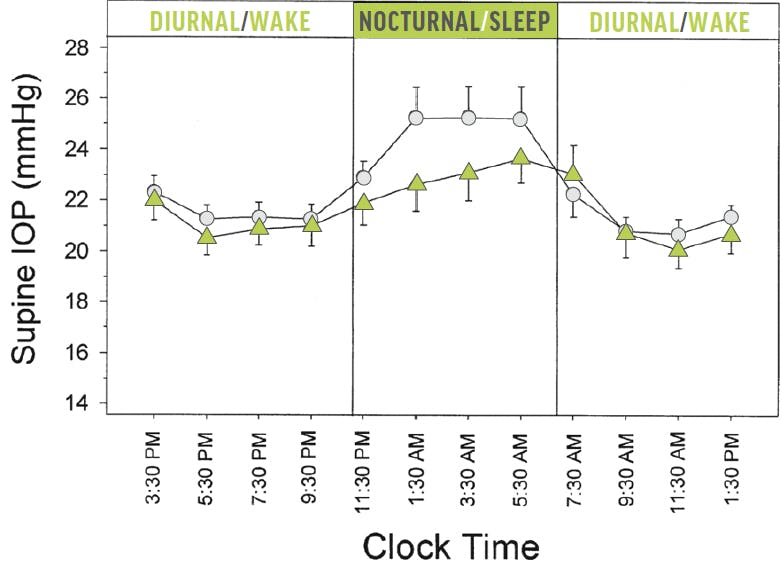
Figure 2. Patients experienced improved diurnal IOP control with SLT versus drop therapy. Circles represent baseline IOP and triangles represent postlaser IOP. Error bars represent the standard error of the mean (n = 28).
Adapted from Wright et al. Ophthalmology. 2000.
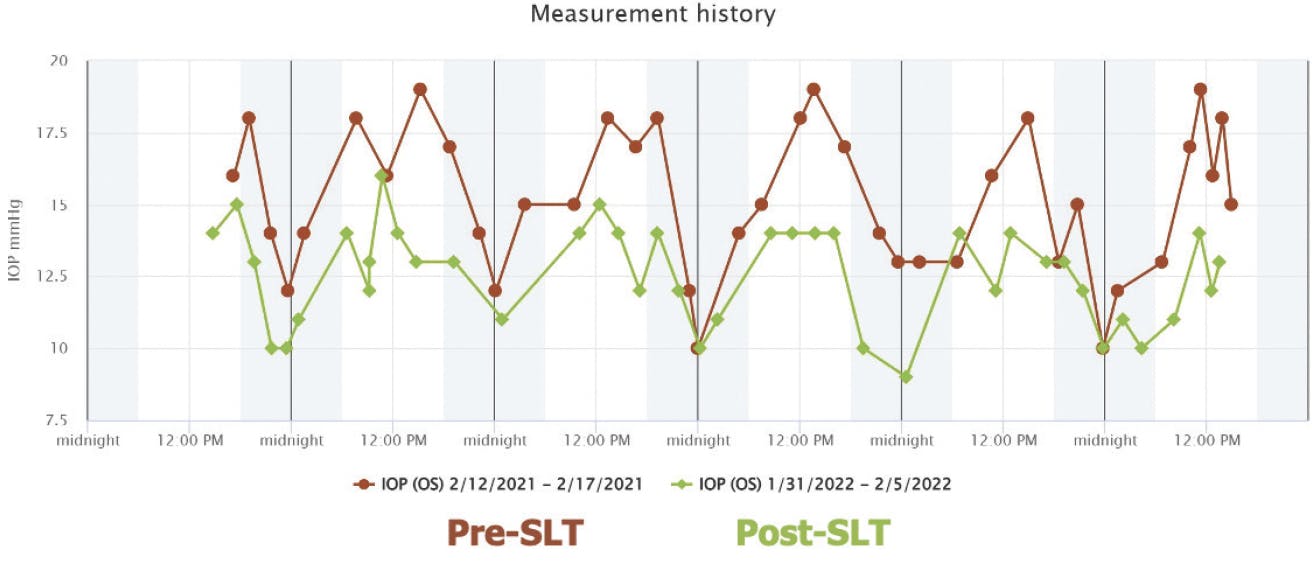
SLT also has diurnal benefits. The procedure has been shown to improve nocturnal IOP control, whereas medications can lose their effectiveness overnight.10 Figure 3 shows iCare Home (iCare Oy) tonometry measurements from a patient who had stable IOP measurements in the office but fluctuating measurements at home. The red and green lines represent their IOP measurement history before and after SLT, respectively. Fluctuations occurred both before and after SLT intervention, but they were less pronounced after the treatment.
FUTURE OUTLOOK
Although there are barriers to more widespread adoption of interventional approaches to glaucoma care, including access, cost, practice workflow, and patient acceptance, a growing body of evidence supports that SLT should be considered as a first-line treatment for open-angle glaucoma. According to a 2022 Market Scope study, 61% of clinicians who perform laser-based glaucoma therapy recommend SLT as a first-line therapy for up to 40% of their patients with newly diagnosed glaucoma, 12% recommend it for 41% to 60%, and 27% recommend it for 61% to 100%.
Presently, the standard treatment protocol for IOP control is multiple medications, followed by SLT and more medications, and then finally invasive trabeculectomy surgery as a last resort. I think the future paradigm includes SLT as a first-line treatment that can be repeated if needed. Drug delivery may also play a role. For patients who have a cataract, phacoemulsification surgery can be combined with one or multiple MIGS procedures before microinvasive bleb surgery and trabeculectomy are considered. Drops will be used only as a supplement to the interventional therapies.
CONCLUSION
SLT and other laser-based therapy is a huge part of the interventional glaucoma mindset. Advances made with these procedures have helped us change the way we approach glaucoma care. I think mindset is the biggest barrier to adopting early laser intervention for the disease, and I predict more clinicians will begin to consider SLT as a first-line treatment.
1. Olthoff CMG, Schouten JSAG, van de Borne BW, Webers CAB. Noncompliance with ocular hypotensive treatment in patients with glaucoma or ocular hypertension an evidence-based review. Ophthalmology. 2005;112(6):953-961.
2. Schwartz GF. Compliance and persistency in glaucoma follow-up treatment. Current Opin Ophthalmol. 2005;16(2):114-121.
3. Nordstrom BL, Friedman DS, Mozaffari E, Quigley HA, Walker AM. Persistence and adherence with topical glaucoma therapy. Am J Ophthalmol. 2005;140(4):598-606.
4. Newman-Casey PA, Robin AL, Blachley T, et al. The most common barriers to glaucoma medication adherence: a cross-sectional survey. Ophthamology. 2015; 122:1308-1316.
5. Sleath B, Blalock S, Covert D, et al. The relationship between glaucoma medication adherence, eye drop technique, and visual field defect severity. Ophthalmology. 2011;118(12):2398-2402.
6. Traverso CE, Walt JG, Kelly SP, et al. Direct costs of glaucoma and severity of the disease: a multinational long term study of resource utilisation in Europe. Br J Ophthalmology. 2005;89(10):1245-1249.
7. Migdal C, Gregory W, Hitchings R. Long-term functional outcome after early surgery compared with laser and medicine in open-angle glaucoma. Ophthalmology. 1994;101(10):1651-1656.
8. Gazzard G, Konstantakopoulou E, Garway-Heath D, et al for the LiGHT Trial Study Group. Selective laser trabeculoplasty versus eye drops for first-line treatment of ocular hypertension and glaucoma (LiGHT): a multicentre ramdonized controlled trial. Lancet. 2019;393:1505-1516.
9. Wright DM, Konstantakopoulou E, Montesano G, et al; Laser in Glaucoma and Ocular Hypertension Trial (LiGHT) Study Group. Visual field outcomes from the multicenter, randomized controlled laser in glaucoma and ocular hypertension trial (LiGHT). Ophthalmology. 2020;127(10):1313-1321.
10. Liu JH, Kripke DF, Hoffman RE, et al. Nocturnal elevation of intraocular pressure in young adults. Ophthalmology. Invest Ophthalmol Vis Sci. 1998;39(213):2707-2712.

