The Function of MIGS Device Implants
The ultimate goal of glaucoma treatment is to stabilize vision; current modalities achieve this by reducing the intraocular pressure from baseline; this is the only current modifiable risk factor in glaucoma treatment. Clinical studies have evaluated the efficacy of MIGS devices implanted with cataract surgery as compared to cataract surgery alone. All implant devices describe their 2-year efficacy data, but the 1-year efficacy data was not reported for all implants – this becomes important when evaluating the short-term efficacy of combined implantation with cataract surgery to discern the effect that cataract surgery alone may have on short-term IOP reduction outcomes. The efficacy of a product relies, in part, on its mechanism of action as well as its proper insertion in order to achieve its intended function.
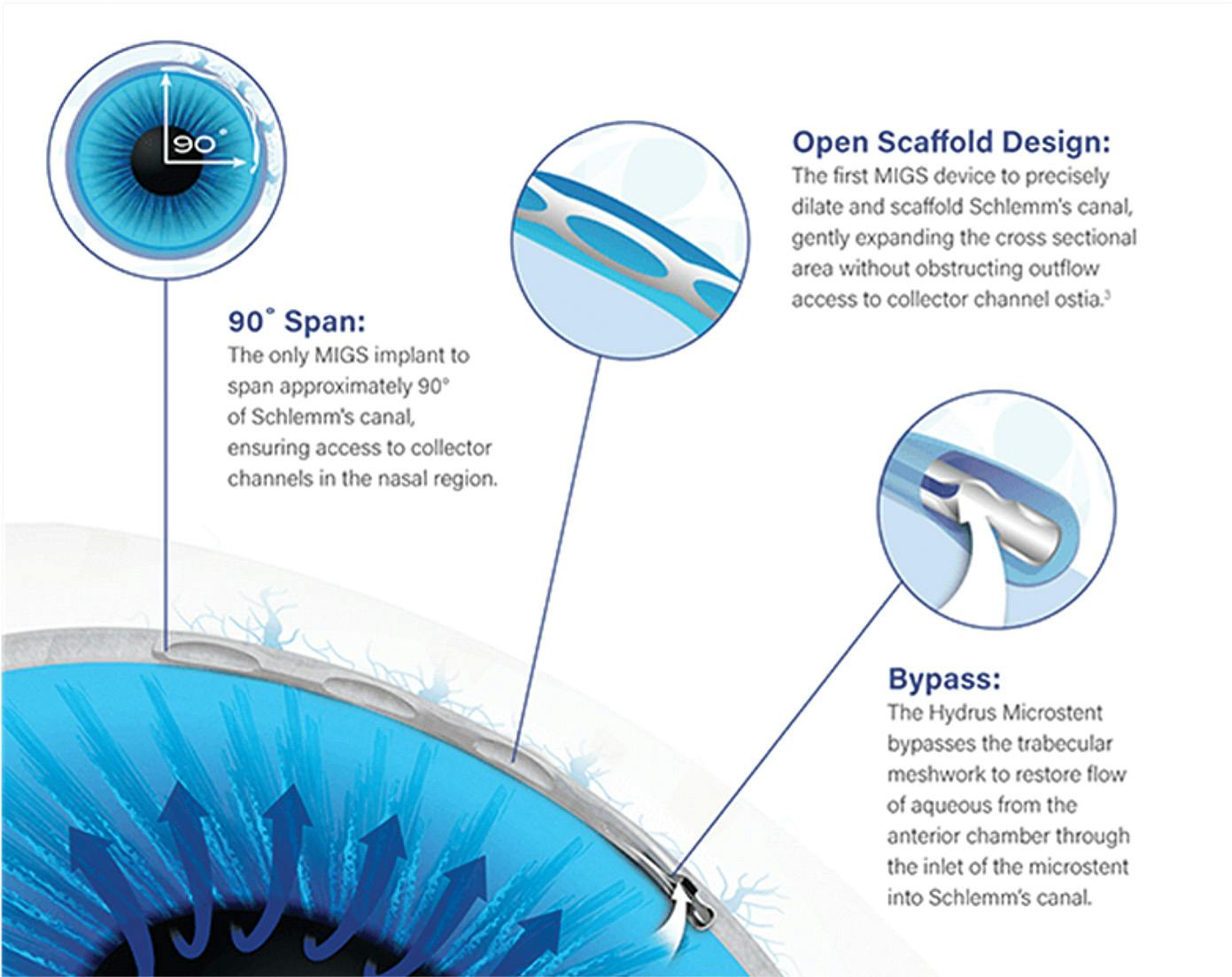
The HYDRUS Microstent (Alcon Vision, LLC; Irvine, CA, USA) is indicated for use in conjunction with cataract surgery for the reduction of intraocular pressure (IOP) in adult patients with mild to moderate primary open-angle glaucoma (POAG). The HYDRUS Microstent is associated with 3 mechanisms of action: After proper insertion, the proximal portion of the implant exits Schlemm's canal (SC) through the trabecular meshwork to allow increased inflow of aqueous humor from the anterior chamber. Alternating “spines” provide structural support and an “open scaffold” to provide an unobstructed pathway along the canal for aqueous outflow to multiple collector channels. The microstent is approximately 8mm in overall length, and combined with its curvature, the implant is designed to occupy approximately 90° or 3 clock hours of SC (Figure 1).1
The iStent inject W Trabecular Micro-Bypass System Model G2-W (Glaukos Corporation; Aliso Viejo, CA, USA) is indicated for use in conjunction with cataract surgery for the reduction of intraocular pressure (IOP) in adult patients with mild to moderate primary open-angle glaucoma. When properly implanted, the iStent inject W stent is intended to create two bypasses through the trabecular meshwork into SC to improve aqueous outflow through the natural physiologic pathway.2
Preclinical Data
Preclinical experimental data for each of these MIGS implants successfully demonstrated increased aqueous outflow resulting from implantation of these devices compared to baseline. However, an important aspect of these experiments also included some histological sampling of the angle structures. In a study by Camras, histologic cross-sections of the eyes with an earlier version of the HYDRUS Microstent showed widely dilated SCs from perfused eyes compared to the SC regions without the Microstent throughout its length.3 In a study by Bahler, when an iStent Inject is inserted correctly (the head lies entirely within SC), there was a local separation of the inner and outer walls of SC immediately at and adjacent to the head of the iStent Inject that diminished past 75 µm.4 For reference, the dimensions of Schlemm’s canal in normal eyes include a meridional diameter of 233.0 ± 34.5 µm and a coronal diameter of 44.5 ± 12.6 µm.5 Finally, a study by Toris evaluated the flow facility of HYDRUS, Gen 1 iStents and iStent Injects and found that, in order of greatest percent increase of baseline flow facility, HYDRUS surpassed that of 2 Gen 1 iStents, which was greater than a single Gen 1 iStent, which was greater than 2 iStent Injects.6
These preclinical models are helpful to surmise the theoretical potential of each of these stents, but how do these stents perform in clinical practice? The function of these stents depends on the mechanism of action and the reliability and consistency of proper stent insertion. The product labeling provides guidance for proper stent insertion. For the HYDRUS Microstent, visualizing the microstent windows during advancement into the canal is important, with visualization of all three windows within Schlemm’s canal representing ideal implantation.1 Implantation for iStent Inject W focuses on proper placement when the flange of each stent is visualized in the anterior chamber with the stent traversing the trabecular meshwork. Blood reflux may confirm stent placement, although this does not always occur.2
Clinical Implantation Data
The pivotal trial submission data to the FDA described the reliability and consistency of proper stent placement for each of these stents. Overall, there were no obvious striking differences with regards to implantation difficulty or the need for additional injectors.7,8
A recent study by Zimmermann in 2023 evaluated the position of 28 iStent Injects implanted in 14 eyes postoperatively using the NIDEK GS-1 Gonioscope (NIDEK, Gamagori, Aichi, Japan). Briefly, iStent Inject was implanted in combination with cataract surgery by two experienced glaucoma surgeons with 1-year IOP and medication outcomes. Only 14.3% of the stents were positioned at the level of the pigmented trabecular meshwork; all others were either outside of this location or were not identified. Clinically, there was a statistically significant reduction of IOP from baseline at 1, 6 and 12 months postoperatively. However, there was no statistically significant reduction in the number of required medications to achieve those IOP results from baseline.9
In 2019, Gillman et al attempted to correlate iStent Inject placement with IOP. In this study, 25 of 38 eyes underwent implantation of 2 iStent inject devices combined with cataract surgery; controls were the unoperated fellow eyes. Only 54.3% of iStent Inject device flanges protruded into the anterior chamber (AC) and 62% of the device’s heads were not positioned within SC when evaluated using anterior segment optical coherence tomography (AS-OCT) at 3 months postoperatively.10 Flange protrusion of only the most anterior device in each eye into the AC did show a positive association with lower postoperative IOP, and in stents with failed placement, device head proximity to SC did correlate with SC diameter as well as with IOP, implying a negative effect on IOP lowering when misplaced. Postoperative SC dimensions were larger than those of the unoperated control eyes,10 however, the SC dilation reported by Gillman could also be attributed to the effect of cataract surgery. Zhao et al used swept-source OCT to evaluate SC dilation after phacoemulsification and reported a SC diameter increase of about 38% at 1 month postoperatively and about 47% at 6 months postoperatively.11 Publicly available data demonstrating a scaffolding effect beyond the immediate region of a properly placed iStent Inject W do not appear to be available.
While data has been reported around post op malpositioning of iStent Generation 1 and iStent inject, similar studies regarding the HYDRUS Microstent are not available. This points towards an area in need of further investigation. However, it can be noted that HYDRUS was suboptimally placed in 1.6% of cases during the HORIZON study12 and in a small case series, there appeared to be little effect on achieving target IOP while achieving medication reduction for HYDRUS Microstents with distal stent mispositioning.13
Proper Intraoperative Implant Verification
A recent publication by Ang et al14 provides insight into the use of intraoperative OCT to guide stent placement for each implant (please click to see video).14 Ang brings attention to the utility of iOCT verification in heavily pigmented TMs for when the windows of a HYDRUS implant are difficult to visualize. For iStent Inject W, flange surface projection (or retraction) from the TM surface after placement was obtainable. However, it was not possible to use iOCT for verification of proper head placement or to verify Schlemm’s canal scaffolding/dilation due to signal loss.14 This leaves the ability to intraoperatively verify proper placement of the head of an iStent inject device questionable.
Postoperative gonioscopy should be performed for all patients after placement of trabecular bypass stents to assess for the development of PAS or obstruction of the inlet. At 2 years, stent obstruction was observed in 4.3% of iStent implants.15 Obstructive PAS was observed in 3.8% of HYDRUS implanted eyes in the HORIZON study at 2 years, although eyes observed to have PAS or adhesion were not related to an increase in IOP.12
Summary
Proper positioning of a stent plays a large part in its ability to function as intended. Physical and visual feedback during implantation for the HYDRUS Microstent can aid in proper placement. This differs from iStent Inject implantation, where physical feedback is minimal and visual feedback can be challenging. Studies using both NIDEK Gonioscopy and AS-OCT have demonstrated a substantial proportion of misplaced iStent inject implants, potentially compromising their ability to reduce IOP. Further study is needed to understand the rate of HYDRUS malpositioning and whether a malpositioned stent has any impact on IOP.
Important Product Information
CAUTION: Federal law restricts this device to sale by or on the order of a physician.
INDICATIONS FOR USE:
The Hydrus Microstent is indicated for use in conjunction with cataract surgery for the reduction of intraocular pressure (IOP) in adult patients with mild to moderate primary open-angle glaucoma (POAG).
CONTRAINDICATIONS:
The Hydrus Microstent is contraindicated under the following circumstances or conditions: (1) In eyes with angle closure glaucoma; and (2) In eyes with traumatic, malignant, uveitic, or neovascular glaucoma or discernible congenital anomalies of the anterior chamber (AC) angle.
WARNINGS:
Clear media for adequate visualization is required. Conditions such as corneal haze, corneal opacity or other conditions may inhibit gonioscopic view of the intended implant location. Gonioscopy should be performed prior to surgery to exclude congenital anomalies of the angle, peripheral anterior synechiae (PAS), angle closure, rubeosis and any other angle abnormalities that could lead to improper placement of the stent and pose a hazard. The surgeon should monitor the patient postoperatively for proper maintenance of intraocular pressure. The surgeon should periodically monitor the status of the microstent with gonioscopy to assess for the development of PAS, obstruction of the inlet, migration, or device-iris or device-cornea touch. The Hydrus Microstent is intended for implantation in conjunction with cataract surgery, which may impact corneal health. Therefore, caution is indicated in eyes with evidence of corneal compromise or with risk factors for corneal compromise following cataract surgery. Prior to implantation, patients with history of allergic reactions to nitonal, nickel or titanium should be counseled on the materials contained in the device, as well as potential for allergy/hypersensitivity to these materials.
PRECAUTIONS:
If excessive resistance is encountered during the insertion of the microstent at any time during the procedure, discontinue use of the device. The safety and effectiveness of use of more than a single Hydrus Microstent has not been established. The safety and effectiveness of the Hydrus Microstent has not been established as an alternative to the primary treatment of glaucoma with medications, in patients 21 years or younger, eyes with significant prior trauma, eyes with abnormal anterior segment, eyes with chronic inflammation, eyes with glaucoma associated with vascular disorders, eyes with preexisting pseudophakia, eyes with pseudoexfoliative or pigmentary glaucoma, and when implantation is without concomitant cataract surgery with IOL implantation. Please see a complete list of Precautions in the Instructions for use.
ADVERSE EVENTS:
The most frequently reported finding in the randomized pivotal trial was peripheral anterior synechiae (PAS), with the cumulative rate at 5 years (14.6% vs 3.7% for cataract surgery alone). Other Hydrus postoperative adverse events reported at 5 years included partial or complete device obstruction (8.4%) and device malposition (1.4%). Additionally, there were no new reports of persistent anterior uveitis (2/369, 0.5% at 2 years) from 2 to 5 years postoperative. There were no reports of explanted Hydrus implants over the 5-year follow-up. For additional adverse event information, please refer to the Instructions for Use.
MRI INFORMATION:
The Hydrus Microstent is MR-Conditional meaning that the device is safe for use in a specified MR environment under specified conditions.
Please see the Instructions for Use for complete product information.
© 2023 Alcon Inc. 01/24 US-HDM-2300251
1. HYDRUS Microstent [instructions for use]. Irvine, CA: Alcon Vision LLC; September 2021 (United States).
2. iStent Inject W TrabecularMicro-Bypass System [instructions for use]. San Clemente, CA: Glaukos Corporation; June 2020 (United States).
3. Camras LJ, Yuan F, Fan S, Samuelson TW, Ahmed IK, Schieber AT, Toris CB. A novel Schlemm’s Canal scaffold increases outflow facility in a human anterior segment perfusion model. Invest Ophthalmol Vis Sci. 2012 Sep 12;53(10):6115-21.
4. Bahler CK, Hann CR, Fjield T, Haffner D, Heitzmann H, Fautsch MP. Second-generation trabecular meshwork bypass stent (iStent inject) increases outflow facility in cultured human anterior segments. Am J Ophthalmol. 2012 Jun;153(6):1206-13.
5. Yan X, Li M, Chen Z, Zhu Y, Song Y, Zhang H. Schlemm’s Canal and Trabecular Meshwork in Eyes with Primary Open Angle Glaucoma: A Comparative Study Using High-Frequency Ultrasound Biomicroscopy. PLoS One. 2016 Jan 4;11(1):e0145824.
6. Toris CB, Pattabiraman PP, Tye G, Samuelson TW, Rhee DJ. Outflow Facility Effects of 3 Schlemm’s Canal Microinvasive Glaucoma Surgery Devices. Ophthalmol Glaucoma. 2020 Mar-Apr;3(2):114-121.
7. US Food and Drug Administration. Summary of Safety and Effectiveness Data (SSED): HYDRUS Microstent. US Food and Drug Administration website. https://www.accessdata.fda.gov/cdrh_docs/pdf17/P170034B.pdf. Accessed 14 July 2023.
8. US Food and Drug Administration. Summary of Safety and Effectiveness Data (SSED): iStent inject Trabecular Micro-Bypass System (Model G2-M-IS). US Food and Drug Administration website. https://www.accessdata.fda.gov/cdrh_docs/pdf17/P170043b.pdf. Accessed 14 July 2023.
9. Zimmermann JA, Storp JJ, Merté RL, Heiduschka P, Eter N, Brücher VC. Position of the ISTENT Inject® Trabecular Micro-Bypass System Visualized with the NIDEK GS-1 Gonioscope-A Postoperative Analysis. J Clin Med. 2023 Aug 8;12(16):5171.
10. Gillmann K, Bravetti GE, Mermoud A, Mansouri K. A Prospective Analysis of iStent Inject Microstent Positioning: Schlemm Canal Dilatation and Intraocular Pressure Correlations. J Glaucoma. 2019 Jul;28(7):613-621.
11. Zhao Z, Zhu X, He W, Jiang C, Lu Y. Schlemm's Canal Expansion After Uncomplicated Phacoemulsification Surgery: An Optical Coherence Tomography Study. Invest Ophthalmol Vis Sci. 2016 Dec 1;57(15):6507-6512.
12. Samuelson TW, Chang DF, Marquis R, Flowers B, Lim KS, Ahmed IIK, Jampel HD, Aung T, Crandall AS, Singh K; HORIZON Investigators. A Schlemm Canal Microstent for Intraocular Pressure Reduction in Primary Open-Angle Glaucoma and Cataract: The HORIZON Study. Ophthalmology. 2019 Jan;126(1):29-37.
13. Laroche D, Martin A, Brown A, Sakkari S, Ng C. Mispositioned Hydrus Microstents: A Case Series Imaged with NIDEK GS-1 Gonioscope. J Ophthalmol. 2022 Sep 8;2022:1605195.
14. Ang BCH, Betzler BK, Lim SY. Intraoperative Optical Coherence Tomography for Ab-Interno Trabecular Bypass Glaucoma Surgery. J Glaucoma. 2023 May 10.
15. Craven ER, Katz LJ, Wells JM, Giamporcaro JE; iStent Study Group. Cataract surgery with trabecular micro-bypass stent implantation in patients with mild-to-moderate open-angle glaucoma and cataract: two-year follow-up. J Cataract Refract Surg. 2012 Aug;38(8):1339-45.