


For physicians integrating minimally invasive glaucoma surgery (MIGS) procedures at the time of cataract surgery (phaco+MIGS) into their treatment armamentarium, the postoperative journey should ideally be as smooth and seamless as the procedure itself. A common goal of phaco+MIGS is to lower medication burden, so developing a postoperative IOP medication strategy is important to ensure that patients can safely and reliably achieve this goal.
It is widely accepted that patients with glaucoma are at an increased risk of transient IOP elevation following cataract surgery, but it is important to differentiate the possible causes. When IOP elevation occurs within the first 24 hours, it is most likely due to retained OVD, inflammation, or blood in the anterior chamber (AC). However, when IOP elevation occurs within one to four weeks postoperatively, steroid-induced ocular hypertension should be considered. Therefore, for some glaucoma patients undergoing phaco+MIGS, maintaining IOP lowering medications may be warranted to help mitigate transient IOP elevation or reduce its effect, both in the immediate postoperative period and mid-term follow-up period. However, maintaining IOP-lowering medications postoperatively may conflict with the treatment goal of eliminating one or more IOP-lowering medications.
A key question for physicians performing phaco+MIGS surgeries, therefore, is whether to stop, reduce, or maintain IOP-lowering medications postoperatively. Physicians may also want to know how to identify patients who may be at increased risk of transient IOP elevation. To provide perspective on these questions, a group of experienced phaco+MIGS users assembled to discuss their approaches to individualizing postoperative care and the role of IOP-lowering medications.
Q: Do you generally stop or maintain IOP-lowering medications after phaco+MIGS?
Dr. De Francesco: It really depends. Disease severity and the number of preoperative medications are the two main factors that guide my decision-making.
Dr. Schweitzer: I approach the decision similarly. For a patient with mild disease who is using only one medication, I would feel comfortable stopping all medications. For a patient with moderate to severe disease with a higher preop medication load, I would maintain at least one medication because the impact of transient IOP elevation could be more significant for that patient.
Dr. Lindfield: For me, it depends on the treatment goal. If my treatment goal is to reduce the number of medications, I aim to do that in the postoperative period. However, if IOP reduction is my primary treatment goal, I maintain the medications. My decision is also influenced by the size of the gap between where the patient is preoperatively and where I want them to be postoperatively. For example, if I’m trying to reduce the medication burden, but our starting point is three medications, I’m unlikely to eliminate all of them at once.
Q: How does the use of IOP-lowering medications in the early postop period influence your long-term treatment goals?
Dr. De Francesco: The true effect of the MIGS component of a phaco+MIGS procedure is difficult to gauge until 4 to 8 weeks after surgery, so it is important to be patient during that initial postoperative period and accept that using IOP-lowering drops in the short term may help to achieve the desired outcomes in the long term. I explain this to all my patients so that they are not disappointed to still be using drops postoperatively. If I can remove a poorly tolerated drop in the early postop period, then I will aim to do that.
Q: How do you define a transient postoperative IOP “spike”? And how common is it after phaco+MIGS?
Dr. Lindfield: Any early postop IOP above baseline instinctively feels like a negative outcome, but I’ve learned that the early postop period doesn’t necessarily determine the long-term effects. For this reason, I tend to reduce drops slowly and don’t judge the outcome until 4 to 8 weeks after surgery.
Dr. De Francesco: I typically define a transient IOP spike as IOP > 30 mmHg or an increase of >10 mmHg from baseline. Transient IOP elevation after MIGS is not uncommon, and our main concern is the potential for further optic nerve damage. But equally important is how transient IOP elevation can negatively impact the patient’s postoperative experience. It may require extra monitoring visits, delay visual recovery, or contribute to anxiety about the overall management of their glaucoma. It is imperative to inform patients about the possibility of IOP fluctuations during the first 4 to 8 weeks postop, so they understand that an IOP elevation does not mean that the surgery has failed.
Q: Which patients might be at an increased risk for transient IOP elevation?
Dr. Schweitzer: If a patient has a known steroid response, we can anticipate that they might experience IOP elevation. When treating the second eye of a patient with steroid-induced ocular hypertension in the first eye, for example, I would taper the steroid more quickly after surgery, which can help limit the need for or duration of IOP-lowering medications.
Dr. De Francesco: We know from the literature that younger age, long axial length, history of steroid response, and retained intraoperative blood reflux are risk factors for transient IOP elevation. Worse disease severity, higher preoperative IOP, and a greater number of medications can also increase the chances of a patient developing a hypertensive response. We recently came up with a schema (Figure) to provide some guidance to physicians on whether to stop, reduce, or maintain preoperative medications after surgery, depending on the presence of these risk factors.
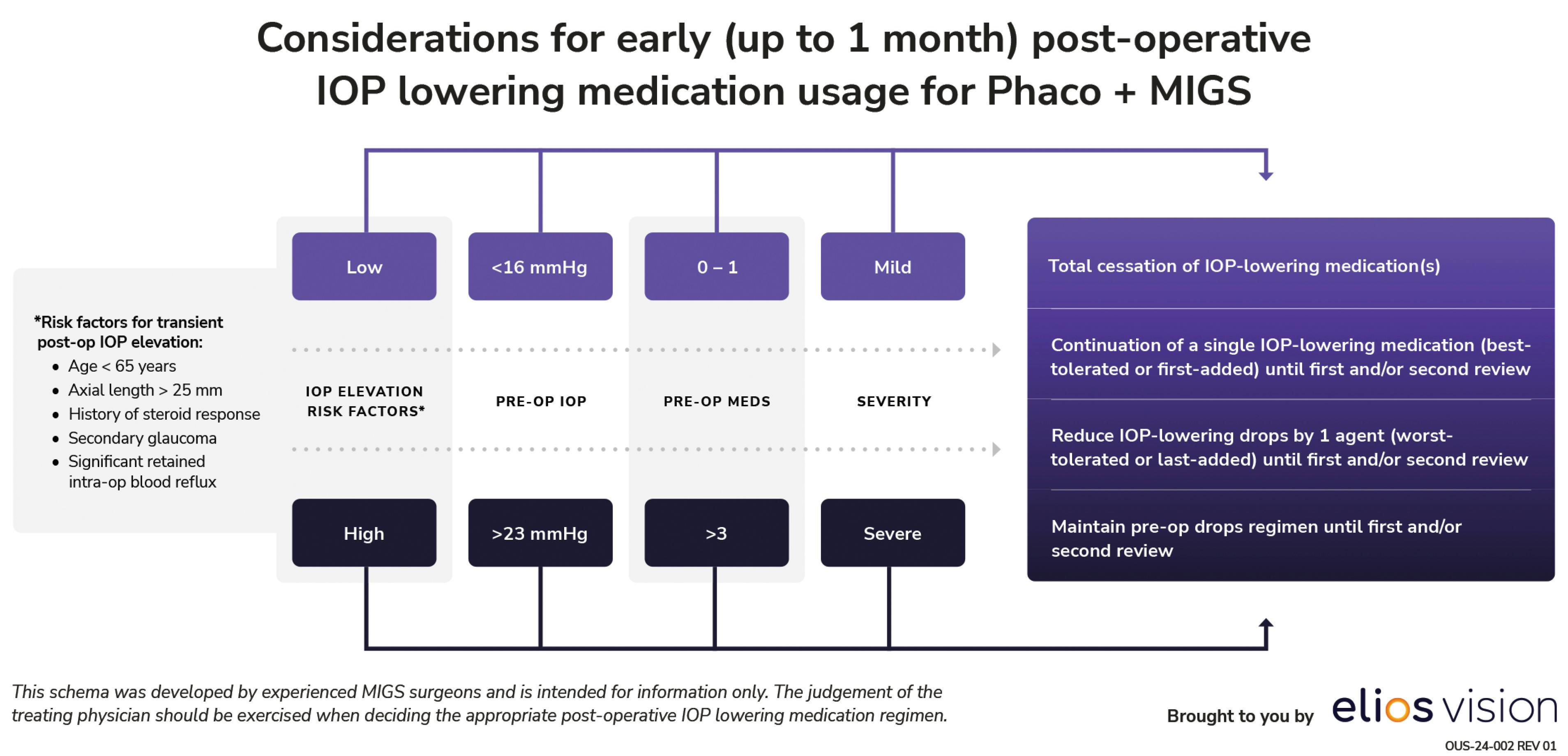
Figure. A schema can help ECPs communicate individualized treatment goals and rank what is most important to achieve for each patient.
Q: Does continuation of IOP lowering medications during the postoperative period affect patient satisfaction?
Dr. Amerasinghe: In my experience, maintaining some medications is not necessarily a source of disappointment. If a patient who is using three medications preop is informed that the goal of treatment is to reduce that by one or two drops, which should benefit their ocular surface health, then they’re going to be happy even if one of the drops is retained. Patient education and communication is key, so that patients understand how long they might still be using IOP-lowering medication after surgery.
Dr. Ahmed: In my experience with MIGS, the best approach is to try to individualize medication use by stopping drops where I feel it is safe to do so, as well as maintaining medications for patients who have risk factors for postoperative IOP elevation. However, individualization can also make planning unnecessarily complex, due to all the different permutations of patient factors that affect IOP. Using the schema that Dr. De Francesco mentioned is a great way to simplify your medication strategy according to risk factors, while avoiding reactionary decisions, unplanned additional visits, and unexpected IOP spikes.
TAKE-HOME POINTS
- Be patient when evaluating the IOP-lowering effects of phaco+MIGS. It may take up to 8 weeks postoperatively to understand the impact on IOP.
- If using IOP-lowering medications postoperatively, set a time point and IOP target where the possibility of reducing medications further can be evaluated.
- Schedule an additional IOP check 2-3 weeks after stopping or reducing medications to see if the new regimen is sustainable.
- The effect of removing a medication postoperatively may not be as easy to predict as the addition of a medication preoperatively.
- Patients at increased risk of transient IOP elevation include those with younger age, myopia, a known history of steroid response (e.g. fellow eye), severe glaucomatous disease, higher preoperative IOP, and a greater number of medications.
- An individualized approach to IOP lowering meds postop can generally enhance patient satisfaction with phaco+MIGS treatment. Consider using the schema to simplify decision-making.
Q: If maintaining some medications, which type or class of IOP-lowering drugs do you keep?
Dr. Lindfield: There are two factors that I consider. The first is compliance. I am more likely to keep the patient on the medication that is easiest for them to use, best tolerated, or least frequently administered. The second is which drop I would rather have my patient on long-term if needed. If I can’t achieve both goals with a single drop, then I tend to be biased towards long-term efficacy rather than short-term gains.
Dr. Amerasinghe: I agree that compliance is relevant to our choice. I’d probably choose to first eliminate a drop that the patient tolerates least. If there isn’t an obvious 'problematic' medication, then I tend to remove the drop that I added most recently. In my practice, that would mean that patients are most likely to be maintained on a prostaglandin when medical therapy is still required, because that is generally my first-line medication.
Dr. Schweitzer: My preference is to maintain patients on a preservative-free combination of a beta blocker and carbonic anhydrase inhibitor (CAI) because I'm confident of the efficacy and tolerability after surgery.
Q: At what time point postoperatively do you consider reducing or stopping medications?
Dr. Lindfield: My recommendations are linked to the standard schedule of postoperative follow-up appointments. Patients are generally on steroids for 4 weeks after surgery, so I don’t make any changes at the one-month visit. I ask them to stop using their IOP-lowering drops three days before their next follow-up visit at 3 months. By that time, I feel I’m observing the 'pure' effect of the MIGS procedure, and I can reasonably decide whether to continue without any drops or reintroduce medications based on my observations at the 3-month visit.
Dr. Ahmed: I think it’s important that we aim to reduce medications after the steroid regimen has ended, provided this can be achieved safely. Otherwise, it’s easy to accept the status quo and keep patients on medication unnecessarily. We also need to consider what level of IOP is acceptable to reduce or stop medications for a given patient. If the physician has the flexibility to schedule an additional IOP check 2 to 3 weeks after stopping or reducing medications, that can be very helpful.
Dr. Lindfield: The effect of drops on IOP is not so easy to determine in practice. You really have to be open to removing or reducing drops whenever a patient is at or below target IOP. I would encourage physicians to refer to the original treatment goals and not accept the status quo.
Q: Does the co-managing doctor have a role to play in postoperative medication management?
Dr. Ahmed: It is very important to keep co-managing doctors informed about your medication strategy. The patient may visit the co-managing doctor 3 to 4 weeks after cataract surgery for a refraction. At that point, patients may still be on both steroid and IOP-lowering drops. Providing an explanation about why drops are being maintained can be helpful so that the physician or optometrist is aware of your long-term objectives and the time frame for getting there.
ML-OUS-015 Rev 01


