Topical drop medications have been a mainstay of glaucoma therapy for decades, yet they are not always intuitive or easy to use for the average patient, especially those who are elderly and have physical or financial challenges. Barriers to using topical drops lead to issues with compliance and poor adherence to the treatment regimen we prescribe. Furthermore, with extended use, topical glaucoma medications can compromise the ocular surface.1
With iDose TR (Glaukos Corporation, Figure 1), glaucoma physicians have a unique treatment option that has been proven safe and effective in clinical studies.2 The iDose TR, a procedural pharmaceutical, is implanted directly into the eye, where it steadily releases a concentrated IOP-controlling medication for up to 3 years, potentially offering an alternative to daily eye drops.2 The phase 2b data for the implant demonstrated no clinically significant corneal endothelial cell loss and no serious corneal adverse events.2 In the pivotal trials, the most common ocular adverse reactions reported in 2% to 6% of patients were increases in IOP, iritis, dry eye, visual field defects, eye pain, ocular hyperaemia, and reduced visual acuity.3 In addition, data from the phase 3 clinical trial showed that, at 12 months, 81% of iDose TR patients were completely free of IOP-lowering topical medications.4
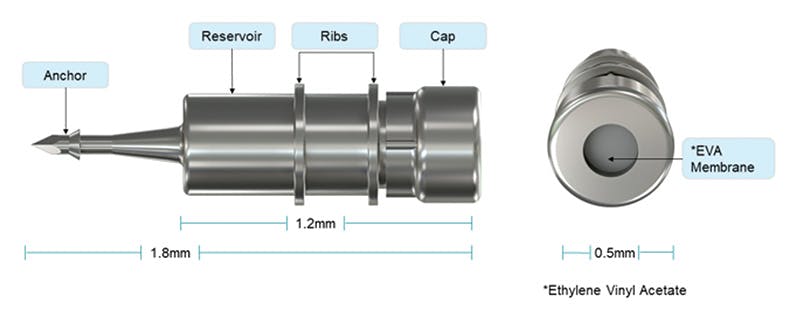
In the case presented here, a recent patient with mild-to-moderate open-angle glaucoma met what I believe were ideal selection criteria for this treatment approach.
Case Report
A 77-year-old pseudophakic white woman was referred to me by her previous glaucoma specialist, who was retiring. The patient had a history of glaucoma, but no MIGS procedure was performed at the time of her cataract surgery 6 years ago. When I saw her, her visual acuity was 20/20 and her IOP was 14 mm Hg bilaterally. Although her disease was well controlled, she was taking four topical glaucoma medications: Ocudose (timolol maleate ophthalmic solution; Bausch + Lomb) twice daily in both eyes; Azopt (brinzolamide; Novartis) three times daily; and Rocklatan (netarsudil and latanoprost ophthalmic solution; Alcon) at night. This complex regimen was due to her history of elevated IOP and having undergone two rounds of selective laser trabeculoplasty in previous years. Her highest recorded IOP from the referring doctor measured more than 30 mm Hg in both eyes.
On my examination, OCT imaging showed severe inferotemporal thinning of the retinal nerve fiber layer (RNFL) in both eyes (78 μm OD and 76 μm OS). She also had moderate visual field loss with a mean deviation of -1.47 dB OD and -2.38 dB OS (Figure 2). As a result of topical medication use, she experienced conjunctival injection, sensitivity, and significant corneal verticillata that were causing bright red eyes.
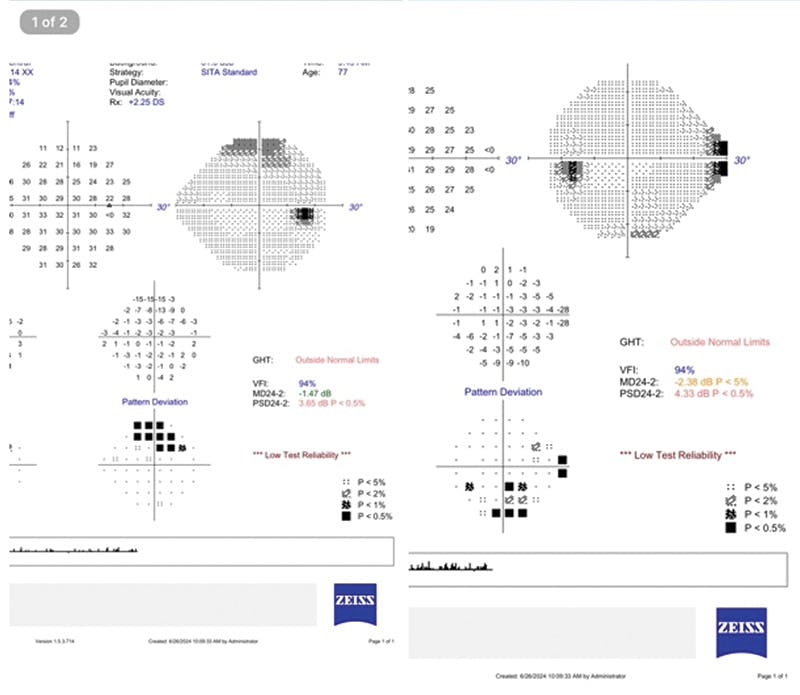
Figure 2. Preoperative examination showed moderate visual field loss with a mean deviation of -1.47 dB OD and -2.38 dB OS.
To put it simply, this patient’s topical medication regimen, despite controlling her IOP, was giving her a miserable quality of life. She also expressed to me that the cost of her medication was burdensome on her retirement income. This individual was in excellent health considering her age, except that her ocular health was significantly worse than her overall wellbeing.
I determined this patient to be an ideal candidate for iDose TR implantation. As a physician dedicated to matching the right therapy to the right patient, I believe this safe and effective technology can benefit patients who do not have significant visual field deterioration but who struggle with drops. Treating these individuals early in their disease process makes the biggest impact on their lives. The iDose TR procedural pharmaceutical addresses the most common disadvantages of topical IOP-lowering medications, including poor compliance and side effects.2
Procedural Implantation
I find the iDose TR procedure to be elegant and straightforward. I performed the iDose TR implantation in this patient’s right eye first, with a follow-up procedure for the left eye 1.5 months later. The right eye had an open, nicely pigmented trabecular meshwork, which made for excellent visualization of the angle. I made two small incisions on the cornea, starting with a paracentesis site, where I injected preservative-free lidocaine followed by OVD. Then, I made a separate, roughly 1.8-mm corneal incision. I tilted the patient’s head and tilted the scope for en face view of the angle, then I anchored the implant into the scleral wall superonasally. After confirming proper position, I slowly released the injector, gently nudging the implant to make sure it was secure. Finally, I removed the OVD by injecting BSS into the anterior chamber. Like with any procedure, there is risk involved and up to a surgeon’s discretion to decide what is best for that patient.
Quality of Life
On the day of the procedure, the patient did not use any of her glaucoma drops—just prednisolone and an antibiotic drop. On postoperative day 1 for each eye, her IOPs were stable at 12 mm Hg. Initially, I had her continue the Azopt and Ocudose drop regimen but removed the Rocklatan to rid her of the corneal verticillata and redness. After 1 week postoperatively, her IOP in both eyes remained stable, and I removed the Azopt, only continuing the Ocudose drop regimen.
After 3 months, the patient’s visual acuity remained at 20/20 with IOP at 15 mm Hg OD and 12 mm Hg OS on only one topical medication (twice-daily Ocudose). Her RNFL thickness values were also stable and identical to where they had been 1.5 years ago. Most importantly, she had no more eye redness, irritation, or photophobia from her years of topical drops.
At her most recent follow-up appointment, the patient expressed that her grandchildren did not recognize her at first without her having red eyes. When she was first referred to me, I asked her to rate her quality of life, and she said it was a 5 out of 10. Now, post-iDose TR, her self-reported quality of life is “an 11 out of 10!” Thanks to iDose TR, I had the opportunity to remove this patient’s medication burden with tremendous quality-of-life outcomes. Individual outcomes may vary.
This case presented me with the perfect opportunity to take advantage of technological advancements in our field. With early intervention and reducing the medication burden from patients, we can potentially improve their quality of life, stabilize IOP, and reestablish glaucoma management.
1. Kolko M, Gazzard G, Baudouin C, et al. Impact of glaucoma medications on the ocular surface and how ocular surface disease can influence glaucoma treatment. Ocul Surf. 2023;29:456-468.
2. Berdahl JP, Sarkisian SR Jr, Ang RE, et al. Efficacy and safety of the travoprost intraocular implant in reducing topical IOP-lowering medication burden in patients with open-angle glaucoma or ocular hypertension. Drugs. 2024;84(1):83-97.
3. iDose TR: Prescribing information. Glaukos Corporation. 2024. Accessed January 9, 2025. Available at: https://www.glaukos.com/wp-content/uploads/2024/03/iDose-TR-Prescribing-Information.pdf
4. iDose TR Phase 3 Clinical Trials, Data on file, Glaukos Corporation.
INDICATIONS AND USAGE
iDose TR (travoprost intracameral implant) is indicated for the reduction of intraocular pressure (IOP) in patients with open angle glaucoma (OAG) or ocular hypertension (OHT).
IMPORTANT SAFETY INFORMATION
Dosage and Administration
For ophthalmic intracameral administration. The intracameral administration should be carried out under standard aseptic conditions.
Contraindications
iDose TR is contraindicated in patients with active or suspected ocular or periocular infections, patients with corneal endothelial cell dystrophy (e.g., Fuch’s Dystrophy, corneal guttatae), patients with prior corneal transplantation, or endothelial cell transplants (e.g., Descemet’s Stripping Automated Endothelial Keratoplasty [DSAEK]), patients with hypersensitivity to travoprost or to any other components of the product.
Warnings and Precautions
iDose TR should be used with caution in patients with narrow angles or other angle abnormalities. Monitor patients routinely to confirm the location of the iDose TR at the site of administration. Increased pigmentation of the iris can occur. Iris pigmentation is likely to be permanent.
Adverse Reactions
In controlled studies, the most common ocular adverse reactions reported in 2% to 6% of patients were increases in intraocular pressure, iritis, dry eye, visual field defects, eye pain, ocular hyperaemia, and reduced visual acuity.
Please see full Prescribing Information. https://www.glaukos.com/wp-content/uploads/2024/03/iDose-TR-Prescribing-Information.pdf
You are encouraged to report all side effects to the FDA. Visit www.fda.gov/medwatch, or call 1-800-FDA-1088. You may also call Glaukos at 1-888-404-1644.
These participants been compensated by Glaukos for their participation.
© 2025 Glaukos PM-US-2281