Introduction
To say that glaucoma management has been revolutionized by the introduction of MIGS is an understatement. Because of the safety of MIGS devices and procedures, surgeons can intervene surgically earlier in the disease continuum, thereby forestalling glaucomatous progression and delaying the need for incisional techniques. At the same time, MIGS offers the potential to reduce patients’ dependence on drops. In short, because of MIGS, surgeons are able to truly enhance patients’ quality of life while preserving the health of the optic nerve for longer.
Now, over a decade since the introduction of MIGS, we are witnessing an evolution of the technologies used for procedural intervention in glaucoma, and with it, further improvement of the outcomes for patients. Canaloplasty is a perfect example. While modern canaloplasty owes its heritage to the technique introduced by Stegman et al in 1999,1 the procedure, as it is performed with the iTrack™ Advance (Nova Eye Medical), is much less invasive, far safer, and much simpler to learn and master. Yet, the fundamental principles remain the same: introduction of a microcatheter to the Schlemm canal to break herniations, followed by introduction of a hyaluronic acid-based ophthalmic viscosurgical device to dilate the canal, create microperforations in the trabecular meshwork, and flush the collector channels.
The sum total of the procedure is that 360° of the outflow pathway is treated with a trimodal mechanism of action, and the anatomy is addressed in at least three areas critical to glaucomatous pathophysiology. When performing canaloplasty, the surgeon is working with the anatomy rather than altering or removing it, and so, important physiologic functions that regulate pressure dynamics are reset.
We were fortunate to moderate a roundtable at the Interventional Glaucoma Consortium on the role of canaloplasty with the iTrack™ Advance in glaucoma management. Following is a summary of the proceedings in which our expert panel explored a diverse range of topics, including how the procedure works, its myriad benefits, techniques and pearls, and considerations for patient selection. Readers are also directed to a library of videos that are available by following the QR code below. We hope that these educational resources will provide a thorough introduction to canaloplasty and help to explain why this panel believes the procedure has an essential role in the glaucoma management armamentarium.
—Analisa Arosemena, MD, and Rachel G. Simpson, MD
1. Stegmann R, Pienaar A, Miller D. Viscocanalostomy for open-angle glaucoma in black African patients. J Cataract Refract Surg. 1999;25:316-322.
What is Canaloplasty?
Shivani Kamat, MD: Canaloplasty with the iTrack™ Advance (Nova Eye Medical) involves two steps: catheterization, where a microcatheter is introduced ab interno and advanced for 360° through the Schlemm canal, and viscodilation, which entails pressurized delivery of a hyaluronic acid (HA)-based ophthalmic viscosurgical device (OVD). These steps are synergistic in delivering a trimodal mechanism of action in the treatment of glaucoma.1 Specifically, advancing the microcatheter mechanically breaks herniations, the delivery of OVD dilates the canal to create patency, and the pressurized delivery also flushes the collector channels. Thus, canaloplasty with the iTrack™ Advance is fundamentally a rejuvenating procedure to enhance the existing drainage system versus making a new one. It resets the anatomy in multiple locations while preserving the integrity of the trabecular meshwork (TM) tissue.
It is important to understand the rationale of why these steps are performed sequentially. First, we know that glaucoma is essentially a failure of the outflow pathway. Much like a sink that gets clogged, leaving nowhere for the water to drain, glaucoma pathology is driven by a blockage somewhere in the system, leaving nowhere for the aqueous humor to drain—it builds up in the eye and the pressure goes up. The issue we have as ophthalmic surgeons is that we don’t know where the system is getting clogged, which explains canaloplasty’s main appeal in treating multiple parts of the outflow pathway, for 360°.
Why is it important to address multiple parts of the pathway? Because studies demonstrate that while up to 75% of the outflow resistance may reside in the TM,2 other parts of the pathway may be affected. For instance, up to 50% of decreased outflow facility may be caused by blockages within the canal,3,4 and up to 90% of collector channels may be blocked in glaucomatous eyes.5
I mentioned that canaloplasty with the iTrack™ Advance spares the TM. There is a dual rationale for why that is important. First, a growing body of evidence suggests that the TM has a physiologic role in regulating pressure spikes,6 and so procedures that mechanistically destroy TM tissue remove a natural defense against glaucomatous damage. Second, one of the subtle truths we are learning in the MIGS era is that intervening early in the disease process provides better disease control overall. Furthermore, it is likely that our patients will require multiple procedures throughout their lifetime. It makes sense to leave real estate to work with for future procedures before we have to turn to incisional options, such as trabeculectomy and glaucoma drainage devices.
Lastly, it bears repeating that a HA-based OVD is used during the viscodilation step. Why? Because under normal conditions, endothelial cells in the TM help regulate levels of HA,7 which plays an important role in clearing deposition of extracellular matrix.8 However, low levels of HA lead to a conversion of its receptor to a form that is toxic to endothelial cells.9 It has been shown that HA levels are lower in eyes with primary open-angle glaucoma compared to healthy eyes.10 A further reduction in the number of TM endothelial cells therefore compromises the ability to regulate HA levels, and by extension, IOP.11-13 On the other hand, the introduction of synthetic HA via injection of OVD during the iTrack™ Advance procedure may help restore physiologic levels of HA, and in turn facilitate the ability to regulate pressure dynamics.
Analisa Arosemena, MD: One of the things I really appreciate about canaloplasty is that the same device can be used in a wide range of eyes. We surgeons can also titrate the amount of OVD delivery during viscodilation. Overall, the adaptability and safety of the device makes it suitable for use in early glaucoma, but because it treats multiple parts of the outflow pathway, it can also be effective in more moderate to severe cases.
Mary Qiu, MD: My practice pattern with respect to tissue-stripping procedures has evolved because of the advances in canaloplasty. In my training, I performed a lot of phacogoniotomy and goniotomy alone procedures. So, when I started practice, goniotomy was my go-to procedure for patients who needed to reduce pressure by a point or two or to reduce their medication burden. At the time, canaloplasty was often performed ab externo, which involved unroofing of the Schlemm canal, and the devices available for the procedure were difficult to use. A little bit later, I tried an early iteration of a different ab interno canaloplasty device when it became available, but it only delivered 11 µL of viscoelastic, which I found to be insufficient. So, I went back to cutting. When the iTrack™ Advance came out in mid 2023, it really changed my approach. Its ease of use impressed me. Having a device that is designed to easily advance and retract the microcatheter, and one that delivers around 100 µL of OVD, is a real advantage.
Christine Funke, MD: I think that sparing the TM tissue is a big discussion that we all need to have, both with our patients and within the glaucoma community. I’m a fan of doing tissue-sparing procedures for a lot of reasons, including that it leaves room for more options later. In my practice, I treat a lot of patients early in the glaucoma treatment paradigm, and it doesn’t really make sense to go to a goniotomy or other TM-stripping procedure first. If I start with canaloplasty, however, I know that I’ve left options available, including repeating the procedure if necessary, or coming back with selective laser trabeculoplasty if there is a need to further lower pressure.
Rachel Simpson, MD: Goniotomy, to me, is a scorched-earth procedure. There’s no coming back. That’s a last-ditch effort before moving on to incisional surgery. There’s nothing else you can do once you’ve taken that tissue away. Canaloplasty, on the other hand, preserves the natural anatomy of the canal and of the TM, but it still impacts the filtration through the TM, the canal, and the distal collector channels all at the same time.
Larissa Camejo, MD: I still perform goniotomy in select patients, but I will say that I do it less than I did before. Preservation of the TM is something that has taken a bigger role in my thinking over the past few years, because there is so much we are learning about the role of the TM tissue in regulating pressure dynamics. Goniotomy does give you a bigger effect, but it comes at a price. I believe it is best to spare the TM whenever possible. But if you are going to preserve the TM with a procedure like canaloplasty, you need to introduce a lot of viscoelastic with the hopes of achieving a more robust effect. That’s where the iTrack™ Advance has a real advantage.
iTrack™ Advance: Technique and Pearls
Dr. Qiu: The iTrack™ Advance microcatheter is introduced to the eye through a paracentesis—as small as 1.0 mm in standalone cases.
After positioning the patient’s head, adjusting the scope, and coupling the gonioprism to the cornea with viscoelastic, the next step is to incise the TM. In most cases, I use the injector itself to make the entry. The injector is then introduced to the Schlemm canal at a slightly upwards angle, about 15°, as the slider on the handpiece is advanced forward. I like to hold the handpiece toward the back so that one push of my index finger will advance the microcatheter for 360°. Notably, the handpiece has a rotating nozzle, so the surgeon can swivel the handpiece and hold it at an angle that is most ergonomic.
As the microcatheter is advanced, you may encounter an obstruction. In that scenario, the microcatheter can be retracted slightly; you can then introduce a little bit of viscoelastic before again moving forward. If the obstruction ultimately proves unpassable, fully retract the microcatheter, rotate the nozzle, and attempt a pass in the opposite direction.
I prefer to deliver OVD during both advancement and retraction of the microcatheter, but this is entirely up to the surgeon. Others viscodilate only as the microcatheter is retracted. In either case, you want to use about 10 clicks per quadrant, or about 40 total, to deliver the full 100 µL of OVD.
Sahar Bedrood, MD, PhD: I learned through my own experience that the stability of the chamber is important. About 6 months ago, I noticed some hyphemas after my canaloplasty cases. After looking at all my surgical variables, I figured out that eggressing fluid from my phacoemulsification, which I was doing prior to canaloplasty, was causing the chamber to collapse slightly. That led me to look closely at my technique and what equipment I was using, everything from the I/A tip I was using to how I was creating the wound. Eventually, I switched my phaco machine to one that offered better chamber stability, and that worked. I am no longer seeing reflux of heme during my canaloplasty cases.
Dr. Arosemena: If you don’t keep that chamber pressurized, you can run into all sorts of issues, because you’re putting a lot of volume into a closed system. There needs to be some counter pressure.
Dr. Kamat: With respect to chamber stability, I might be in the minority, but I perform my canaloplasty before phacoemulsification, so that I can delay opening the main wound. My preferred technique is to create a small paracentesis, and then to make an extra paracentesis for the iTrack™ Advance. I also use Healon GV (Johnson & Johnson Vision) for all my MIGS. I have found that these steps help keep the chamber more stable. That said, I understand the thinking of starting with phacoemulsification, as you may have a deeper angle to work with. I encourage surgeons to try it both ways to see what they prefer.
canaloplasty and ovd volume
Dr. Arosemena: Dr. Qiu mentioned delivering up to 100 µL of OVD. Is that important, and why does it matter that iTrack™ Advance offers pressurized delivery during the viscodilation portion of the case?
Dr. Funke: There is some research and data to support that both pressurized delivery and the volume of OVD delivered during a canaloplasty case are important. One of the signs we can look for that the OVD is reaching the collector channels, and thereby draining to the episcleral venous system, is blanching of the vessels (see Blanching of the Episcleral Venous System for more information).
As for the ideal volume of OVD to use, there are some data we can look at from the iTrack™ Global Data Registry, which is a multicenter, cloud-based, prospective, real-world study of outcomes in patients undergoing canaloplasty with either the iTrack™ or iTrack™ Advance.14 One of the variables investigated was outcomes in terms of complete success, qualified success, or failure, according to OVD volume used during the case. Interestingly, there appears to be a sweet spot in OVD delivery at a volume between 100 and 148 µL, which correlates to about 40 to 59 clicks with the iTrack™ Advance (Figure 1).
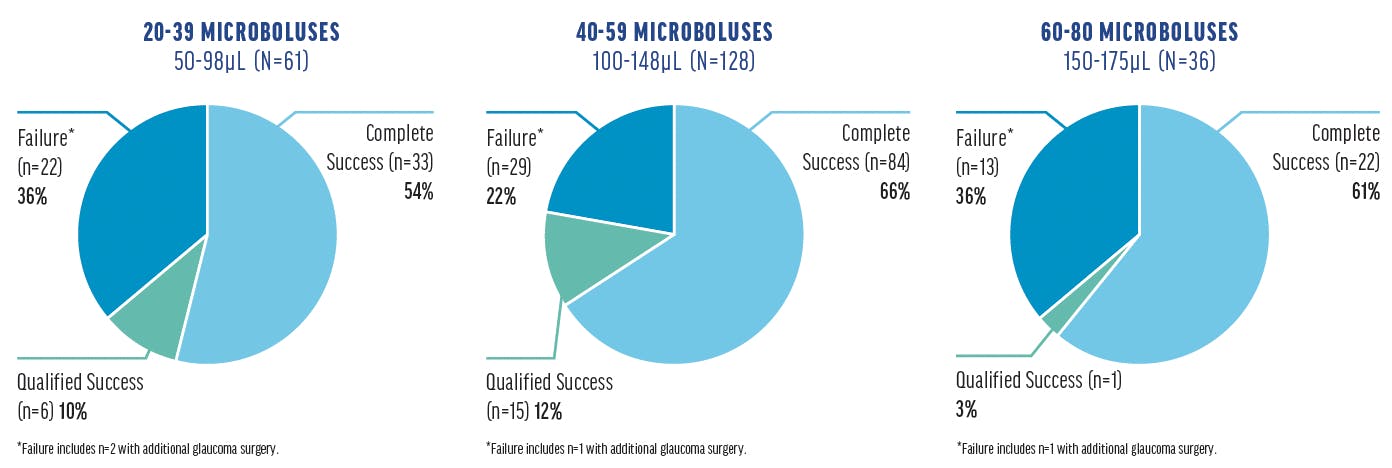
Figure 1. Rates of complete success, qualified success, and failure according to OVD volume used during canaloplasty from the iTrack Global Data Registry. Complete success was defined as postoperative IOP less than 18 mm Hg and zero medications; qualified success was postoperative IOP less than or equal to 18 mm Hg and 1 or more medication; and failure was a postoperative IOP over 18 mm Hg.
Dr. Bedrood: I’m curious to know what OVD everyone uses to maintain chamber stability and in the actual device?
Dr. Arosemena: I am in a private-practice setting, where cost is really important, so my answer is that I fill the chamber with whatever viscoelastic is left over from the cataract surgery. However, when I am teaching new surgeons, I prefer to fill the chamber with Healon5 (Johnson & Johnson Vision), as that gives the best visibility and control.
Dr. Kamat: I use Healon GV for all my MIGS. In the iTrack™ Advance itself, I use Healon Pro (Johnson& Johnson Vision).
Dr. Qiu: I use Healon Pro in the microcatheter and Healon Pro in the anterior chamber if it’s a standalone case, or Healon5 if it’s combined with phacoemulsification.
Dr. Camejo: I use ProVisc (Alcon Laboratories) for all of it.
Considerations for Patient Selection
Dr. Bedrood: A great aspect of canaloplasty with the iTrack™ Advance is that it can be used at almost any point in a patient’s disease trajectory. It really is suitable for all severities of open-angle glaucoma, but it is ideally suited to mild to moderate cases. iTrack™ Advance can be used in a variety of glaucoma types, including normal-tension glaucoma, pigmentary glaucoma, and pseudoexfoliation glaucoma. And, it can be performed as a standalone procedure or concurrently with cataract surgery in any of those settings. I tend to combine canaloplasty and phacoemulsification in my practice, because I think of canaloplasty as an opportunity to help the patient reduce their IOP a few additional points, potentially reduce their medication burden, and to revive the eye’s anatomy while sparing the function of the TM tissue.
Dr. Arosemena: It is reassuring to have a device that can be used for almost any glaucoma severity in a standalone setting that is also covered by insurance.
Dr. Kamat: I agree. One of the key components of the iTrack™ Advance is its versatility—I can use it in all stages of disease and with and without cataract surgery. I will often pair it with goniotomy for my more advanced patients, but I like that I can offer tissue sparing surgery to my milder patients with great IOP lowering results. I have also done standalone canaloplasty in phakic patients that either want to achieve more drop independence or need further IOP lowering and do not want to add additional medications. I have seen great results in this setting as well. I find these features make iTrack™ Advance usable in almost any patient with open-angle disease.
Dr. Camejo: Canaloplasty is a great option for the standalone setting. It’s great to tell the patient that you have a procedure that leaves the tissue intact and which is associated with a fast recovery.
Dr. Simpson: Dr. Camejo brings up a great point about leaving the TM tissue intact. MIGS is supposed to be minimally invasive, and so this procedure is truly the definition of MIGS.
Dr. Funke: Sparing ocular tissue becomes even more important as you follow a patient over time. I am starting to see patients in my own practice in whom I did a prior canaloplasty who now need a second MIGS procedure, and I am really happy that I have so much anatomy left to perform a next step.
BLANCHING OF THE EPISCLERAL VENOUS SYSTEM
A noteworthy aspect of the iTrack™ Advance is the real-time blanching of the episcleral venous system, observed during the procedure. This acts as a visual cue, demonstrating the improvement in outflow facility through the trabecular meshwork, Schlemm canal, and the collector channels. Importantly, this blanching effect is observed prior to I&A.
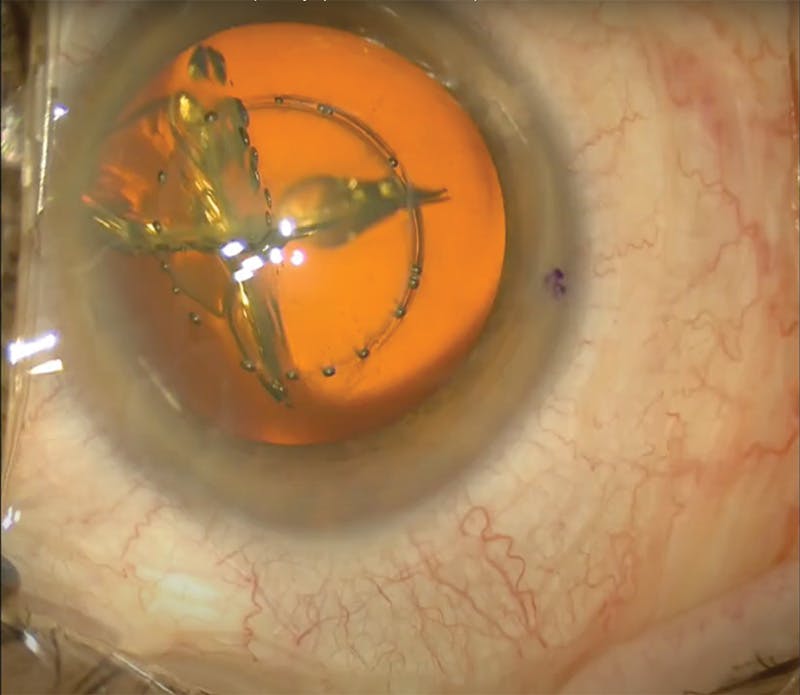
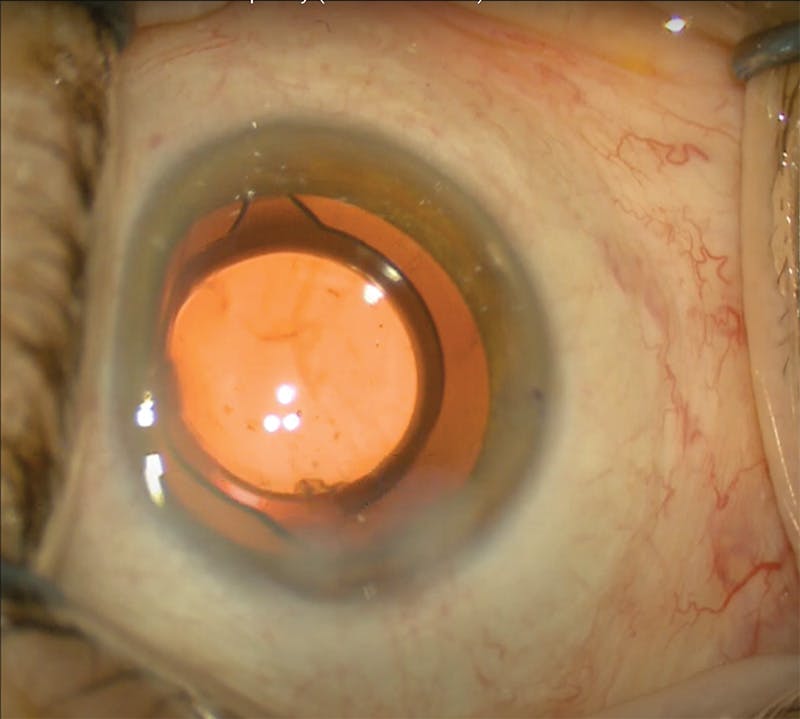
To view the entire surgery, click here. Images and video courtesy of Sahar Bedrood, MD, PhD.
Dr. Bedrood: Another great thing about canaloplasty is that it really is suitable for early intervention. Instead of escalating the patient to a second or third drop, you may actually consider this as an early surgical intervention, so that you can get something working on the anatomy and maybe still keep the patient on the minimum drops they need before you escalate to incisional surgery.
Dr. Camejo: There are always going to be patients who won’t tolerate any drops, or don’t want to use them. Canaloplasty is a great option in this setting. Canaloplasty might also be preferable over goniotomy in patients with early glaucoma stages when combining surgery with premium lenses and you want a faster recovery.
Dr. Qiu: I especially like canaloplasty for pseudophakic patients, because it’s so safe and minimally invasive. I would think twice about doing a standalone canaloplasty in a phakic patient that is going to be left phakic, but if the patient is already pseudophakic, it’s very straightforward to make a small paracentesis, enter the canal, flush everything out, and get out. In my opinion, canaloplasty with the iTrack™ Advance is the least invasive MIGS we can possibly do, which is why it’s now become my new favorite form of MIGS.
1. Khaimi MA, Dvorak JD, Ding K. An Analysis of 3-year outcomes following canaloplasty for the treatment of open-angle glaucoma. J Ophthalmol. 2017;2017:2904272.
2. Goel M, Picciani RG, Lee RK, Bhattacharya SK. Aqueous humor dynamics: a review. Open Ophthalmol J. 2010;4:52-59.
3. Johnstone MA, Grant WG. Pressure-dependent changes in structures of the aqueous outflow system of human and monkey eyes. Am J Ophthalmol. 1973;75:365-383.
4. Allingham RR, de Kater AW, Ethier CR. Schlemm’s canal and primary open angle glaucoma: correlation between Schlemm’s canal dimensions and outflow facility. Exp Eye Res. 1996;62(1):101-109.
5. Cha EDK, Xu J, Gong H. Variations in active areas of aqueous humor outflow through the trabecular outflow pathway. Invest Ophthalmol Vis Sci. 2015;56(7):4850.
6. Grant WM. Experimental aqueous perfusion in enucleated human eyes. Arch Ophthalmol. 1963;69:783-801.
7. Entwistle J, Hall CL, Turley EA. HA receptors: regulators of signaling to the cytoskeleton. J Cell Biochem. 1996;61(4):569-577.
8. Umihira J, Nagata S, Nohara M, et al. Localization of elastin in the normal and glaucomatous human trabecular meshwork. Invest Ophthalmol Vis Sci. 1994;35(2):486-494.
9. Green KA, Yue BY, Samples JR, Knepper PA. Glaucoma Research and Clinical Advances: 2016-2018. In: Knepper PA, Samples JR, eds. Trabecular meshwork cell death in primary open-angle glaucoma. Amsterdam, the Netherlands: Kugler Publications. 2016:1-16.
10. Knepper PA, Goossens W, Hvizd M, Palmberg PF. Glycosaminoglycans of the human trabecular meshwork in primary open-angle glaucoma. Invest Ophthalmol Vis Sci. 1996;37(7):1360-1367.
11. Alvarado J, Murphy C, Juster R. Trabecular meshwork cellularity in primary open-angle glaucoma and nonglaucomatous normals. Ophthalmology. 1984;91:564-579.
12. Alvarado J, Murphy C, Polansky J, Juster R. Age-related changes in trabecular meshwork cellularity. Invest Ophthalmol Vis Sci. 1981;21:714-727.
13. Grierson I, Howes RC. Age-related depletion of the cell population in the human trabecular meshwork. Eye (Lond). 1987;1:204-210.
14. Data on file. Nova Eye Inc.
The iTrack™ Advance has a CE Mark (Conformité Européenne) and US Food and Drug Administration (FDA) 510(k) # K221872 for the treatment of open-angle glaucoma.
The iTrack™ Advance is indicated for fluid infusion or aspiration during surgery. The iTrack™ Advance is indicated for the cutting or disruption of the trabecular meshwork during goniotomy procedures.* The iTrack™ Advance is indicated for catheterization and viscodilation of Schlemm’s canal to reduce intraocular pressure in adult patients with open-angle glaucoma.
* The iTrack™ Advance cutting function (goniotomy) is a Class 1 510(k) exempt device function that is not specifically indicated for the reduction of intraocular pressure (IOP) or the treatment of open-angle glaucoma.
For additional information about clearances and indications for use, please visit: iTrack-Advance.com
Opinions expressed are solely of the surgeon(s) involved and do not express the views or opinions of Nova Eye Medical. Not all clearances apply to all regions.