At a symposium during the American Glaucoma Society 2025 annual meeting, experts convened to have a cultural and scientific discussion about the treatment of glaucoma in an interventional era. During the symposium, the panelists sought to answer a question of how we can empower ourselves to improve the care of our patients: Will we wait, or act?
CURRENT TRENDS IN GLAUCOMA SURGERY
A recently published report offers a comprehensive analysis of the current global market for glaucoma devices, including important trends, upcoming products, and other key factors.1
Market dynamics suggest that the incidence of primary open-angle glaucoma will increase by 2% over the next 5 years, and that surgical procedures are expected to grow by 8% in the same time period.1 However, in recent years, the data have shown a flattening in the use of MIGS procedures.
Insurance and Reimbursements
One factor that could hinder the growth of the adoption of MIGS procedures is a lack of insurance coverage for patients. In some instances, physicians’ hands are tied in terms of what can be offered in real-world practice even though there may be several suitable options for the given patient.
Reimbursement rates could also be a factor in stagnant MIGS growth, as some physicians may base their treatment recommendations on reimbursements if they believe they can achieve similar efficacy and safety with more traditional approaches. In those cases, we recommend physicians look at the science and allow clinical data to drive treatment decisions in the direction of what has longevity, better response rates, reductions in topical medications, etc.
Physician Preferences
A substantial number of surgeons have embraced MIGS and interventional glaucoma. For this group, it’s not a matter of if they will perform MIGS, but which MIGS procedure to perform to achieve the best outcome.
However, it has been a challenge for many comprehensive surgeons to adopt a more interventional approach. Glaucoma specialists must address this gap between science, efficacy, and adoption to assess how to best support the wider surgical community in understanding the value of an early interventional approach. To this end, glaucoma specialists must simplify the treatment algorithm in a way that is evidence-based, accessible, understandable, and trusted by the greater population of eye care physicians to usher in a new era of interventional treatment.
THE PATIENT JOURNEY AND THE ZONE OF UNMET CLINICAL NEED
We often describe a glaucoma diagnosis as the beginning of a treatment journey for patients (Figure). We start patients with first-line therapy and progress to additional options as needed. There is no one-size-fits-all approach, but glaucoma physicians must consider thoughtful, evidence-based intervention on every step of the journey.
For patients who have cataracts and glaucoma, it has become common to consider performing combination cataract surgery and MIGS as the evidence has accumulated in support of this approach. However, an area of unmet clinical need is emerging—and growing—as we diagnose glaucoma at younger ages, patients live longer, and the population of pseudophakic patients with primary open-angle glaucoma continues to expand (Figure).
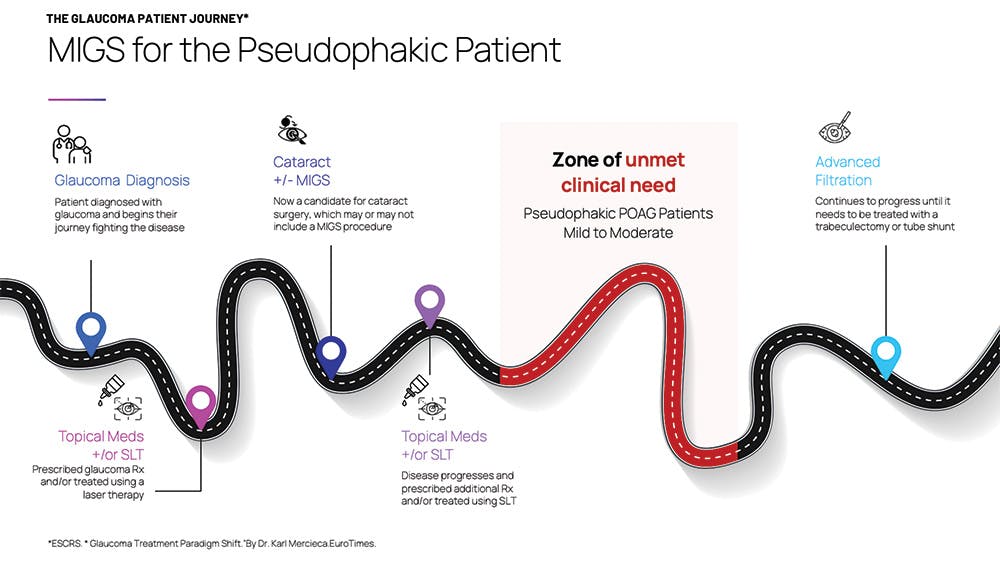
Figure. Interventional glaucoma leads patients on the treatment journey, addressing unmet clinical needs as they arise.
Why Do We Intervene?
When we think about early intervention, we must consider the lifetime of a patient, the progression rate of the disease, and the impact we can have on disease outcomes in the short and long terms.
The earlier the intervention, the more we can preserve or augment a patient’s natural anatomy and hopefully avoid major glaucoma procedures in the future. If we delay treatments until later in the disease state, when patients may have tissue sclerosis or fibrosis, treatment may not be as effective.2
Improving Quality of Life
Data show that nearly 50% of glaucoma patients stop taking their medication after 6 months.3 The reasons for this are multifactorial, including undesirable side effects, forgetfulness, cost, and complexity of the regimen. Because lasers, drug delivery, and MIGS procedures may reduce or eliminate drop burden, early intervention provides an opportunity to take ownership of the disease into glaucoma practitioners' hands instead of relying on patients’ adherence.
Outside of the drop burden, visual field loss can have a substantial impact on a patient’s quality of life, including driving, reading speed, risk of falling, physical activity, and more. This challenge increases as contrast sensitivity is reduced even in cases of mild glaucoma. If glaucoma physicians can reduce this progression and structural loss, they may help reduce the loss of quality of life for their patients.2
THE SIGHT SCIENCES STORY
The mission of Sight Sciences is to develop transformative interventional technologies that allow eye care providers and surgeons to elevate the standard of care. Sight Sciences’ commitment is to build a diverse portfolio of interventional technologies to address the unmet needs in the glaucoma patient’s journey. Technology innovation is at the core, but innovation does not become transformational until it is activated and adopted. That happens in clinicians’ hands.
More than $100 million has been invested by the company in technology innovation, and more than $75 million* is committed over the next 5 years to continue to drive innovation in glaucoma and ocular surface treatments. This does not and cannot happen in a vacuum—it happens in partnership with eye care practitioners who can best identify unmet patient needs and how to fulfill them.
The focus is to give surgeons the tools and put the power in their hands to reduce patients’ medication burdens while optimizing care and outcomes. It is not just about the technology. It is about training, education, and changing the mindset.
“*The investment amounts provided herein represent our current estimates based on our current capital allocation plans and strategies, and other factors we believe are appropriate. The actual amount of our investments are subject to change and may ultimately differ materially from those estimated herein due to a variety of factors.”
TECHNOLOGY AND WORKFLOW
Consider the reality of how to employ interventional approaches into practice workflow, which affects how we educate, schedule, manage expectations, and identify patients. Thus, shifting one’s mindset first means overcoming operational challenges in order to set patients up for success.
A Team Approach
A tremendous opportunity exists to educate primary eye care providers about the benefits of early intervention, especially because optometrists are often the first point of contact for mild-to-moderate glaucoma patients. Empowering the community of optometrists to educate patients about interventional glaucoma can support the shift of one’s practice to a more proactive approach to glaucoma management. Streamlining and simplifying the treatment algorithm and standard of care across the whole community creates a more efficient patient discussion.
1. Market Scope. 2024 Glaucoma Surgical Device Market Report: Global Analysis for 2023 to 2029, August, 2024. Available at: https://www.market-scope.com/pages/reports/456/2024-glaucoma-surgical-device-market-report-global-analysis-for-2023-to-2029-august-2024.
2. Ahmed IA, Vendal Z, Funke C, Brown R. Will you wait or act? The crucial choice in combating glaucoma with interventional treatment. Presented at American Glaucoma Society; March 1, 2025; Washington, D.C.
3. Nordstrom BL, Friedman DS, Mozaffari E, et al. Persistence and adherence with topical glaucoma therapy. Am J Ophthalmol. 2005;140(4):598.e1-598.e11.
OMNI Surgical System: Important Product Information
INDICATIONS FOR USE
The OMNI® Surgical System is indicated for canaloplasty (microcatheterization and transluminal viscodilationof Schlemm’s canal) followed by trabeculotomy (cutting of trabecular meshwork) to reduce intraocular pressure in adult patients with primary open-angle glaucoma.
CONTRAINDICATIONS
• Do not use the OMNI in any situations where the iridocorneal angle is compromised or has been damaged (e.g., from trauma or surgery), since it may not be possible to visualize the angle or to properly pass the microcatheter.
• Do not use the OMNI in patients with angle recession; neovascular glaucoma; chronic angle closure; narrow-angle glaucoma; traumatic or malignant glaucoma; or narrow inlet canals with plateau iris.
• Do not use the OMNI Surgical System in quadrants with previous MIGS implants.
Please refer to the full Instructions For Use, available at omnisurgical.com, for warnings, precautions, and adverse event information.
Drs. Ahmed, Brown, Funke, and Vendal are paid consultants of Sight Sciences. Dr. Brown is Chief Medical Offer of Sight Sciences.
© 2025 Sight Sciences, Inc. Sight Sciences, the Sight Sciences logo, OMNI, and SION are registered trademarks of Sight Sciences.
06/25 SS-3425-US.v2