Glaucoma diagnosis and management continue to evolve as clinicians strive to better connect structural and functional data to detect disease earlier and monitor progression more precisely. Compared to other optic neuropathies, glaucoma is often asymptomatic in its early stages and can progress silently until it is caught during advanced stages. Therefore, it is essential to detect both structural and functional changes as early as possible to preserve vision.
In an educational webinar, Sarah Van Tassel, MD, and Anupam Laul, OD, FAAO, led an interactive discussion on how integrating optical coherence tomography (OCT) with visual field testing—particularly Humphrey Field Analyzer interpretation—can improve decision-making across all stages of disease. The session emphasized bridging structure and function in daily practice, from initial diagnosis through surgical planning for advanced cases.
Early Disease: Optical Coherence Tomography, the Macular Vulnerability Zone, and Paracentral Risk
Structural change may predate field loss. | Anupam Laul, OD, FAAO, DIPL. ABO
Glaucoma is an optic neuropathy characterized by progressive structural damage to retinal ganglion cells (RGCs) and their axons, leading to optic nerve head and retinal nerve fiber layer (RNFL) thinning. These changes are often accompanied by functional loss of vision (measured as visual field defects).
In clinical practice, diagnosing and monitoring glaucoma typically involves imaging tests (eg, OCT) to assess structural integrity of the optic nerve, and perimetry tests such as standard automated perimetry (SAP) to measure functional vision. Since glaucoma typically affects temporal nerve fiber bundles, when analyzing OCT data, it is helpful to rearrange the TSNIT curve to the NSTIN curve. This will allow the more vulnerable regions to be displayed centrally and allow you to detect loss in the superior and inferior vulnerability zones. This can be particularly helpful in identifying disease progression. Furthermore, it is important to review structure–function maps, specifically the superior/inferior vulnerability zones and macular vulnerability zone (MVZ), which link RNFL sectors to 24-2 visual field points. The inferior vulnerability zone is where most glaucomatous loss is seen in the average population.
Structural damage, such as optic disc cupping and RNFL thinning, ultimately underlies the visual field loss that patients experience. However, by the time a standard visual field test first shows an abnormality, a substantial proportion of RGCs may already be lost. Estimates suggest 25% to 35% of RGCs can be damaged before functional deficits are detectable on perimetry,1 highlighting that structural loss often precedes measurable functional loss in early glaucoma.
Structural and functional damage in glaucoma do not always progress in unison. Long-term studies have demonstrated that it is rare for an eye to exhibit detectable structural worsening and functional worsening at the same visit. In a recent 5-year prospective study of open-angle glaucoma patients, investigators found that OCT-based structural tests and visual field tests signaled progression at the same time in only about 5% to 16% of eyes.2
The contrasting behavior of structural and functional glaucoma indicators means that clinicians must utilize both for optimal care. A key principle is not to wait for all tests to “agree” if a trusted test reveals disease progression. It can sometimes take months or years for detectable progression to be seen on the other test; it should prompt intervention even if another modality has not changed yet and there is a strong suspicion of glaucomatous disease progression. Use every tool at your disposal, both structural and functional, and your clinical insights to safeguard the patient’s sight.
Case-Based Discussion: Early Disease
Case No. 1 (Anupam Laul, OD, FAAO, DIPL. ABO)
The importance of structure-function relationships in assessing glaucoma and tracking its progression is exemplified in the case of a 72-year-old woman referred to my clinic.
- Maximum IOP (Tmax): 27 mm Hg OD, 26 mm Hg OS
- Central corneal thickness (CCT): 525 µm OD, 530 µm OS
- Cup-to-disc ratio: 0.7 OD, 0.8 OS
- Relevant family history: maternal glaucoma
The patient’s longitudinal OCT trends demonstrated RNFL loss OU, which was more pronounced OD (Figure 1). The average RNFL change OD was around -1.43 µm/year. However, inferiorly, the patient’s rate of change OD was around -3.00 µm/year, which is a fast rate of change per year. The patient’s Humphrey Field Analyzer (HFA) 24-2 visual field data looked surprisingly stable when compared to OCT longitudinal data (Figure 2).
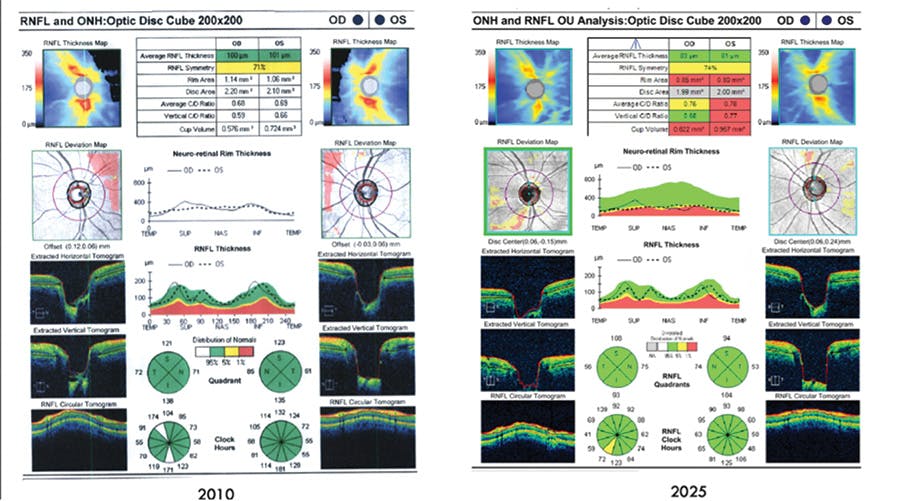
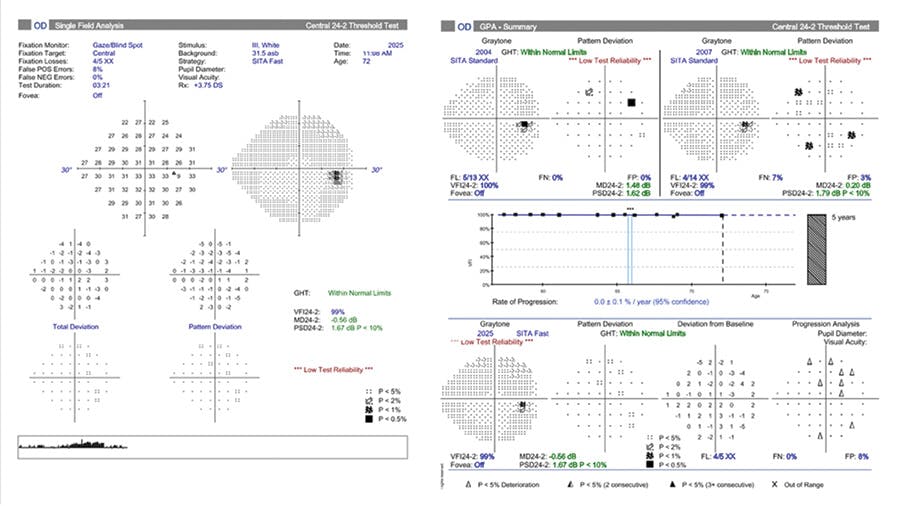
Figure 2. The patient’s visual field data from 2025 (left) versus longitudinal data from 2004 to 2025 (right, top).
When it comes to early glaucoma, it is important to collect OCT imaging in addition to visual field tests to detect changes in disease. As seen in this mild/early glaucoma case, there can be optic nerve abnormalities consistent with glaucoma, but no abnormalities on the visual field test.
Additionally, I believe it to be fundamental to always run a macular ganglion cell analysis scan on every patient, as this is critical for corroborating any MVZ-driven paracentral defects and ruling out other disease processes. In this patient case, a scan demonstrated the formation of an inferior RNFL notch and ganglion cell wiper defect that had been developing over time (Figure 3). Based on the progression demonstrated on imaging, the patient was referred for selective laser trabeculoplasty.
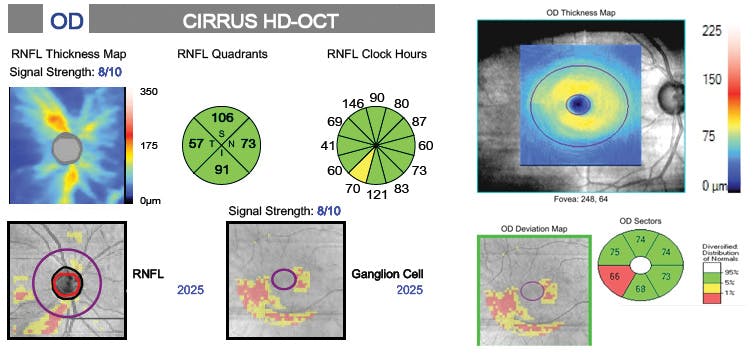
Figure 3. Macular ganglion cell analysis scan demonstrated an inferior wiper defect that corresponds to the progressive inferior RNFL thinning OD.
This case illustrated that structural loss can precede measurable functional loss and should prompt intervention even when the HFA 24-2 data appear stable.
Case-Based Discussion: Severe Disease
Case No. 2 (Sarah Van Tassel, MD)
My first case involves a 64-year-old woman who had been followed for many years with annual eye exams. She was referred to my clinic following a diagnosis of optic disc hemorrhage.
- Patient had a long-standing non-mobile central “spot/floater”
- A HFA 24-2 test demonstrated subtle paracentral abnormalities (Figure 4) that were confirmed to be a fixation-threatening superior arcuate defect on 10-2 testing (not shown)
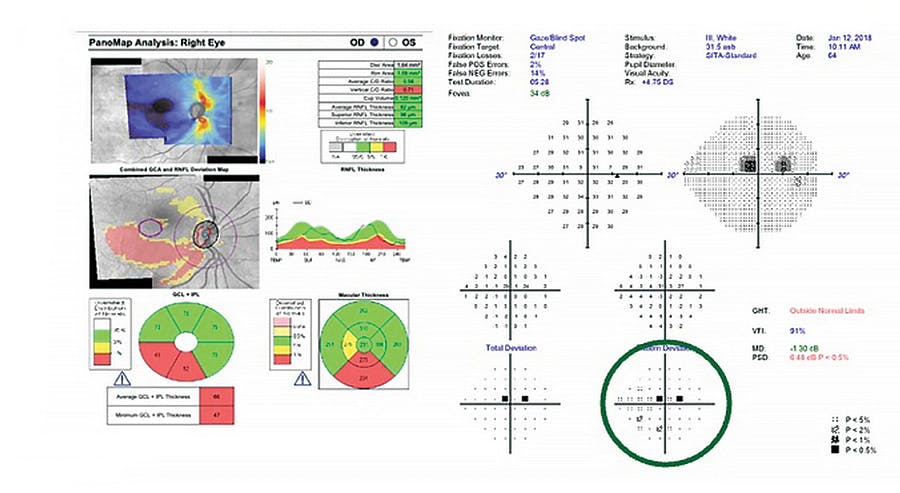
Figure 4. PanoMap of the patient’s right eye (left) showed ganglion cell loss, which correlated with visual field testing (right) that demonstrated a superior paracentral arcuate defect.
Based on these results, I believe this patient had been symptomatic of her glaucoma for quite some time and that what she had described as a floater was an area of paracentral visual field loss. Staging glaucoma correctly at the time of diagnosis is important for offering prognostic information, and it also affects decision-making with regard to the most suitable intervention.
This case is an important reminder to not rely solely on the grayscale map on the single field analysis, which is primarily to be used for patient education. Small paracentral field defects can look insignificant on the grayscale map but prove to be severe, fixation-threatening defects when better characterized with a 10-2 study. This patient elected for treatment with latanoprost after discussing multiple options, and she has been very stable for nearly a decade.
Case No. 3 (Sarah Van Tassel, MD)
My second case features a 67-year-old woman who has been followed in my practice for her glaucoma for over a decade.
- History of loss to follow-up (most recently for ~ 1 year)
- Typical IOP: ~ 14 mm Hg on latanoprost (~30% reduction from Tmax)
- History of unreliable visual field results (high false positives)
In a patient with unreliable field results, it is vital to closely review OCT RNFL and ganglion cell layer (GCL) data. In this patient’s case, results demonstrated she was experiencing the “floor effect” in the RNFL—the point at which the RNFL has thinned so much that further thinning can no longer be accurately detected by OCT—of the superior and inferior poles of the optic nerve head (Figure 5; left).
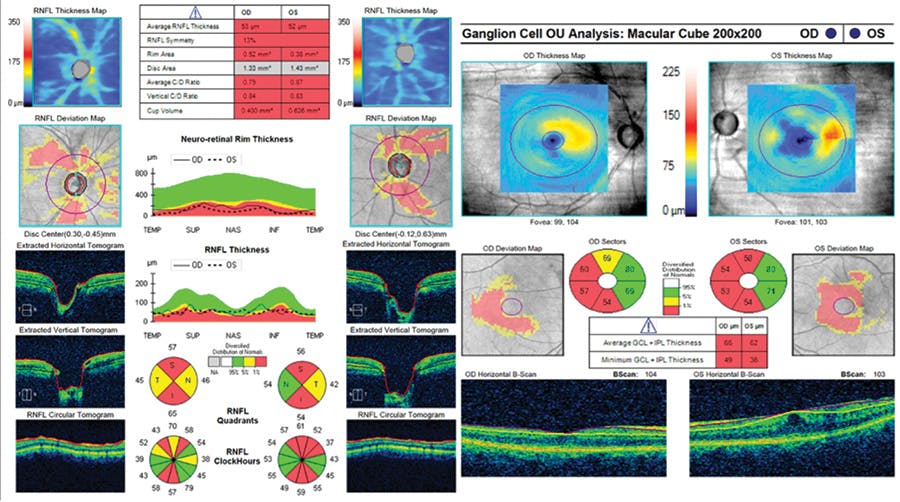
Figure 5. Patient’s RNFL in the right eye has reached the floor, but the right eye GCL continues to have meaningful thickness to follow for evidence of progression.
Despite the floor effect, there was a sufficient GCL for continued monitoring in the right eye; indeed, the GCL in the right eye showed disease progression. However, the patient’s left eye was more complicated. GCL data are still useful in the presence of some subretinal or outer retinal pathology, but epiretinal membranes and intraretinal changes can eliminate the possibility of using GCL data for meaningful information. Unfortunately for this patient, data from the left eye showed the formation of an epiretinal membrane and a perifoveal cyst.
I proceeded with a phaco-trabeculectomy for this patient in both eyes. I opted for trabeculectomy to definitively lower this patient’s IOP given the history of poor adherence to follow-up and the need for an IOP target within the low teens.
This case is an example of OCT data (in the right eye) providing helpful information in a patient with advanced disease—perhaps the most helpful information for making a treatment decision because her visual field results were not reliable.
Advanced Glaucoma: The Role of OCT for Guiding Decision-Making
Paracentral, fixation-threatening defects demand timely action. | By Sarah Van Tassel, MD
In severe glaucoma cases, OCT is still invaluable for glaucoma diagnosis and monitoring disease progression. In Case 2 and 3 above, I demonstrated the structure-function relationship in severe glaucoma.
Conclusion
Glaucoma care benefits when structural imaging and functional testing are interpreted together at every stage of disease. The cases highlighted in this webinar showed how structural damage may precede, mirror, or outpace traditional SAP visual field findings, and how paracentral, fixation-threatening defects can emerge even when earlier results seem subtle. Because structural and functional indicators do not consistently progress in tandem, the panel emphasized a practical approach: act on trustworthy evidence of change rather than waiting for perfect concordance when glaucoma or glaucoma progression are highly suspected. In early disease, careful attention to OCT can facilitate detection of glaucomatous progression before obvious field loss; in some cases of advanced disease, OCT may provide the most dependable information when fields are unreliable. Lastly, don’t forget comorbid findings, such as epiretinal membrane, traction, posterior vitreous detachment (PVD), etc., when interpreting OCT results. Applied consistently, this integrated analysis of OCT and HFA data supports timely decisions that prioritize vision preservation.
1. Sakata R, Araie M, Yoshitomi T; for lower normal pressure glaucoma study members in Japan Glaucoma Society. Factors associated with visual field or structure progression occurring first in a prospective study on patients with untreated open-angle glaucoma with normal intraocular pressure. Eye (Lond). 2024;38(4):737-744.
2. Manik D, Ratanawongphaibul K, Kim J, et al. Frequency of agreement between structural and functional glaucoma testing: a longitudinal study of 3D OCT and current clinical tests. Am J Ophthalmol. 2024;266:196-205.
The statements of the speakers reflect only their personal opinions and experiences and do not necessarily reflect the opinion of any institution that they are affiliated with. The speakers alone are responsible for the content of their experience reported and any potential resulting infringements. Carl Zeiss Meditec AG and its affiliates do not have clinical evidence supporting the opinions and statements of the speakers nor accept any responsibility or liability of the speakers' content.