Click here to watch the event on Eyetube

The conversation surrounding interventional glaucoma has matured over the past decade, with ophthalmic surgeons focusing less on whether to use a procedural strategy and more on when to intervene, how to combine modalities, and which patients are most likely to benefit from a particular approach.
Those themes dominated the discussion during the second annual MIGS Unplugged Live at ASCRS 2026. Moderated by Iqbal Ike K. Ahmed, MD, FRCSC, and Arsham Sheybani, MD, and featuring panelists Sahar Bedrood, MD, PhD, and I. Paul Singh, MD, the open-forum discussion touched on a broad range of topics, including the emergence of sustained drug delivery, the appearance of blanching, procedural sequencing, and promising new subconjunctival procedures (Figure 1). While opinions differed on technique, there was broad agreement that interventional glaucoma is becoming increasingly individualized, with surgeons leveraging complementary technologies rather than relying on any single procedure.
The Patient Journey and the Interventional Mindset
One of the recurring messages from the panel was that glaucoma management should no longer be viewed as a sequential algorithm starting with drops and culminating in surgery only after medical therapy fails. Instead, procedural intervention is becoming part of a continuum of care that evolves throughout a patient’s disease course. Because of the many options available for use—ranging from lasers to drug delivery to surgeries—procedures are viable as a first-line option, with patients subsequently receiving additional interventions as the need arises. As Dr. Sheybani reminded the audience, “This is not like a one-and-done type of thing that we’re dealing with.”
Acknowledging that patients are likely to need multiple interventions over the course of their treatment journey, and preparing them for that eventuality from the onset, fundamentally changes clinical decision-making. Rather than asking whether a patient needs medications or MIGS, for instance, surgeons can increasingly consider how lasers, sustained drug delivery, canaloplasty, trabecular procedures, and subconjunctival surgery can be sequenced over time to reduce the treatment burden.

Figure 1. Drs. Ahmed (far left) and Sheybani (far right) moderated the panel that also included Drs. Bedrood and Singh.
The Impact of Drug Delivery Devices
Drug delivery has become an important component of the glaucoma management continuum. Panelists described using sustained-release therapies not simply as medication replacements, but as procedural adjuncts that increase confidence that patients will achieve relief from their medication burden.
“Sometimes you do a MIGS procedure, and you don’t know how many drops you’re going to get them off of. But [with a drug delivery device] I know for a fact we’ll get them off at least that one,” Dr. Bedrood said.
During the program, Dr. Bedrood presented a case in which she used her preferred combination of canaloplasty with iTrack (Nova Eye Medical) and iDose (Glaukos) implantation, with canaloplasty performed first to minimize reflux and maintain chamber stability, followed by placement of the sustained-release implant. She explained that combining various modalities during a single intervention has the obvious benefit of achieving additive IOP reduction, but more so, the use of two or more interventions that target different parts of the aqueous drainage pathway maximizes biologic benefit while outflow tissue remains capable of remodeling.
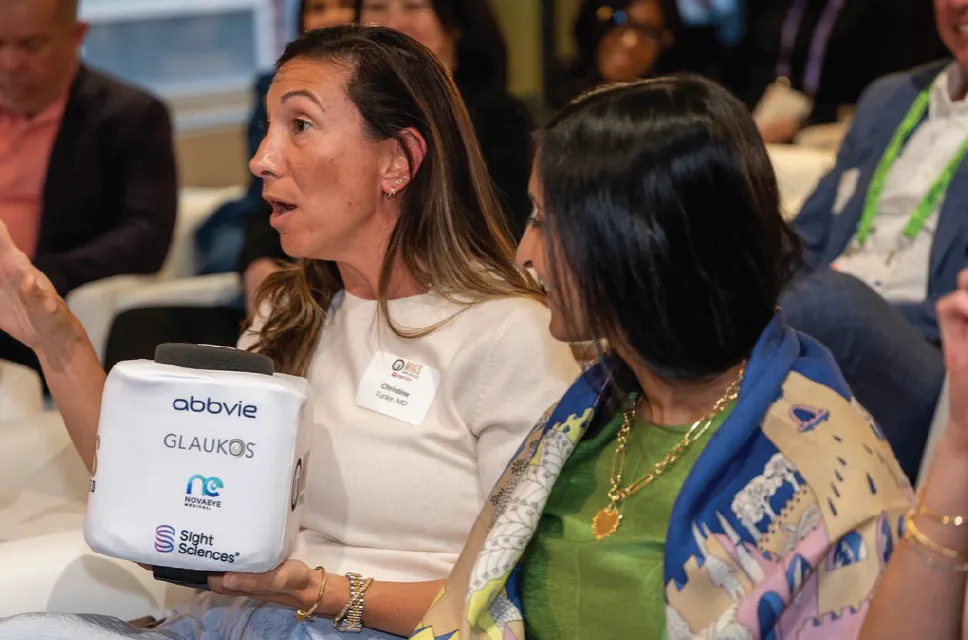
Christine Funke, MD, echoed this sentiment from the audience, pointing out that the optimal timing for combined procedures is in early disease, rather than in advanced disease as some may suspect (Figure 2). Although it may not be apparent as a measurable surgical outcome, addressing multiple parts of the drainage pathway with multiple mechanisms of action may achieve tissue remodeling that yields better long-term disease stability. Such a paradigm seems to meld with a broader evolution in glaucoma management: intervening proactively while conventional pathways remain responsive rather than waiting for progressive structural dysfunction.
“If we’re doing, say, canaloplasty in conjunction with doing a drug deliverable, we know that those drug deliverables for whatever reason keep working for some people even when the drug is gone. So, I think pathophysiologically, we’re doing something there, and then mix that with what you’re doing pathophysiologically with the canaloplasty. … The more I can do to heal tissue early, the better,” Dr. Funke said.
Another key aspect of having drug delivery devices available is that they increase confidence in performing standalone procedures. The panel noted that having both Durysta (AbbVie) and iDose available has expanded treatment options rather than replacing one another.
“I think when you talk about standalone, I think some of the fear that a lot of us have, honestly, is that if I go in for surgery just for that standalone with stenting, canaloplasty, goniotomy, whatever it is, is it going to get me to what my goals are?” Dr. Singh said. “It's helped me feel more comfortable going into surgery, because I know I have that drug delivery there.”
Minimally Invasive Bleb-Based Surgeries (MIBS): More Than an Alternate to Trabeculectomy
The panel concluded by examining newer subconjunctival procedures, including PreserFlo MicroShunt (Glaukos/Santen) and AquaLumen (PLU Ophthalmic), which many participants viewed as expanding the therapeutic window between traditional MIGS and trabeculectomy.
“A lot of us push MIGS, like GATT even, [for] those really difficult patients that we don’t want to do a trab for, but I think these newer MIBS procedures allow us to go to them earlier,” Dr. Ahmed said.
Speaking from the audience, Ticiana De Francesco, MD, described how newer bleb-forming procedures have altered her treatment algorithm (Figure 3). When caring for a patient with uncontrolled glaucoma on three medications, for instance, she said she would ideally move to MIBS rather than introduce an additional drop—something she would not consider if trabeculectomy was the only other option.
“Instead of going for the fourth medication ... I already go for a bleb-based procedure,” she said. “Because I feel that the outcomes are more predictable ... I feel confident already moving to a bleb-based procedure.”
Dr. Singh also demonstrated the AquaLumen technique, describing it as a method of creating a subconjunctival drainage pathway without leaving a permanent implant.

Figure 3. According to Dr. De Francesco, the predictability associated with newer minimally invasive bleb-based procedures makes them viable earlier in the treatment paradigm relative to trabs and tubes.
Conclusion
The overarching takeaway from the discussion was that interventional glaucoma is becoming less about selecting the “best” procedure and more about constructing the right procedural sequence for each patient. The expanding procedural options are, collectively, advancing and expanding the interventional glaucoma toolbox. The emergence of multiple drug delivery devices is increasing confidence in standalone MIGS. Canaloplasty preserves future treatment options while restoring physiologic outflow. Trabecular meshwork-stripping procedures remain valuable for appropriately selected eyes, while newer bleb-forming technologies may justify earlier intervention in patients requiring lower target pressures.