Sponsored by Sight Sciences
Avneet K Sodhi Gaur, MD
I am Managing Partner and the Director of Glaucoma Services at a multispecialty glaucoma, cataract, and LASIK practice that has been deeply rooted in the heart of Los Angeles since 1949. We offer a full range of glaucoma procedures, including traditional incisional surgeries (trabeculectomies and tubes), a variety of MIGS, and lasers such as SLT and LPI. In 2018, we decided to add the OMNI® Surgical System (Sight Sciences, Inc.) after it was FDA cleared. We made that decision because it is the only MIGS procedure that allows the surgeon to tailor canaloplasty and goniotomy treatment in adult patients with POAG across the spectrum of disease severity.
In short, it is the ideal MIGS that lets me customize the treatment for each eye.
PATIENT SELECTION FOR OMNI PROCEDURES
In my view, OMNI is a consideration across the spectrum of primary open-angle glaucoma as long as there is a good view of the trabecular meshwork and no compromise of the angle structure such as neovascularization. In combination cases, when OMNI is performed at the time with cataract surgery, the patient benefits from two mechanisms for intraocular pressure lowering (IOP): drainage pathways tend to open after a cataract is removed, and then I use the OMNI to reinstate more flow and salvage the aqueous drainage pathways and collector channels (Figure 1).
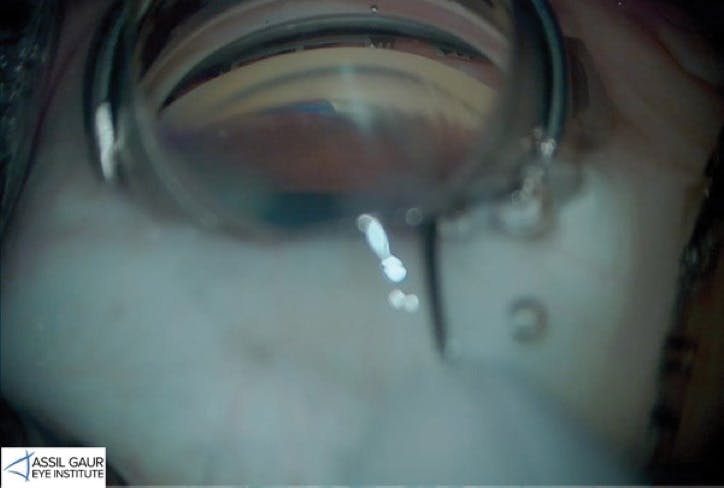
Figure 1. A patient with moderate primary open-angle glaucoma who was on 3 medications presented with a visually significant cataract. She underwent cataract surgery and a 360º viscocanaloplasty with 180º goniotomy using the OMNI surgical device. She was able to achieve 20/20 vision with the implantation of a toric IOL, and she eliminated all three of her glaucoma medications. (Image courtesy of Avneet K. Sodhi Gaur, MD)
However, lens status is not necessarily a deciding factor anymore, as recent studies have demonstrated equivalent outcomes in standalone cases compared to combination cases.1,2 Those data effectively open the indications to a wider patient population, including pseudophakic patients and younger patients who are not yet eligible for cataract surgery. Equally as important, it makes OMNI a more attractive option for the anterior segment surgeon to add to his or her surgical toolkit.
EDUCATING OPTOMETRIST PARTNERS ABOUT MIGS PROCEDURES
PERSONAL TOUCH

We believe that outreach to our referring optometry network about MIGS is best handled with the personal touch. We take time to discuss the outcomes we achieve in the clinic, which are similar to what was reported in published studies.1,2 However, the real thrust of these efforts is to listen and answer questions. One thing we learned through this process is that a lot of optometrists still believe that MIGS can only be performed at the time of cataract surgery for patients who are not controlled in their primary open-angle glaucoma, even though data have been published on OMNI in standalone cases.2 However, this is where the opportunity to educate optometrists in understanding that MIGS procedures have a role as a standalone procedure to not only establish glaucoma control; but also, in some cases to reduce medication burden even in those patients who are controlled.
VIDEO SEMINARS

Video seminars have been another effective tool for us to educate optometrists about MIGS. We recently hosted an in-person event where I featured some of my surgeries with the OMNI device. We showed recordings at a movie theater for optometrists who donned 3D glasses so they could watch the procedure as if they were performing it. Then, we discussed preoperative criteria and ideal patients for the procedure as well as postoperative management.
“LIVE” SURGERY

Having watched a “live” surgery, the optometrists can tell their patients what to expect if they elect this procedure. This information in turn gives their patients confidence that their doctor is knowledgeable about the procedure he or she is recommending. From my perspective as the surgeon who sometimes has less long-standing established history with the patient, the optometrist’s endorsement goes a long way toward establishing rapport and trust.
REFERRAL PROCEDURES
Some physicians think about referrals as a one-way street. I tend to think that misses an important opportunity to develop collaboration that is in the best interest of the patient. Ensuring we respond back to each referral with an acknowledgement as well as an explanation of findings goes a long way in showing we value these partners’ input. I also make it known that I am always available by phone if referring practitioners want to discuss a case further.
Aliona Radzinsky, OD
My primary office is in Sherman Oaks, CA, but I also offer mobile eye care to patients in assisted-living facilities and nursing homes. I see an array of ocular pathology in that patient demographic, including a substantial amount of glaucoma.
THE CONVERSATION: SETTING PATIENTS’ EXPECTATIONS ABOUT LIVING WITH GLAUCOMA
One of the challenges in communicating with newly diagnosed patients is having to tell them that they will never be cured of glaucoma, but that there are pharmaceutical and surgical options for managing IOP and slowing glaucoma’s progression. We want to accomplish three things in that encounter:
1. PROPERLY EDUCATE.

Patients need to understand what is going on with the health of their eye and the importance of regular follow-up.
2. SET EXPECTATIONS.

Patients also need to know that they will be living with this condition for the rest of their lives, managing it rather than seeking a cure.
3. INSPIRE HOPE.

Let them know that the array of drops and procedures available for glaucoma treatment means we can be proactive and think long-term about their eye health.
Bottom line, we want patients to know we will always have their best interest in mind, and there are options for addressing their concerns about glaucoma. Conversations about MIGS come up most frequently with cataract patients because it is a natural fit with cataract surgery, but also prominently in interactions with patients for whom medication compliance is challenging. Medication compliance is especially difficult in the assisted-living environment, so if a MIGS procedure can alleviate some of that burden, either performed alone or as part of cataract surgery, then it can be a nice option for those patients.
COLLABORATING ON GLAUCOMA CARE AND MANAGEMENT WITH SURGEONS
My staff and I have had a longstanding comanagement relationship with Dr. Sodhi Gaur’s practice. She and her staff send their representatives to our office to educate us about the services they offer, and it gives us a chance to discuss the parallels and differences between our levels of care.
Administratively, I appreciate being able to share charts and other patient data digitally using EMR. To refer to Dr. Sodhi Gaur’s clinic, I just attach the PDF of the patient’s chart to the email I send to their office. Then, they contact the patient, let me know when the first visit is scheduled, and they send me an update following that first visit. Their office also alerts me when the patient’s surgery is scheduled. My colleagues and I appreciate this very easy online trail to follow when we comanage with them.
POSTOPERATIVE CARE OF MIGS PATIENTS
I put a lot of value on patients’ feedback, and those I refer to Dr. Sodhi Gaur are always happy with the care they received. Postoperative visits with these individuals are always smooth sailing; the eyes I’ve seen that have received the OMNI treatment look clear very quickly postoperatively. The IOP typically can take 4 weeks to stabilize, especially if there is postoperative inflammation.
There is one particular patient who stands out in my mind for having had a successful and happy experience being treated with the OMNI Surgical device. This was a 70-year-old male patient I had been seeing for glaucoma for 5 or 6 years, and he was on 4 IOP-lowering medications. When he was ready to discuss cataract surgery, I told him that a MIGS procedure could be done at the same time, and that it might lower his need for eye drops. Although this patient was skeptical that surgery could lower his medication usage, he consented to the combined procedure. Immediately, the surgery eliminated the need for 3 of his medications. Dr. Gaur kept him on one drop for the first postoperative year, but now he is successfully off that drop as well and stable in his glaucoma. He is extremely happy with his outcome. I now see this patient about 3 times per year, and his IOP has not been an issue since his surgery.
1. Vold SD, Williamson BK, Hirsch L, et al. Canaloplasty and trabeculotomy with the OMNI System in pseudophakic patients with open- angle glaucoma: the ROMEO study. Ophthal Glauc. 2021;4(2):173-181.
2. Williamson BK, Vold SD, Campbell A, et al. Canaloplasty and trabeculotomy with the OMNI system in patients with open-angle glaucoma: two-year results from the ROMEO study. Clin Ophthalmol. 2023;17:1057-1066. doi: 10.2147/OPTH.S407918.
Dr. Avneet K. Sodhi Gaur is a paid consultant of Sight Sciences, Inc.
Dr. Aliona Radzinsky is a paid consultant of Sight Sciences, Inc.
OMNI is a registered trademark of Sight Sciences, Inc.