


Sponsored by Glaukos
If you only had one option at your disposal, what would you choose? The iStent infinite Trabecular Micro-Bypass System (Glaukos) is indicated for adult patients with primary open-angle glaucoma (POAG) who have failed prior medical and surgical procedures. The device is designed to enhance aqueous outflow through the trabecular meshwork, offering significant IOP reduction even in severe cases.
The pivotal trial for the iStent infinite, documented by Sarkisian et al,1 enrolled 72 patients, of which 61 failed prior surgical and medical therapy, with a mean baseline IOP of 23.5 mmHg who were on an average of 3.0 medications and had undergone an average of two or more failed prior surgeries. At 12 months, 73.4% of participants achieved a reduction in mean diurnal IOP (MDIOP) of 20% or greater from baseline, while remaining on the same or fewer medications. The trial demonstrated a mean MDIOP reduction of 6.5 mmHg across all participants, with no serious adverse events related to the device.1
A recent review highlights the shift toward standalone interventional glaucoma procedures like the iStent infinite for patients who are inadequately managed by conventional therapies. This paradigm shift allows for earlier, and potentially more effective, interventions, improving long-term outcomes for patients with refractory glaucoma.2
Below I present a case of a patient successfully treated with the iStent infinite that demonstrates how early adoption of interventional techniques can help reduce the burden of using topical medications.
Preoperative Details
The patient in this case was an 82-year-old woman with a history of POAG. She had previously undergone two selective laser trabeculoplasty (SLT) procedures and cataract surgery with the XEN Gel Stent (AbbVie) in 2017 in the right eye. Despite being on a regimen of three glaucoma medications (a prostaglandin analog, a beta-blocker, and a carbonic anhydrase inhibitor), the patient’s IOP remained uncontrolled, averaging around 24 mm Hg. Additionally, the patient exhibited progressive visual field loss, and OCT imaging revealed significant thinning of the retinal nerve fiber layer (Figures 1 and 2).
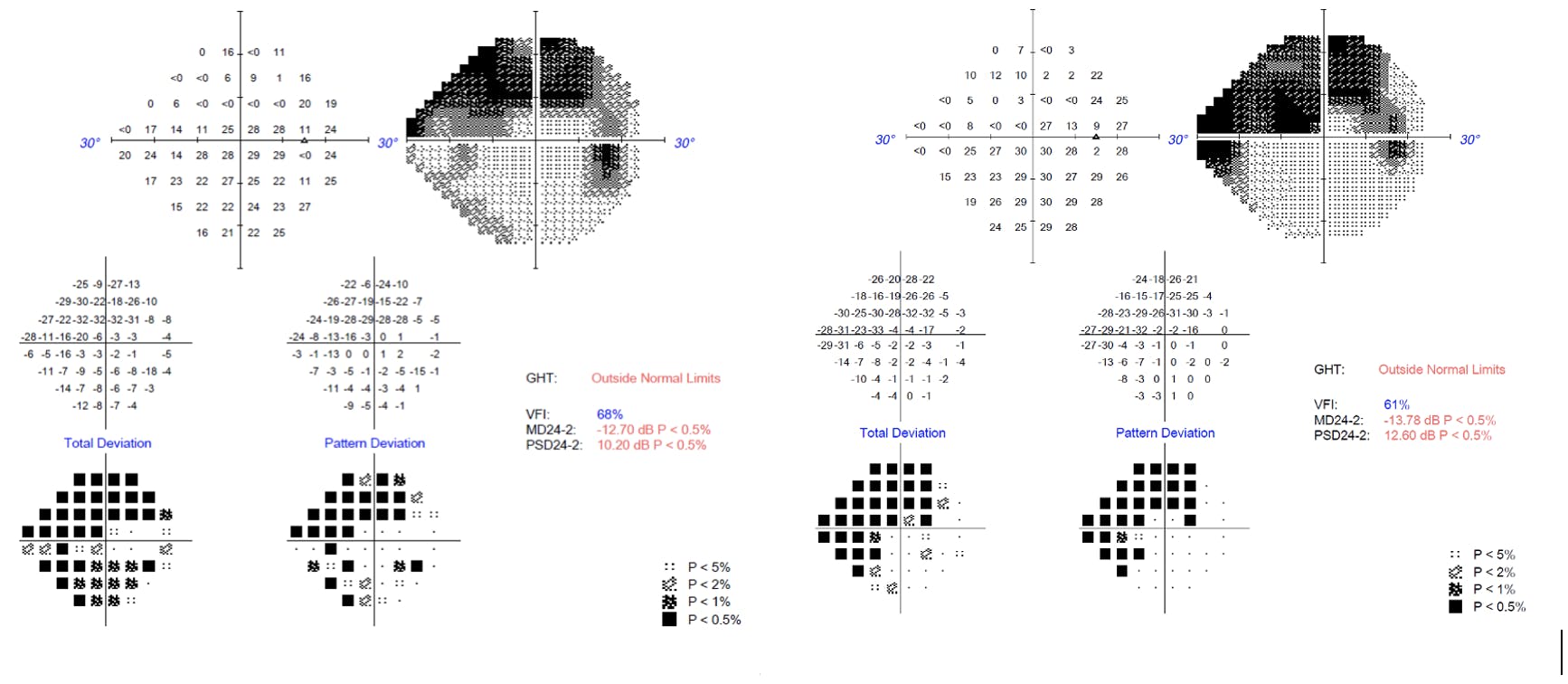
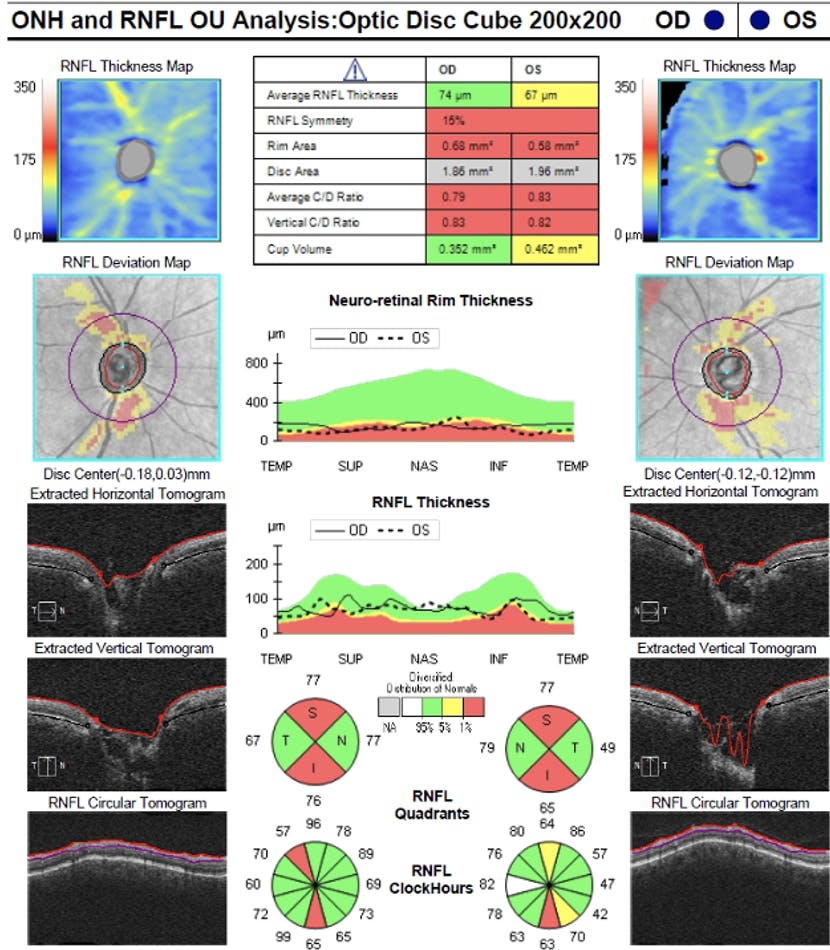
Figure 2. OCT imaging of the same patient in Figure 1 revealed significant thinning of the retinal nerve fiber layer.
Selection of iStent Infinite
Given the patient’s uncontrolled IOP, visual field progression, and compliance issues, the decision was made to proceed with iStent infinite implantation in the right eye. The primary goals of the surgery were to achieve substantial IOP reduction, stabilize the progression of her disease, and, if possible, reduce the patient’s dependence on multiple glaucoma medications. The iStent infinite was selected due to its proven ability to enhance aqueous outflow and its favorable safety profile, making it an ideal choice for this patient with advanced glaucoma.1
Postoperative Results
Postoperatively, the patient’s IOP decreased to an average of 14 mm Hg, representing a significant reduction from her preoperative levels (Figure 3). The patient was able to discontinue two of her three glaucoma medications, continuing only on a nightly prostaglandin analog. Follow-up OCT and visual field testing have been stable, with no further progression noted. The patient reported a significant improvement in her quality of life, particularly appreciating the reduced medication burden and the simplification of her treatment regimen.
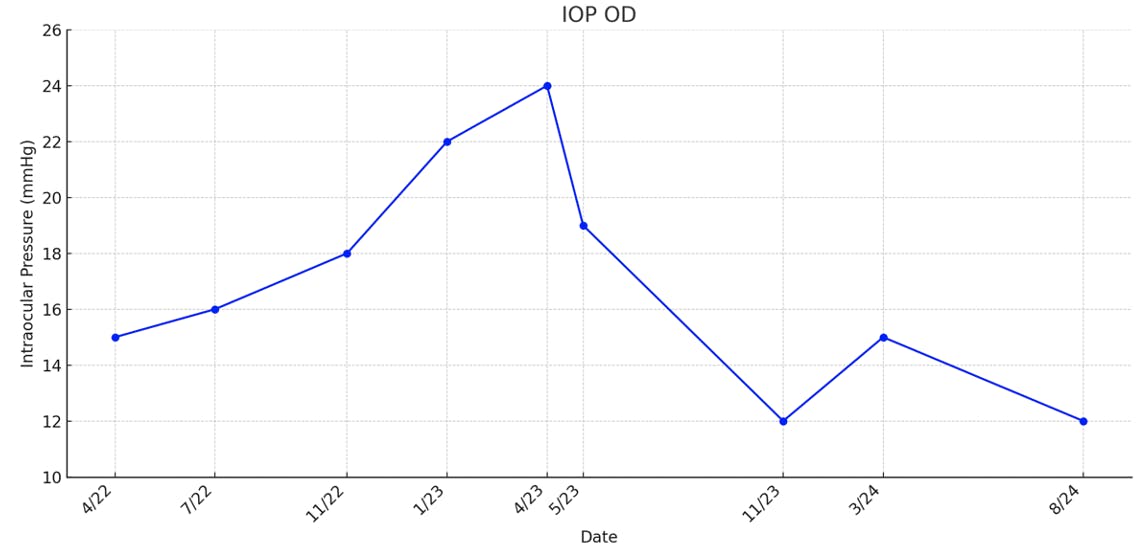
Figure 3. Line graph showing the patient’s IOP in the right eye before and after receiving an iStent infinite in April 2023.
Clinical Lessons and Insights
This case underscores several key lessons in glaucoma management while showing how the interventional mindset can be adopted in real-world settings. Firstly, it demonstrates the efficacy of the iStent infinite in achieving significant IOP reduction and reducing medication burden in a patient with advanced glaucoma who failed prior medical and surgical treatments. Secondly, it highlights the importance of considering patient compliance when selecting a treatment strategy. For patients like this one, surgical interventions can offer a more sustainable and patient-friendly solution. Studies have shown that compliance worsens as a topical drop regimen gets more complex.3 Finally, the case reinforces the evolving paradigm in glaucoma care, where surgical options are increasingly considered earlier in this treatment process to help achieve better long-term outcomes.1,2
1. Sarkisian SR Jr, Grover DS, Gallardo MJ, et al; iStent infinite Study Group. Effectiveness and safety of iStent Infinite trabecular micro-bypass for uncontrolled glaucoma. J Glaucoma. 2023;32(1):9-18.
2. Micheletti JM, Brink M, Brubaker JW, et al. Standalone interventional glaucoma: an evolution from the combination-cataract paradigm. J Cataract Refract Surg. Published online ahead of print Aug 12, 2024.
3. Tsai JC. A comprehensive perspective on patient adherence to topical glaucoma therapy. Ophthalmology. 2009;116(11 Suppl):S30-S36.
The participant has been compensated by Glaukos for his participation.

